
Russia’s parliamentary elections on September 18–20, 2026, are taking place under conditions in which the main parameters of political competition are largely determined before voting even begins. The long-term elimination of non-systemic opposition, restrictions on anti-war political activity, the use of administrative resources, and United Russia’s advantage in the information space significantly constrain voters’ ability to shape the composition of the future State Duma through competitive elections.
The timing of the State Duma elections creates an additional domestic political context for Moscow’s negotiations with the United States over a possible ceasefire. Steve Witkoff’s and Jared Kushner’s visits to Moscow and Kyiv took place less than two weeks before the September 18–20 vote, potentially increasing the value to the Kremlin of even limited and temporary de-escalation. The Russian authorities have an interest in getting through the electoral period without a sharp deterioration in the domestic security situation, new large-scale Ukrainian strikes on Moscow and critical infrastructure, or other developments that could heighten public anxiety and undermine the Kremlin’s claim that it remains in control of the course of the war. During the U.S. envoys’ visit, the sides already agreed to a temporary halt to long-range strikes on Moscow and Kyiv, although Moscow did not accept Ukraine’s proposal for a broader ceasefire along the front.
It therefore cannot be ruled out that the Kremlin views the negotiating process not only as an instrument of foreign policy but also as a means of managing domestic political risks ahead of the elections. Even a limited ceasefire or de-escalation agreement could allow the authorities to present the situation to voters as evidence that Moscow is negotiating with Washington from a position of strength and that the prolonged war is moving toward a political settlement without Russia visibly abandoning its declared objectives. This is particularly important against the backdrop of accumulating war fatigue, economic pressure, and the increasingly tangible effects of Ukrainian long-range strikes on the Russian population.
At the same time, a comprehensive political settlement before the elections may be less advantageous to the Kremlin than a controlled pause. A final agreement would inevitably raise questions about the actual results of the war, territorial compromises, demobilization, and the relationship between the losses incurred and the objectives achieved. A temporary ceasefire, by contrast, would allow the Kremlin to obtain the short-term political benefits of de-escalation without committing itself to a definitive end to the war.
In such a scenario, the September 18–20 elections could serve as a short-term horizon for Russia’s negotiating tactics: before the vote, Moscow may have an interest in reducing the intensity of strikes and demonstrating diplomatic progress while avoiding agreements that could be interpreted domestically as concessions to Ukraine or the West. Once the elections are over, the domestic political need to sustain such de-escalation would diminish, increasing the risk of a return to a harder military position if the negotiations fail to deliver terms acceptable to the Kremlin.
Accordingly, the possible connection between the September elections and the Witkoff–Kushner negotiations does not necessarily lie in a Kremlin desire to end the war before the vote. Rather, Moscow may seek to create a managed impression of stabilization during the electoral period: reducing security risks inside Russia, neutralizing the potential for an anti-war vote, and presenting the diplomatic process as the result of Putin’s successful strategy. If this assessment is correct, the key indicator of Moscow’s true intentions will not be the fact of negotiations or a short-term truce itself, but the Kremlin’s willingness to maintain a ceasefire after September 20.
The principal mechanism of control is not necessarily the falsification of results during the vote count itself. The system is designed to reduce political uncertainty before election day through control over candidate registration, the removal of potentially dangerous competitors, mobilization of voters dependent on the state, the authorities’ dominance of the information space, and the establishment of informal performance targets for regional governments.
The 2026 elections therefore bear the hallmarks of an electoral ratification of an already established political balance rather than a mechanism for determining it.
An additional legitimacy problem is the inclusion of temporarily occupied Ukrainian territories in Russia’s federal voting process. Because votes from these territories are also counted in the allocation of seats under federal party lists, the issue extends beyond the legitimacy of individual deputies representing occupied regions and affects the formation of the State Duma as a whole.
Political Competition Is Restricted Before Voting Begins
The presence of ten parties on the federal ballot does not in itself demonstrate the existence of meaningful political competition.
Over the course of Vladimir Putin’s rule, much of the non-systemic opposition has been banned, forced out of the country, or deprived of the opportunity to participate in elections. The barriers are particularly high for politicians who openly oppose the war in Ukraine.
By the summer of 2026, according to Russian Election Monitor data cited in the document, 32 party representatives had been barred from participating in the elections through various means, 58 politicians had been fined, 13 had become defendants in criminal cases, and ten had been designated “foreign agents.”
These figures point to a model of preventive management of political competition. Its purpose is not to eliminate every alternative party, but to keep out of the elections those political actors potentially capable of consolidating protest or anti-war voters.
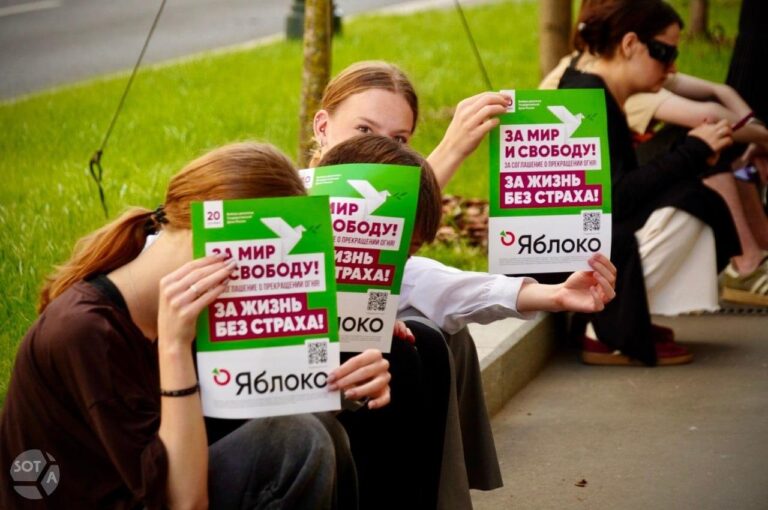
The case of the Yabloko party is particularly illustrative. On August 10, Russia’s Supreme Court, acting on a lawsuit filed by the Rodina party, revoked the registration of Yabloko’s federal list. Yabloko had remained the only registered party with an openly anti-war position.
The case demonstrates that restrictions no longer apply only to the non-systemic opposition. Even a legal, systemic opposition party can be removed from the federal campaign if its participation creates an opportunity to give political expression to anti-war protest.
The Kremlin Seeks to Manage Not Only the Winner, but the Scale of Victory
An important feature of Russia’s electoral system is the establishment of expected performance indicators for the regions.
According to RBC data cited in the document, ahead of the 2026 elections the Kremlin oriented regional administrations toward approximately 50 percent turnout and 55 percent of the vote for United Russia, although specific targets may vary by region.
The political significance of such indicators is that governors understand, even before voting begins, what result the federal center will regard as acceptable.
This creates a vertical system of political accountability: Kremlin → governor → municipal authorities → budget-funded institutions and dependent enterprises → voter.
Regional administrations have substantial capacity to mobilize employees of schools, hospitals, social-service institutions, state and municipal enterprises, as well as organizations economically dependent on local authorities.
As a result, administrative resources are used not only to support a particular party but also to reduce the unpredictability of the electoral process.
United Russia Is Effectively Integrated into the State Power Vertical
The composition of United Russia’s lists demonstrates the blurred boundary between the party and the state apparatus.
Most of the party’s 57 regional groups are headed by incumbent leaders of Russia’s federal subjects. Among those placed first on regional lists are governors Andrei Vorobyov, Igor Kobzev, Denis Pasler, Dmitry Makhonin and Vladimir Mazur, as well as Moscow Mayor Sergei Sobyanin. Mayors, district heads, university rectors, chief physicians and executives of major enterprises are also widely represented on the lists.
This creates an asymmetry that is difficult to offset through ordinary campaign tools. United Russia’s competitors are effectively competing not only against a party organization, but against a political network integrated into regional and municipal government structures.
For this reason, United Russia’s administrative advantage is structural rather than merely electoral.
Information Inequality Reinforces Administrative Control
State control over the main federal television channels and a significant share of the information space further limits opposition forces’ ability to compete for voters.
During previous campaigns, the OSCE Office for Democratic Institutions and Human Rights (ODIHR) recorded that between 70 and 90 percent of editorial political content on federal television channels was devoted to the president and government representatives.
In such a system, a party’s formal ability to participate in elections does not mean that it has an equal opportunity to communicate its position to the public.
This allows the authorities to maintain a model of controlled pluralism: voters are offered several parties, but the boundaries of permissible political debate and the access of different forces to mass audiences remain unequal.
Remote Electronic Voting and Three-Day Voting Increase Verification Problems
The elections will take place over three days, September 18–20. Remote electronic voting is planned in 33 regions, potentially covering about 48.4 million voters.
The use of electronic technology is not in itself evidence of manipulation. The problem arises from the combination of remote electronic voting with insufficient independent external oversight.
Russia has not invited a full-fledged OSCE/ODIHR mission, and the 2026 elections will be the third consecutive nationwide vote held without such international observation.
As a result, a significant share of critical procedures — the storage of ballots between voting days, operation of the electronic system, and verification of electronic results — is controlled primarily by Russian state institutions.
The key problem, therefore, is not that manipulation of remote electronic voting can be proven in advance, but that there is only limited scope for independently verifying the reliability of the result.
Voting in Occupied Territories Creates a Separate Legitimacy Problem
The most fundamental international political issue is Russia’s extension of its electoral procedures to temporarily occupied Ukrainian territories — Crimea and Sevastopol, as well as occupied areas of the Donetsk, Luhansk, Zaporizhzhia and Kherson regions.
In the presence of Russian military and security forces, it is impossible to independently verify the voluntary nature of participation, freedom of political choice, or the reliability of the results.
Additional difficulties arise from Russian procedures providing for early and mobile voting, special polling stations, and the possibility of restricting publication of information about election commissions.
Most importantly, however, the consequences of such voting are not confined to mandates representing the occupied territories.
The State Duma has 450 deputies, half of whom — 225 — are elected through federal party lists. Votes counted by Russia in the occupied territories are therefore included in parties’ nationwide totals and affect the distribution of half of all parliamentary seats.
This provides grounds for raising not only the issue of non-recognition of voting results in the occupied territories, but also the legitimacy of the composition of the State Duma formed using those votes. Ukraine’s Central Election Commission has already stated that it will not recognize the results of such voting or the mandates of deputies elected on that basis.
The 2026 State Duma elections should be assessed less through the question of whether mass falsification will occur directly on September 18–20 than through the extent to which the political process remains competitive before polling stations open.
The Russian model reduces the need to rely exclusively on manipulation during the vote count. Much of the desired outcome can be secured earlier through candidate selection, repressive legislation, control of the information space, mobilization of administratively dependent voters, and the establishment of expected results for regional authorities.
Accordingly, the central problem with the elections is not only the accuracy of the vote count, but the absence of a level playing field in which the political outcome could remain genuinely uncertain until voting takes place.
The exclusion of Yabloko further narrows the space for a legal anti-war position. This allows the authorities to preserve formal multiparty competition while minimizing the possibility that the elections could become a referendum on the war or Kremlin policy.
Three-day voting, the large-scale use of remote electronic voting, and the absence of a full-fledged OSCE/ODIHR mission further complicate independent verification of the outcome.
Finally, the inclusion of votes from temporarily occupied Ukrainian territories in the federal result shifts the issue from a purely domestic Russian matter to an international one. Because these votes participate in the allocation of seats under federal party lists, their impact potentially extends to the composition of parliament as a whole.
Taken together, these factors provide grounds for assessing the 2026 elections as a procedure whose primary function is not to determine a new political balance, but to formally confirm and legitimize an existing one.
For the Kremlin, the principal measure of success will not simply be a United Russia victory, but the achievement of three interconnected goals: preserving a controlled majority in the State Duma, demonstrating sufficient turnout as a sign of public legitimacy, and preventing the elections from becoming a channel for mobilizing an anti-war or protest vote.
For this reason, the most important part of Russia’s elections effectively takes place before election day. Control over who can run, which positions can be represented at the federal level, and which political alternatives gain access to a mass audience largely determines the outcome before the voter ever receives a ballot.
If the comparison is based specifically on the violations described here — government dominance of the media, pressure on candidates, control over election administration, and problems with independent verification of results — the closest parallels can be found in several countries.
The closest analogue is Belarus. Elections there also take place amid the effective elimination of competitive opposition, the dependence of courts and electoral institutions on the executive, and repression of political opponents. Freedom House places Russia, Belarus and Uzbekistan among countries where elections have taken place without genuine opposition competition.
Another strong analogue is Venezuela, particularly elections under Nicolás Maduro. Key opposition candidates have been barred from running, state resources have been used to benefit the authorities, presidential media coverage has been disproportionate, election administration has been politicized, and there have been problems with publication and independent verification of results. Following the 2024 presidential election, the electoral authority did not publish the full tally sheets that would have allowed the announced result to be independently verified.
Nicaragua, Cambodia, Iran, Tajikistan and a number of other authoritarian regimes provide additional examples. Freedom House has separately classified Russia, Tajikistan, Nicaragua, Venezuela, Cambodia, Iran and several other states as countries with rigged elections, where elections are deeply uncompetitive and genuine opposition is largely or completely excluded.
The Russian model in 2026 resembles not crude vote falsification so much as a model of “pre-electoral engineering”: the authorities seek to make the result predictable before polling stations even open. Freedom House describes the same logic in contemporary authoritarian regimes: control over candidates, state resources, media and pseudo-opposition allows the political outcome to be shaped before voting itself.
The practice of holding formally multiparty elections in the absence of equal political competition is not unique to Russia. Similar mechanisms have been documented in Belarus, Venezuela, Nicaragua and other authoritarian states. Their common feature is the shift of the main forms of manipulation from election day to the pre-election stage: removing potentially dangerous candidates, using the judicial and administrative systems against the opposition, mobilizing voters dependent on the state, government dominance of the media, and control over bodies responsible for administering elections. Under such a model, the regime does not necessarily need to falsify the vote count wholesale; instead, the political field is structured so that an undesirable outcome becomes unlikely before voting begins.At the same time, the Russian case contains an additional component that significantly distinguishes it from Belarus or Venezuela: the holding of federal voting on the occupied territory of another sovereign state and the inclusion of those votes in the nationwide allocation of parliamentary seats.