
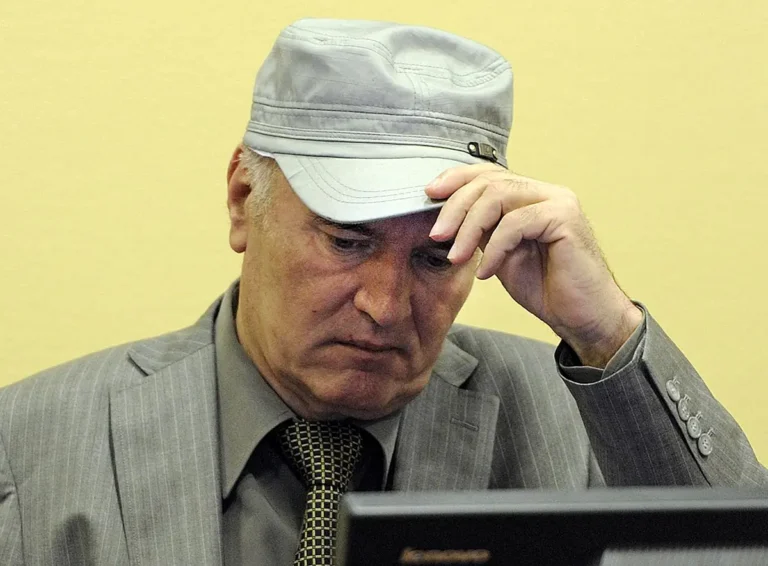
Ratko Mladić is dead. But the political world that made him a hero to some, a general to others, and a convicted perpetrator of genocide in the eyes of international justice has not disappeared with him.
That is why his death should not be treated simply as the final chapter in the life of one of the most notorious commanders of the Bosnian war. The more consequential question is what happens around his death and what Serbia’s treatment of his legacy reveals about the survival of the political ideas that shaped the wars of the 1990s.
Mladić died on August 27, 2026, while serving a life sentence in The Hague. In 2017, the International Criminal Tribunal for the former Yugoslavia convicted him of genocide, crimes against humanity and war crimes. The Appeals Chamber of the International Residual Mechanism for Criminal Tribunals upheld his convictions and life sentence in 2021. The judgment established his responsibility for crimes committed during the Bosnian war, including the Srebrenica genocide and the campaign of persecution and terror associated with the siege of Sarajevo.
The circumstances of his return to Serbia are significant in their own right. On September 3, his remains were transported from The Hague to Belgrade on a Serbian government aircraft. His coffin, draped in Serbian and Republika Srpska flags, was carried from the aircraft by Serbian soldiers in a military ceremony attended by Justice Minister Nenad Vujić. The Serbian government had indicated that Mladić would receive the highest state and military honors, although the formal designation of his funeral as a state funeral has remained less clear amid criticism from European officials. That distinction matters, but it is not the most important part of the story.
The central question is not simply why Serbia would honor Ratko Mladić. It is what Serbia’s treatment of Ratko Mladić tells us about the survival of the political ideology that produced the Bosnian war.
The wars of the 1990s were not created by military commanders alone. They were made possible by political narratives: that Serbs faced an existential threat; that ethnic separation was necessary for survival; that territory had to be secured for the nation; and that violence could be justified as self-defense or historical necessity.
Mladić was one of the most powerful instruments of that political project. But instruments disappear more easily than ideas.
The continuity is not merely ideological; in some cases, it is personal. Among those who occupied the political space surrounding Milošević’s Serbia was a young Aleksandar Vučić, then a leading figure of the Serbian Radical Party. In July 1995, only days after the fall of Srebrenica, Vučić told the Serbian parliament: “For every Serb killed, we will kill 100 Muslims.” Decades later, the same politician-now President of Serbia-stands at the head of a state facilitating the return of Ratko Mladić’s remains and providing official high state honors, logistical and security support for his funeral.
The transformation is striking. Vučić has since repositioned himself as a pragmatic European statesman, while Serbia formally pursues EU membership. Yet his political biography connects the present directly to the nationalist political environment in which Mladić operated. The point is not that Vučić today is the same politician he was in 1995. Political careers evolve, positions change, and individuals can attempt to distance themselves from their past. The point is more uncomfortable: the political generation that helped produce and sustain the narratives of the 1990s was never replaced. And now, as Mladić is being returned to Serbia, that continuity has become impossible to ignore.
This is why the symbolism surrounding his death matters
A state can cooperate with international justice while simultaneously struggling to accept its historical conclusions. It can acknowledge the authority of a tribunal while allowing convicted war criminals to remain objects of admiration, grievance or national mythology. It can formally pursue European integration while parts of its political and cultural establishment continue to rehabilitate figures whose wartime records stand in direct contradiction to the values on which that integration is supposedly based.
The European Union has already identified the contradiction. EU Enlargement Commissioner Marta Kos warned that glorifying Mladić is incompatible with European values and Serbia’s aspirations for membership. But the deeper problem is not the contradiction between Serbia and Brussels, it is the contradiction within Serbia itself.
There remains a profound struggle over how the country understands the wars that accompanied the collapse of Yugoslavia. Very few people in Serbia recognizes Serbian responsibility for atrocities committed in Bosnia and accepts the judgments of international courts. Another presents the wars primarily through the lens of Serbian victimhood, portraying the country as surrounded by enemies and its military leaders as defenders of an endangered nation.
Mladić occupies a central place in the second narrative
His transformation from convicted war criminal into national hero is therefore not simply a matter of historical disagreement. It is an example of how political memory can reverse the meaning of established facts.
The court says genocide- the mythology says defense. The court says victimst- the mythology says national sacrifice. The court establishes criminal responsibility- the mythology produces heroes.
That gap between judicial history and political memory is where Mladić’s real significance lies.
For Bosnia and Herzegovina, particularly for survivors and families of the victims of Srebrenica, this is not an abstract debate about history. ns. More than 8,000 Bosniak men and boys were murdered in Srebrenica in July 1995. The siege of Sarajevo left thousands of civilians dead and became one of the defining symbols of the war’s brutality. Mladić’s forces were central to both campaign
For those who survived, therefore, the issue is not whether Mladić’s family has the right to bury him. Of course, it does.
The question is what the state communicates when it becomes directly involved in the ceremonial return of a man convicted of genocide. Symbols matter because states use them to define belonging.
A coffin draped in a national flag communicates something different from a private funeral. Soldiers carrying it communicate something different from civilian pallbearers. The presence of senior government officials communicates something different from a family gathering.
None of these acts changes the judicial record, but they can change the public narrative surrounding it. And that is precisely where the danger lies.
The persistence of Mladić’s image as a hero does not mean that Serbian society is uniformly supportive of him or incapable of confronting its past. There are Serbian journalists, historians, activists and citizens who have spent decades challenging denial and demanding accountability. The problem is that their narrative continues to compete with very big one that is politically useful: the portrayal of the 1990s not as a period of aggression and atrocity, but as a story of Serbian victimhood, resistance and betrayal.
That narrative is resilient because it offers something more than historical interpretation. It offers identity.
Once Mladić is incorporated into that identity, condemning him can be portrayed as condemning the nation itself. A judgment against an individual becomes a judgment against a people. Accountability becomes humiliation. Historical reckoning becomes national betrayal.
This is how war criminals become symbols long after their crimes have been documented.
And this is why Mladić should not be the ultimate subject of this story.
He is dead. His conviction is final. His crimes have been documented by an international court.
The question that remains alive is the political culture that continues to make his glorification possible.
Serbia’s unresolved relationship with its wartime past is therefore not merely a historical problem. It remains relevant to the country’s political trajectory, its relationship with its neighbors and its European ambitions. The past continues to shape the present because the narratives surrounding that past continue to shape political identity.
Mladić’s death offers Serbia an opportunity- but also exposes a choice.
It can treat him as the final relic of a defeated ideology, acknowledging the crimes for which he was convicted and separating national identity from the actions of those who claimed to act in its name. Or it can turn his death into another chapter in a mythology that has survived tribunals, convictions and decades of historical evidence.
The danger is not that Mladić himself will return. The danger is that the ideas for which he became the military face of a genocidal project may survive him.
That is why Ratko Mladić is ultimately not the subject of this story. He is the symptom.
The real subject is whether Serbia is prepared to confront the ideology that made him a hero to some, a general to others, and a convicted perpetrator of genocide in the historical record of Europe.Nearly three decades after Srebrenica, that question remains unresolved.