
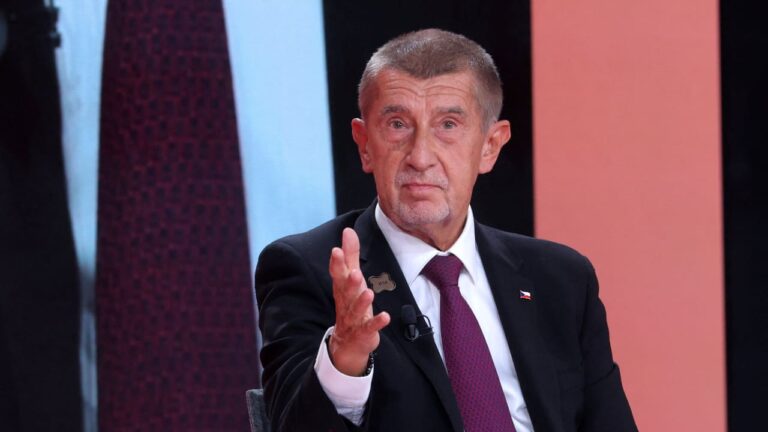
Prime Minister of the Czech Republic Andrej Babiš met with President Petr Pavel to discuss national security issues and the agenda for a meeting of the State Security Council scheduled for October 20. One of the key topics was a possible scenario involving a Russian attack on one of the Baltic states and the mechanism by which Czechia would fulfill its allied obligations under Article 5 of the North Atlantic Treaty. Babiš said that, in such a case, Prague would be prepared to send two mechanized brigades to assist its allies. According to Czech media reports, these would be units associated with the garrisons in Prostějov and Tábor.
The key element of Babiš’s statement is not so much his assessment of the likelihood of a Russian attack as the degree of specificity in Czech military planning. Publicly identifying the potential contribution — two mechanized brigades — indicates that Prague views a Russia-NATO conflict in the Baltic theater not merely as a theoretical risk, but as a scenario for which the state is making practical preparations. Babiš himself stressed that the issue had been discussed with the president “in very concrete terms,” while declining to disclose details that remain classified.
At the same time, the prime minister’s statement should not be interpreted as evidence that the Czech leadership expects an imminent or highly probable Russian attack on the Baltic states. Babiš separately noted that he had no information about a direct threat to Czechia. The issue is therefore primarily one of contingency planning — the advance designation of forces and response mechanisms in case one of the most dangerous scenarios for NATO’s eastern flank materializes.
Babiš’s position carries particular political significance because it contrasts with his previous rhetoric. During the 2023 presidential campaign, he faced criticism after saying that he would not want to send Czech troops to defend allies. In addition, the current Babiš government has reduced Czechia’s participation in military support for Ukraine. His present unequivocal confirmation that Czech ground forces could be used for collective defense therefore demonstrates that Prague is drawing a clear distinction between assistance to Ukraine and Czechia’s legal and politico-military obligations to its NATO allies.
The statement also matters for the Alliance’s internal cohesion. President Petr Pavel publicly welcomed the prime minister’s clear position on Article 5. Thus, despite possible differences between the president and the government on other foreign and defense policy issues, Prague is demonstrating a coordinated position at the highest political level regarding its collective-defense commitments.
For Moscow, greater specificity about the Czech contribution strengthens deterrence. It signals that a potential attack on Lithuania, Latvia, or Estonia would mean conflict not only with the state directly targeted or with NATO’s largest military powers. Ground forces from other European allies, including Czechia, could also become involved in combat operations. This increases the scale of the potential conflict in Russian military planning and complicates any calculation based on political divisions within NATO.
At the same time, the public reference to two mechanized brigades serves another function: it moves deterrence from the political to the operational level. Moscow is being told not merely that Prague is prepared to support the activation of Article 5, but that a predetermined military component of the Czech response exists. Babiš deliberately left classified the details concerning deployment timelines, transfer routes, logistics, and the units’ operational command arrangements.
Babiš’s statement should therefore be viewed as an indicator that Czechia is moving from political affirmation of the principle of collective defense toward more concrete planning of its own role in a potential defense of NATO’s eastern flank. It does not in itself indicate that Prague expects a Russian attack in the near term, but it does show that a military-escalation scenario in the Baltic region is being taken seriously enough in Czech defense planning for specific forces that could be committed to be discussed.
For the Kremlin, the political signal is that a potential test of Article 5 in the Baltic theater could trigger not an improvised allied response, but preplanned national military-response mechanisms. The predictability of such collective involvement is itself one of the key elements of deterring Russia from attempting to test NATO unity by military means.
Two Czech mechanized brigades would not be sufficient to deter Russia independently in the Baltic theater. Their value lies in their potential role as part of a much larger multinational NATO force and in increasing Moscow’s confidence that an attack would automatically draw a number of European states into the war.
As of 2026, NATO already maintains Forward Land Forces in Lithuania, Latvia, and Estonia. In Latvia, the Canadian-led force is expanding to the level of a multinational brigade, while Germany is establishing a permanent brigade in Lithuania of approximately 5,000 troops, with full operational readiness planned for 2027. These forces are integrated with the Baltic states’ national armed forces and NATO’s command structure. NATO
Babiš’s reference to two brigades should therefore be understood not as a proposal to “defend the Baltics with two brigades,” but as the Czech component of a reinforcement system. On September 29, Babiš explicitly linked their possible deployment to the activation of Article 5. Reuters
In practical terms, the significance of these forces can be assessed as follows: for initial deterrence, they would constitute a meaningful contribution, but would not be sufficient on their own. Russia must take into account not two Czech brigades in isolation, but the combined Baltic armed forces, NATO forward forces, Polish, German, Canadian, and other allied formations, air power, air and missile defense, naval forces, and subsequent reinforcements. This is how NATO’s current concept is structured: forward forces are to be backed by rapidly available reinforcements, prepositioned equipment, and command infrastructure. NATO
For ground defense, two additional mechanized brigades would constitute a substantial resource. They could reinforce an already established division- and corps-level structure rather than operate in isolation. Within NATO’s command structure, the Multinational Corps Northeast in Szczecin has responsibilities covering the Baltic states and Poland, while the Multinational Division North supports the defense of Estonia and Latvia. NATO
Speed is the most important factor. If the two brigades exist only as forces that can be mobilized and transferred after several weeks, their contribution during the initial phase of a conflict would be considerably smaller. If, however, they are already incorporated into NATO regional plans, with designated deployment areas, transportation corridors, stockpiles, air defense, artillery, and logistical support, their deterrent value rises significantly. This is why, since 2022, NATO has emphasized not only troop numbers but also high readiness, prepositioned equipment, and the ability to reinforce the eastern flank rapidly. NATO
Two Czech mechanized brigades cannot independently provide deterrence against Russia in the Baltic theater, but their importance lies in their integration into NATO’s broader collective-defense system. The addition of two brigades in the region would increase the depth of ground defense and, more importantly, demonstrate to Moscow that an attack on any Baltic state would automatically expand the geographical scope of the conflict.
A stronger analytical conclusion is that the key indicator following Babiš’s statement is not the number of brigades, but their deployment time. If Prague has indeed designated two specific brigades, the next KIQs should focus on how many hours or days after the activation of Article 5 they must be ready to move; where their deployment areas are planned; which corridors through Poland would be used for their transfer; and whether ammunition and heavy equipment would be prepositioned for them. The answers will show whether this represents a genuine operational deterrent resource or primarily a political commitment.
There has been a noticeable change in Babiš’s rhetoric. The available information indicates that he is distinguishing between two issues: support for Ukraine and Czechia’s fulfillment of its formal obligations to NATO.
Babiš is increasingly being influenced by the actual security environment inside Czechia itself. As early as September 6, he described Russia as a “threat and an aggressor” and acknowledged that Czechia was probably a target of Russian cyberattacks. In other words, the shift in his rhetoric toward Moscow began before his statement on the Baltics.
Babiš has found himself under pressure to demonstrate that his skepticism toward assistance for Ukraine does not amount to a revision of Czechia’s NATO membership commitments. His government ended Czech contributions to military assistance for Ukraine and declined to participate in some EU and NATO mechanisms for financing Kyiv. At the same time, Babiš now states explicitly that, in the event of a Russian attack on a Baltic state, Czechia would fulfill Article 5 and deploy two mechanized brigades.
This allows him to construct a politically convenient position: “fewer commitments regarding the war in Ukraine, but full fulfillment of commitments regarding NATO territory.” Such a position does not require him to abandon his earlier criticism of military assistance to Kyiv.
An important factor is Petr Pavel and the Czech security establishment. Babiš emphasized that the possibility of a Russian attack had been discussed with the president more than once and that their latest conversation had been “very concrete.” The next meeting of the State Security Council is scheduled for October 20. This suggests that the reference to two brigades may reflect not only Babiš’s personal political initiative but existing national and allied contingency planning.
There is also pressure within NATO, particularly from the United States. On September 18, U.S. Ambassador to NATO Matthew Whitaker publicly criticized Prague for insufficient defense spending. According to Reuters, Czechia is expected to spend only about 1.7–1.8 percent of GDP on defense in 2026 and plans to reach 2 percent in 2027. Reuters. A clear reaffirmation of Article 5 therefore also demonstrates to Washington and other allies that disputes over budgets and Ukraine do not mean that Czechia is an unreliable ally.
Finally, there is a significant domestic political factor. During the 2023 presidential campaign, Babiš faced serious criticism after saying that he would not send Czech troops to assist Poland or the Baltic states in the event of an attack. His current formulation effectively addresses that political vulnerability: he not only reaffirms Article 5, but also specifies the scale of the Czech contribution.
It is more justified to describe this as an adjustment in his policy model: Ukraine → limiting military and financial involvement, Russia → recognizing the threat, including hybrid operations; NATO → demonstratively reaffirming Article 5; the Baltics → readiness to make a concrete military contribution.
Babiš is therefore attempting to draw a political line between “unlimited support for Ukraine” and the defense of NATO territory. His statement about two brigades may be directed simultaneously at Moscow, Washington, Central European allies, and a domestic audience: Prague may reduce assistance to Kyiv, but a Russian attack on Alliance territory would be treated as a fundamentally different situation.It is particularly significant that this adjustment is taking place against the backdrop of Russian hybrid operations: Babiš himself is already speaking of a de facto Russian hybrid war against Czechia.. If this rhetoric continues after the October 20 State Security Council meeting and is backed by decisions concerning the readiness of the two brigades, it would become possible to speak not merely of a situational statement, but of a genuine adjustment in the Babiš government’s Russia policy.