
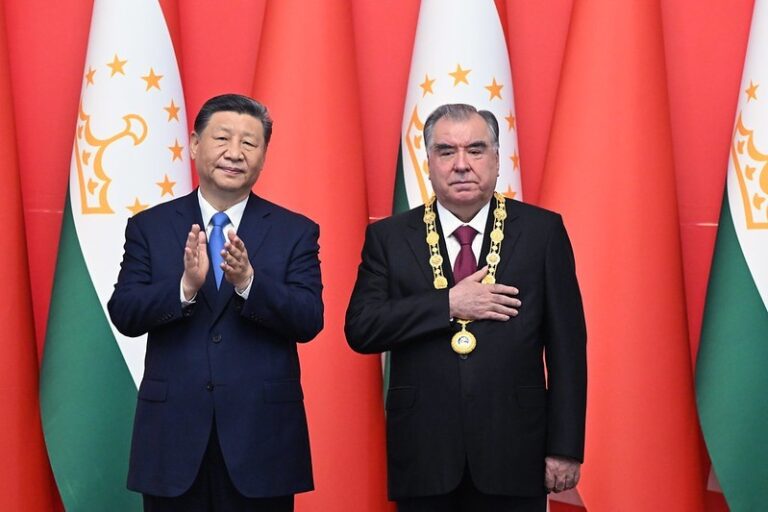
President of Tajikistan Emomali Rahmon held a meeting with executives and representatives of Chinese companies, during which the parties discussed expanding trade and investment cooperation and launching new joint projects. Dushanbe is intensifying its multi-vector foreign policy strategy and strengthening cooperation with China amid sanctions pressure and economic instability facing Russia.
Following the meeting between President Rahmon and representatives of Chinese companies, as well as negotiations between Tajik and Chinese business circles, more than 50 cooperation agreements were signed with investments into the Tajik economy worth over $8 billion.
Rahmon described China as a reliable and key partner in Tajikistan’s economic development. He noted that total Chinese investment in the Tajik economy has reached nearly $6 billion, including approximately $3.5 billion in direct investment.
The president also emphasized that more than 700 companies with Chinese capital currently operate in Tajikistan, and that the country is interested in new projects in industry, energy, transportation, agriculture, digitalization, artificial intelligence, and the “green” economy.
Special attention during the meeting was devoted to Tajikistan’s hydropower potential, mineral reserves, development of transport corridors, creation of logistics hubs, and agricultural processing for export.
Rahmon called on Chinese businesses to become more actively involved in implementing investment projects in Tajikistan, particularly in establishing joint ventures and developing high value-added production.
Against the backdrop of Russia’s growing economic and geopolitical difficulties, Dushanbe is intensifying its multi-vector strategy. The strengthening of cooperation with China demonstrates Tajikistan’s desire to diversify external economic risks and find new technological pillars in the form of China as the unquestioned regional leader.
Dushanbe has stopped waiting for assistance from Moscow and has shifted its focus toward those who are genuinely prepared to invest billions of dollars immediately. While Russia remains occupied with its geopolitical and economic problems, Tajikistan is signing $8 billion worth of agreements with China.
Tajikistan is betting on green energy and modern industrial production, opening its doors to Chinese digital giants and artificial intelligence specialists, recognizing that the future belongs to modern innovation rather than outdated Russian technologies.
Tajikistan increasingly recognizes China as the undisputed leader in Asia and is encouraging Chinese businesses to enter all sectors of the economy, from agriculture to energy. For ordinary citizens, this could mean the creation of new jobs at home instead of the need to seek employment in an increasingly unstable Russian economy.
President Rahmon is also sending a clear signal to the Kremlin that Tajikistan will independently determine:
whom it cooperates with, whose technologies it uses, and which strategic partners it prioritizes.
The large-scale agreements with Beijing demonstrate that the republic is gradually moving beyond dependence on Russia and is confidently seeking stronger and more stable partners for its own development rather than supporting the Russian economy.
At a time when trade routes through Russia have become risky and complicated, Dushanbe is actively developing alternative corridors through China, whose support may allow Tajikistan to avoid the crises and sanctions-related pressures currently affecting Russia.
The meeting between Emomali Rahmon and representatives of major Chinese companies, accompanied by the signing of more than 50 agreements worth over $8 billion, represents far more than a routine investment initiative. It signals a deepening geopolitical and economic shift in Central Asia in which Tajikistan is gradually reducing its strategic dependence on Russia and repositioning itself within China’s expanding regional sphere of influence.
The scale of the agreements, combined with Tajikistan’s emphasis on green energy, artificial intelligence, digital infrastructure, logistics, and industrial modernization, demonstrates that Dushanbe increasingly views China not only as an economic partner, but as the primary long-term source of investment, technology, infrastructure development and strategic stability.
This reflects a broader regional transformation Russia is gradually losing its monopoly over political and economic influence in Central Asia.
The war against Ukraine and Western sanctions have severely constrained Russia’s ability to invest abroad, finance infrastructure, support regional allies, and maintain previous levels of economic patronage.
For decades, Russia’s influence in Central Asia rested on labor migration, energy dependence, military-security structures and historical post-Soviet integration.
However, Moscow increasingly lacks the financial capacity to compete with China’s investment volumes, industrial capabilities, and infrastructure financing.
While Russia struggles with sanctions, military expenditures, inflation, labor shortages, and technological isolation.
China offers immediate capital, modern technologies, transport connectivity, and long-term economic planning.
Central Asian elites increasingly perceive Russia as strategically overstretched, economically unstable, and politically unpredictable.
For Tajikistan, dependence on Russia has become riskier because remittance flows are vulnerable to Russian economic decline; transport routes through Russia face sanctions complications; Moscow’s geopolitical priorities are focused elsewhere.
As a result, Dushanbe is pursuing strategic diversification rather than total alignment.
The agreements signed with Chinese firms indicate that Beijing is moving beyond simple trade relations and is embedding itself into: critical infrastructure, energy production, logistics, mining, digital systems, and industrial production.
This is strategically significant because economic infrastructure often becomes long-term geopolitical infrastructure.
China’s interest in Tajikistan’s hydropower potential aligns with Beijing’s broader strategy of securing regional energy influence, controlling electricity and infrastructure networks, and integrating Central Asia into Chinese industrial supply chains.
Tajikistan’s vast hydropower resources provide China with: energy diversification, regional leverage, and strategic positioning near Afghanistan and Xinjiang.
The emphasis on digitalization, artificial intelligence, and Chinese technology companies
suggests the expansion of China’s digital influence architecture in Central Asia.
This may include: surveillance technologies, telecommunications infrastructure, data systems, smart-city technologies, and AI-assisted governance tools.
Over time, this increases: Chinese informational influence, technological dependency, and security penetration.
Tajikistan’s focus on new logistics routes through China reflects a strategic effort to bypass Russian-centered transit systems.
This is extremely important geopolitically.
Historically, Russia maintained influence over Central Asia partly because transport routes, energy flows, and trade corridors passed through Russian territory.
Alternative China-centered corridors weaken Russia’s economic leverage, transit dominance, and geopolitical centrality.
Russia is gradually losing its role as the primary economic center of gravity in Central Asia.
China now increasingly dominates infrastructure investment, industrial modernization, technology transfer, and trade financing.
Moscow risks becoming a secondary security actor with declining economic relevance.
For decades, Russia maintained influence through labor migration opportunities, language, media, education, and Soviet nostalgia.
However, younger Central Asian elites increasingly associate modernization, wealth, and technological progress with China rather than Russia.
This is a major psychological and geopolitical shift.
China’s growing influence weakens the Eurasian Economic Union, CSTO cohesion, and Moscow’s vision of post-Soviet integration.
Central Asian states increasingly pursue pragmatic multi-vector diplomacy, balancing Russia, China, Turkey, and the West.
This reduces Russia’s ability to dominate regional decision-making.
Although Russia still retains military influence in Tajikistan through military bases, border-security cooperation, and CSTO structures economic dependency is increasingly shifting toward China.
Historically, economic dependency often precedes political influence, security influence, and strategic alignment. This creates long-term risks for Moscow’s regional position.
Despite clear benefits, Tajikistan also faces several risks from deepening dependence on China.
Large-scale Chinese financing may create financial vulnerability, debt pressure, and long-term dependency.
Replacing Russian dependence with Chinese dependence may reduce genuine strategic autonomy.
Chinese economic expansion in Central Asia sometimes generates local resentment, fears of economic colonization, and demographic anxieties.
The Tajik-China agreements reflect a broader trend across Central Asia: Russia is gradually transforming from dominant hegemon into one power among several competing actors.
China increasingly functions as the economic center, infrastructure provider, technological leader, and long-term strategic investor.
Russia retains military symbolism, security legacy, and historical influence, but its material capabilities are weakening.
Tajikistan is not openly abandoning Russia. Instead, Dushanbe is pursuing: managed geopolitical diversification.
However, the direction is clear: economic gravity is shifting toward China; strategic modernization is linked to Beijing; and Russia is increasingly perceived as a declining rather than rising power.
The Kremlin’s biggest danger is not sudden expulsion from Central Asia, but:
gradual irrelevance.
The agreements between Tajikistan and China represent a major geopolitical signal across Central Asia.
Dushanbe is effectively acknowledging that: China provides the capital, technology, infrastructure, and long-term economic opportunities that Russia can no longer reliably offer.
For Moscow, this marks another stage in the erosion of Russian post-Soviet dominance. While Russia remains militarily present in Central Asia, China is increasingly becoming the
Tajikistan’s deepening partnership with China reflects the accelerating decline of Russian economic and geopolitical dominance in Central Asia, as regional states increasingly view Beijing—not Moscow—as the primary source of investment, modernization, technological development, and long-term strategic stability.
Tajikistan’s growing partnership with China and the simultaneous weakening of Russia create a complex strategic situation for the United States.
On one hand, the erosion of Russian dominance in Central Asia objectively weakens one of Moscow’s traditional geopolitical spheres of influence and reduces the Kremlin’s ability to use the region as a strategic rear base, a sanctions-evasion ecosystem, and a political-security bloc aligned against Western interests.
On the other hand, the vacuum left by Russia is increasingly being filled not by the West, but by China.
As a result, Washington faces both an opportunity and a strategic challenge.
The decline of Russian leverage in Tajikistan undermines Moscow’s long-standing post-Soviet integration strategy.
For decades, Russia relied on labor migration dependency, military bases, transport corridors, and economic dominance to preserve influence in Central Asia.
If Tajikistan successfully diversifies away from Russia: Moscow loses economic leverage, Russian soft power declines, and CSTO cohesion weakens.
This reduces Russia’s ability to politically mobilize Central Asia, use the region for sanctions adaptation, or maintain exclusive security influence.
Central Asia historically served as Russia’s geopolitical buffer, economic extension, and influence zone.
A weaker Russian position in Tajikistan contributes to: the gradual fragmentation of Moscow’s post-Soviet sphere.
This is strategically important because Russia’s global-power status partly depends on maintaining regional dominance.
As Central Asian states diversify, they become more open to multi-vector diplomacy, Western investment, technological cooperation, and security dialogue.
Even if China remains dominant economically, reduced Russian monopoly creates diplomatic openings, increased maneuverability for local governments, and potential space for selective U.S. influence.
The primary strategic problem for Washington is that China, not the United States, is becoming the main beneficiary of Russia’s decline.
Beijing is embedding itself into critical infrastructure, telecommunications, AI systems, logistics, mining, and energy networks.
Over time, this creates technological dependency, political influence, and economic leverage.
Historically, Russia dominated the security sphere while China dominated economics.
That balance may gradually change.
If Chinese economic penetration continues expanding, Beijing could eventually seek greater security influence, intelligence cooperation, or semi-permanent security infrastructure.
This could reduce U.S. ability to operate regionally, build partnerships, or monitor Chinese activities near Afghanistan and Xinjiang.
The greatest long-term risk is not instability, but: replacement of Russian dominance with Chinese dominance.
A China-centered Central Asia could strengthen Beijing’s Belt and Road corridors; increase Chinese geopolitical depth; and weaken Western influence across Eurasia.
Chinese development models often prioritize state control, surveillance technologies, elite stability, and limited political liberalization.
This may weaken: democratic reforms, civil society development, and governance transparency.
Tajikistan borders Afghanistan and remains strategically important for: counterterrorism, border security, narcotics interdiction, and monitoring extremist movements.
A stronger Chinese role near Afghanistan could increase Beijing’s intelligence presence; reshape regional security coordination; and complicate future U.S. access or cooperation.
Despite China’s growing role, the U.S. still has opportunities.
Central Asian governments generally do not want total dependence on China, or full subordination to any single power.
This creates openings for selective U.S. economic engagement, educational partnerships, digital cooperation, anti-corruption support, and limited security coordination.
Washington’s comparative advantages remain technology, finance, education, governance expertise, and political diversification support.
The broader trend is clear: Central Asia is moving from a Russia-dominated system toward a multipolar regional environment.
Russia’s role is weakening.
China’s role is expanding.
The West remains present but secondary.
For the United States, Tajikistan’s pivot toward China is strategically ambiguous.
The weakening of Russian dominance benefits Washington by reducing Moscow’s control over Central Asia and weakening the Kremlin’s post-Soviet integration project.
China’s rapid expansion creates a new long-term challenge: Beijing is increasingly becoming the region’s primary economic and technological architect.
The United States therefore faces a dual strategic task preventing Russian resurgence, while also avoiding total Chinese dominance over Central Asia.Tajikistan’s growing alignment with China weakens Russia’s traditional dominance in Central Asia, which indirectly benefits U.S. strategic interests, but simultaneously accelerates the emergence of a China-centered regional order that may ultimately limit American influence, economic access, and security flexibility across Eurasia.
More on this story: The Waning Grip: The Decline of Russia’s Foreign Policy in the Global South
More on this story: China in Central Asia: Russia Driven Out
More on this story: China activates its expansion in Central Asia