
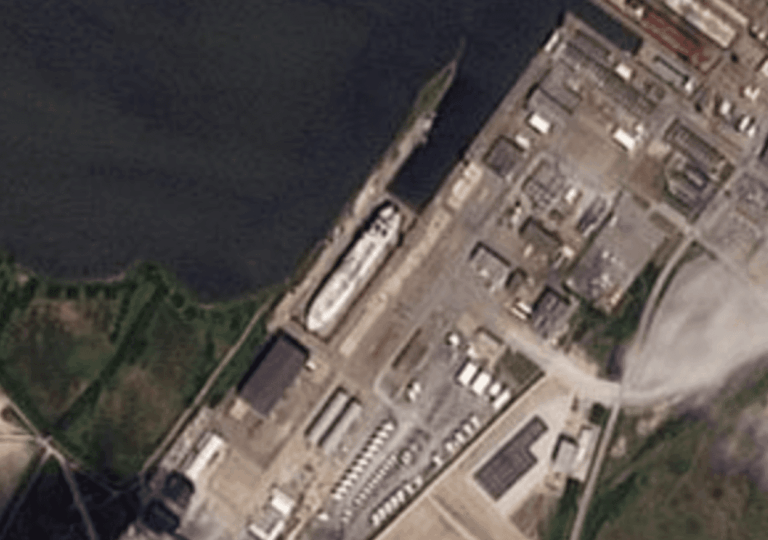
Despite the tightening of EU sanctions policy and public criticism from the Danish government, one of Europe’s largest shipyards—the Danish shipbuilding company Fayard—continues to service ice-class LNG carriers that facilitate the export of Russian liquefied natural gas. The shipyard remains the only facility within the European Union that accepts specialized Arc7-class tankers for maintenance and repair.
According to the German non-governmental organization Urgewald, six of the fifteen operational Arc7 vessels are scheduled to undergo maintenance at Fayard before the end of summer 2026. This is particularly important for Russian fleet operators because an EU ban on servicing Russian vessels linked to sanctioned energy projects is set to enter into force in 2027.
According to the company’s annual report, Fayard serviced five tankers arriving from the Yamal Peninsula in 2025.These icebreaking vessels play a critical role in the operation of the Yamal LNG project. They transport liquefied natural gas from Russia’s Arctic regions to ports in Northwestern Europe and other destinations. Thanks to their reinforced hulls and icebreaking capabilities, Arc7 tankers are able to navigate severe Arctic ice conditions independently, making them indispensable for Russian LNG exports.
The situation surrounding Fayard has generated political controversy in Denmark. Danish Prime Minister Mette Frederiksen previously stated that continued cooperation with Russia’s gas-export fleet appears incomprehensible and should be discontinued. The problem, however, is that existing Danish legislation does not currently prohibit such services, leaving the government with limited direct mechanisms to influence the company’s activities.
The Fayard case highlights significant shortcomings in the European Union’s sanctions policy. A situation in which a single private shipyard located within the EU can help sustain one of the most profitable assets of Russia’s energy sector demonstrates the inability of European institutions to effectively counter commercial lobbying, where private economic interests are placed above the collective security interests of the European Union.
The postponement of restrictions on maintenance services for Russian vessels allows operators of the Yamal LNG project to complete scheduled repairs on six of their fifteen strategically important Arc7-class tankers during the summer of 2026. The availability of highly specialized dry-dock services at the only accessible EU facility effectively guarantees the continued long-term operational viability of Russia’s Arctic fleet and enables the Kremlin to maintain substantial LNG export revenues that contribute to financing the Russian state budget.
The uninterrupted operation of Arc7 icebreaking tankers—an indispensable logistical artery for the Yamal LNG project—undermines broader efforts by other EU member states to economically isolate Russia.
While other European countries have distanced themselves from Russian projects because of reputational and political risks, Denmark continues to maintain indirect cooperation with Russia by exploiting loopholes in national legislation. In 2025, the Dutch shipbuilding group Damen Shipyards Group completely ceased servicing Arc7 tankers at its French shipyard, citing the foreign-policy position of the Netherlands. Nevertheless, investigations concerning Damen reportedly continue over allegations of potential violations of sanctions regulations.
Copenhagen should urgently introduce effective mechanisms to prevent Danish businesses from supporting Russia’s liquefied natural gas sector and immediately launch an official review of Fayard’s activities to determine whether the company may have violated the spirit or intent of existing sanctions regimes.
It is important to distinguish between evidence of Russian influence and structural vulnerabilities created by commercial incentives and regulatory loopholes.
Ownership Structure: Limited Evidence of Russian Links
Available corporate information indicates that FAYARD A/S is a privately owned Danish company controlled by the Andersen family, which has owned and managed the shipyard for several generations. There is no publicly available evidence that the company is owned by Russian individuals, Russian entities, or intermediaries linked to the Kremlin.
Similarly, there is currently no public evidence suggesting that members of the Andersen family maintain direct business relationships with Russian state-owned companies, Russian oligarchs, or Russian political structures.
The Real Problem: Commercial Interests vs. Strategic Policy
The more important issue is that the Fayard case illustrates a broader contradiction within the European sanctions regime.
While the Danish government has been among Ukraine’s strongest supporters and Prime Minister Mette Frederiksen publicly criticized the continued servicing of Russian LNG carriers, Danish law has not prohibited such activities. As a result, Fayard is operating within a legal framework that permits servicing vessels not formally designated under sanctions.
This creates a situation in which: Denmark’s foreign policy seeks to reduce Russian energy revenues; EU sanctions are intended to constrain Russian export capacity; a Danish company continues providing critical technical services to vessels supporting Russian LNG exports because the activity remains technically legal.
Possible Connections to Danish Political Circles
There is no public evidence of direct political patronage between Fayard’s owners and the Danish government. However, as one of Denmark’s largest ship-repair facilities and an important regional employer, the company inevitably possesses economic significance at both local and national levels.
This does not imply corruption or political influence. Rather, it reflects a common dilemma in democratic states: governments seek to maintain employment and industrial capacity; private companies seek profitable contracts; national security considerations increasingly conflict with commercial interests.
The Fayard case therefore appears less like a Russian influence operation and more like an example of how economic interests can exploit gaps between political intentions and regulatory implementation.
Strategic Intelligence Assessment
The most important question is not whether Fayard’s owners are connected to Russia.
The more relevant intelligence question is:
Why has the European Union allowed a situation in which a single private shipyard has become a critical maintenance hub for vessels supporting one of Russia’s most important LNG export projects?
The strategic vulnerability lies in the fact that Russia’s Yamal LNG project remains dependent on specialized Arc7 icebreaking tankers. Those vessels require highly specialized maintenance facilities. Fayard has effectively become the last major EU-based repair option for this fleet before the 2027 servicing ban enters into force.
This gives the shipyard disproportionate strategic importance in sustaining Russian Arctic LNG exports.
Additional Analytical Angle
The Fayard case does not necessarily demonstrate Russian influence within Denmark. Rather, it demonstrates how the Kremlin can benefit from inconsistencies within Western regulatory systems. The continued servicing of Arc7 tankers illustrates how private commercial incentives may undermine the strategic objectives of sanctions policy even in countries that are among Ukraine’s strongest political supporters.”
This line of analysis is more difficult to challenge because it focuses on documented structural weaknesses rather than unproven allegations of Russian connections.
The Fayard case exposes a structural weakness in sanctions enforcement rather than a simple legal loophole. If Western governments genuinely want to prevent strategic support for Russian LNG exports, several measures could be implemented.
Sanction the Service, Not Just the Vessel
The current system primarily focuses on whether a specific vessel or company is listed under sanctions. A more effective approach would prohibit: repair; maintenance; dry-docking; certification; software updates; technical suppor for vessels supporting sanctioned Russian energy projects, regardless of the vessel’s ownership structure.
This would eliminate the possibility of servicing tankers that technically remain unsanctioned but are essential to projects such as Yamal LNG.
The EU already sanctions companies and individuals but has been less effective at targeting critical infrastructure.
A dedicated list could include: Arc7 LNG carriers; icebreaking support vessels; LNG transshipment hubs; specialized Arctic logistics assets.
Any vessel designated as part of Russia’s strategic Arctic energy infrastructure would become ineligible for repair within the EU.
Introduce Secondary Sanctions
The most powerful tool would likely be secondary sanctions similar to those used by the United States.
Under such a framework: shipyards; insurers; certification societies; maintenance contractors that support sanctioned Russian energy projects could lose access to Western financial markets.
This would dramatically reduce incentives for continued cooperation.
Close the “Grandfather Clause” Problem
Many sanctions include delayed implementation periods.
The Fayard situation emerged partly because operators know restrictions will tighten in 2027 and are rushing to service vessels beforehand.
A solution would be: immediate restrictions on new contracts phase-out periods only for existing contracts; mandatory disclosure of all scheduled maintenance activities.
Even if repairs become unavailable, vessels still require certification from organizations such as: DNV, Lloyd’s Register, Bureau Veritas.
Without certification, many ports, insurers, and charterers refuse to accept vessels.
Restricting certification services can be more effective than restricting repairs.
One of the largest weaknesses is fragmentation.
Today: Denmark interprets sanctions one way; France another; Greece another.
A centralized EU body could issue binding guidance on strategic sectors and prevent individual member states from becoming weak links.
Shipyards should be required to disclose: Russian-related contracts; vessel ownership structures; beneficial owners; cargo history.
Public scrutiny often produces stronger compliance than legal requirements alone.
The most effective strategy is not targeting a single shipyard.
Instead, sanctions should focus on the entire ecosystem: LNG production; shipping; transshipment; insurance; financing; maintenance; technology transfers.
If only one element is restricted, operators simply adapt elsewhere.
The Fayard issue is less about one Danish company and more about a broader lesson: Modern sanctions are effective only when they target entire economic ecosystems rather than individual entities.
As long as the EU sanctions Russian LNG revenues while allowing critical maintenance, insurance, certification, and logistics services to continue, Russia retains the ability to preserve export capacity and generate income from projects such as Yamal LNG. The challenge is therefore not merely legal enforcement, but aligning commercial activity with the strategic objectives of European security policy.
More on this story: The Greek Connection: How Shipowners Sustain Russia’s Shadow Oil Fleet