

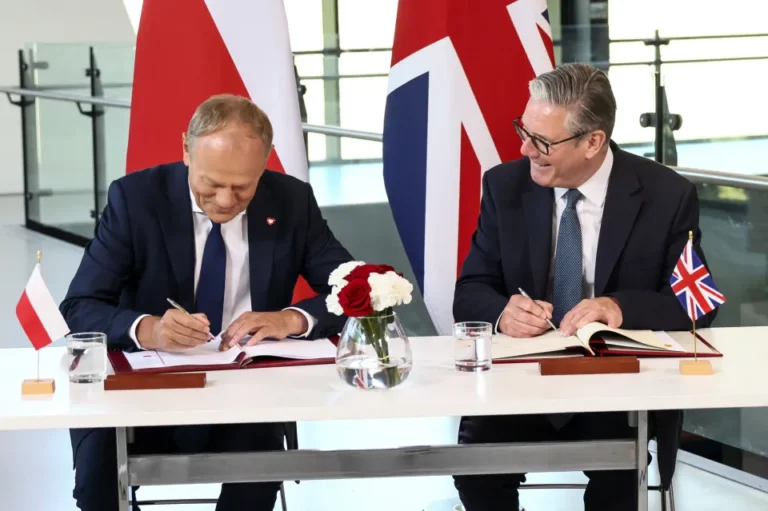
Polish Prime Minister Donald Tusk has stated that Warsaw seeks the closest possible coordination with London in response to growing Russian military and hybrid threats.
According to Prime Minister Donald Tusk, Russia represents a strategic and long-term threat to Poland, the United Kingdom, NATO, and the wider Euro-Atlantic community. Consequently, the bilateral partnership will focus on strengthening collective security and enhancing resilience against external challenges. Under the new Polish-British defense agreement, the two countries plan to deepen military cooperation, expand joint defense-industrial projects, coordinate cybersecurity efforts, enhance intelligence sharing, and strengthen capabilities to counter disinformation campaigns and other forms of Russian hybrid influence.
The Polish government has emphasized that, due to its critical role in facilitating international military and humanitarian assistance to Ukraine, Poland has become one of the primary targets of Russian information operations, intelligence activities, and cyberattacks.
The United Kingdom has previously concluded similar agreements with France and Germany, while Poland signed a defense treaty with Paris in May 2025 and is currently finalizing negotiations on a comparable agreement with Berlin.
Donald Tusk’s statement confirms a broader shift among European leaders from crisis management toward strategic planning for the coming decades. Defining Russia as a “long-term threat” indicates that both Warsaw and London do not expect relations with Moscow to normalize in the foreseeable future and are laying the foundation for long-term cooperation between their defense-industrial sectors.
Tusk’s remarks also send a clear message to both domestic political opponents and external observers that issues of national defense and Poland’s alliance commitments are being placed beyond the scope of partisan political debate. The Polish government is demonstrating that, in the face of a long-term Kremlin threat, national security is an overriding priority that will not be subject to political fluctuations.
The strengthening of defense cooperation between Warsaw and London suggests that Russian expectations of a gradual weakening of Western support for Kyiv have failed to materialize. On the contrary, Russia’s aggression against Ukraine is accelerating the rearmament of European states, increasing defense spending, and deepening military-political coordination across the continent. In the long run, this may contribute to the emergence of a more self-sufficient, technologically advanced, and resilient European security architecture.
In response to the threat of missile-related incidents, NATO’s borders are expected to see enhanced cooperation in the field of air and missile defense. This includes the synchronization of early-warning systems, joint airspace patrols, and the integration of British technologies—particularly the Sky Sabre air-defense system—with Poland’s Narew air-defense program.
Polish-British cooperation is not intended to replace NATO mechanisms. On the contrary, it is expected to strengthen the Alliance through regional leadership. By creating a precedent for military-technological integration between the United Kingdom and Poland, both countries are establishing a new benchmark for other NATO members regarding the practical—not merely declaratory—reinforcement of the Alliance’s eastern flank.
Particular attention will be devoted to countering hybrid threats within the so-called “gray zone.” The establishment of rapid intelligence-sharing channels between Polish and British security services will improve the ability to detect and neutralize emerging threats—including artificial migration crises, sabotage against critical infrastructure, and disinformation campaigns—at an early stage.
Bilateral economic cooperation will also focus on closing loopholes that enable Russia to circumvent sanctions. The United Kingdom and Poland intend to strengthen oversight of Russia’s “shadow fleet,” financial transactions involving third countries, and the transit of dual-use goods. These measures are expected to reduce Russia’s ability to finance its defense-industrial complex.
A key priority will be the protection of government communications, military command-and-control systems, and critical energy infrastructure in both countries.
Donald Tusk’s statement should be viewed not as a routine diplomatic declaration but as part of a broader transformation of the European security architecture driven by the war in Ukraine and growing concerns about a prolonged confrontation with Russia. By explicitly defining Russia as a “long-term strategic threat,” Warsaw and London are effectively acknowledging that the current security crisis is not temporary and may extend well beyond the end of active hostilities in Ukraine.
The emerging Polish-British defense partnership reflects a shift from deterrence-by-presence toward deterrence-by-integration. Unlike previous NATO initiatives, which often relied on rotational deployments and political declarations, the new framework aims to integrate defense-industrial capacities, intelligence structures, cyber-defense capabilities, and air-defense networks. This significantly increases resilience because it reduces dependence on crisis-driven decision-making and creates permanent mechanisms for cooperation.
For Poland, the agreement serves several strategic purposes. First, it reinforces Warsaw’s position as the leading security actor on NATO’s eastern flank. Second, it allows Poland to diversify its security partnerships beyond traditional dependence on Germany and France, whose approaches toward Russia have historically been more cautious. Third, it strengthens Poland’s role as the primary logistical hub supporting Ukraine, making it harder for Moscow to disrupt military assistance through hybrid operations.
For the United Kingdom, the agreement represents an opportunity to preserve strategic influence in continental Europe after Brexit. By building bilateral defense relationships with key European powers—including France, Germany, and Poland—London is establishing a parallel network of security partnerships that complements NATO while enhancing British influence over European defense planning.
Russia is likely to interpret the agreement as evidence that its strategy of exhausting Western support for Ukraine has failed. Instead of fragmentation, Moscow is witnessing the emergence of increasingly institutionalized security cooperation among NATO members. This may prompt the Kremlin to intensify hybrid operations against Poland and the United Kingdom, including cyberattacks, sabotage, disinformation campaigns, election interference, and efforts to exploit migration routes as instruments of political pressure.
Particularly significant is the emphasis on intelligence cooperation. Russia’s hybrid campaigns typically exploit gaps between national intelligence systems and bureaucratic barriers to information sharing. Real-time intelligence exchange between Polish and British services would reduce these vulnerabilities and improve the ability to identify Russian activities before they develop into major security incidents.
The proposed integration of British Sky Sabre systems with Poland’s Narew air-defense architecture suggests that Warsaw and London are preparing not only for conventional military threats but also for the possibility of missile incidents involving Kaliningrad, Belarus, or future Russian deployments closer to NATO territory. This reflects growing concern that future crises may develop faster than traditional NATO decision-making mechanisms can respond.
In strategic terms, the agreement contributes to the gradual emergence of a multilayered European security system composed of NATO structures, bilateral defense agreements, regional military initiatives, and defense-industrial partnerships. Rather than weakening NATO, these arrangements increase its resilience by creating additional channels of military cooperation that remain operational even during periods of political disagreement within the Alliance.
Ultimately, the significance of the Polish-British agreement lies less in its immediate military provisions and more in its long-term political message: key European powers are preparing for a security environment in which confrontation with Russia may remain a defining feature of the continent’s strategic landscape for years, if not decades.
The Kremlin is likely to view the expanding network of bilateral defense agreements between the United Kingdom, Poland, France, and Germany as a strategic setback that undermines several long-standing assumptions underlying Russian foreign and security policy.
For more than two decades, Russian policy sought to exploit divisions within Europe by: separating Western Europe from Eastern Europe; driving wedges between the United States and its European allies; encouraging competition among major European powers; promoting the perception that NATO lacked political cohesion.
The emergence of overlapping defense agreements linking London, Warsaw, Paris, and Berlin suggests the opposite trend. From the Kremlin’s perspective, Russia’s invasion of Ukraine has accelerated military cooperation among key European powers rather than weakening it.
As a result, Moscow likely views these agreements as evidence that its coercive diplomacy has produced strategic consolidation instead of fragmentation.
Historically, Russia viewed Germany, France, the United Kingdom, and the United States as the principal security decision-makers in Europe.
Today, Poland is increasingly becoming: NATO’s primary logistics hub for Ukraine; one of Europe’s fastest-growing military powers; a key advocate of deterrence against Russia; an increasingly influential voice in European defense policy.
The Kremlin is likely concerned that Warsaw is moving from the role of a frontline state to that of a regional security leader.
For Moscow, this is particularly problematic because Poland’s threat perception of Russia is fundamentally different from that of many Western European countries. Warsaw consistently supports stronger sanctions, increased defense spending, and long-term military support for Ukraine.
One of Russia’s assumptions after Brexit was that British influence in continental Europe would gradually decline.
Instead, London has: strengthened security cooperation with Poland; concluded major defense agreements with France and Germany; maintained a leading role in supporting Ukraine; remained one of the most active European intelligence and military actors.
The Kremlin likely sees these developments as proof that Brexit did not remove Britain from European security affairs.
Russian military planners tend to focus less on declarations and more on practical capabilities.
The Kremlin is likely particularly concerned about: joint weapons production; integrated air-defense systems; coordinated intelligence sharing; common ammunition stockpiles; interoperability of military forces.
From Moscow’s perspective, these developments increase Europe’s capacity to sustain long-term military competition.
The greatest concern is not a single agreement but the gradual creation of a permanent military-industrial network that would remain functional regardless of changes in political leadership.
The Kremlin’s most probable response is unlikely to be military escalation against NATO.
Instead, Russia is likely to intensify efforts to: undermine public support for defense spending; exploit disagreements between European governments; target critical infrastructure; conduct cyber operations; expand influence campaigns through social media and fringe political movements; weaponize migration routes where possible.
The objective would be to increase political costs and reduce public support for deeper military integration.
One of the most important long-term implications of these agreements is the emergence of increasingly dense networks of military cooperation inside NATO itself.
The Kremlin likely fears that: European countries are learning to coordinate more independently; defense planning is becoming less dependent on U.S. political cycles; regional coalitions can react faster than traditional NATO mechanisms.
This is particularly important in light of uncertainty about future U.S. administrations and Washington’s long-term strategic focus.
The Kremlin probably does not view the Polish-British agreement as an isolated bilateral arrangement.
Rather, Russian planners are likely to see it as part of a broader trend: a gradual transformation of European security from a system heavily dependent on U.S. leadership into a more interconnected network of European military powers capable of sustaining deterrence against Russia even during periods of transatlantic uncertainty.
This development directly challenges one of Moscow’s traditional strategic assumptions—that political divisions, differing threat perceptions, and varying national interests would prevent Europe from building a durable and coordinated security architecture.
Russia likely believes that Western support for Ukraine can still be weakened, but not eliminated, through a sustained campaign of political pressure, economic leverage, information operations, cyber activity, and influence campaigns. Moscow’s assessment has evolved significantly since 2022.
The Kremlin’s initial expectation in 2022 was that Western unity would collapse within months under the pressure of: rising energy prices; inflation; refugee flows; political polarization; electoral cycles.
This assessment proved largely incorrect. NATO expanded, defense spending increased, and military support for Ukraine continued.
However, Moscow has not abandoned the objective. Instead, it has shifted from seeking a rapid collapse of support to pursuing a strategy of gradual erosion.
The Kremlin likely calculates that Ukraine’s supporters do not need to be defeated militarily if they can be exhausted politically.
Russian strategists traditionally view democratic elections as periods of vulnerability.
Moscow closely monitors: elections in major European states; coalition negotiations; leadership transitions; parliamentary crises.
The Kremlin believes that governments change, while Russia can pursue a consistent long-term strategy.
A key Russian assumption is that public attention and political priorities will eventually shift away from Ukraine toward domestic issues.
Russia likely assesses that support for Ukraine becomes more vulnerable when linked to: inflation; energy costs; budget deficits; defense spending increases; economic slowdown.
The Kremlin’s objective is not necessarily to create an economic crisis but to increase the perceived cost of supporting Ukraine.
Russian influence operations increasingly focus on: questioning the effectiveness of aid; amplifying corruption allegations; exploiting disagreements among allies; promoting “peace at any cost” narratives; portraying the conflict as unwinnable.
The goal is not always to persuade people to support Russia but rather to weaken consensus behind continued assistance to Ukraine.
Russia likely sees hybrid operations as one of its most effective tools because they remain below the threshold of conventional military conflict.
Examples include: cyberattacks; sabotage; GPS interference; migration pressure; influence networks; covert support to extremist actors.
These activities increase security costs for Western governments while avoiding direct military confrontation with NATO.
Russian leaders likely acknowledge several realities: They No Longer Expect Immediate Western Collapse
The Kremlin understands that: NATO remains united; Ukraine retains broad support; sanctions have not been lifted; defense-industrial production is expanding in Europe.
Therefore, Moscow probably does not expect support for Ukraine to disappear suddenly. They Believe Time Favors Russia. This is likely the core assumption of Russian strategy.
Moscow probably calculates that: democratic governments face elections; public attention shifts; coalition politics creates disagreements; economic pressures accumulate.
In contrast, Russia believes it can sustain a prolonged confrontation through centralized decision-making and tighter domestic control.
To assess whether Russia believes its strategy is succeeding, we should monitor: Are Russian state media increasing emphasis on Western political divisions? Are Russian intelligence services expanding influence operations before major European elections? Is Moscow increasing support for actors advocating reduced assistance to Ukraine? Are Russian officials increasingly speaking about “war fatigue” in the West? Are hybrid attacks against logistics hubs, ports, energy infrastructure, and defense industries increasing?
Positive answers would suggest that the Kremlin still sees political and hybrid pressure as viable tools for weakening support for Ukraine. Russia likely assesses that Western support for Ukraine remains resilient in the short term but vulnerable in the long term. The Kremlin probably does not expect a dramatic collapse of support. Instead, it believes that a combination of electoral cycles, economic pressure, information warfare, and hybrid operations can gradually reduce the willingness of some Western governments to sustain military, financial, and political assistance to Ukraine over many years.
The central Russian calculation is not that the West will suddenly abandon Ukraine, but that maintaining support indefinitely may prove more difficult than sustaining pressure against it.
Russia is likely to employ all three major intelligence services—GRU, SVR, and FSB—against Poland and the United Kingdom, but their roles, priorities, and operational methods differ significantly.
Poland is likely one of the GRU’s highest-priority targets in Europe because it serves as the principal logistics hub for military assistance to Ukraine; a key transit route for weapons deliveries; NATO’s most important eastern-flank military actor after the United States.
Likely GRU objectives include: monitoring arms shipments; mapping military infrastructure; identifying vulnerabilities in transport networks; conducting cyber operations; supporting sabotage activities; gathering targeting intelligence on NATO deployments.
The GRU would probably be the primary organization involved in any covert action against railways, logistics hubs, ports, defense companies, or military facilities supporting Ukraine.
Although traditionally focused on domestic security, the FSB has increasingly participated in influence and hybrid operations abroad.
Against Poland, the FSB likely focuses on: influence networks; diaspora communities; migration-related operations; counterintelligence targeting Russian expatriates; recruitment of local intermediaries.
The FSB would also likely play a major role in operations linked to the Belarus-Poland border and migration pressure orchestrated through Belarus.
The SVR is likely focused on: Polish government decision-making; NATO planning; EU policy discussions; defense procurement; diplomatic negotiations.
The SVR generally prioritizes long-term intelligence collection rather than disruptive activities.
The United Kingdom is one of Russia’s most important intelligence targets.
The SVR is likely primarily interested in: British foreign policy; intelligence cooperation; Ukraine policy; sanctions enforcement; defense-industrial planning; NATO decision-making.
Because London remains one of Kyiv’s strongest supporters, the SVR likely devotes substantial resources to understanding British strategic intentions.
2. GRU — Military and Cyber Operations
The GRU likely focuses on: military facilities; naval infrastructure; weapons programs; cyber operations; support to Ukraine.
Particular targets likely include: defense contractors;Royal Navy facilities;military communications;weapons-production chains.
The GRU would likely be the lead service in any offensive cyber or covert action against British defense infrastructure.
The FSB’s activity in the UK is likely more limited than that of the GRU and SVR.
However, it may increasingly participate in: influence activities; monitoring Russian expatriates; recruitment of intermediaries; information operations.
The service most likely to expand activity is the GRU because Poland’s role in supporting Ukraine continues to grow.
Probability of increased activity:
The most significant growthin the
Uk is likely to come from the SVR and GRU.
Probability of increased activity:
The most important issue for Western counterintelligence agencies is: Is Russia moving toward a more integrated model in which the GRU conducts disruptive operations, the SVR provides strategic intelligence and influence support, and the FSB manages recruitment, logistics, and proxy networks inside NATO countries?Evidence from recent Russian hybrid activities suggests increasing coordination between the three services, particularly in countries such as Poland, the United Kingdom, Germany, and the Baltic states, where Moscow views long-term confrontation with NATO as a defining strategic challenge.