
Russia’s transfer of the former Prigozhin-linked influence network known as Africa Politology, or internally as “The Company,” to the control of the Foreign Intelligence Service, or SVR, represents more than an administrative restructuring. It marks the transformation of a commercially managed political consultancy and propaganda apparatus into a more institutionalized instrument of Russian state intelligence.
The central judgment is that SVR control is likely to make the network more strategically coordinated, intelligence-oriented, geographically scalable and closely integrated with Russian diplomacy, security policy and economic objectives. At the same time, formal intelligence management may reduce some of the entrepreneurial flexibility that characterized Yevgeny Prigozhin’s operations and create bureaucratic rivalry with the Russian Defence Ministry, the GRU, the Foreign Ministry and other Russian influence structures.
The SVR had taken control of the organization after Prigozhin’s death, financed it through intermediary companies and used it not only for propaganda but also to recruit local political, military and intelligence contacts
The reported leadership structure combines two distinct cadres: senior or former SVR personnel capable of setting intelligence priorities and providing state protection; veteran Prigozhin political technologists with operational experience in Sudan, Mali, the Central African Republic, Madagascar, Zimbabwe, Libya and Latin America.
This combination is particularly significant. The SVR gains access to an existing covert infrastructure of political consultants, media operatives, polling specialists, local intermediaries and cash-based logistics. The former Prigozhin personnel, in turn, gain more dependable state financing, diplomatic access, intelligence support and protection from competing Russian agencies.
The most important consequence is that Africa Politology can no longer be treated merely as a propaganda contractor. Under SVR direction, it should be assessed as a hybrid intelligence-support platform able to combine political influence, covert collection, media manipulation, economic lobbying and preparation of destabilizing political scenarios.
Africa Politology was originally part of the wider political and information infrastructure associated with Yevgeny Prigozhin. The network complemented Wagner’s military deployments by attempting to shape the political environment in countries where Russia sought security contracts, access to natural resources, diplomatic support or the removal of Western influence.
The United States sanctioned Africa Politology in 2023, describing it as a Prigozhin-linked propaganda organization involved in influence operations in the Central African Republic and Mali and in efforts to discredit Western governments, human-rights institutions and the United Nations.
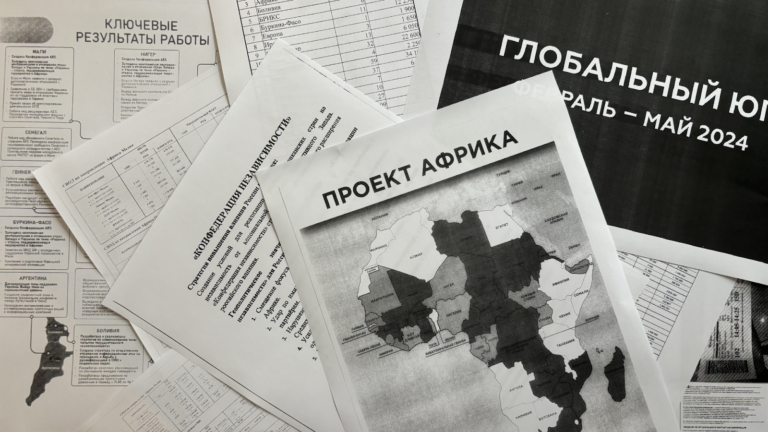
After Wagner’s failed mutiny in June 2023 and Prigozhin’s death in August, Moscow divided parts of his system among state institutions. Military capabilities were increasingly absorbed into structures associated with the Russian Defence Ministry and Africa Corps, while the political-influence branch was reportedly transferred to the SVR at the end of 2023. The leaked documents reviewed by the investigative consortium indicate that Africa Politology subsequently became fully integrated into the intelligence service and began implementing tasks ordered by it.
The resulting architecture appears to separate, but also reconnect, three functional spheres: military and regime-security support; political and information influence; intelligence collection and access-building.
The SVR’s assumption of control over the political branch therefore creates the possibility of closer coordination between overt diplomacy, clandestine intelligence collection and deniable influence activity.
Source Reliability and Evidentiary Limits
The strongest corroborated findings are: the existence of an organization internally called “The Company” and publicly associated with Africa Politology; the survival of the network after Prigozhin’s death its financing through intermediary entities; its management by veteran Prigozhin operatives; operational involvement by identified or alleged SVR officers; the recruitment of local political, military, media and intelligence contacts; activities across Africa and Latin America.
More specific claims—particularly those concerning individual operational responsibilities, exact chains of command and particular covert actions—should be treated with varying levels of confidence unless supported by additional documentation.
Key Individuals
Dmitry Leonidovich Faddeev
Dmitry Faddeev appears to be the most strategically important figure named in the reporting.
Faddeev is a retired or former senior SVR general and a former first deputy to SVR Director Sergei Naryshkin. He was reportedly directly involved in taking over Africa Politology and now defines the network’s principal strategic priorities, especially in Africa.

Faddeev reportedly served under diplomatic cover at the Russian Embassy in Berlin between 2006 and 2008, officially as a political adviser. He had previously worked in the Russian Foreign Ministry’s currency and finance department, a structure that the investigation described as historically associated with intelligence officers operating under official cover.
Assessment
Faddeev’s reported role indicates that the network is not merely receiving occasional assistance from the SVR. A former first deputy director would be positioned to: translate Kremlin priorities into intelligence tasking; coordinate access to diplomatic and financial infrastructure; manage relations with SVR stations in African capitals; resolve disputes between the network and other Russian agencies; determine which influence operations support wider Russian foreign-policy objectives.
His involvement also suggests that the operation is regarded as strategically important by the Russian intelligence leadership rather than as a marginal legacy project.
Ilya Savelyev
Ilya Savelyev is described as an SVR officer who provides the operational link between the service and Africa Politology’s management. The investigation reported that he served as Russia’s consul in Mumbai in 2015 and later headed the Centre for the Study of Socio-Political Problems of African and BRICS Countries. (Forbidden Stories)

Assessment
Savelyev’s reported background is suited to liaison and access-building. A consular posting can provide experience in official-cover operations, while leadership of an Africa- and BRICS-focused research body offers a legitimate platform for contacts with academics, diplomats, political consultants and business representatives.
He is therefore likely to serve as an interface between: formal SVR priorities; Africa Politology’s civilian operatives; local political and intellectual networks; Russian diplomatic and business structures.
Faddeev appears to provide strategic direction; Savelyev is more likely to maintain continuing operational control and communication.
Sergei Vasilyevich Mashkevich, 1986
Mashkevich is identified as Africa Politology’s global project manager and one of the central figures responsible for expansion in Africa and Latin America. He reportedly worked in the Russian Presidential Administration from 2015 to 2018 and later headed the organization’s Sudan project.
In Sudan, Africa Politology attempted to support the political survival of President Omar al-Bashir before his removal in 2019. Internal reporting also credits Mashkevich with helping organize the network’s response to the political crisis surrounding Bolivian President Luis Arce in 2024.

Assessment
Mashkevich appears to be the principal civilian operational manager. His reported experience indicates capability in: political crisis management; regime-support campaigns; deployment of political consultants; coordination of cross-border teams; design of anti-opposition narratives; conversion of intelligence requirements into political operations.
His continued leadership under the SVR demonstrates institutional continuity between the Prigozhin period and the present. Moscow appears to have retained experienced personnel rather than replacing the network wholesale.
Sergei Sergeyevich Klyukin, 1984
Klyukin reportedly heads the analytical department and supervises approximately 34 specialists responsible for monitoring political conditions in at least 15 countries. The team conducts surveys, prepares political assessments and supports operational planning.
He previously worked with Mashkevich and Artem Gorny in Sudan and was associated with Africa Politology’s sociological work there.

Assessment
Klyukin’s unit is important because it turns propaganda into a data-driven influence process. Polling, elite mapping and public-opinion analysis can be used to: identify social divisions; test anti-Western narratives;
- determine vulnerable politicians;
- measure the effectiveness of disinformation;
- prioritize recruitment targets;
- predict protest potential.
Under SVR control, such analysis may also support intelligence collection and political-risk assessments for Russian decision-makers.
Dmitry Viktorovich Volkov, 1972.

Volkov, aged 54 according to the leaked material, reportedly worked as a political and media adviser and had experience with Russian state television. He joined the network in February 2023, headed information operations in Mali and later led the mission in Bolivia.
In Bolivia, the network reportedly organized an anti-crisis headquarters, advised government communications and developed campaigns against former president Evo Morales.
Assessment
Volkov’s profile illustrates the organization’s geographic expansion beyond Africa. His role suggests the network is exporting an established operational model:
- enter during a political crisis;
- embed advisers near the executive branch;
- reshape official communications;
- conduct polling and elite analysis;
- create smear campaigns against opponents;
- establish a permanent local office and recruit nationals.
This model is closer to covert political intervention than conventional public diplomacy.
Taras Kirillovich Pribyshin, 1991.

Pribyshin is one of the best-documented members of the older Prigozhin network. The U.S. Treasury sanctioned him in April 2021, stating that he had conducted influence operations in Africa for the Internet Research Agency in support of Prigozhin’s objectives since at least 2019.
The later leaked material links him to operations in Madagascar, Zimbabwe and the Central African Republic and indicates that he had earlier experience connected with Syria.
Assessment
Pribyshin represents the institutional memory of the network. His value lies not only in propaganda skills but also in his likely knowledge of:
- local intermediaries;
- election-influence methods;
- media-placement channels;
- covert financial arrangements;
- Prigozhin-era commercial and political networks.
His retention under the SVR suggests that Moscow prioritizes operational experience despite sanctions exposure.
Nikolai Vladimirovich Radkovskiy

Radkovskiy is identified as another long-serving operative with experience dating to the Prigozhin period and reportedly took part in activities connected with Syria. The public reporting provides less detailed information about his specific African responsibilities than it does for Pribyshin.
Assessment
Radkovskiy is likely a senior field or project operative, but the available sources do not sufficiently establish his precise command responsibilities. His inclusion among long-serving personnel nonetheless supports the judgment that the SVR inherited a mature cadre rather than building a new network from the ground up.
Yulia Andreevna Afanasyeva-Berg, 1988
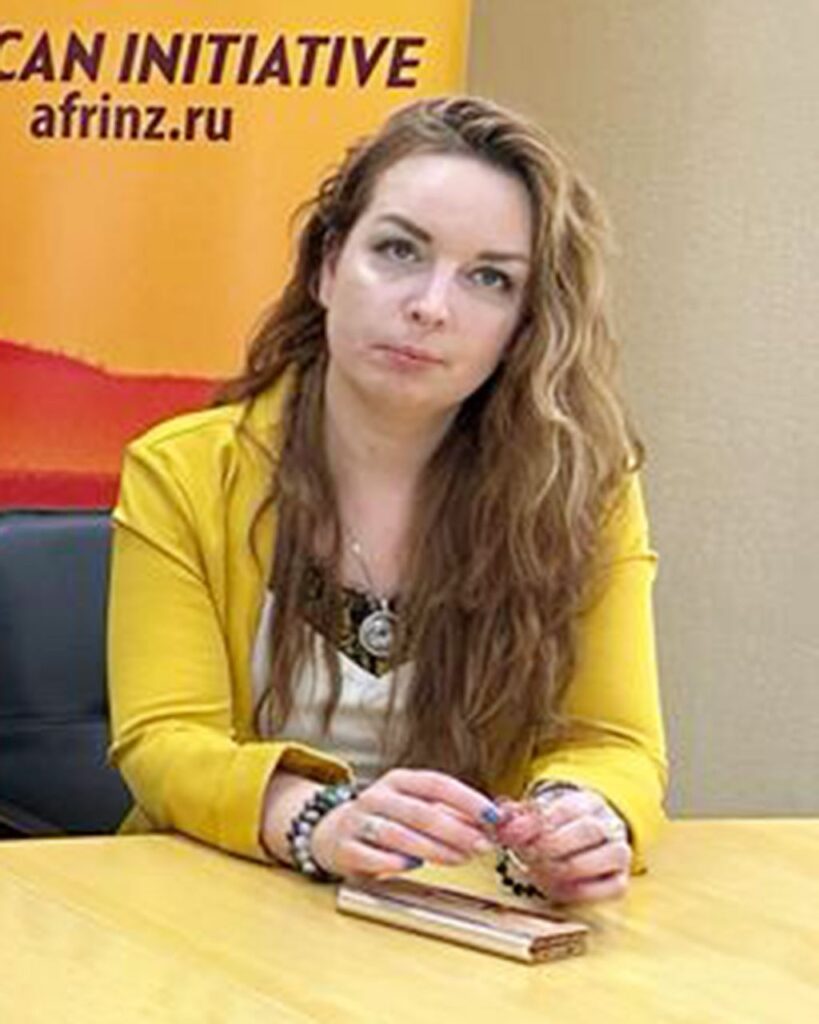
The person named in the original text as “Yulia Afanasyeva-Bereg” appears to correspond to Yulia Andreevna Afanasyeva-Berg, who was previously associated with Prigozhin’s Africa Back Office.
The U.S. Treasury sanctioned Yulia Afanasyeva in 2021, stating that she ran the Association for Free Research and International Cooperation and the International Anticrisis Center—structures used to support Prigozhin’s influence operations and fraudulent election-monitoring missions in Africa.
The leaked material indicates that she continued to travel in connection with network activity, including in South Africa in 2024.
Assessment
Afanasyeva-Berg’s specialization appears to involve the creation of ostensibly legitimate civil-society, research and election-observation structures. These can be used to: legitimize preferred candidates; challenge unfavorable election results; produce pseudo-independent analytical reports; recruit academics and political activists; conceal Russian state direction.
Under SVR control, such organizations can become particularly useful as non-official-cover platforms for access and influence.
Ksenia Valeryevna Soboleva

Internal documents reportedly show Soboleva purchasing clusters of fake Facebook accounts, funding Telegram channels and coordinating online media activities. She later rose to lead the organization’s media department.
Assessment
Soboleva appears responsible for the network’s digital infrastructure and distribution mechanisms rather than high-level strategy. Her operational importance nevertheless should not be underestimated. Fake accounts, paid media placements, Telegram channels and cloned websites create the connective tissue through which broader political narratives are disseminated.
Under SVR direction, such tools can support: targeted disinformation; laundering of intelligence-derived narratives; attacks on Western diplomatic or commercial projects; amplification of protests; covert support to selected political actors.
The available sources clearly associate her with the network but do not conclusively establish that she was personally sanctioned by the United States. That part of the original text should therefore be treated cautiously.
Alexey Evgenyevich Shilov
Shilov, reportedly 33, was deployed in Bolivia and Argentina and received a Russian state decoration, according to internal personnel biographies.
Assessment
The state decoration is important if authentic because it indicates official recognition of nominally deniable influence work. Shilov’s presence in both Bolivia and Argentina also suggests that the organization is developing regional rather than purely country-specific operational teams.
The available open sources reviewed for this paper do not independently confirm the original text’s assertion that Shilov is under U.S. sanctions.
Artem Vitalievich Gorny

Although not emphasized in the supplied text, Gorny is important to the logistical structure. Investigators linked him to office rentals, cash deposits and the Russian back office. He also reportedly worked in Sudan and became associated with StratConsult LLC, a company used for financial operations.
Assessment
Gorny appears to manage administrative, financial and logistical functions. Such personnel are critical vulnerabilities because they connect otherwise compartmented field operations through: travel records; leases; company registrations; bank deposits; procurement; communications infrastructure.
Consequences of SVR Management
From Commercial Influence to Intelligence Tasking .Under Prigozhin, political operations were shaped by a mixture of Kremlin objectives, commercial opportunities and the personal ambitions of the network’s owner. SVR management is likely to subordinate these activities more directly to state intelligence priorities.
This means campaigns may increasingly be designed not only to promote pro-Russian narratives but also to: collect political and security information; identify recruitable officials; gain access to intelligence institutions; map Western diplomatic and commercial activity; support covert negotiations; prepare the political environment for Russian security agreements.
The leaked documentation already describes the recruitment of local “counter-agents,” including opposition figures, ruling-party officials, military personnel and former or serving intelligence officers.
Improved Access to Russian State Resources
SVR control can provide the network with assets that Prigozhin could access only indirectly: intelligence reporting from SVR stations; diplomatic cover and embassy support; secure communications; official travel facilitation; assistance in opening bank accounts; links to Russian state companies; coordination with foreign security services.
The internal plans reportedly tasked the SVR with supplying information on French and U.S. military and political intentions in the Sahel, supporting Russian commercial entry, facilitating contacts with the United Nations and assisting Russian-backed regional security initiatives.
This significantly raises the network’s value to Moscow.
Integration of Propaganda and Espionage
The most serious consequence is the collapse of the boundary between media influence and clandestine intelligence work.
A journalist or blogger initially recruited to publish paid content may later be tasked to report on: embassy activity, political party divisions, military attitudes, foreign-funded organizations, opposition plans, elite vulnerabilities.
Similarly, opinion surveys and political consulting can be used as collection tools. They can generate detailed information about ethnic, regional and socioeconomic divisions that may be exploited during elections or political crises.
Africa Politology therefore offers the SVR a low-cost human-intelligence environment disguised as media, research and political consultancy.
More Systematic Targeting of Western and UN Presence
The supplied text identifies campaigns against FHI 360, MINUSCA, France, Ukraine and Western-backed infrastructure projects. The broader leaked material also describes operations targeting the Lobito Corridor, the French company Orano and Western political influence in the Sahel.
SVR control is likely to make such targeting more coordinated. Rather than isolated propaganda attacks, campaigns may support a sequence of state objectives: discredit Western partners, generate public pressure for their withdrawal, undermine local officials who support them, promote Russian security or commercial alternatives, obtain access to strategic sectors after Western competitors are removed.
Greater Capacity to Support Authoritarian Regimes
The network’s experience in Sudan, the Central African Republic, Mali, Bolivia and Namibia indicates a recurring preference for assisting incumbent governments or political actors prepared to deepen relations with Moscow.
SVR management can enhance this model by combining: regime-protection advice, opposition surveillance, strategic communications, elite recruitment, security-service cooperation, support for restrictive legislation.
This may strengthen authoritarian incumbents and reduce political space for civil society, independent media and opposition parties.
Expansion Beyond Africa
Africa Politology’s deployment in Bolivia and Argentina, as well as planning across Latin America, demonstrates that the name no longer accurately defines the organization’s operational scope.
Under SVR control, the network is likely to become a reusable Global South platform. Countries with the following characteristics are especially vulnerable: weak media-financing transparency, high anti-Western sentiment, competitive or disputed elections, authoritarian or military-led governments, dependence on extractive industries, political demand for Russian security assistance, limited counterintelligence capability.
Stronger State Control but Less Flexibility
SVR management also creates disadvantages.
Prigozhin’s system was corrupt and often poorly controlled, but it could move quickly, take commercial risks and improvise. A state intelligence bureaucracy may impose:
- more reporting requirements, tighter compartmentation, slower decision-making;
- competition between headquarters departments, risk aversion after exposure.
The continuing use of large cash flows also appears to generate internal corruption. According to the leaked accounts, almost the entire monthly budget was received in cash, while the organization spent more than $7.3 million between January and September 2024.
This may reduce efficiency and create opportunities for penetration, defection or financial disruption.
Interagency Rivalry
The Russian system in Africa is not fully unified. The SVR, GRU, Defence Ministry, FSB, Foreign Ministry, Rossotrudnichestvo and state companies possess overlapping interests.
The leaked documents indicate that the SVR sometimes had to protect Africa Politology or Wagner-linked structures from obstruction by the Russian Defence Ministry or Foreign Ministry.
This means centralization under the SVR does not eliminate rivalry. It may instead institutionalize competition between: the SVR’s political-intelligence network, the GRU-linked Africa Corps, diplomatic structures seeking formal state control, surviving Wagner commercial interests.
Such rivalry could create operational friction but may also serve the Kremlin’s preference for preventing any single actor from accumulating excessive independent power.
Country-Level Implications
Central African Republic
The CAR remains the network’s most mature operating environment. Russia possesses close access to the presidency, security institutions, media and commercial sectors. Efforts to weaken MINUSCA or discredit Western humanitarian organizations would help reduce external scrutiny of Russian activity.
SVR control increases the risk that political influence will be used to penetrate state institutions and manipulate relations between Bangui, the UN and Western donors.
Mali and the Sahel
In Mali, Burkina Faso and Niger, information operations can reinforce military regimes, promote anti-French narratives and legitimize Russian security assistance. SVR intelligence may also support Russian efforts to understand Western military movements, regional diplomatic initiatives and internal divisions within the Alliance of Sahel States.
Angola and the Lobito Corridor
Angola is strategically significant because of the Lobito Corridor and competition over access to critical minerals. The use of cloned websites and anti-Western messaging suggests that Russian operations may aim to reduce confidence in U.S. and European infrastructure projects.
Namibia and South Africa
In Southern Africa, the network can exploit liberation-movement ties, anti-colonial rhetoric, skepticism toward Western policy and relationships with established ruling parties. It may also seek access to mining, nuclear-energy, political and media circles.
Madagascar and Zimbabwe
The presence of veteran operatives with election-related experience makes these countries vulnerable to covert campaign consulting, fraudulent observation missions and support for politically useful candidates.
Implications for Ukraine
The SVR-controlled network gives Moscow an established vehicle for systematically attacking Ukraine’s position in the Global South.
Likely narratives include: portraying Russia’s war as a response to Western aggression, blaming sanctions rather than Russia for food and energy disruption, presenting Ukraine as a Western proxy, accusing Kyiv of supporting terrorism or instability in Africa, undermining Ukrainian diplomatic outreach, discouraging African governments from supporting Ukraine in international organizations.
The network may also collect information on Ukrainian diplomatic activity, military cooperation, grain initiatives and relationships with African elites.
Ukraine therefore faces not merely a messaging problem but an intelligence-backed political influence campaign.
Conclusion
The transfer of Africa Politology to the SVR marks the state appropriation of one of the most important surviving components of Prigozhin’s influence empire.
The network’s original strength was its ability to combine political consulting, media manipulation, covert payments, election activity and local access. SVR management adds strategic intelligence direction, state financing, diplomatic support and the ability to integrate influence operations with broader Russian security and economic objectives.
The significance of this change is therefore qualitative, not merely organizational. Africa Politology is evolving from a deniable political enterprise into an intelligence-enabled instrument of Russian power projection.
The most likely operational model will combine: propaganda to weaken Western legitimacy, covert collection through local intermediaries, political support to Russia-friendly elites, campaigns against UN and Western institutions, lobbying for Russian security and commercial access, preparation of destabilizing scenarios where peaceful influence is insufficient.The network is unlikely to be uniformly effective. Its operations suffer from corruption, exposure, cultural misjudgments and interagency rivalry. Nevertheless, its scale, experience and access make it a serious counterintelligence and democratic-security threat.