
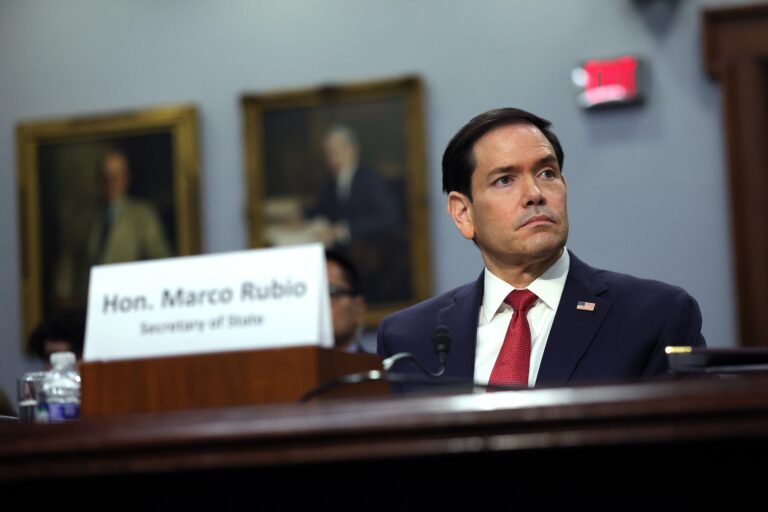
Recent remarks by U.S. Secretary of State Marco Rubio mark a significant shift in the White House’s approach toward the war in Ukraine. Rubio’s statement that Russia “cannot achieve its negotiating goals through military means” represents a departure from earlier assumptions within the Trump administration that Moscow retained substantial leverage and that a rapid negotiated settlement was achievable.
The evolution of U.S. policy since January 2025 can be divided into three distinct phases:
- Rapid Deal-Making Phase (January–March 2025)
- Testing Moscow’s Intentions Phase (Spring 2025–Early 2026)
- Strategic Realism Phase (June 2026–Present)
Rubio’s latest statement suggests that the White House is increasingly concluding that Russia lacks the military capacity to impose its maximalist demands and that the war is unlikely to end on terms dictated solely by the Kremlin. This does not necessarily indicate a return to the Biden-era strategy but rather the emergence of a more pragmatic position recognizing battlefield realities.
Rubio’s Statement as a Strategic Indicator
Rubio stated that: Russia cannot achieve the goals it is demanding in negotiations through military means. He further described Russia’s invasion as a “strategic disaster” and suggested that even some actors inside Russia recognize this reality.
This statement is significant because it contradicts several assumptions that characterized the early months of Trump’s second administration: that Russia possessed overwhelming military momentum; that Ukraine’s negotiating position was steadily deteriorating; that territorial concessions were inevitable; that a quick diplomatic settlement could be achieved primarily through pressure on Kyiv.
Instead, Rubio’s remarks implicitly acknowledge that Russia has failed to achieve its original strategic objectives after more than four years of war.
Phase I: The “Rapid Settlement” Approach
Strategic Assumptions
At the beginning of Trump’s second term, the White House appeared to believe that: both sides were exhausted; the conflict had reached a military stalemate; U.S. diplomatic pressure could produce a quick settlement; Russia might be willing to moderate its demands if offered an acceptable off-ramp.
The administration initially focused on direct engagement with Moscow and sought to determine whether Putin was genuinely interested in ending the war. Rubio himself repeatedly stated that Washington was attempting to “test” Russia’s intentions.
The White House viewed the conflict primarily as a geopolitical burden that distracted Washington from: competition with China; instability in the Middle East; domestic economic priorities.
Therefore, ending the war quickly became a strategic objective independent of the battlefield situation.
Phase II: Testing Moscow
By mid-2025 and early 2026, it became increasingly apparent that Moscow’s fundamental demands remained unchanged.
Russia continued insisting on: recognition of occupied territories; restrictions on Ukrainian sovereignty; limits on Ukraine’s Western integration; broader revisions of European security arrangements.
Rubio gradually shifted his rhetoric.
Instead of expressing confidence in a near-term settlement, he increasingly emphasized: the lack of meaningful progress; the necessity of negotiations; uncertainty regarding Russian intentions.
The White House began realizing that the central obstacle was not Kyiv’s unwillingness to negotiate but Moscow’s unwillingness to abandon maximalist objectives.
This realization became increasingly difficult to ignore as: Russian offensives failed to achieve decisive breakthroughs; Ukrainian long-range strikes expanded; Russian economic pressures intensified; divisions emerged among Russian elites regarding the sustainability of the war.
Phase III: Strategic Realism
Rubio’s June 2026 statement appears to mark the beginning of a new phase.
The administration now seems to recognize three realities: Russia Cannot Win Decisively
Despite significant military resources, Russia has failed to: overthrow the Ukrainian government; destroy Ukrainian statehood; force Ukrainian capitulation; secure international recognition of its territorial claims.
Even Russian elite circles increasingly question the feasibility of achieving these goals.
Ukraine Has Greater Staying Power Than Expected. The administration has observed: growing Ukrainian drone capabilities; deep strikes inside Russian territory; improved defensive resilience; sustained Western support.
These developments have undermined assumptions that Ukraine would eventually be compelled to accept Russian conditions.
The War Is Becoming a Liability for Russia. Economic pressures are accumulating.
Russian officials and business elites increasingly express concern regarding: economic stagnation; sanctions; manpower challenges; long-term strategic costs.
What Has Changed Inside the White House?
The most important evolution is not a change in America’s ultimate goal—ending the war—but a change in how Washington believes that goal can be achieved.
The administration initially appeared to believe: Pressure on Ukraine → Negotiations → Settlement. The emerging logic appears closer to: Military Balance → Mutual Recognition of Limits → Negotiated Settlement.
In this framework, strengthening Ukraine is not necessarily incompatible with diplomacy. Rather, military pressure may be required to convince Moscow that its maximalist objectives are unattainable.
Rubio’s acknowledgment that Russia cannot obtain its goals militarily reflects this shift.
Implications for Future U.S. Policy
Rubio’s comments coincide with growing Congressional pressure for additional Ukraine assistance and tougher sanctions against Russia.
While the White House remains committed to negotiations, it may become more willing to: maintain military aid; support Ukrainian defense-industrial cooperation; preserve sanctions leverage.
The administration is increasingly unlikely to pressure Ukraine into accepting a settlement that appears indistinguishable from capitulation.
Rubio’s formulation effectively rejects the premise that Russia can simply continue fighting until Ukraine accepts its demands.
The White House increasingly appears to view Putin’s negotiating position as disconnected from battlefield realities.
It suggests a growing belief that diplomacy will only succeed after Moscow revises its expectations.
Intelligence Assessment
Rubio’s statement should be interpreted as more than a routine diplomatic comment. It is likely an indicator of an internal reassessment within the White House regarding the nature of the conflict.
The administration’s approach has evolved from:“Russia can be persuaded to settle quickly” to: “Russia must first recognize that it cannot achieve its objectives through force.”
This represents perhaps the most important conceptual shift in U.S. policy toward Ukraine since Trump’s return to office.
If this trend continues, the United States may increasingly support a strategy aimed not at securing an immediate peace agreement, but at convincing Moscow that continued war offers diminishing returns. Such a strategy would seek to create conditions in which negotiations become a consequence of Russian strategic exhaustion rather than a reward for Russian military pressure.
The central implication of Rubio’s statement is therefore clear: Washington is beginning to move from peace through urgency toward peace through leverage.
Washington Now Assess That Russia’s Military Offensive Potential Has Peaked.
Current public statements by Secretary of State Marco Rubio, combined with the broader shift in White House rhetoric, suggest that Washington increasingly believes Russia has reached the limits of what it can achieve through large-scale offensive operations.The emerging assessment appears to be that Moscow can still fight, but cannot achieve its maximalist political objectives through military force.
In 2025, Rubio still spoke about narrowing gaps between the parties and possible diplomatic momentum. By June 2026, he is openly stating that Russia cannot achieve the objectives it is demanding at the negotiating table through military means and that neither side is positioned for a decisive military victory.
Such language usually reflects intelligence assessments rather than mere diplomatic messaging.
Recent battlefield assessments indicate that Russian advances in 2026 have slowed considerably compared with 2025. Open-source and military analysts report that Russia’s spring-summer offensive has generated only limited gains despite increased assault activity. Some analysts argue that Ukrainian forces have effectively stalled the offensive and even regained territory in certain sectors.
From Washington’s perspective, this suggests diminishing returns despite Russia’s continued expenditure of manpower and materiel.
American and European analysts increasingly point to: declining operational momentum; growing equipment shortages; heavy casualty rates; reduced industrial flexibility due to sanctions; increasing dependence on drones and long-range strikes rather than maneuver warfare.
The White House likely sees this as evidence that Russia can sustain war but cannot generate a breakthrough capable of forcing Ukrainian capitulation.
What Washington Probably Does NOT Believe
The administration almost certainly does not assess that Russia is close to military collapse.
Russia still possesses: substantial manpower reserves; significant missile and drone production; the ability to conduct strategic strikes; the capacity to continue attritional warfare for years.
Therefore, the White House probably distinguishes between: Peak offensive potential and ability to continue fighting.
Russia may have reached the first while retaining the second.
If Washington has indeed concluded that Russian offensive potential has peaked, several policy implications follow:
The White House becomes less likely to push Ukraine toward accepting unfavorable territorial concessions merely because of fears of imminent Russian victory.
If Russia cannot achieve a breakthrough, then continued Western support becomes a strategy for gradually worsening Moscow’s strategic position rather than merely delaying defeat.
Rubio’s remarks suggest the administration increasingly believes that negotiations will occur not because Russia wins, but because Russia eventually recognizes that it cannot achieve more through continued military action.
The strongest interpretation of Rubio’s statement is not that Washington believes Russia is losing the war. Rather, Washington increasingly appears to believe that Russia has reached the ceiling of what military force can realistically deliver.
This is a significant evolution from the White House’s earlier assumption that Moscow retained sufficient momentum to dictate the terms of a settlement. Today, the administration appears much closer to the assessment that Russia can prolong the conflict indefinitely but lacks the military capability to achieve the strategic objectives that Putin continues to demand—namely the political subordination of Ukraine, recognition of all occupied territories, and a fundamental revision of the European security order.
The Key Intelligence Question: Has the White House concluded that Russia’s remaining offensive capability is sufficient to prolong the war but insufficient to alter its ultimate political outcome?
How Do Rubio’s Remarks Align with Internal Pentagon and Intelligence Community Assessments of Russia’s Long-Term War Prospects?
Rubio’s remarks appear highly consistent with the dominant trend in Pentagon and U.S. Intelligence Community (IC) assessments that has emerged since late 2024 and strengthened throughout 2025–2026.
The core assessment increasingly visible across public statements by U.S. military officials, intelligence testimony, and strategic reviews is not that Russia is about to lose the war, but that Russia is unlikely to achieve its original strategic objectives at an acceptable cost.
Rubio’s statement that Russia cannot achieve through military means what it demands at the negotiating table reflects a view that has gradually become more prevalent within the Pentagon, the CIA, the Defense Intelligence Agency (DIA), and the National Intelligence Council.
Evolution of U.S. Intelligence Thinking
Phase 1: Russia Still Possessed Strategic Initiative (2022–2023)
During the first years of the war, U.S. intelligence assessments focused on: Russia’s numerical superiority; Ukraine’s dependence on Western aid; uncertainty regarding Ukrainian sustainability; the possibility of Russian adaptation.
At this stage, intelligence agencies did not exclude the possibility that Moscow could eventually force Kyiv into an unfavorable settlement through attritional warfare.
Phase 2: Russia Can Sustain War but Not Achieve Decisive Victory (2024–2025)
By 2024, assessments increasingly emphasized a distinction between: Military endurance and strategic success.
Analysts began concluding that: Russia could sustain military operations for years; Russia could continue mobilizing manpower; Russia could maintain defense-industrial production; but Russia faced severe obstacles in translating these resources into decisive strategic outcomes.
This distinction is almost identical to Rubio’s latest formulation.
Areas of Strong Alignment
Neither Rubio nor most Pentagon assessments suggest Russia is approaching collapse.
The Pentagon generally assesses that Russia retains: significant manpower reserves; substantial defense-industrial capacity; strong domestic repression mechanisms; growing military cooperation with Iran, North Korea, and China.
Rubio’s statement does not contradict this assessment.
Instead, it implicitly acknowledges that Russia remains dangerous.
Washington likely assesses: Russia can continue the war.
But Russia cannot achieve its maximalist objectives through continued warfare.
This is perhaps the strongest point of convergence.
The Kremlin continues demanding: recognition of annexed territories; demilitarization of Ukraine; limits on NATO enlargement; de facto Russian veto power over Ukraine’s foreign policy.
However, Pentagon war-gaming and intelligence assessments increasingly suggest that Russia lacks the military capability to impose these conditions on Ukraine.
Rubio’s statement directly reflects this conclusion.
The U.S. intelligence community increasingly highlights long-term vulnerabilities:
Russia faces: labor shortages; declining working-age population; increasing recruitment costs.
Although sanctions have not collapsed the Russian economy, they have: reduced technological access; increased military expenditures; created long-term growth challenges.
Russia has adapted remarkably well, but adaptation itself indicates limits: greater reliance on drones; increasing use of glide bombs; reduced dependence on large-scale maneuver operations.
These are indicators of military evolution but also evidence of strategic constraints.
Rubio’s comments fit closely with this analytical framework.
Areas Where Pentagon May Be More Cautious Than Rubio
Military planners traditionally assume worst-case scenarios.
Consequently, Pentagon assessments may be somewhat more cautious than Rubio’s public messaging.
The Pentagon likely remains concerned about: potential Russian breakthroughs; future mobilization waves; expanded cooperation with North Korea; Chinese support to Russia’s defense-industrial base.
Thus, Pentagon planners probably assess: Russia is not winning.
but also Russia remains capable of generating dangerous surprises.
Intelligence Community Debate
The most important debate inside Washington is probably no longer:
“Can Russia survive?”
Instead, the debate is increasingly:
Camp A
Russia has entered a long-term strategic decline.
Advocates argue: war costs are unsustainable; military gains are marginal; elite dissatisfaction is growing.
Camp B
Russia is successfully adapting.
Advocates argue: sanctions have not produced collapse; military production remains high; Moscow can continue the war indefinitely.
Rubio’s remarks appear to occupy a middle ground between these camps.
Rubio’s statement likely reflects a consensus view emerging across Washington: Russia is not collapsing. Russia is not winning. Ukraine is not collapsing. Ukraine is not capable of rapidly liberating all occupied territory. Therefore, the war is becoming a contest of strategic endurance rather than military breakthrough.
This is precisely the type of assessment one would expect from an administration increasingly focused on creating leverage for negotiations rather than pursuing outright military victory for either side.
Strategic Implications for White House Policy
If Rubio’s remarks genuinely reflect internal intelligence assessments, several policy shifts become more likely: Continued Military Assistance
The administration may conclude that sustaining Ukraine remains cheaper than allowing Russia to gain leverage.
Stronger Sanctions. Washington could increasingly focus on raising the long-term costs of Russian war-making.
Long-War Planning. The White House may be moving away from assumptions about an imminent settlement and toward managing a prolonged conflict.
Pressure on Moscow Rather Than Kyiv
Earlier diplomatic efforts often focused on encouraging Ukrainian flexibility.
Rubio’s statement suggests increasing skepticism that Russia—not Ukraine—is the primary obstacle to negotiations.
Rubio’s remarks align closely with what appears to be the prevailing assessment within the Pentagon and the U.S. Intelligence Community: Russia retains the capacity to continue the war for many years, but it is increasingly unlikely to achieve the political and strategic objectives that the Kremlin continues to demand.
This assessment does not predict Russian defeat. Rather, it suggests that Washington increasingly views the war as one in which Russia can sustain military operations indefinitely while simultaneously being unable to translate those operations into a decisive strategic victory.