
During the night of June 14–15, 2026, the Russian Armed Forces launched a massive combined strike against Ukraine using attack UAVs and air- and ground-launched missiles. The primary target of the attack was Kyiv, while the cities of Dnipro and Kharkiv were also struck.
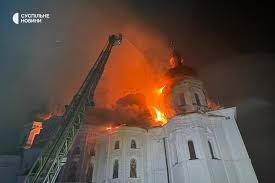
In Kyiv’s Pechersk district, a fire broke out on the grounds of the Kyiv Pechersk Lavra, a UNESCO World Heritage Site. The roof of the Dormition Cathedral caught fire, while residential buildings and non-residential infrastructure were also damaged.
Russia struck a civilian enterprise in the Kholodnohirskyi district of Kharkiv, employing the insidious tactic of a double-tap strike. The initial attack caused large-scale fires and injured three civilian men. A subsequent strike was carried out while emergency responders were already working at the scene, resulting in the deaths of five firefighters from Ukraine’s State Emergency Service (DSNS).
This attack reflects Russia’s continued use of tactics that not only target civilian infrastructure but also deliberately endanger first responders, practices that have been widely condemned under international humanitarian law.
he double-tap strike is a tactic in which an attacker conducts an initial strike against a target and then launches a follow-up attack after first responders, medical personnel, journalists, or civilians have arrived at the scene. The objective is to maximize casualties, create fear, and discourage rescue efforts.
Under international humanitarian law, deliberate attacks on first responders may constitute a war crime.
Timeline of Notable Double-Tap Attacks by Terrorist and Militant Groups
| Year | Actor | Location | Description |
| 2003–2011 | Al-Qaeda | Iraq | Insurgent groups frequently conducted secondary bombings targeting police and emergency responders after initial explosions. |
| 2004 | Al-Qaeda | Madrid | Investigators noted planning intended to maximize emergency response disruption following the train bombings. |
| 2008–2011 | Tehrik-i-Taliban Pakistan | Pakistan | Suicide bombers repeatedly targeted funerals, hospitals, and rescue personnel arriving after an initial attack. |
| 2010 | Al-Shabaab | Mogadishu | Follow-on attacks targeted rescuers and security forces responding to bombings. |
| 2013 | Boko Haram | Nigeria | Militants used sequential bombings to inflict casualties on emergency responders. |
| 2015–2017 | Islamic State | Iraq and Syria | ISIS systematically employed double-tap tactics against civilians, rescue workers, and security personnel. |
| 2016 | Taliban | Kabul | Secondary explosions targeted police and medical responders. |
| 2019–present | Islamic State Khorasan Province | Afghanistan | Repeated use of secondary attacks against hospitals, funerals, and emergency services. |
| 2022–present | Russian forces | Ukraine | Numerous documented cases of repeat strikes on rescue operations and civilian infrastructure during the war. |
Why Terrorist Groups Use Double-Tap Strikes
1. Increase Casualties
The second strike is often timed to hit: Emergency responders, Medical personnel, Journalists, Civilians assisting victims.
This increases the overall death toll beyond the initial attack.
Double-tap strikes send the message that no place is safe—not even rescue operations. This magnifies fear far beyond the physical damage caused.
By targeting firefighters, paramedics, and police, attackers: Reduce future rescue capabilities; Delay aid to victims;Force responders to operate more cautiously.
High-profile attacks on rescuers tend to receive extensive coverage, amplifying the political and psychological impact sought by terrorist organizations.
Repeated attacks force governments to: Invest more resources in security; Change emergency procedures; Accept disruptions to daily life and infrastructure.
Double-tap strikes reflect a broader strategy of attrition and coercion: Attrition: inflicting losses on responders and infrastructure; Coercion: pressuring populations and governments by making even humanitarian activities dangerous.
The tactic has been employed by numerous terrorist organizations and insurgent groups because it multiplies the effects of a single attack at relatively low cost. Its use against civilian rescuers and protected personnel has drawn widespread condemnation from international organizations and human rights monitors.
Russia’s use of tactics that resemble those historically employed by terrorist organizations—such as double-tap strikes—can be analyzed through military, psychological, and political lenses.
Several factors may explain why Russia employs such tactics in Ukraine:
Military campaigns are often designed not only to destroy physical targets but also to affect public morale. Repeated attacks on cities and emergency response capabilities can: Increase fear and uncertainty among civilians; Create pressure on local authorities; Raise the social and economic costs of continuing the war.
This approach aligns with theories of strategic coercion, where violence is used to influence the political will of an adversary.
Double-tap strikes can reduce the effectiveness of: Fire and rescue services; Medical responders; Civil defense systems.
By targeting or endangering responders, an attacker may seek to complicate recovery efforts after strikes.
A second strike can generate effects disproportionate to the resources expended: One attack damages infrastructure; A follow-on attack affects rescuers and creates additional disruption.
From a military perspective, this can increase operational impact without requiring significantly more munitions.
Modern warfare includes an informational and psychological dimension. Attacks that create fear or receive extensive media coverage can: Influence public opinion; Undermine perceptions of safety; Signal the attacker’s ability to strike repeatedly.
Analysts have noted that Russian and Soviet military doctrine has historically placed significant emphasis on: Breaking the adversary’s will to resist; Strategic bombardment; The use of coercive measures against civilian infrastructure in some conflicts.
Critics argue that some Russian operations in conflicts such as: Grozny during the Second Chechen War, Aleppo during the Syrian Civil War, and Ukrainian cities since 2022 have reflected this approach.
Under international humanitarian law, including the principles of distinction and proportionality, attacks deliberately directed at civilians or emergency responders may constitute war crimes if intent and circumstances are established. Investigations by bodies such as the International Criminal Court and the United Nations seek to determine responsibility for specific incidents.
In short, Russia may use tactics associated with terrorist groups because such tactics can be militarily efficient in coercing populations, degrading emergency response, and exerting psychological pressure. Whether specific attacks amount to war crimes or state terrorism is ultimately a matter for legal and political determination by courts and governments.
Attacks on cultural heritage are not only assaults on physical structures but also on identity, memory, and civilization itself. The deliberate destruction of UNESCO sites has increasingly become a tool of extremist groups seeking propaganda, ideological purification, or psychological impact. UNESCO and international courts regard intentional attacks on cultural heritage as potential war crimes.
| Year | Site | Country | Perpetrator | Type of Attack | Consequences |
| 1991–1992 | Old City of Dubrovnik | Croatia | Yugoslav/Serb forces | Shelling | Extensive damage to the medieval city; later restored. |
| 1993 | Stari Most | Bosnia and Herzegovina | Bosnian Croat forces | Destruction of historic bridge | Symbol of multicultural coexistence destroyed; rebuilt in 2004. |
| 2001 | Buddhas of Bamiyan | Afghanistan | Taliban | Explosive demolition | Two 1,500-year-old statues destroyed as “idols.” The attack led UNESCO to adopt stronger heritage protection measures. |
| 2012 | Timbuktu | Mali | Ansar Dineand Al-Qaeda in the Islamic Maghreb | Destruction of shrines and mausoleums | Fourteen mausoleums and religious sites destroyed. An ICC prosecution later convicted militant leader Ahmad Al Faqi Al Mahdi for war crimes. |
| 2015 | Ancient City of Palmyra | Syria | Islamic State | Explosive demolition | The Temple of Baalshamin and other monuments were destroyed. UNESCO called the destruction a war crime. |
| 2015–2017 | Ancient City of Palmyra | Syria | Islamic State | Repeated demolitions | The Temple of Bel, funerary towers, and the Arch of Triumph were destroyed. |
| 2022–present | Kyiv Pechersk Lavra | Ukraine | Russian forces | Missile and drone strikes in surrounding areas | UNESCO has documented damage to hundreds of cultural sites across Ukraine, including World Heritage properties. |
Why Terrorists Attack UNESCO Sites
Terrorist organizations target cultural heritage for several strategic reasons:
- Erasing Identity
Cultural monuments embody historical memory and national identity. Destroying them weakens community cohesion and morale. - Propaganda Value
Spectacular destruction attracts global media attention at low cost. The demolition of the Bamiyan Buddhas and Palmyra generated worldwide coverage. - Ideological Purification
Groups such as the Taliban and ISIS viewed certain monuments as “idolatrous” and incompatible with their interpretation of religion. - Psychological Warfare
Attacking iconic sites signals that no symbol of a society’s past is safe, amplifying fear and uncertainty. - Economic Damage
Heritage destruction harms tourism and local economies, increasing long-term instability.
Legal Consequences
The intentional destruction of cultural heritage can constitute a war crime under the International Criminal Court and the 1954 Hague Convention for the Protection of Cultural Property. The conviction of Ahmad Al Faqi Al Mahdi in 2016 was the first ICC case focused exclusively on the destruction of cultural heritage.
from an intelligence-analysis perspective, several hypotheses could explain why Russia might conduct large-scale strikes before, during, or around high-level diplomatic contacts.
Possible Linkages Between Russian Strikes and Witkoff Diplomacy
One recurring pattern in Russian military behavior is to escalate military pressure ahead of or during negotiations. Large strikes can: Demonstrate that Russia retains escalation dominance; Strengthen Moscow’s bargaining position; Signal that diplomatic concessions will require Ukrainian or Western compromises.
This pattern has been observed in earlier phases of the war, including around previous negotiations.
If Moscow expected or anticipated a visit by Witkoff, a major strike could serve as a message to the Trump administration regarding: Russia’s unwillingness to negotiate under pressure; The costs of continued Western support for Ukraine; The military realities on the ground.
The Kremlin has maintained communication channels with Witkoff and Kushner even when formal talks have stalled.
Strikes timed near diplomatic engagements can seek to: Force discussions toward ceasefires rather than territorial questions; Increase urgency among mediators; Create new facts on the ground before negotiations.
Military actions often aim to shape not only the battlefield but also the diplomatic environment.
The June 14–15 attacks occurred after Ukraine intensified long-range strikes against Russian logistics, Crimea-linked infrastructure, and energy facilities. Analysts have noted that Ukrainian operations increasingly threaten Russian supply lines.
From Moscow’s perspective, the strikes may therefore have been: Retaliatory; Coercive; Intended to restore deterrence.
The attack took place on the eve of major international meetings, including the G7 summit, where Ukraine sought additional support and sanctions. Russian actions may have been intended to influence Western political calculations or demonstrate resilience to pressure.
The correlation between Russia’s use of tactics historically associated with terrorist organizations and longstanding U.S. policy of “not negotiating with terrorists” is primarily a matter of political doctrine, legal definitions, and strategic consistency. The issue is analytically complex because states and non-state actors are treated differently under international law.
The U.S. Policy: “We Do Not Negotiate with Terrorists”
The United States has long maintained a policy of not making concessions to terrorists. The rationale is threefold: Deny incentives for hostage-taking and coercion; Avoid legitimizing violence as a political tool; Deter future attacks by demonstrating that coercion does not yield rewards.
This doctrine has been applied primarily to non-state actors such as: Al-Qaeda; Islamic State; Hezbollah (designated as a terrorist organization by the U.S.).
The Core Dilemma: What if a State Uses Similar Tactics?
Critics of Russian military operations argue that certain practices—such as: attacks on civilian infrastructure; alleged double-tap strikes against rescuers; strikes affecting cultural heritage sites; resemble tactics historically used by terrorist groups to create fear and exert political pressure.
If one accepts that premise, a strategic question emerges:
If the U.S. refuses to negotiate with non-state actors using coercive violence, should similar logic apply when a state employs comparable methods?
This is a policy debate rather than an established legal doctrine.
Why States Are Treated Differently
Under international law, states retain sovereignty and international legal personality even when accused of grave violations.
The U.S. has historically negotiated with adversarial states accused of serious violations, including: the Soviet Union during the Cold War; the North Korea over nuclear issues; the Iran over its nuclear program.
The rationale is pragmatic: States possess armies, territory, and nuclear weapons; Negotiations can reduce risks of escalation; Diplomacy does not necessarily imply legitimacy or approval.
UNESCO Heritage and International Norms
Deliberate attacks on cultural heritage may violate: the 1954 Hague Convention for the Protection of Cultural Property; the UNESCO framework; provisions of the International Criminal Court concerning war crimes.
The destruction of: the Buddhas of Bamiyan by the Taliban; the Ancient City of Palmyra by ISIS was widely condemned as cultural terrorism.
Establishing that attacks damaged or intentionally targeted sites such as the Kyiv Pechersk Lavra, critics may argue that these actions similarly undermine international norms protecting cultural heritage.
Strategic Implications for U.S. Policy
From a policy perspective, the United States faces a tension between two objectives:
| Objective | Implication |
| Maintain “no concessions to coercion” | Avoid rewarding attacks on civilians or cultural heritage |
| Prevent wider war and nuclear escalation | Keep diplomatic channels open with Russia |
This tension is not unique to Russia. Historically, the U.S. has often balanced deterrence and diplomacy simultaneously.
Analytic Assessment
The use of tactics associated with terrorist organizations does not automatically make a state legally equivalent to a terrorist group. However, it can create:
- Normative inconsistency: if similar conduct is condemned differently depending on the actor;
- Political pressure: to impose sanctions, isolation, or accountability measures;
- Strategic dilemmas: over whether negotiations under coercive conditions incentivize future violence.
Ultimately, U.S. policy toward Russia has generally sought to combine: Military support for Ukraine; Economic sanctions; Diplomatic engagement aimed at reducing escalation.
Whether negotiations with a state accused of employing terror-like tactics contradict the principle of “not negotiating with terrorists” remains a contested question in international relations and policy circles.
If one accepts the premise that Russian forces have employed tactics historically associated with terrorism—such as alleged double-tap strikes or attacks affecting protected cultural sites—then such actions could create significant political and diplomatic obstacles for any negotiations conducted by Steve Witkoff or other U.S. envoys in Moscow. However, these obstacles are primarily political and reputational, not necessarily legal.
Potential Obstacles to Witkoff’s Negotiations
If Russian strikes occur shortly before or during diplomatic outreach, critics may argue that negotiations risk appearing to reward coercion or violence.
This could lead to accusations that: Moscow is negotiating under military pressure; diplomacy is being used to extract concessions after escalation; U.S. engagement undermines its own principles regarding coercive actor. Such concerns can be particularly acute if attacks involve civilians or cultural heritage.
Damage to a UNESCO World Heritage Site—such as the Kyiv Pechersk Lavra—can increase international pressure because cultural heritage carries symbolic significance beyond the immediate conflict.
Past destruction of sites like: the Buddhas of Bamiyan by the Taliban; and the Ancient City of Palmyra by ISIS; generated global condemnation and reinforced narratives of cultural destruction.
If Russian strikes are perceived similarly, this may complicate diplomatic engagement.
Any U.S. envoy negotiating with Moscow amid high-profile strikes could face scrutiny from: Congress; European allies; civil society groups.
Questions may arise regarding: the timing of negotiations;whether Russia is acting in good faith; whether diplomacy should proceed during periods of escalation.
Successful negotiations require at least minimal confidence that the parties are serious about reaching an agreement.
Major strikes against civilian areas can: reduce trust; harden negotiating positions; increase domestic pressure on leaders not to compromise.
Russia and Ukraine both seek to shape international narratives. A major strike near a diplomatic initiative can alter perceptions of: who is escalating; who is seeking peace; whether negotiations are credible.
The United States has historically negotiated with adversarial states accused of serious violations, including the: Soviet Union during the Cold War; North Korea over nuclear issues; Iran regarding its nuclear program.
There is generally no legal prohibition on diplomacy with states accused of war crimes or other violations. Diplomatic engagement is often maintained precisely to manage escalation and seek conflict resolution.