
The murder of Russian opposition artist Semyon Skrepetsky in the Polish city of Biała Podlaska, near the Belarusian border, should be viewed not merely as a criminal act but also as a potential element of a Russian campaign aimed at intimidating political émigrés, exerting pressure on Poland, and sending a signal to the regime of Alexander Lukashenko.
At this stage, there is no publicly confirmed evidence linking Russian or Belarusian intelligence services to the killing. However, the victim’s profile, the location of the attack, its timing, and the broader context of Russian-Belarusian relations provide grounds for considering a political motive.
The key analytical hypothesis is that Moscow may use such incidents to restrict Lukashenko’s room for maneuver. Russia seeks to prevent any cautious drift by Minsk toward the West, preserve Belarus’s military-political dependence, and push the Belarusian regime toward deeper involvement in the war against Ukraine.
In this context, statements by Belarusian Defense Minister Viktor Khrenin regarding the high probability of a large-scale conflict between Russia, Belarus, and the West take on particular significance. Such remarks may reflect not only Belarusian military doctrine but also Russian pressure on Minsk designed to narrow Lukashenko’s options for normalizing relations with the West.
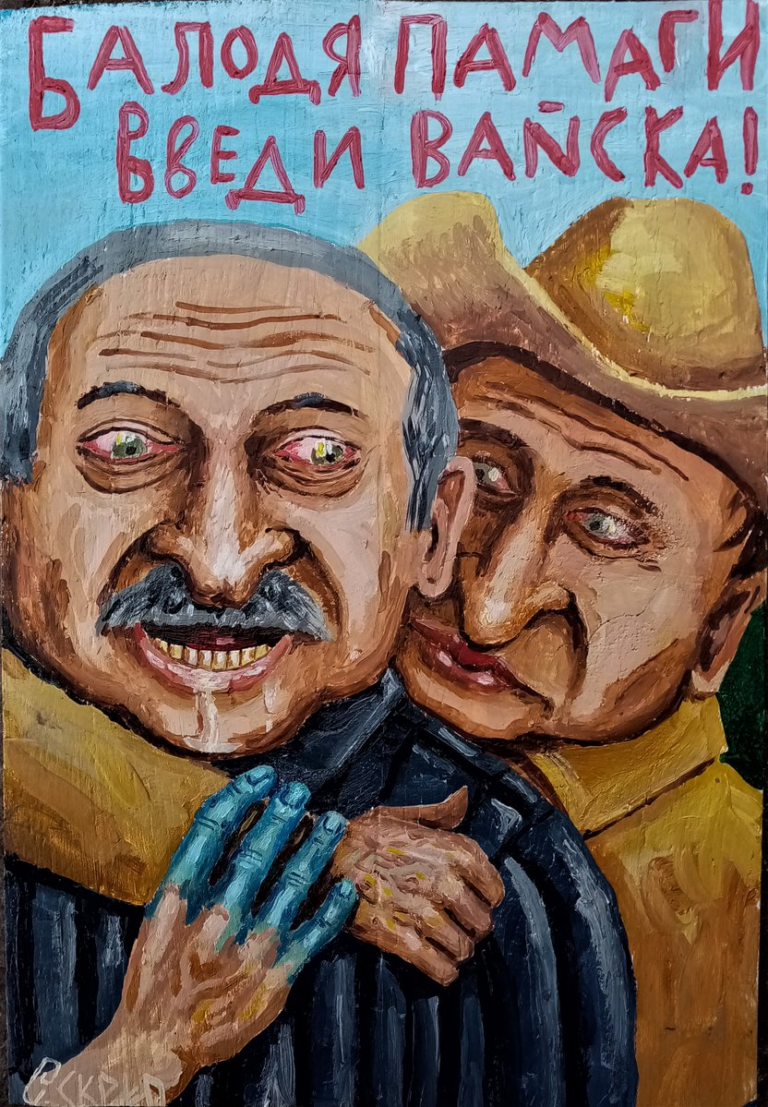
Semyon Skrepetsky was known as a performance artist and caricaturist who mocked Vladimir Putin, Ramzan Kadyrov, Alexander Lukashenko, and Soviet-imperial symbolism. Living in Poland as a political émigré, he remained a vocal critic of authoritarian regimes. His murder occurred in Biała Podlaska, near the Belarusian border—a location with both symbolic and operational significance. The region is highly sensitive for Polish security due to its proximity to Belarus, a direction that Moscow and Minsk have already used for migration pressure, intelligence activity, and hybrid operations against Poland and the European Union.
The killing of a Kremlin critic on NATO territory creates an atmosphere of intimidation for Russian, Belarusian, and Ukrainian political exiles. Even if the perpetrator acted independently, the Kremlin could still exploit the incident to reinforce the message that opponents of the Russian regime are not safe even in Europe.
Since 2022, Lukashenko has remained dependent on Moscow while trying to avoid deploying Belarusian troops directly into the war against Ukraine. His strategy has been one of balancing: providing Russia with territory, infrastructure, military support, and political loyalty without turning the Belarusian army into a full participant in combat. For the Kremlin, however, this position is insufficient. Russia seeks deeper Belarusian involvement to increase pressure on Ukraine, tie down Ukrainian forces along the northern front, heighten threats to Poland and Lithuania, and demonstrate to the West that the war can expand geographically. Consequently, Moscow is interested in undermining any potential Belarusian outreach toward the West. Attempts by Minsk to ease sanctions, maintain indirect dialogue with the EU, or preserve communication channels with Washington contradict Russia’s strategy of fully integrating Belarus into its military architecture.
Viktor Khrenin, Belarus’s defense minister, serves as one of the key public advocates of military integration with Russia. His statements about the likelihood of war between Russia, Belarus, and the West serve several functions:
- Domestic Mobilization: They foster a sense of inevitable external threat within Belarusian society, helping justify militarization, repression, mobilization measures, and greater dependence on Russia.
- Signaling to Moscow: They demonstrate loyalty to Russia’s strategic framework and a willingness to adopt escalation rhetoric.
- Constraining Lukashenko: Such rhetoric narrows Belarus’s diplomatic flexibility and limits opportunities for engagement with the West.
In this sense, Khrenin may function as an institutional channel for Russian influence within the Belarusian system. He may not be an independent political actor, but his role appears to be anchoring Belarus within Russia’s military orbit.
Lukashenko periodically attempts to portray himself as an ally of Russia who has not been entirely absorbed by Moscow. He needs limited engagement with the West to negotiate sanctions relief, preserve a degree of autonomy, and avoid a complete loss of sovereignty. For Putin, this creates strategic risks: if Lukashenko regains some diplomatic maneuverability, Moscow could lose full control over Belarus as a military platform. Consequently, Russia pursues three key lines of effort:
- Military Integration: Joint exercises, Russian nuclear deployments, integrated air defense systems, and preparation of Belarusian forces within Russian planning structures.
- Political Blocking: Encouraging Minsk to take positions that render dialogue with the West politically toxic.
- Control Through Fear: Leveraging incidents involving Poland, opposition groups, border tensions, and security threats to convince Lukashenko that the West is not a negotiating partner but a direct threat.
Russia’s strategy toward Belarus has direct implications for Ukraine. Even without Belarusian troops entering the war, Belarus already serves as a logistical hub, military rear area, and instrument of strategic pressure. Moscow may seek more: maintaining a constant northern threat to force Kyiv to retain significant forces near the Belarusian border, increasing psychological pressure on Poland and Lithuania, and legitimizing an expanded Russian military presence in Belarus.
In this context, incidents along the Polish-Belarusian frontier could be used to generate a new phase of tension. Moscow may push Lukashenko toward increasingly confrontational rhetoric and practical measures that gradually narrow the gap between indirect support and direct participation in the war.
For Poland, Skrepetsky’s murder highlights the need to strengthen protection for political émigrés, particularly Russians, Belarusians, Ukrainians, Chechens, and other vulnerable groups. For the EU, it confirms that the Russian threat extends beyond Ukraine to include political assassinations, intimidation, sabotage, information operations, intelligence penetration, and the use of third countries as operational platforms. For NATO, the incident is significant because it occurred in a border region where Russia and Belarus have long tested Alliance resilience through hybrid methods.
The murder of Semyon Skrepetsky in Poland may become a marker of a new phase of Russian hybrid activity in Europe, regardless of whether a direct order from Moscow or Minsk is ever proven. Combined with militaristic rhetoric emanating from within Belarus, and figures such as Viktor Khrenin cultivating an atmosphere of inevitable escalation, the Kremlin appears intent on binding Minsk ever more tightly to its military framework. For Ukraine, the principal risk lies not in a single incident but in a broader trend: Moscow’s sustained effort to transform Belarus from a controlled ally into a fully integrated component of Russia’s war machine.
Open-source information suggests the possible existence of an informal coalition within Belarus’s security apparatus that favors deeper military integration with Russia and potentially greater involvement in the war against Ukraine in order to demonstrate loyalty to the Kremlin. This coalition likely consists not of a single “war party” but of several interconnected groups:
- Military leadership integrated with Russian structures, particularly Viktor Khrenin and Pavel Muraveiko.
- Security and intelligence agencies oriented toward Moscow, including the Belarusian KGB, military intelligence, and the Security Council.
- Pro-Russian ideological networks promoting narratives of a “common war against the West.”
However, these groups currently lack sufficient autonomy to force Belarus into the war without Lukashenko’s personal decision. Decades of close ties between Belarusian security services and Russia’s FSB, GRU, and SVR—including joint exercises, intelligence sharing, personnel exchanges, and joint operations—have created institutional incentives for integration. For some actors within the Belarusian security establishment, alignment with Russia may be viewed not only as a political necessity but also as a guarantee of their own survival.
From the Kremlin’s perspective, Lukashenko remains a strategic problem: a dependent ally, yet not one fully under control. After 2022, he provided territory for Russia’s invasion, accepted Russian nuclear deployments, and supported military integration, but he has refrained from sending Belarusian troops into Ukraine and continues to preserve limited channels to the West. As a result, Moscow appears interested in cultivating groups within Belarus that oppose rapprochement with the West, advocate deeper integration with Russia, and promote militarization as a justification for entering the war.
Theoretically, Russia may view Viktor Khrenin as a potential successor to Lukashenko or as part of a transitional power arrangement, though there is no public evidence that the Kremlin has definitively chosen him as its preferred candidate. Analytically, Khrenin appears more as a representative of a security-based transition scenario than as Moscow’s principal favorite.
Khrenin possesses several characteristics that could make him acceptable to Moscow. He has played a central role in the joint regional military grouping, air defense integration, deployment of Russian tactical nuclear weapons in Belarus, and joint exercises with Russian forces. He also lacks an independent political base—an attribute that may be advantageous for the Kremlin, since weaker leaders are generally easier to control. In a transition scenario, security institutions may prefer a figure from the сiloviki capable of guaranteeing regime stability and elite security.
Nevertheless, Lukashenko has traditionally structured the Belarusian system to ensure that no official becomes powerful enough to independently seize authority. Security institutions compete with one another, and no individual accumulates excessive power. Unlike Lukashenko, who spent decades building a personalist regime, Khrenin remains largely unknown to the broader public. While this may suffice for a Kremlin-managed authoritarian transition, it is unlikely to provide a durable basis for long-term rule. Historically, the Kremlin rarely bets on a single individual. Instead, it cultivates networks of influence across the military, security services, the Security Council, economic elites, and members of Lukashenko’s family. Russia likely views Viktor Khrenin not as a full replacement for Lukashenko but as one component of a potential managed transition. His value to Moscow lies primarily in his loyalty, integration into Russian-Belarusian military structures, and lack of an independent political base. In the event of a succession crisis, Khrenin could become part of a Moscow-controlled transfer-of-power mechanism, though his prospects of becoming Belarus’s long-term leader currently appear limited.