
The Italian far-right movement Futuro Nazionale, led by MEP Roberto Vannacci, has found itself at the center of a scandal following the exposure of a closed WhatsApp community of roughly 300 people. The community, which brought together local Lombardy officials and supporters, circulated radically racist, antisemitic and Islamophobic statements, as well as calls for the forcible seizure of power. There were numerous nostalgic and approving comments about Adolf Hitler, alongside open contempt for the European Union and the Italian Constitution. In response to the reports, Massimiliano Simoni, a party coordinator in Lombardy, categorically distanced the organization from the scandal, saying that the chat grossly violated the movement’s internal rules and did not reflect its official position.
The xenophobic and racist character of the correspondence in the closed community sheds light on the ideological attitudes present among some far-right supporters of Futuro Nazionale. Simoni’s attempt to distance the movement from the scandal does not, by itself, resolve the broader question of whether extremist currents have become embedded in the political ecosystem surrounding the party.
If forces of this kind were to gain substantial political power, the principal risk would be a progressive erosion of democratic norms and institutions. Radicalization of public discourse, discrimination against minorities and normalization of calls for coercive political action could place pressure on the constitutional order and damage Rome’s standing internationally.
Around Futuro Nazionale, an environment has emerged in which neo-fascist, racist, antisemitic and anti-democratic views can find sufficient ideological space to become normalized.
The WhatsApp chat is therefore not an isolated piece of evidence. It overlaps with a broader series of programmatic, symbolic and rhetorical signals associated with Roberto Vannacci himself and with the political structure he has built.
On August 17, 2026, la Repubblica reported on a group called “Vannacci ultima speranza” (“Vannacci, the last hope”), which included about 300 people – supporters, organizers and individuals responsible for local committees, particularly in Lombardy. Messages included antisemitic statements, racism, expressions of sympathy for Hitler and references to waiting for “orders” from Vannacci. Other Italian media also reported anti-Muslim and openly anti-constitutional or violent statements.
This must be distinguished from the party’s formal structure. Futuro Nazionale’s national coordinator Massimiliano Simoni said that the group did not belong to the party’s official organization and that its content violated internal rules.
But if the chat was not an official party body, why did a single informal space bring together a substantial number of people connected to the movement’s territorial structures?
The answer should be sought not only in the chat itself, but also in the political ecosystem Vannacci has built over several years.
The current Futuro Nazionale statute contains no provisions explicitly endorsing fascism, Nazism, racial supremacy or the abolition of democracy. Formally, it refers to democratic internal organization, freedom, social justice and the fight against crime.
However, the party’s program and political rhetoric contain elements associated with European radical-right and neo-fascist identitarian traditions: emphasis on ethnocultural homogeneity, the primacy of the nation over universalist principles, remigration, the valorization of strength, sacrifice and discipline, hostility toward liberal universalism, and recurring use of historically loaded symbolism.
For example, the Futuro Nazionale manifesto argues that mass immigration undermines the cohesion of civilization and “dilutes the identity of a people,” while stating that for those who do not assimilate, “remigrazione diventa una necessità” – remigration becomes a necessity.
In June 2026 Vannacci went further, using the slogan “L’Italia agli italiani” – “Italy for Italians.” At the same time, he made remigration a central element of the political platform.
At the party’s founding assembly, Futuro Nazionale proposed reducing the foreign population to roughly 4 percent, ending the decreto flussi mechanism and allowing for the possibility of revoking citizenship in connection with criminal offenses.
Taken together with other signals, these positions form a more revealing pattern.
Vannacci’s Attitude Toward Historical Fascism
Vannacci has repeatedly refused to describe himself as an antifascist. In May 2024 he said he saw no point in being “anti” something that, in his view, no longer existed.
He also described Benito Mussolini as a “statesman” (statista) and later explicitly stood by that characterization. When asked to condemn fascism, Vannacci argued that history should be assessed factually rather than morally.
Even more revealing was a 2025 post in which he offered a revisionist reading of the Fascists’ rise to power. Among other things, he argued that the March on Rome was not a coup and emphasized the formally legislative procedures through which the regime enacted its measures, including the racial laws of 1938.
This is therefore not a matter of one accidental phrase.
A persistent pattern of historical relativization of fascism can be identified: rejection of an antifascist identity -> a neutral or positive characterization of Mussolini -> minimization of the revolutionary and coercive character of the Fascist seizure of power -> repeated use of symbols associated with fascist historical memory.
“Decima” as a Particularly Important Marker
Another significant indicator is Vannacci’s systematic use of the term “Decima.”
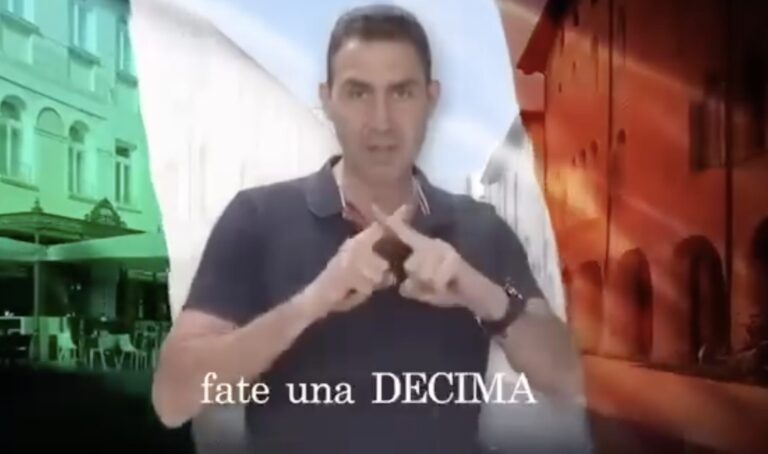
During the European Parliament campaign, he encouraged voters to make a “Decima” on the ballot while forming an X with his hands. This was widely interpreted as an allusion to the Xª MAS. After September 8, 1943, part of that formation fought on the side of the Italian Social Republic and Nazi Germany. Vannacci rejected this interpretation, arguing that he was referring to the unit’s pre-armistice military history.
Yet the allusion did not disappear after the controversy. In May 2025, Vannacci again used “Decima” while endorsing a candidate in the Taranto local elections.
Generazione Decima was subsequently institutionalized within Vannacci’s political environment. The Futuro Nazionale statute even provides for the participation of the Capo di Generazione Decima Nazionale in the party’s national congress.
This makes it possible to speak not merely of an accidental dog whistle – a word, symbol, slogan or allusion that carries a neutral or ambiguous meaning for a broad audience while communicating an additional, often more radical political signal to a specific group – but of the systematic use of a historically ambiguous symbolic code.
In January 2026, Vannacci himself referred to Futuro Nazionale as one of his political symbols alongside Il Mondo al Contrario and Generazione Decima.
The Founding Congress Added Another Layer
The founding event of Futuro Nazionale in June 2026 was particularly revealing.
According to the Financial Times, the atmosphere included elements of fascist nostalgia: participants were addressed as “camerati,” the formula “Dio, Patria e Famiglia” (“God, Fatherland and Family”) was used, and tribute was paid to figures associated with the postwar neo-fascist milieu.
The party program advocates ethnocultural homogenization and remigration; its leader repeatedly relativizes historical fascism and uses the symbolic code of “Decima”; and part of the activist environment, in closed spaces, moves from coded allusions to explicit antisemitism, racism, praise of Hitler and discussion of violent action.
How Can the Existence of Such a Chat Be Explained?
The existence of the chat can be interpreted as an example of a radicalization funnel.
Vannacci publicly uses formulations that allow for dual interpretation. To a broad electorate, “Decima” can be presented as a reference to military tradition; to a radical activist, it can be understood as an allusion to Xª MAS. “Italy for Italians” can be framed as sovereignism, while an ethnonationalist audience may interpret it as a demand for ethnic homogeneity.
This creates a two-layered political communication system: the official platform remains within the boundaries of formally legal radical nationalism, while peripheral networks can radicalize the same propositions into racism, antisemitism or neo-fascism.
An additional factor is Vannacci’s organizational model. In July 2026 he said that he was building the party according to a principle he compared with the “technique of guerrilla warfare”: the center establishes the general direction, while local structures are given considerable autonomy. He acknowledged that such a networked model creates “more chaos” and less controllability.
This is highly relevant to the WhatsApp group. A decentralized structure + radical identitarian rhetoric + weak control of the periphery creates favorable conditions for semi-autonomous radical communities to emerge.
Simoni’s statement that the chat “does not represent the party” may therefore be formally correct, but it does not answer the more important question: why did the Futuro Nazionale political environment become an attractive space for people who consider explicit antisemitism, racism and praise of Hitler acceptable?
The exposure of the closed WhatsApp community should therefore be treated not merely as an isolated reputational scandal, but as an indicator of radicalization within part of the political environment formed around Roberto Vannacci. At the same time, the available evidence is insufficient to claim that Nazism or fascism is formally established as the party’s official ideology. Futuro Nazionale’s statute formally declares democratic mechanisms of internal organization, and the movement’s leadership has distanced itself from the antisemitic and pro-Nazi statements made by participants in the chat.
More significant is the cumulative body of indirect ideological and symbolic indicators. Futuro Nazionale’s programmatic documents emphasize the ethnocultural cohesion of Italian society, assimilation of immigrants and the “remigration” of those who do not accept its cultural values. Vannacci uses the slogan “Italy for Italians,” refuses to identify as an antifascist, has called Benito Mussolini a “statesman,” has offered a revisionist interpretation of the Fascist rise to power, and has repeatedly used the politically loaded image of “Decima.” The latter has acquired an institutionalized form through Generazione Decima, whose representative is integrated into the party organization under the Futuro Nazionale statute.
In this context, the radicalization of some supporters does not appear entirely accidental. Ideological ambiguity allows the leadership to remain within the boundaries of formally legal radical nationalism while creating a symbolic space that can be interpreted much more radically by far-right audiences. Closed Telegram and WhatsApp communities may function as a second, unofficial level of political socialization in which publicly acceptable propositions about national identity, remigration and opposition to “globalism” are transformed into explicit racism, antisemitism, historical revisionism and justification of political violence.
The risk is amplified by Futuro Nazionale’s decentralized model.
A key indicator of Futuro Nazionale’s future evolution will therefore be not Simoni’s formal distancing from the scandalous chat, but the leadership’s practical response: identifying party officials who participated in the correspondence; applying disciplinary procedures; examining other closed regional groups; and either abandoning or continuing to use symbolic codes associated with the historical fascist tradition. Failure to take such measures would increase the likelihood that radical groups are not an accidental fringe but a durable component of the Futuro Nazionale political ecosystem.
Personnel and Organizational Links to the Italian Neo-Fascist Milieu
Futuro Nazionale’s personnel and organizational connections with the Italian neo-fascist milieu are not merely symbolic. The strongest documented links run through individuals with backgrounds in Forza Nuova, CasaPound, Avanguardia Nazionale and the post-MSI milieu, as well as through networks connected to the cult of Xª MAS and Junio Valerio Borghese. In the case of Movimento Sociale-Fiamma Tricolore, however, it is more accurate at present to speak mainly of negotiations, political affinity and personal contacts rather than proven large-scale personnel integration.
Significantly, these connections emerged before Futuro Nazionale was formally established in February 2026. In 2024-2025, a network centered on Il Mondo al Contrario and related structures already existed around Vannacci. Its leadership included people with biographies in Forza Nuova, CasaPound and other neo-fascist organizations. After FN was created, part of this ecosystem effectively became a personnel reservoir for the new movement.
Bruno Spatara is one of the most important examples. In 2024 he served as secretary of the Il Mondo al Contrario association, a structure built around the Vannacci political phenomenon. According to la Repubblica, Spatara had previously been active in CasaPound, Forza Nuova and Azione Identitaria. The newspaper also highlighted his rhetoric about “blood,” “lineage” and the “sacred borders of the Fatherland.”
This is more significant than the sympathies of an isolated activist: Spatara was secretary of an organization that served as part of Vannacci’s political infrastructure before Futuro Nazionale existed.
A second channel involves Giuliano Castellino, one of the best-known former Forza Nuova figures. In 2026, Il Fatto Quotidiano reported that his sister Ramona Castellino joined Futuro Nazionale, while Roma ai Romani, a structure associated with her brother, entered Gianni Alemanno’s Indipendenza movement; Indipendenza itself had already integrated into Futuro Nazionale.
This creates a chain of political transfer:
Forza Nuova / the Castellino milieu -> Roma ai Romani -> Indipendenza -> Futuro Nazionale.
Moreover, in February 2026 Vannacci publicly stated that Futuro Nazionale’s doors were open to Forza Nuova and CasaPound, arguing that their activists were free citizens entitled to put forward their ideas.
CasaPound: Personnel Transfers and Political Convergence
The picture regarding CasaPound is also relatively clear.
Bruno Spatara is again a key figure, having had experience in CasaPound before becoming involved in Vannacci’s political environment.
Another important figure is Fabio Filomeni, one of Vannacci’s closest associates in the early Il Mondo al Contrario organizational structure. La Repubblica reported that Filomeni regularly appeared at events organized by radical-right groups, including CasaPound, Rinascita Nazionale and Presidio Milano.
After Futuro Nazionale was founded, possible convergence became an openly discussed issue. In early February 2026, la Repubblica reported on Vannacci’s ambition to create a broader “cosa nera” and on a possible political pact with CasaPound.
On February 11, Vannacci publicly confirmed FN’s openness in principle to both CasaPound and Forza Nuova.
There is, however, an important limitation: the available evidence is insufficient to claim that CasaPound as an organization has formally merged into Futuro Nazionale. In June 2026, CasaPound participated in a pro-“remigration” demonstration in Rome in parallel with FN’s founding event. This demonstrates political convergence between the milieus, but not organizational identity.
Fiamma Tricolore / MSI: A Weaker but Strategically Important Link
Movimento Sociale Italiano (MSI) must be distinguished from Movimento Sociale Fiamma Tricolore (MSFT).
There is no direct evidence that Fiamma Tricolore has joined FN en masse.
However, Luca Romagnoli is an important figure. A former MEP and former leader/representative of Movimento Sociale Fiamma Tricolore, he was already linked in February 2026 to reports that his Destra Sociale milieu was showing interest in Futuro Nazionale.
In July 2026, Il Fatto Quotidiano reported an open interlocuzione – a channel of negotiations – with Luca Romagnoli. According to the reporting, the strategic objective was to unite different right-wing environments under the FN umbrella, an approach supported by Vannacci.
This is significant because Fiamma Tricolore is a direct successor to the part of the post-MSI milieu that rejected the more moderate transformation toward Alleanza Nazionale in the 1990s.
Vannacci’s project can therefore be interpreted as an attempt to draw fragments of the right that remained outside the mainstream after the post-MSI transformation back toward a single political center.
Xª MAS / Junio Valerio Borghese: The Strongest Historical-Personnel Bridge
The evidence here is particularly noteworthy.
Fabio Filomeni, who led Il Mondo al Contrario and was close to Vannacci for years, publicly expressed a positive view of Junio Valerio Borghese – commander of Xª MAS and later one of the central symbolic figures of the Italian neo-fascist tradition. La Repubblica specifically reported Filomeni’s praise for Borghese and his positive attitude toward imagery associated with the Italian Social Republic.
This matters because “Decima” is one of the central symbolic codes in the Vannacci environment and is closely connected to the memory of Xª MAS.
Another figure in this milieu, Andrea Romiti, according to la Repubblica, also used “Decima” in his communications alongside other historically loaded radical-right formulas.
At the same time, Vannacci himself repeatedly used “Decima” in political campaigning even after its association with Xª MAS became the subject of national controversy.
La Stampa in 2024 described Vannacci’s early environment as a mixture of radical-right activists and former military personnel, some of whom it characterized as “spiritual heirs of the Decima MAS.”
Avanguardia Nazionale: An Important but Less Obvious Channel
Another personnel bridge that should not be overlooked is Angelo Lippi.
According to la Repubblica, Lippi, who was connected to Vannacci’s territorial environment in Trieste, had a long history of political activity alongside Stefano Delle Chiaie, founder of Avanguardia Nazionale.
This matters because Avanguardia Nazionale belonged to one of the most radical currents of Italy’s postwar neo-fascist milieu.
From a network-analysis perspective, this suggests that FN is attracting not only people from contemporary CasaPound and Forza Nuova networks, but also individuals whose political biographies reach back to Italy’s neo-fascist generation of the 1960s and 1970s.
Roberto Jonghi Lavarini: A Node Between the Old and New Far Right
Roberto Jonghi Lavarini, known as the “Black Baron” (Barone Nero), deserves separate attention.
In 2026 he communicated publicly through the Milano 421 Futuro Nazionale committee while stressing that he was not formally a party member. He was a delegate at FN’s founding assembly and discussed negotiations aimed at bringing other far-right milieus into the broader network.
This illustrates why FN cannot be analyzed solely through an official membership list.
The party ecosystem contains an intermediate category:
not an FN member -> organizes or represents an FN committee -> participates as a delegate -> negotiates with other far-right groups.
The actual political network is therefore broader than formal party membership.
Veneto Fronte Skinheads: Signs of an Attempt to Expand the Network Further
According to Il Fatto Quotidiano, in 2026 there was discussion of a possible move into FN by Piero Puschiavo, founder of Veneto Fronte Skinheads, although at the time he remained in Fratelli d’Italia.
This matters less as evidence of a completed personnel transfer – no such transfer has been confirmed – than as an indicator of how broadly FN appears to be scanning the far-right milieu for potential recruits.
Map of Personnel Connections
In simplified form, the network looks as follows:
Roberto Vannacci / Futuro Nazionale
↓
Il Mondo al Contrario
→ Fabio Filomeni → Borghese / Xª MAS / CasaPound events
→ Bruno Spatara → Forza Nuova / CasaPound / Azione Identitaria
→ Andrea Romiti → Decima symbolism
→ Massimiliano Simoni → fascist-salute controversy
→ Angelo Lippi → Stefano Delle Chiaie / Avanguardia Nazionale
Parallel channels:
Giuliano Castellino / Forza Nuova
→ Roma ai Romani
→ Ramona Castellino
→ Indipendenza
→ Futuro Nazionale
Luca Romagnoli / Fiamma Tricolore / Destra Sociale
→ negotiations
→ Futuro Nazionale
Roberto Jonghi Lavarini
→ Milano 421 FN
→ contacts with the broader extreme-right milieu
Piero Puschiavo / Veneto Fronte Skinheads
→ exploratory contact
→ possible FN accession.
What This Means
The most important conclusion is that Futuro Nazionale is not merely attracting random voters from the extreme-right flank.
There are signs of a different model:
FN is attempting to become a political “umbrella” capable of incorporating Italy’s organizationally fragmented radical-right milieu without requiring participants to formally renounce their previous political identities.
This helps explain Vannacci’s “open doors” statement regarding CasaPound and Forza Nuova.
Such a model offers political advantages to both sides.
FN gains experienced personnel that a newly created party lacks: organizers, local coordinators, activists and individuals with longstanding networks.
Older far-right organizations gain something they have largely lacked on their own: an electorally competitive national leader and a parliamentary channel.
In July 2026, Il Fatto Quotidiano described Vannacci’s logic in similar terms: he needs people with years of political experience because the new, lightweight party structure does not yet possess an adequate organizational base.
The Crucial Distinction: FN Is Not Simply a “New Forza Nuova”
This distinction is fundamental.
The available evidence does not show that Futuro Nazionale is a direct reorganization of CasaPound or Forza Nuova.
Vannacci’s political innovation may therefore consist precisely in linking the parliamentary radical right with an extra-parliamentary neo-fascist personnel reservoir.
This could prove more consequential than the simple emergence of another explicitly neo-fascist party.
There is a high probability that Futuro Nazionale is consciously building not simply a new party, but a consolidation center for fragmented segments of the Italian radical right. The strongest indication is not the presence of one or two controversial activists, but the simultaneous existence of:
personnel continuity + negotiations with extreme-right organizations + shared symbolism + an explicit “open doors” policy.
The WhatsApp chat containing pro-Nazi and antisemitic messages therefore takes on a different significance: it may not be an isolated anomaly, but a by-product of FN’s deliberately broad personnel strategy, which attracts individuals with very different degrees of radicalization.
Content Analysis of Roberto Vannacci’s Public Rhetoric, 2023-2026
A content analysis of Roberto Vannacci’s public rhetoric in 2023-2026 provides grounds for assessing his use of historically loaded symbols as predominantly conscious, systematic and politically functional, although not every individual episode can be conclusively classified as a dog whistle. The most persuasive indication of intentionality is the repetition of the same codes after their fascist connotations had already become the subject of broad public debate.
Evolution of the Rhetoric: From Ethno-Identity to Historical Revisionism
In 2023, the core of Vannacci’s rhetoric was not yet organized around direct fascist symbolism. In Il mondo al contrario and related appearances, the dominant categories were “normality,” the ethnocultural majority, racial or somatic identity, and the opposition between majority and minorities. Controversy centered, among other things, on his references to “white skin” as a typical attribute of an Italian and his comments about Paola Egonu, whose physical characteristics he argued did not represent typical “Italianness.”
This was not yet an explicit defense of fascism. But it established a semantic framework that would later become important for Futuro Nazionale:
ethnocultural majority -> threat to its identity -> need to restore “normality” -> political mobilization against minorities and the liberal order.
In 2024, this framework was joined by a more deliberate engagement with the historical memory of fascism.
Mussolini: Not an Accidental Remark but a Persistent Pattern of Relativization
In April 2024, Vannacci described Benito Mussolini as a “statista” – a statesman. At the same time, he rejected an antifascist political identity, arguing that it made little sense to be “anti” something that no longer existed.
The word statista can, in isolation, be defended literally: Mussolini did head a government. For content analysis, however, what matters is not merely the dictionary meaning but the selective choice of characterization.
Vannacci repeatedly favors formulations that remove normative condemnation, shift discussion of dictatorship into a formal-legal register, create space for Mussolini to be discussed as an “ordinary” historical statesman, and avoid direct endorsement of fascism.
This pattern became still more explicit in November 2025. Vannacci published a lengthy text about fascism in which he argued that the March on Rome was not a coup, emphasized the formal procedures through which Mussolini came to power, and stressed the legal form of the regime’s decisions. He did not withdraw these claims after criticism.
“Decima”: The Strongest Dog-Whistle Indicator
This is the most persuasive case.
Before the 2024 European Parliament elections, Vannacci urged voters to make “una Decima” while forming an X with his fingers. In the Italian historical context, this inevitably evoked Xª MAS. After 1943, the formation remained on the side of the Italian Social Republic and Nazi Germany, and its memory later became part of the symbolic repertoire of Italian neo-fascism.
Vannacci rejected the fascist interpretation and said he was referring to the “glorious” Decima MAS of the pre-armistice period.
At first, this explanation leaves some uncertainty about intent.
But a critically important event followed.
In May 2025, during the local election campaign in Taranto, Vannacci again used the “Decima” formula in an appeal to vote for a candidate he supported.
The second use therefore came after the politician already knew that the symbol was being interpreted as a reference to Xª MAS, that the media had explained its neo-fascist semantics, that political opponents had turned it into a major controversy, and that he himself had been required publicly to explain what he meant.
The first use can be explained by ambiguity.
Repeated use after the ambiguity had become publicly established is much harder to treat as accidental.
This does not prove that Vannacci intended to glorify specifically the Republican-Fascist incarnation of Xª MAS. But it does support, with high confidence, a different conclusion: he consciously exploits the symbol’s ambiguity while knowing how it is decoded by far-right audiences.
“Camerati”: Another Strong Marker
After his success in the June 2024 European elections, Vannacci told journalists that he was celebrating with his “camerati.”
Formally, camerata means a comrade or companion and predates fascism. The problem again lies in political context: in contemporary Italy, the word is strongly associated with the language of historical fascism and the postwar neo-fascist milieu.
In June 2026, at the Futuro Nazionale founding congress, MP Domenico Furgiuele openly addressed the audience as “camerati che ritornate a casa con me.” In the same speech, Sergio Ramelli was mentioned, after which the audience responded with the traditional far-right cry “presente.”
The transition is important: in 2024 Vannacci used the word; by 2026 the same code was being used from the party stage by his allies.
The term therefore ceases to look like an individual linguistic eccentricity and increasingly resembles part of a collective political lexicon.
“Dio, Patria, Famiglia”
“Dio, Patria, Famiglia” – “God, Fatherland, Family” – is not an exclusively fascist slogan. It predates Mussolini and has been used by various conservative and Catholic currents.
By 2026, however, it had become part of the broader Futuro Nazionale political package. In May 2026, Vannacci publicly defended the formula Dio, patria, famiglia, presenting it in terms of Catholic values and the “natural family.”
At Futuro Nazionale’s founding event, the formula appeared alongside camerati, neo-fascist memorial symbolism and remigration rhetoric. The Financial Times drew attention to the cumulative effect of these historical allusions.
Taken in combination with Decima + Mussolini + camerati + remigrazione, the evidentiary significance becomes substantially stronger.
“Italia agli italiani”: A Bridge Between the Old and New Far Right
At Futuro Nazionale’s founding congress in June 2026, Vannacci shouted “L’Italia agli italiani” – “Italy for Italians” – and encouraged the hall to repeat the formula.
This represents a different type of signal.
The phrase is not exclusively fascist and cannot automatically be treated as a quotation from Mussolini. Italian nationalist and far-right discourse has used similar formulas in different periods.
What matters is the composition of the message:
Italia agli italiani + remigrazione + reduction of the foreign population + assimilation + the possibility of revisiting citizenship.
Reuters reported that Vannacci proposed reducing the foreign population to roughly 4 percent and said that the party had not an “immigration program” but a remigration program.
The semantics of Italia agli italiani within FN are therefore more specific than those of a generic patriotic slogan.
It functions as an ethnonational frame through which remigration policy is presented as restoration of the country’s natural condition.
Remigrazione: No Longer Much of a Dog Whistle
The most important change in 2026 is that some of the content that could previously be conveyed by implication began to be stated openly by Vannacci.
Futuro Nazionale’s official manifesto argues that mass immigration undermines the “cohesion of civilization,” fragments social solidarity and dilutes the identity of a people, concluding that for those who do not integrate and assimilate, remigrazione becomes necessary.
At the founding congress, Vannacci explicitly emphasized that the word had previously supposedly been something one “could not say,” whereas he was now making it part of legitimate political discourse.
A dog whistle is useful when radical content cannot be stated openly.
Vannacci’s strategy appears to involve a gradual shifting of the boundary of what is considered acceptable:
allusion -> scandal -> denial of the radical meaning -> repetition -> normalization -> incorporation into the official program.
The Most Important Pattern: An Escalation Ladder
When the material is arranged chronologically, a fairly clear sequence appears.
2023: “normality,” ethnicity, “white skin,” majority versus minorities – identitarian framing.
Early 2024: Mussolini as “statista,” refusal of antifascism – historical relativization.
May-June 2024: Decima / X, “camerati” – symbolic dog whistles.
2025: repeated use of Decima – conscious reinforcement of the code.
November 2025: March on Rome and the “legality” of the regime – revisionist historical narrative.
February 2026: remigrazione and assimilation – transition into the official program.
June 2026: Italia agli italiani, camerati, Dio-Patria-Famiglia – consolidated identitarian repertoire.
2026: remigrazione as a central FN policy – movement from coded language to an explicit political demand.
It is this sequence, rather than any single word, that constitutes the most persuasive evidence.
Vannacci’s Communication Model
It can be described as a strategy of controlled ambiguity.
It works approximately as follows.
A radical symbol is introduced into the message – for example, Decima.
The mainstream audience can read it neutrally: “military history,” a “heroic unit,” or the Roman numeral X.
The radical audience receives a second meaning: Xª MAS -> RSI -> neo-fascist tradition.
Following criticism, the politician rejects the radical interpretation.
This preserves plausible deniability.
But the symbol is not abandoned.
It is repeated.
That final point is decisive.
If Vannacci genuinely wanted to prevent a fascist interpretation of Decima after the 2024 controversy, the simplest strategy would have been to stop using the marker.
He did the opposite.
Why Such a Strategy Is Politically Useful
It allows Vannacci to address at least three audiences simultaneously.
A conservative voter hears: fatherland, family, order and immigration control.
A radical nationalist hears: ethnic homogeneity, remigration and “Italy for Italians.”
The neo-fascist milieu additionally recognizes: Decima, camerati, historical rehabilitation or relativization of Mussolini, presente, and symbolic continuity.
Vannacci does not need to declare, “I am a fascist.”
Indeed, for this communication model to remain effective, it is advantageous not to do so.
Why This Helps Explain the WhatsApp Chat
This is where the content analysis directly intersects with the earlier question.
If a leader uses polysemic radical markers for years, some supporters may interpret them not as metaphors but as permission for a more radical reading of the political project.
A hypothetical pyramid then emerges:
Vannacci’s public rhetoric
↓
Decima / camerati / remigrazione / Italia agli italiani
↓
local activists decode the message more radically
↓
antisemitism / racism / Mussolini
↓
closed spaces reduce social constraints
↓
Hitler / forcible seizure of power / rejection of the constitutional order.
This does not prove that Vannacci instructed supporters to write about Hitler or political violence. But it permits a stronger analytical hypothesis:
The WhatsApp chat may not be a deviation from the Futuro Nazionale political ecosystem, but rather a radicalized interpretation of identitarian and historical signals that the center systematically communicates in a more publicly acceptable form.
Accordingly, Vannacci may consciously use historically loaded symbolism to transmit an additional signal to far-right and neo-fascist audiences.
An important distinction remains necessary.
The strongest potential dog whistles are:
Decima -> camerati -> relativization of Mussolini.
Contextual amplifiers are:
Dio, Patria, Famiglia -> Italia agli italiani.
No longer a hidden code but open programmatic radicalization:
remigrazione + assimilation + the concept of ethnocultural homogeneity.
Vannacci’s rhetoric demonstrates a gradual transition from controlled historical ambiguity to openly radical-identitarian politics. In 2024-2025, markers such as Decima, camerati and the relativization of Mussolini’s role made it possible to mobilize far-right supporters while preserving the ability to deny neo-fascist meaning. After the creation of Futuro Nazionale in 2026, part of the discourse that had previously remained peripheral – above all remigrazione, ethnocultural assimilation and Italia agli italiani – was transferred into the official political platform. This points less to a formal restoration of historical fascism than to a systematic normalization of elements of its symbolic and identitarian repertoire within contemporary electoral politics.