

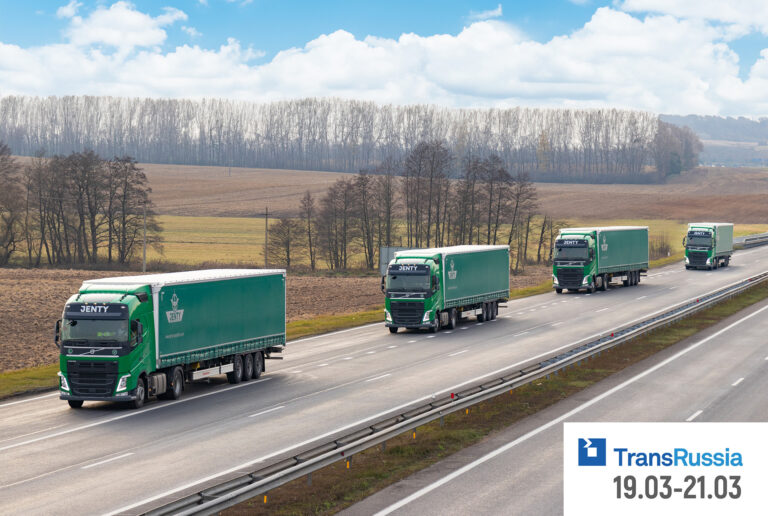
Poland hosts a network of logistics companies that are effectively controlled by Russian and Belarusian owners who continue to circumvent European Union sanctions imposed on Russia. The central figure in this scheme is Belarusian-Russian millionaire Vasily Smetanin, owner of the Belarusian company Jenty Spedition and the Russian firm SDS Holding.
To legitimize operations within the EU, Smetanin reportedly relies on a complex corporate structure involving Austrian financier Florian Koschat and former Sberbank executive Yulia Chechet. The network includes Polish-registered companies such as DSPL, Azonik, BIRC Transport, and Rezon Trans. The scheme also involves the Austrian holding company Albereta GmbH and its subsidiary Eastin Forwarding Holding.
Despite EU sanctions prohibiting Belarusian and Russian transport operators from operating within the Union, these Polish companies—owned or controlled by Belarusian and Russian interests—have obtained Road Transport Undertaking (RTU) status by exploiting legal loopholes.
Since April 2022, the European Union has barred Belarusian and Russian transport companies from conducting operations within the EU. Freight transportation between Belarus and the EU is now generally carried out through transshipment or trailer exchanges at border crossings. Furthermore, any transport company established in Belarus or Russia, or one in which citizens of those countries own at least 25 percent of shares, is prohibited from operating within the EU.
The purpose of these restrictions is to prevent Minsk and Moscow from circumventing sanctions through joint ventures or subsidiaries established in EU member states. A Road Transport Undertaking (RTU) is a company engaged in the commercial transportation of goods or passengers by road within the EU and is required to comply with a range of regulatory and operational standards.
Previously, Polish authorities audited more than 11,000 transport companies and initiated proceedings to revoke the licenses of 453 firms. Companies such as Azonik, BIRC Transport, and Rezon Trans should not have been granted RTU status, as they were established—and remain controlled by—Belarusian and Russian owners holding more than a 25 percent stake.
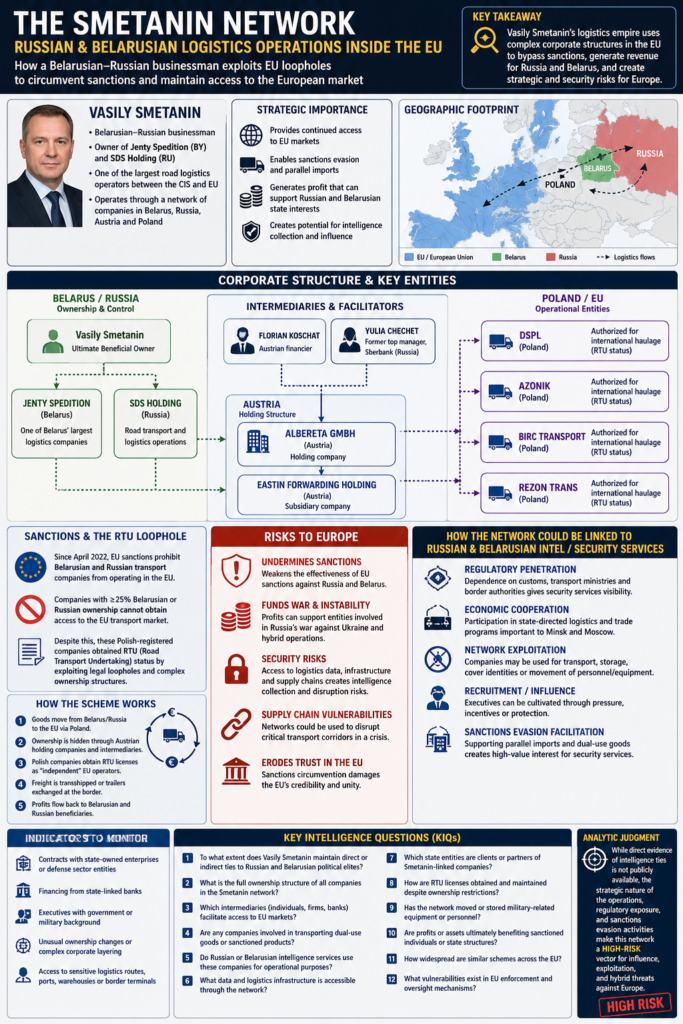
The logistics network uncovered in Poland demonstrates that Russia and Belarus have adapted to sanctions pressure and are increasingly relying on financial, legal, and corporate mechanisms to bypass EU restrictions. Economic activity is becoming an instrument of the Kremlin’s hybrid warfare strategy, while companies and intermediaries operating within the EU are emerging as critical enablers of these efforts, undermining sanctions effectiveness and creating additional risks to European security.
The case involving Polish logistics companies linked to Vasily Smetanin highlights vulnerabilities in the EU sanctions regime. As long as Russian and Belarusian business groups retain access to the European market through legal loopholes and complex ownership structures, sanctions policy will require continuous adaptation to counter new methods employed by Moscow and Minsk.
Poland is one of the key logistical hubs supporting Ukraine. Consequently, the penetration of Russian- and Belarusian-linked entities into the transport sector creates risks not only for the Polish economy but also for the security of Europe as a whole. Profits generated through these operations may ultimately support Russian and Belarusian companies involved in the war against Ukraine or in hybrid pressure campaigns targeting EU member states.
The use of Russian- and Belarusian-linked structures in the transport sector also poses risks to Europe’s strategic supply chains. In times of crisis, such networks could become instruments not only of economic influence but also of disruption targeting critical logistics infrastructure, directly threatening European security.
Sanctions circumvention undermines confidence in European Union decisions regarding restrictions on Russia and Belarus. If such schemes are not adequately addressed, they weaken the EU’s credibility as a unified and consistent actor in countering Russian aggression. Consequently, the EU must not only punish direct sanctions violations but also treat any attempt to circumvent sanctions as an illegal act, ensuring effective detection and enforcement.
Since 2025, both direct sanctions violations and sanctions circumvention schemes have been considered illegal within the European Union. The implementation of EU Directive 2024/1226 has established a legal framework for the criminal prosecution of individuals and entities that facilitate the concealed activities of Russian and Belarusian companies. Consistent enforcement of these rules across all member states has therefore become a matter of strategic importance.
Poland, having already implemented the directive, must rigorously enforce the legislation to prevent its territory from being used as a platform for sanctions evasion.
The European Union should strengthen coordination between national regulators and the European Commission, conduct a systematic audit of companies granted RTU status, and ensure transparency regarding the ownership structures of holding companies and their subsidiaries. Particular attention should be devoted to intermediaries who help legitimize the activities of sanctioned entities, as they represent a critical link in sanctions-evasion schemes and transform ordinary economic activity into an instrument of Russia’s hybrid warfare against the European Union.
The case surrounding Belarusian-Russian businessman Vasily Smetanin is significant not merely as a sanctions-evasion scheme but as a broader illustration of how Russian and Belarusian economic actors have adapted to the post-2022 sanctions environment. The issue extends beyond commercial transportation and highlights the growing convergence between business networks, sanctions circumvention, and hybrid influence operations targeting the European Union.
Who Is Vasily Smetanin?
Vasily Smetanin is one of the most influential figures in the Belarusian logistics sector and has built extensive transportation and freight-forwarding operations across Belarus, Russia, and the European Union.
His principal asset, Jenty Spedition, developed into one of Belarus’s largest logistics operators, specializing in road freight transportation between the CIS and European markets. Through SDS Holding and associated companies, Smetanin has maintained commercial interests spanning Russia, Belarus, and EU jurisdictions.
Unlike oligarchs directly associated with the Kremlin, Smetanin represents a category of businessmen who operate in strategically important sectors that indirectly support Russian and Belarusian economic resilience. Such actors are particularly valuable because they possess: extensive transport infrastructure; established relationships with customs and regulatory authorities; access to European markets; expertise in creating multinational corporate structures.
For Moscow and Minsk, individuals like Smetanin serve as facilitators who help maintain critical economic links despite sanctions.
Why Poland Matters
Poland occupies a unique position in the sanctions landscape.
It is simultaneously: the EU’s principal eastern logistics gateway; one of Ukraine’s most important supply corridors; a frontline state confronting Russian hybrid operations; a major transportation hub connecting Western Europe with Eastern Europe.
Control or influence within Poland’s logistics sector provides advantages that extend beyond commercial profit.
For Russian and Belarusian actors, access to Polish transport networks offers: continued access to EU supply chains opportunities to obscure ownership structures; visibility into trade flows; potential leverage over critical transportation infrastructure.
This makes the logistics sector a strategic target rather than merely an economic opportunity.
Russia increasingly views economic networks as instruments of state power.
Since the full-scale invasion of Ukraine, the Kremlin has expanded its use of: shell companies; intermediary firms; offshore ownership structures; logistics operators; transportation networks.
The RTU status granted to companies allegedly linked to Belarusian and Russian ownership raises concerns far beyond regulatory compliance.
If sanctioned actors can obtain legal operating status within the EU through complex ownership arrangements, it creates a precedent that may be replicated elsewhere.
The implications include: erosion of sanctions effectiveness; reduced transparency of ownership structures; expansion of Russian economic influence inside EU markets; creation of potential channels for sanctions circumvention across multiple sectors.
This is especially concerning because transport companies serve as critical nodes within broader economic systems.
Security Risks Beyond Commerce
The most serious long-term implications may be security-related rather than economic.
Transport companies possess access to: freight movement data; customs information; warehouse infrastructure; border-crossing logistics; transportation corridors used by governments and private industry.
The Smetanin case highlights a broader challenge facing European policymakers.
The second generation must focus on: beneficial ownership; intermediary structures; corporate control mechanisms; family ownership networks; nominee shareholders.
The implementation of Directive 2024/1226 marks an important step because it criminalizes not only sanctions violations but also sanctions circumvention schemes.
In Belarus especially, large logistics firms cannot operate independently from state institutions.
Jenty Spedition likely interacts regularly with: Belarusian Customs Committee; Ministry of Transport; Border Guard authorities; regional administrations.
Many of these institutions maintain close cooperation with: Belarusian KGB; Belarusian Security Council; Presidential Administration.
Under this model, intelligence agencies gain visibility into company operations through regulatory oversight rather than direct recruitment.
The principal threat posed by companies linked to Vasily Smetanin is not necessarily that they are directly involved in intelligence activities, but that they operate in a sector that is strategically important to Russia and Belarus and could be exploited for economic, political, and security purposes.
The most immediate threat is the potential circumvention of EU sanctions.
If Russian- or Belarusian-controlled logistics networks maintain access to the European market through subsidiaries, intermediaries, or opaque ownership structures, they can: preserve trade flows that sanctions were designed to restrict; facilitate parallel imports; generate revenue for Russian and Belarusian business groups; weaken the deterrent effect of EU sanctions.
This directly affects the EU’s ability to pressure Moscow economically.
Transport companies occupy a privileged position within supply chains.
Such firms may gain visibility into cargo movements; industrial procurement; border procedures; transportation bottlenecks; critical logistics corridors.
This information has both commercial and strategic value.
If companies linked to Russian or Belarusian interests gain significant positions within transportation networks, there are concerns regarding: monitoring of supply routes; identification of logistical vulnerabilities; collection of commercially sensitive information; potential interference during future crises.
Russia increasingly treats economic infrastructure as part of its broader hybrid warfare toolkit.
Logistics networks can potentially be used for: influence operations; sanctions evasion; economic pressure; information gathering; creation of strategic dependencies.
The Kremlin has repeatedly demonstrated that it views transportation, energy, finance, and trade as instruments of geopolitical competition rather than purely commercial sectors.
Large logistics companies possess access to: warehouses; customs facilities; transportation hubs;
These sectors are traditionally of interest to intelligence services because they facilitate:
The risk is therefore less about a specific company being an intelligence asset and more about the possibility that such networks could be leveraged by state actors.
Corruption and Regulatory Capture
Complex ownership structures often rely on:
- intermediaries;
- shell companies;
- nominee shareholders;
- legal loopholes.
If these practices become widespread, they can:
- weaken trust in EU regulatory systems;
- undermine enforcement of sanctions;
- create opportunities for corruption;
- erode public confidence in European institutions.
Crisis Scenario Risk
In a major confrontation between Russia and the West, transport networks connected to hostile-state interests could become strategic vulnerabilities.
Potential concerns include:
- disruption of freight flows;
- manipulation of logistics capacity;
- denial of services;
- exploitation of infrastructure dependencies.
Even if such actions never occur, the existence of these vulnerabilities creates security concerns for policymakers.
Strategic Assessment
The greatest threat posed by companies associated with Smetanin is not that they are merely transport firms, but that they may represent part of a broader ecosystem through which Russia and Belarus preserve economic access to Europe despite sanctions.
For the EU, the core issue is therefore strategic resilience:
Can Russian- and Belarusian-linked business networks continue operating inside critical European sectors while formally complying with regulations but effectively undermining the objectives of sanctions policy?
If the answer is yes, the challenge extends far beyond logistics and becomes a question of European economic security, sanctions credibility, and resistance to hybrid influence operations.
The public evidence supports “exploitation of transport and logistics networks” more clearly than it proves direct FSB/GRU/KGB control of specific EU-based trucking firms.
The strongest documented pattern is that Russian and Belarusian actors use commercial logistics networks to evade sanctions, preserve access to EU markets, move restricted goods, and sustain Russia’s war economy. The European Commission specifically warns EU operators to watch for Russian sanctions-circumvention techniques, and EU transport rules ban Russian-owned road transport undertakings above the 25% ownership threshold.
For intelligence services, logistics networks are useful because they provide access to cargo flows, border procedures, warehouses, customs brokers, and transport data. That does not require formal ownership or declared control. Russian or Belarusian services could exploit such networks through pressure on owners, cooperation with customs-linked intermediaries, use of front companies, recruitment of managers, or insertion of trusted personnel.
There are public precedents showing the security dimension of sanctions evasion. The UK recently targeted a covert procurement network for military technology allegedly linked to Russia’s GRU, while German authorities arrested suspects accused of sending thousands of sanctioned shipments to Russian arms manufacturers in a case reportedly monitored by the BND and believed to involve Russian intelligence support.
Russian- and Belarusian-linked companies have obtained access to EU haulage despite post-2022 restrictions, using corporate structures and RTU status. That is a sanctions-enforcement and security concern, but it is not yet public proof of intelligence-service tasking. Assessment: Russian and Belarusian services almost certainly monitor and may exploit commercial transport networks in the EU where those networks support sanctions evasion, parallel imports, or strategic supply chains. The evidence is strongest for state-enabled exploitation and covert procurement, weaker for direct proof that every exposed logistics network is intelligence-controlled.