
Recent statements by U.S. representatives at the United Nations signal a notable shift in Washington’s messaging toward Moscow. Rather than focusing exclusively on military developments, U.S. officials increasingly emphasize the growing imbalance between Russia’s deteriorating economic fundamentals and Ukraine’s rapidly evolving innovation ecosystem. The underlying message is clear: time is no longer working in Russia’s favor.
The United States argues that while the Kremlin continues to pursue a strategy of attrition, Russia’s economic capacity to sustain a prolonged war is gradually eroding. At the same time, Ukraine is leveraging technological innovation, drone warfare, decentralized defense production, and Western industrial support to offset Russia’s advantages in manpower and resources. This emerging dynamic suggests that Moscow may face a narrowing window of opportunity to negotiate from a position of relative strength.
Russia’s Economy: Resilience Concealing Structural Weakness
Despite repeated predictions of economic collapse, Russia has succeeded in maintaining macroeconomic stability throughout the war. However, this resilience increasingly masks deep structural vulnerabilities.
The Russian economy has become heavily dependent on military spending, state subsidies, and wartime production. Defense expenditures now function as the primary driver of industrial activity and regional employment. While this model sustains short-term growth, it simultaneously crowds out private investment, accelerates inflationary pressures, and increases dependence on state-directed economic management.
Several indicators suggest growing economic strain: Persistent labor shortages caused by mobilization, military recruitment, and demographic decline; Rising inflation and increasing pressure on household purchasing power; Growing fiscal dependence on energy exports; Escalating costs associated with sanctions circumvention; Increasing reliance on shadow financial and logistical networks; Diminishing foreign investment and technological isolation.
The Kremlin has managed to compensate for sanctions through trade diversification, particularly with China, India, and other non-Western markets. However, these relationships are increasingly asymmetric, providing Moscow with access to markets while simultaneously increasing Russian dependence on external partners.
The longer the war continues, the more Russia risks transitioning from a diversified industrial economy into a militarized resource-exporting state characterized by declining productivity and technological stagnation.
Ukraine’s Innovation Advantage
The U.S. narrative places particular emphasis on Ukraine’s ability to innovate faster than Russia.
Over the past two years, Ukraine has transformed into one of the world’s most dynamic military innovation ecosystems. Ukrainian defense manufacturers, technology startups, volunteer organizations, and military units have created a decentralized model capable of rapidly adapting to battlefield conditions.
Key advantages include: Rapid development cycles for drones and autonomous systems; Integration of artificial intelligence into targeting and reconnaissance; Expansion of domestic defense production; Flexible cooperation between private technology companies and military institutions; Access to Western research, financing, and industrial capacity.
Ukraine increasingly compensates for quantitative disadvantages through qualitative improvements. Rather than matching Russia tank-for-tank or missile-for-missile, Kyiv seeks to impose disproportionate costs through precision strikes, long-range drones, and advanced battlefield networking.
Recent Ukrainian operations targeting oil infrastructure, logistics hubs, and military-industrial facilities illustrate how innovation can generate strategic effects beyond the front line. Ukrainian officials claim that strikes have disrupted a substantial portion of Russia’s refining capacity and logistics networks, increasing economic pressure on the Kremlin.
Why Washington Is Increasing Pressure on Moscow
The U.S. statement at the UN should be viewed as a strategic warning rather than merely a diplomatic appeal.
Washington appears to assess that Russia’s current position may represent the peak of its relative leverage. Although Russian forces continue offensive operations, the long-term trajectory increasingly favors states capable of generating innovation, attracting investment, and integrating advanced technologies.
The American message suggests three key assumptions: Russia’s military gains are not translating into sustainable strategic advantages. Ukraine’s technological adaptation is occurring faster than Russia’s ability to counter it. Russia’s economic model becomes less sustainable with each additional year of war.
Consequently, U.S. officials are signaling that Moscow may eventually face negotiations under less favorable conditions than those available today.
While economically costly, Russian leadership may perceive escalation as preferable to accepting strategic failure.
Strategic Assessment
The core significance of the U.S. statement lies in its challenge to one of the Kremlin’s central assumptions—that Russia can outlast Ukraine and its Western supporters.
Washington increasingly argues that the decisive variable is not territory but adaptability. Russia retains larger resources, but Ukraine is demonstrating a greater capacity for innovation, technological integration, and institutional flexibility. Meanwhile, Russia’s wartime economy faces mounting structural pressures despite its apparent resilience.
If current trends continue, Moscow may discover that military endurance alone is insufficient to secure victory. The critical question for the next two years is whether Russia can reform and modernize its wartime economy faster than Ukraine can continue to innovate with Western support.
The answer to that question will largely determine whether the conflict ends through negotiation, prolonged attrition, or a fundamental shift in the strategic balance.
Russia in 2026 exhibits some structural similarities to the late Soviet Union of the 1980s, yet there are also important differences that make a sudden Soviet-style collapse less likely in the near term.
Executive Assessment
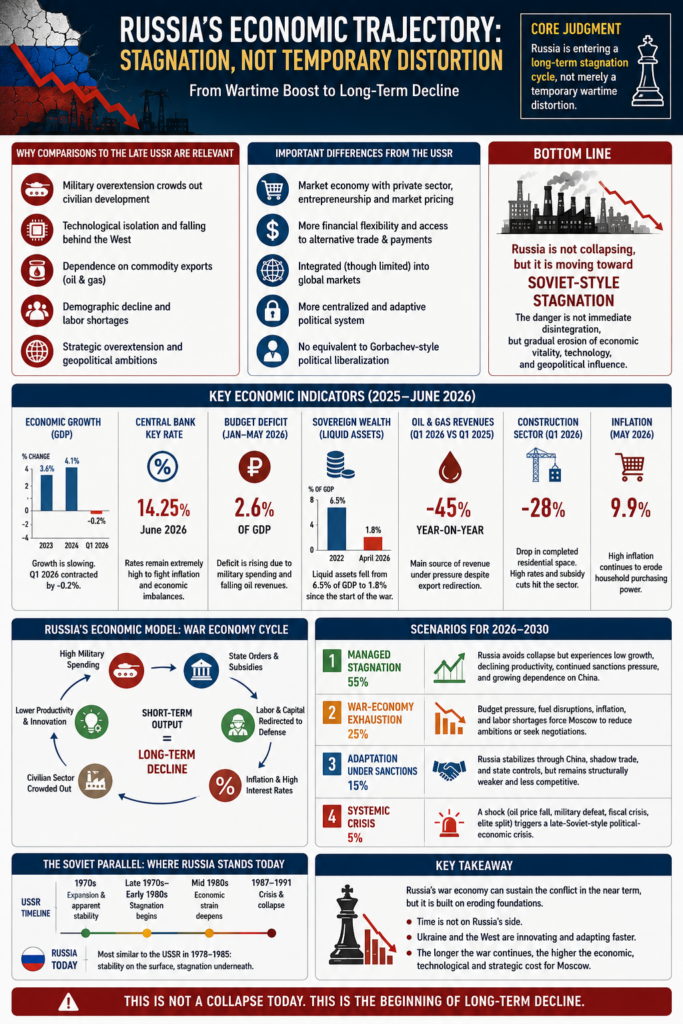
High Confidence: Russia is displaying several economic characteristics that resemble the late Soviet period, particularly military overextension, technological isolation, declining productivity, and growing dependence on commodity exports.
Moderate Confidence: Russia is not yet facing the systemic crisis that confronted the Soviet Union between 1987 and 1991.
Moderate-to-High Confidence: If current trends continue through the late 2020s, Russia could gradually evolve toward a Soviet-style stagnation model characterized by low growth, fiscal stress, technological backwardness, and declining geopolitical influence.
Similarities with the Late USSR
1. Military Spending Is Crowding Out Civilian Development
One of the major drivers of Soviet decline was excessive military expenditure.
By the mid-1980s, the USSR was allocating a substantial share of national resources to: Defense production; Strategic nuclear forces; Foreign military commitments; Competition with the United States.
Today, Russia faces a similar challenge.
The war economy increasingly directs: Capital; Skilled labor; Industrial capacity; Research and development toward military production.
The result is growing pressure on: Housing; Infrastructure; Healthcare; Civilian industry.
This mirrors a key Soviet vulnerability.
2. Technological Isolation
The Soviet Union struggled to compete in: Computing; Electronics; Advanced manufacturing.
Today’s Russia faces comparable constraints.
Although it maintains strengths in: Defense technologies; Nuclear energy; Aerospace, it remains heavily dependent on external suppliers for many advanced technologies.
Sanctions have accelerated: Import substitution costs; Technology gaps; Reduced access to Western innovation ecosystems.
The Soviet Union ultimately lost the technological race with the West; Russia risks facing a similar challenge in AI, semiconductors, robotics, and advanced manufacturing.
3. Dependence on Commodity Exports
The USSR depended heavily on: Oil; Gas; Raw materials.
When oil prices collapsed during the 1980s, Soviet finances deteriorated rapidly.
Modern Russia remains heavily dependent on: Oil exports; Gas exports; Commodity revenues.
Although export routes have shifted toward Asia, the structural dependence remains.
This creates a vulnerability similar to that faced by the Soviet Union.
4. Demographic Problems
Late Soviet leadership faced: Aging population trends; Labor shortages; Health challenges.
Russia today faces: Population decline; Low birth rates; Emigration of skilled workers; Military casualties.
Demographics may become one of the most significant constraints on long-term economic growth.
Strategic Overextension
The Soviet Union spent heavily supporting: Eastern Europe; Cuba; Vietnam; Afghanistan; Africa.
Russia is engaged in: Ukraine; Military commitments abroad; Influence operations; Expensive security structures.
While the scale is smaller than Soviet commitments, the principle is similar: geopolitical ambitions increasingly compete with economic realities.
Important Differences
Russia Has a Market Economy
This is the biggest difference.
The Soviet economy was a centrally planned system.
Russia today retains: Private ownership; Market pricing; Entrepreneurial activity; Flexible trade relationships.
These mechanisms provide far greater resilience than the Soviet model possessed.
Russia Is More Financially Flexible
The USSR had limited integration into global markets.
Modern Russia can still: Redirect trade; Use alternative payment systems; Employ sanctions-evasion networks; Utilize shadow shipping fleets; Expand trade with China, India, and the Global South.
This flexibility did not exist in the Soviet era.
The Political System Is Different
The Soviet Union suffered from: Ideological exhaustion; Elite fragmentation; Nationalist movements; Declining belief in communism.
Modern Russia faces legitimacy challenges but does not currently confront: Comparable separatist pressures; Ideological collapse on the scale of late communism.
The political system is more centralized and more adaptive than the late Soviet leadership structure.
No Equivalent to Gorbachev
A crucial factor in Soviet collapse was the combination of: Economic problems; Political liberalization.
Mikhail Gorbachev introduced reforms that weakened central control faster than the economy could recover.
Russia today shows little indication of pursuing a comparable political opening.
This reduces the likelihood of a sudden systemic breakdown.
The Better Historical Analogy
Rather than the USSR of 1991, today’s Russia more closely resembles the USSR of 1978–1985.
Characteristics include: Apparent stability; Military strength; Energy revenue dependence; Slowing productivity; Technological lag; Growing structural inefficiencies.
The danger is not necessarily imminent collapse.
The danger is prolonged stagnation.
Possible Scenarios (2026–2030)
Scenario 1: Managed Stagnation
Russia avoids collapse but experiences: Low growth; Declining productivity; Continued sanctions pressure; Growing dependence on China.
Scenario 2: War-Economy Exhaustion
Military spending becomes increasingly unsustainable.
Consequences: Inflation; Fiscal pressures; Reduced living standards; Increased elite competition.
Scenario 3: Strategic Adaptation
Russia successfully restructures: Defense production; Trade networks; Technology partnerships.
Growth remains limited but stability is preserved.
Scenario 4: Systemic Crisis
A combination of: Falling energy prices; Military setbacks; Fiscal crisis; Elite fragmentation
produces a political and economic crisis comparable to the late Soviet period.
This remains possible but is not currently the most likely scenario.
Is Russia entering a temporary wartime economic distortion, or is it entering a long-term stagnation cycle similar to the one that weakened the Soviet Union before its collapse?
At present, the evidence points more toward Brezhnev-era stagnation than Gorbachev-era collapse. The greater risk for the Kremlin is not a sudden disintegration of the state, but a gradual erosion of economic competitiveness, technological capacity, and geopolitical influence over the remainder of the decade.
Russia is entering a long-term stagnation cycle, not merely a temporary wartime distortion.
The best comparison is not the USSR in 1991, but the USSR in the late Brezhnev–early Andropov period: still militarily powerful, still politically controlled, but structurally losing productivity, technology, fiscal flexibility, and future growth.
Difference from the Soviet collapse
Russia is not yet in a 1991-style collapse. It has a market economy, low public debt, private-sector flexibility, and strong coercive control. CEPA’s recent assessment is useful here: Russia is stagnating, but not facing imminent bread queues, banking collapse, or state bankruptcy.
So the key formula is:
No immediate collapse — but deepening strategic exhaustion.
\ Managed stagnation
Russia avoids collapse but becomes poorer, more militarized, more dependent on China, and less technologically competitive.
War-economy exhaustion
Budget pressure, fuel disruptions, inflation, and labor shortages force Moscow to reduce ambitions or seek negotiations.
Adaptation under sanctions
Russia stabilizes through China, shadow trade, and state controls, but remains structurally weaker.
Systemic crisis
A shock — oil price fall, military defeat, elite split, or fiscal panic — creates a late-Soviet-style political-economic crisis.Russia is not temporarily distorted by war; it is being structurally transformed into a militarized stagnation economy. The construction downturn is a warning sign: after a mortgage-driven boom, completed residential space reportedly fell 28% in Q1 2026, showing how high rates and subsidy cuts are hitting civilian sectors.The danger for the Kremlin is not immediate collapse, but the gradual Soviet-style erosion of economic vitality while Ukraine and the West improve technological and industrial adaptation.