

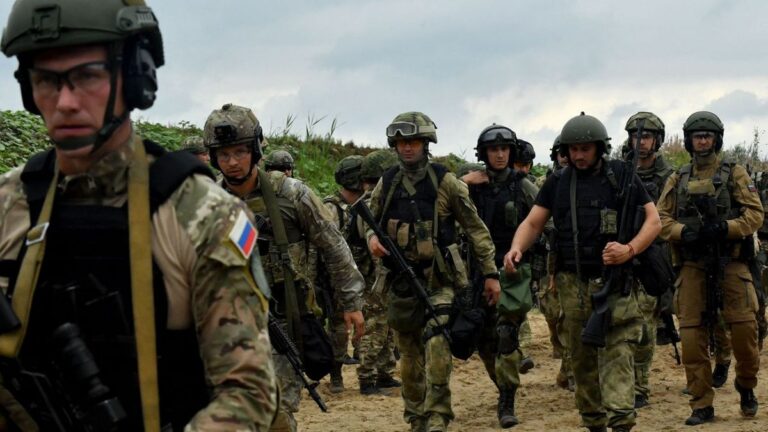
Reuters’ report on Chinese training for Russian forces in radiological, chemical, and biological protectionopens a serious window into the evolution of the Ukraine war, because it suggests that Moscow is preparing its military to function inside a wider environment of contamination risk, nuclear anxiety, infrastructure vulnerability, and psychological pressure. The immediate question is whether this points to a coming Russian nuclear strike. The more plausible answer is that nuclear use remains unlikely,since Putin still gains immense strategic value from keeping catastrophe suspended in the imagination of Western decision-makers. His nuclear rhetoric has worked best as a pressure system: it slows arms transfers, conditions allied hesitation, frightens European publics, and forces every major discussion about Ukraine through the prism of escalation.
Inside the reported training portfolio, the specific subjects matter more than the general fact of Sino-Russian military cooperation. Radiological protection, chemical reconnaissance, radiation reconnaissance, nuclear-reactor models, and ventilation-system protection from contamination all point to forces preparing for hazardous environments and for military operations in which fear of invisible harm can alter political behavior. These are the technical foundations of fighting near damaged industrial sites, operating around nuclear facilities, surviving in contaminated zones, or exploiting the possibility of contamination as a battlefield and diplomatic instrument. Russia does not need to detonate a nuclear weapon to make nuclear fear operational. It can create uncertainty around a facility, engineer panic around a reactor, stage accusations involving dirty bombs, threaten contamination, or manipulate emergency conditions in a way that forces Europe into crisis-management mode.
Putin has strong reasons to keep actual nuclear use at the far edge of policy rather than bring it into the center of the war. A nuclear strike would unleash a crisis Moscow could no longer calibrate with the same precision. It would force a level of Western response that Russia cannot confidently model, place China under much greater diplomatic pressure, and potentially fracture the network of states that have tolerated Russian aggression under the language of neutrality, anti-Western grievance, or transactional opportunism. The Kremlin’s advantage has come from making others imagine a nuclear threshold and then police themselves around it. Once Russia crosses that threshold, menace becomes liability, ambiguity becomes evidence, and coercion becomes a direct test of allied credibility.
For that reason, the more likely danger lies in the space beneath nuclear use, where Russia can generate some of the political effects of nuclear escalation at a lower immediate cost. That space includes nuclear-plant brinkmanship, radiological panic, dirty-bomb narratives, chemical allegations, industrial contamination scenarios, and CBRN-related false flags designed to confuse attribution. Russia has already shown a sophisticated instinct for exploiting uncertainty. It creates a crisis, disputes the facts, floods the information space, accuses Ukraine or NATO, then calls for restraint on terms favorable to Moscow. In a CBRN environment, that model becomes even more dangerous because evidence is technical, public fear moves quickly, and international institutions need time to verify what happened.
Ukraine’s nuclear infrastructure remains the most obvious arena for this kind of coercion.Zaporizhzhia offers Moscow a uniquely valuable pressure point because a nuclear plant under wartime conditions can produce panic even during limited disruptions. External power failures, contested access, military activity near sensitive systems, emergency cooling concerns, inspection disputes, and conflicting claims can all become raw material for Russian psychological operations. A crisis around the plant would not need to reach catastrophic scale to serve Moscow’s purposes. A controlled emergency, a sabotage accusation, a power interruption, or a radiological scare could pressure European governments, frighten civilian populations, and revive calls for negotiations framed around “nuclear safety” rather than Russian occupation.
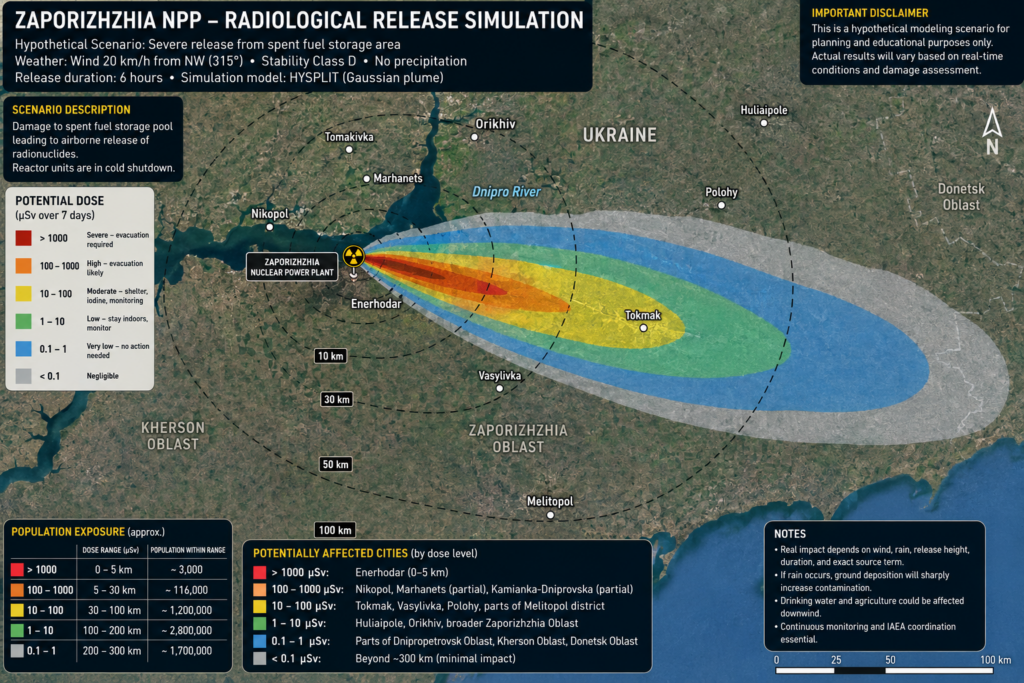
Around such a facility, military activity and narrative warfare become inseparable. Russia could claim that Ukrainian strikes endangered the plant, that Western weapons created unacceptable risks, that Kyiv was planning a dirty-bomb provocation, or that Moscow alone was acting to preserve stability. Chinese diplomatic messaging could then amplify the call for restraint, negotiations, and de-escalation, placing formal blame on no one while shifting practical pressure onto Ukraine and its supporters. The Kremlin does not need the world to believe every Russian claim. It only needs enough confusion to slow decision-making, divide audiences, and make continuation of the war feel more dangerous than capitulation to Russian demands.
China’s reported role gives this development a larger strategic meaning because Beijing has spent the war presenting itself as a responsible great power, a mediator, and a stabilizing force with ordinary commercial ties to Moscow. Training Russian personnel in a field connected to battlefield resilience,contamination control, and escalation management reveals a far more operational relationship. This goes beyond diplomatic cover, commodity purchases, dual-use trade, sanctions evasion, and technology pathways. It suggests direct military learning tied to Russia’s needs in a live war against a Western-backed state. The public language of neutrality becomes harder to take seriously when Chinese institutions are reportedly training Russian soldiers in skills relevant to surviving and exploiting CBRN conditions on the Ukrainian battlefield.
From Beijing’s perspective, the value of such cooperation is not limited to helping Moscow. China can extract lessons from Russia’s battlefield experience, including lessons about Western intelligence support, sanctions pressure, drone warfare, attrition, mobilization, logistics, electronic warfare, air defenses, and public messaging under wartime conditions. The People’s Liberation Army has modern equipment, scale, and industrial depth, yet it lacks recent high-intensity combat experience. Russia has paid for that experience in Ukraine. Training exchanges allow China to study a modern war indirectly, including the ways a major power adapts when facing a determined opponent backed by Western technology, intelligence, and finance.
The implications extend well beyond Ukraine. Any future Indo-Pacific crisis, especially over Taiwan, would involve infrastructure pressure, cyberattacks, blockades, maritime disruptions, energy insecurity, financial coercion, information operations, sanctions, drone systems, and a global battle over legitimacy. CBRN resilience may appear peripheral to such scenarios, yet modern conflict increasingly revolves around civilian systems that carry strategic consequences: ports, power grids, hospitals, laboratories, undersea cables, satellites, fuel depots, water systems, and nuclear facilities. The ability to operate amid contamination risk, real or manufactured, gives authoritarian militaries another tool for paralysis, intimidation, and denial.
Russia also benefits from the symbolism of Chinese participation. Every military exchange reinforces the message that Moscow is not isolated, that time favors authoritarian coordination, and that Western pressure has failed to sever Russia from major-power support. This matters inside Russia, inside occupied Ukraine, across Europe, and throughout the Global South. Moscow wants Ukrainians to believe Western fatigue is inevitable. It wants Europeans to believe escalation risks will keep expanding. It wants non-Western audiences to see Russia as part of a durable bloc capable of absorbing punishment. Chinese training in such a sensitive field strengthens that psychological architecture.
The CBRN dimension is especially suited to Russian doctrine because it fuses material preparation with narrative manipulation. Chemical allegations, biological-defense rhetoric, dirty-bomb claims, radiological scares, and nuclear drills all exploit the same human fear of invisible, lingering harm. These threats do not need to kill at scale to shape political behavior. They can empty cities, frighten investors, paralyze local authorities, disrupt troop movements, overwhelm media cycles, and pressure governments to prioritize emergency containment over strategic clarity. In the Ukraine war, where Russia has struggled to achieve decisive conventional victory, such instruments offer a way to widen the battlefield into civilian psychology.
Western governments have often struggled with precisely this middle zone. Clear violations prompt condemnation and sometimes action. Ambiguous threats generate meetings, legal reviews, intelligence debates, and public caution. Russia understands the rhythm of allied delay. It tests the edges of what can be denied, disputed, or reframed. A military academy can be described as a training venue. CBRN instructioncan be described as defensive. A nuclear-plant crisis can be presented as an accident. A chemical incidentcan be blamed on Ukraine. A dirty-bomb narrative can be seeded before a battlefield setback. The gray zone is useful because it slows consensus.
Preventive action should begin with exposure, since Beijing’s strategy depends heavily on maintaining distance between public language and operational conduct. Western intelligence services should identify the Chinese institutions, military academies, instructors, logistics channels, research centers, and defense intermediaries involved in training Russian personnel connected to the Ukraine war. Public attribution should be careful, evidentiary, and sustained. A single statement will not be enough. The architecture of support needs to be mapped in detail so that Chinese denials lose their diplomatic utility.
Sanctions should then target the network rather than only the most visible entities. Military education, technical instruction, research cooperation, procurement assistance, logistics facilitation, and specialized training can all sustain a war effort. A Chinese academy hosting Russian officers can matter as much as a company shipping components. A research institute providing expertise can matter as much as a defense contractor. A logistics intermediary enabling access can matter as much as a battlefield supplier. Western governments need to broaden the definition of material support to include institutional military learning that strengthens Russia’s ability to continue operations in Ukraine.
Ukraine’s defense support should also include a much deeper CBRN resilience package. Detection systems, protective equipment, mobile laboratories, decontamination units, specialized medical capacity, hardened communications, secure public-warning channels, backup power systems, and emergency repair tools should become routine elements of assistance. This is deterrence through readiness. If Moscow knows that a chemical or radiological provocation will be detected quickly, documented properly, attributed credibly, and communicated clearly, the political value of the operation declines. Preparedness narrows the space in which Russia can exploit panic.
Nuclear-site protection deserves particular urgency. Ukraine’s nuclear facilities and related infrastructure need expanded monitoring, redundant power support, rapid inspection protocols, physical protection, satellite surveillance, emergency repair capacity, and preplanned communication channels with international institutions. The goal is to deny Russia the ability to turn technical vulnerability into geopolitical leverage. In wartime, nuclear infrastructure becomes a battlefield when the aggressor discovers that fear around the facility can deliver political returns. Protection therefore has to include engineering, security, intelligence, diplomacy, and public communication at the same time.
NATO’s declaratory policy should become clearer and more disciplined. Moscow should hear that nuclear use, radiological dispersal, engineered nuclear-plant crises, chemical escalation, and CBRN false-flag operations would bring severe consequences. The message should avoid theatrical language and still leave no doubt that Russia cannot gain advantage through nuclear-adjacent coercion. Allied planning should be visible enough to deter and coordinated enough to prevent the Kremlin from exploiting differences between Washington, Brussels, Berlin, Paris, Warsaw, and other capitals. Russia studies hesitation. It probes vague language. It treats silence as room for maneuver.
The information domain requires preparation before any crisis begins. Russian narratives around a future CBRN incident are predictable: Ukrainian sabotage, Western provocation, technical accident, environmental negligence, reckless weapons transfers, or defensive necessity. Governments, independent experts, Ukrainian officials, and allied institutions should prepare rapid-response evidence packages, satellite-imagery protocols, open-source verification networks, multilingual public briefings, and clear explanations of likely Russian claims. Narrative readiness is not public relations. It shapes the first hours of a crisis, when audiences are most vulnerable to confusion and when Moscow is most likely to exploit uncertainty.
Europe faces a particular test because the Chinese angle collides directly with its long-standing economic habits. Many European governments have treated China as a commercial challenge, a market, a supply-chain risk, and a diplomatic complication. Training Russian forces in a sensitive military domain connected to the Ukraine war places Beijing inside Europe’s core security problem. A state that helps Russia prepare for CBRN-relevant wartime operations cannot be addressed only through trade language.Europe needs a security policy toward China that matches the reality of Chinese conduct.
The United States should see the same pattern through the lens of global deterrence. If Beijing can support Russia incrementally, technically, and deniably with minimal cost, that lesson will travel. It will inform Chinese risk calculations in the Indo-Pacific, Iranian calculations in the Middle East, and broader authoritarian confidence in gray-zone escalation. The issue is larger than Ukraine because Ukraine is the testing ground for methods that can be exported elsewhere: hidden support, formal denials, proxy amplification, technical training, coercive signaling, and manipulation of Western fear.
Across the authoritarian axis, the lesson being studied is whether ambiguity protects aggression. Russia, China, Iran, and their networks are watching whether nuclear language still intimidates Europe, whether legal uncertainty delays response, whether public fear can slow military support, and whether covert cooperation can remain below the threshold of meaningful punishment. Their common method is not identical coordination in every theater. It is shared adaptation: each actor studies what works, then applies it where local conditions allow.
The Reuters report therefore points to something larger than one training program. It shows a war-support ecosystem maturing around Russia’s campaign in Ukraine. Moscow contributes battlefield experience, escalation practice, and a live confrontation with the Western security order. Beijing contributes industrial depth, institutional cover, technical pathways, training infrastructure, and diplomatic shielding. Together, they are learning how to stretch conflict below the threshold of direct NATO confrontation while still making the war more dangerous, more global, and more psychologically costly.
A Russian nuclear strike remains unlikely because Putin still benefits from intimidation he can modulate. That assessment should not create complacency. The more immediate danger is a radiological or chemical crisisdesigned to frighten, confuse, divide, and pressure Ukraine’s partners. Such a crisis could unfold near a nuclear facility, in occupied territory, around industrial infrastructure, or through a preemptive accusation campaign timed to blunt Ukrainian military momentum. It could combine battlefield movement with disinformation, diplomatic messaging, and calls for urgent de-escalation. It could be calibrated to create panic without forcing Russia into open nuclear use.
The West’s objective should be to close that coercive space before Moscow exploits it further. Exposure, sanctions, CBRN support for Ukraine, nuclear-site protection, intelligence sharing, allied messaging, and narrative preparation should advance together. Moscow should hear that nuclear-adjacent coercionwill not produce military or diplomatic advantage. Beijing should hear that hidden participation in Russia’s war machine carries consequences even when it is disguised as training, technical exchange, or defensive instruction.The central danger revealed by this story is that Russia is preparing to fight inside the psychology of catastrophe. Contamination, nuclear fear, chemical ambiguity, infrastructure vulnerability, and disinformation are becoming instruments of pressure against Ukraine and the West. China’s reported role shows that this threat is no longer a Russian problem alone. It belongs to a wider authoritarian adaptation to modern war, where civilian infrastructure, public fear, legal ambiguity, and military planning converge. Preventing nuclear use remains essential. Preventing Russia from profiting from nuclear-adjacent coercionis now the more urgent task.