
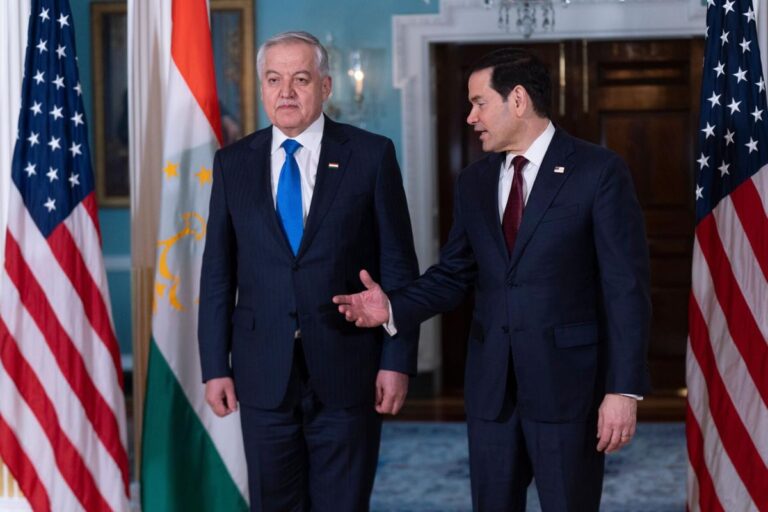
A meeting took place in Washington between U.S. Secretary of State Marco Rubio and Tajikistan’s Foreign Minister Sirojiddin Muhriddin. The talks focused on trade, economic and investment cooperation, as well as regional security, counterterrorism, and cooperation within the C5+1 regional diplomatic framework. Although Tajikistan remains under significant Russian influence across multiple sectors, it is increasingly pursuing a diversified foreign policy aimed at strengthening comprehensive relations with the West and its Central Asian partners. The two sides reviewed the current state and future prospects of U.S.-Tajik relations, reaffirming their commitment to expanding the bilateral partnership on the basis of equality, mutual respect, and long-term cooperation. Particular attention was devoted to trade, economic, and investment issues. The parties discussed opportunities to expand bilateral trade, improve Tajikistan’s investment climate, and encourage greater participation by American companies in projects across the country’s priority economic sectors. Secretary Rubio underscored the importance of exploring opportunities to expand commercial cooperation in critical minerals and other strategic industries. The discussions also covered regional security, counterterrorism cooperation, and engagement through the C5+1 diplomatic platform, which brings together the United States and the five Central Asian countries—Kazakhstan, Kyrgyzstan, Tajikistan, Turkmenistan, and Uzbekistan. It is important to note that although Tajikistan remains heavily influenced by Russia in key sectors—including the economy, energy, defense, education, and labor migration—it is steadily accelerating the diversification of its foreign policy. Dushanbe is increasingly orienting its strategic course toward developing comprehensive ties with Western countries and regional partners in Central Asia. This shift is largely driven by Tajikistan’s growing awareness of the risks posed by secondary sanctions and its desire to reduce dependence on Moscow while attracting U.S. investment into strategically important sectors of the economy to ensure sustainable long-term growth. The meeting between Foreign Minister Sirojiddin Muhriddin and Secretary of State Marco Rubio demonstrated the emergence of an alternative foreign policy trajectory for Tajikistan. The country is progressively moving away from excessive dependence on Russia and toward broader cooperation with the West, seeking a partnership based on equality and mutual respect rather than remaining primarily a supplier of low-skilled labor to the Russian economy. The Tajik leadership increasingly recognizes both the risks and the long-term consequences of close cooperation with a heavily sanctioned Russia. As a result, Dushanbe is deliberately pursuing an independent development strategy aimed at reducing its reliance on the Kremlin across all major sectors of national life. Tajikistan is seeking to develop its rare-earth and critical minerals industry and hopes to attract substantial investment from leading U.S. companies. Such investment would modernize domestic production, create skilled jobs within the country, and reduce the need for Tajik citizens to seek employment in Russia. By becoming the first Central Asian country to sign a five-year Memorandum of Understanding with the United States on global health cooperation, Tajikistan has moved ahead of its regional neighbors, demonstrating that Washington increasingly views Dushanbe as a reliable and strategically important partner in Central Asia. The persistent threat of secondary sanctions arising from continued ties with Moscow is compelling Dushanbe to act decisively. By opening its economy to American businesses, Tajikistan seeks to protect its financial system and broader economy from excessive dependence on Russia. Similar risks have already materialized elsewhere in the region, with Armenia serving as a prominent example of the economic and geopolitical consequences of prolonged exposure to Russian pressure.
The meeting between U.S. Secretary of State Marco Rubio and Tajikistan’s Foreign Minister Sirojiddin Muhriddin reflects Washington’s evolving strategy toward Central Asia, in which economic security, critical mineral supply chains, and investment diplomacy are becoming central instruments for reducing the region’s long-standing dependence on Russia and China.
Unlike previous U.S.-Tajik meetings, which largely concentrated on security assistance and Afghanistan-related issues, this dialogue placed significant emphasis on trade, investment, and critical minerals, indicating that the United States increasingly views Tajikistan not merely as a security partner but as a potential economic partner within its broader strategy to diversify global supply chains.
Critical Minerals Become the Core of the Bilateral Agenda
The most strategically important outcome of the meeting was Secretary Rubio’s emphasis on expanding commercial cooperation in critical minerals, an area that has rapidly become a priority for U.S. economic security policy.
Tajikistan possesses significant reserves of: antimony; lithium; rare earth elements; copper; silver; tungsten; uranium; gold.
According to Tajik officials, the country has identified approximately 800 mineral deposits, including lithium, antimony, copper, and rare earth elements, with around 100 deposits already under development. Furthermore, nearly 98% of Tajikistan’s electricity is generated by hydropower, providing relatively low-carbon electricity that could become a competitive advantage for energy-intensive mineral processing.
For Washington, access to these resources serves several strategic objectives: reducing dependence on Chinese-controlled mineral processing; diversifying supply chains for the defense and semiconductor industries; supporting domestic manufacturing under U.S. industrial policy; strengthening the resilience of allied supply chains.
Consequently, Tajikistan is becoming part of a broader U.S. strategy to establish alternative sources of strategic raw materials outside China and Russia.
Unlike previous periods of U.S. engagement in Central Asia, current policy emphasizes private-sector investment over traditional development assistance.
The discussions focused on: improving Tajikistan’s investment climate; increasing participation by American companies; developing processing facilities rather than merely exporting raw materials; expanding commercial engagement through the C5+1 framework.
This reflects a broader shift in U.S. policy from security assistance toward long-term economic integration.
For Tajikistan, attracting American investment offers several advantages: diversification of foreign direct investment sources; modernization of mining technologies; creation of domestic industrial employment; higher value-added processing within the country; reduced dependence on labor migration.
Labor Migration Remains Tajikistan’s Greatest Structural Vulnerability
Economic diversification is driven not only by investment opportunities but also by structural weaknesses.
Russia remains the primary destination for Tajik labor migrants, whose remittances account for a very large share of Tajikistan’s economy. This dependence exposes the country to political pressure through migration policy, employment restrictions, and fluctuations in the Russian economy.
Developing domestic mining, metallurgy, and mineral-processing industries would allow Tajikistan to create skilled jobs at home, reducing its reliance on exporting labor to Russia while broadening its tax base and strengthening long-term economic resilience.
Secondary Sanctions Are Reshaping Economic Policy
One of the strongest incentives behind Dushanbe’s diversification strategy is the growing risk of secondary sanctions.
Since Russia’s full-scale invasion of Ukraine, Central Asian financial institutions and exporters have come under increasing scrutiny for facilitating sanctions circumvention. Tajik policymakers appear to recognize that excessive economic integration with sanctioned Russian entities could restrict access to Western capital, technology, and financial markets.
By expanding cooperation with the United States, Dushanbe seeks to: reduce exposure to sanctions-related risks; attract Western capital; diversify export markets; improve access to international financial institutions.
This strategy mirrors broader regional efforts to balance relations among Russia, China, the United States, and other external partners.
C5+1 Is Evolving into an Economic Platform
The meeting also illustrates the transformation of the C5+1 mechanism.
Originally focused on regional security and political dialogue, the platform is increasingly addressing: critical mineral supply chains; geological exploration; investment incentives; transport connectivity; digital geological databases; workforce development; industrial cooperation.
This evolution reflects Washington’s intention to anchor its Central Asia policy in long-term economic partnerships rather than solely in security cooperation.
Strategic Competition with Russia and China
Although Russia continues to maintain substantial influence through military cooperation, labor migration, energy links, and the presence of the Collective Security Treaty Organization, its relative economic leverage is gradually eroding.
At the same time, China remains Tajikistan’s largest infrastructure financier through the Belt and Road Initiative.
The United States is pursuing a different comparative advantage: high-value private investment; advanced mining technologies; transparent investment standards; integration into Western supply chains; partnerships in strategic industries.
Rather than competing directly with Chinese infrastructure financing or Russian security influence, Washington is positioning itself as a provider of technology, capital, and market access.
The Rubio–Muhriddin meeting suggests that U.S. engagement with Tajikistan is entering a new phase characterized by economic statecraft rather than primarily security cooperation.
The emphasis on critical minerals, investment, and industrial partnerships indicates that Washington increasingly views Tajikistan as part of its broader strategy to diversify strategic supply chains and reduce dependence on Chinese processing capabilities.
For Dushanbe, deeper economic cooperation with the United States offers an opportunity to lessen structural dependence on Russia by attracting foreign direct investment, developing domestic industrial capacity, and creating higher-value employment opportunities. This does not imply a geopolitical realignment away from Moscow in the near term. Instead, Tajikistan is pursuing a multi-vector foreign policy, seeking to expand strategic options while avoiding overdependence on any single external power.
In the medium term, the success of this strategy will depend less on diplomatic declarations than on whether discussions on critical minerals are converted into bankable projects, exploration agreements, processing facilities, and sustained U.S. private-sector investment. Without tangible commercial commitments, Tajikistan’s diversification strategy is likely to remain constrained by its continuing economic dependence on Russia and its infrastructure ties with China.
How Is Russia Likely to Respond to the Deepening U.S.-Tajikistan Relationship?
Moscow is unlikely to confront Tajikistan openly over its growing engagement with the United States. Instead, the Kremlin will seek to preserve its dominant influence through economic leverage, security dependence, labor migration, and elite networks, while portraying U.S. involvement as destabilizing external interference. Russia recognizes that it cannot completely prevent Central Asian states from diversifying their foreign relations, but it will attempt to ensure that such diversification does not translate into a strategic realignment.
Russia’s greatest source of leverage remains Tajikistan’s structural dependence on the Russian economy.
Approximately one million Tajik citizens work in Russia, and remittances remain one of the country’s principal sources of foreign income, accounting for a substantial share of GDP. This provides Moscow with significant coercive tools.
Potential Russian measures include: tightening migration and work permit regulations; increasing deportations over administrative violations; introducing stricter employment quotas; expanding financial monitoring of remittance flows; increasing inspections of Tajik businesses operating in Russia.
These measures can generate immediate economic pressure without constituting formal sanctions.
Russia is likely to reinforce its security partnership with Dushanbe.
Tajikistan hosts Russia’s 201st Military Base, Moscow’s largest military installation abroad, and remains a member of the Collective Security Treaty Organization.
The Kremlin may respond by: expanding military assistance; increasing joint exercises; accelerating deliveries of military equipment; emphasizing threats from Afghanistan; strengthening intelligence cooperation.
Russia will argue that only Moscow can guarantee Tajikistan’s border security against extremist groups operating in northern Afghanistan.
Russian media are likely to frame growing U.S.-Tajik cooperation as: Western geopolitical expansion; an attempt to establish military infrastructure in Central Asia; exploitation of Tajikistan’s natural resources; “color revolution” preparation; efforts to weaken regional stability.
These narratives have previously been deployed against Kazakhstan, Armenia, Georgia, and Moldova.
The emphasis placed by Secretary Rubio on critical minerals directly challenges Russia’s long-term economic interests.
If U.S. companies gain access to Tajik deposits of: antimony; lithium; rare earth elements; uranium; copper;
Russia risks losing influence over an increasingly strategic sector.
The Kremlin could respond by: encouraging Russian state companies to submit competing investment proposals; offering preferential financing; seeking joint ventures; using political influence over licensing decisions.
Rather than confronting Tajikistan publicly, Moscow is likely to increase engagement with: political elites; security services; business leaders; regional governors; educational institutions.
Russia possesses decades of institutional relationships that the United States cannot quickly replicate.
These networks remain one of Moscow’s strongest instruments of influence.
Russia may increasingly use institutions such as: Eurasian Economic Union (through observer arrangements and economic integration initiatives); Collective Security Treaty Organization; Commonwealth of Independent States;
to reinforce Tajikistan’s integration into Russian-led regional structures while discouraging closer strategic cooperation with Western partners.
Russia is unlikely to: threaten regime change; impose comprehensive economic sanctions; significantly reduce military cooperation; openly accuse President Emomali Rahmon of aligning with the West. Unlike Armenia or Moldova, Tajikistan remains too important for Russian regional security strategy, particularly because of its proximity to Afghanistan.
The Rubio–Muhriddin meeting challenges several long-standing assumptions underlying Russia’s Central Asia policy.
For decades, Moscow has relied on: labor migration,military protection, energy cooperation,Russian-language education,elite patronage networks to maintain influence.
The emergence of the United States as an investor—particularly in critical minerals—offers Tajikistan an alternative source of capital and technology that Russia is less able to match under current sanctions and fiscal constraints.
Possible Russian Responses (2026–2028)
| Response | Potential Impact |
| Increased economic pressure through migration policy | High |
| Expanded security cooperation and military engagement | Moderate |
| Intensified information campaigns against U.S. influence | Moderate |
| Competitive investment offers in mining and energy | Moderate |
| Covert political influence through elite networks | High |
| Direct confrontation with Tajik leadership | Very High if it occurred |
Russia is likely to respond with a hybrid balancing strategy rather than direct confrontation. The Kremlin understands that Tajikistan is pursuing a multi-vector foreign policy rather than abandoning its relationship with Moscow. Consequently, Russia’s objective will be to raise the costs of deeper U.S.-Tajik cooperation while preserving its own indispensable role in Tajikistan’s security, economy, and political system.
The principal arena of competition is likely to shift from traditional military influence toward economic statecraft, especially in the development of critical minerals, infrastructure, transport corridors, and investment. If the United States succeeds in translating diplomatic engagement into sustained commercial projects, Russia’s leverage could gradually erode. However, as long as Tajikistan’s economy remains heavily dependent on migrant remittances, Russian labor markets, and security cooperation, Moscow is likely to retain substantial influence despite growing Western engagement.
The current U.S. outreach to Dushanbe is not an isolated initiative, but rather the culmination of several waves of engagement over the past decade. Washington’s priorities have evolved from security cooperation after 9/11, to regional diplomacy through C5+1, and now toward economic statecraft centered on critical minerals, investment, and supply-chain resilience.
The first major attempt to deepen relations came in 2015, when John Kerry established the C5+1 dialogue with the five Central Asian republics.
Objectives included: institutionalizing U.S.–Central Asia dialogue; reducing regional dependence on Russia; strengthening border security; expanding trade and transport connectivity; improving water and energy cooperation.
Although security remained the dominant theme, this initiative marked the first sustained U.S. effort to engage Tajikistan as part of a broader regional strategy rather than solely through Afghanistan-related cooperation.
A second significant phase occurred under the Biden administration.
Major milestones included: the first-ever presidential-level C5+1 summit; expansion of economic cooperation; increased emphasis on sanctions compliance; greater attention to critical minerals; efforts to diversify Central Asian economies away from Russia and China.
For Tajikistan specifically, Washington increasingly recognized that economic resilience—not just counterterrorism—would determine the country’s long-term strategic orientation.
One of the clearest recent attempts to strengthen bilateral relations occurred in April 2026, when U.S. Special Envoy for South and Central Asia Sergio Gor visited Dushanbe.
His meetings with President Emomali Rahmon and Foreign Minister Sirojiddin Muhriddin focused on: expanding trade, attracting U.S. investment, hydropowe, mining; mineral processing, artificial intelligence, digital infrastructure; agriculture;, regional security, implementation of the Trade and Investment Framework Agreement (TIFA).
Importantly, President Rahmon described the United States as one of Tajikistan’s top five investment partners, indicating Dushanbe’s growing interest in balancing Russian and Chinese influence.
Another notable development was the signing of a five-year Memorandum of Understanding on Global Health.
According to U.S. officials Washington intends to provide approximately $38 million in health assistance (subject to congressional appropriations). Tajikistan committed roughly $40 million in domestic health spending over the same period.
Although framed as a public health initiative, the agreement carries broader strategic significance by institutionalizing long-term U.S. engagement in Tajikistan.
The latest milestone is Secretary of State Marco Rubio’s meeting with Muhriddin.
This marks a shift from security-driven engagement toward economic statecraft.
Why This Wave Is Different
Compared with previous U.S. initiatives, the current approach places far greater emphasis on strategic economic cooperation.
| Earlier U.S. Policy | Current U.S. Policy |
| Afghanistan | Critical minerals |
| Counterterrorism | Private investment |
| Border security | Supply-chain resilience |
| Foreign assistance | Commercial partnerships |
| Military cooperation | Industrial development |
| Regional stabilization | Economic diversification |
The United States appears to be pursuing a long-term strategy aimed at integrating Tajikistan into Western-oriented economic networks without requiring Dushanbe to sever its ties with Russia or China. Instead of forcing a geopolitical choice, Washington is offering an additional vector of cooperation through investment, technology, and critical mineral development.
For Tajikistan, this approach aligns with its longstanding multi-vector foreign policy. Dushanbe seeks to preserve security ties with Moscow and maintain economic relations with Beijing while expanding access to U.S. capital, technology, and export markets.The Rubio–Muhriddin meeting therefore represents the most ambitious U.S. attempt in years to move bilateral relations beyond security cooperation toward a comprehensive economic partnership. If followed by concrete investments in mining, mineral processing, hydropower, and digital infrastructure, it could gradually reduce Tajikistan’s structural dependence on Russia while complementing—rather than directly displacing—its existing ties with both Moscow and Beijing.