
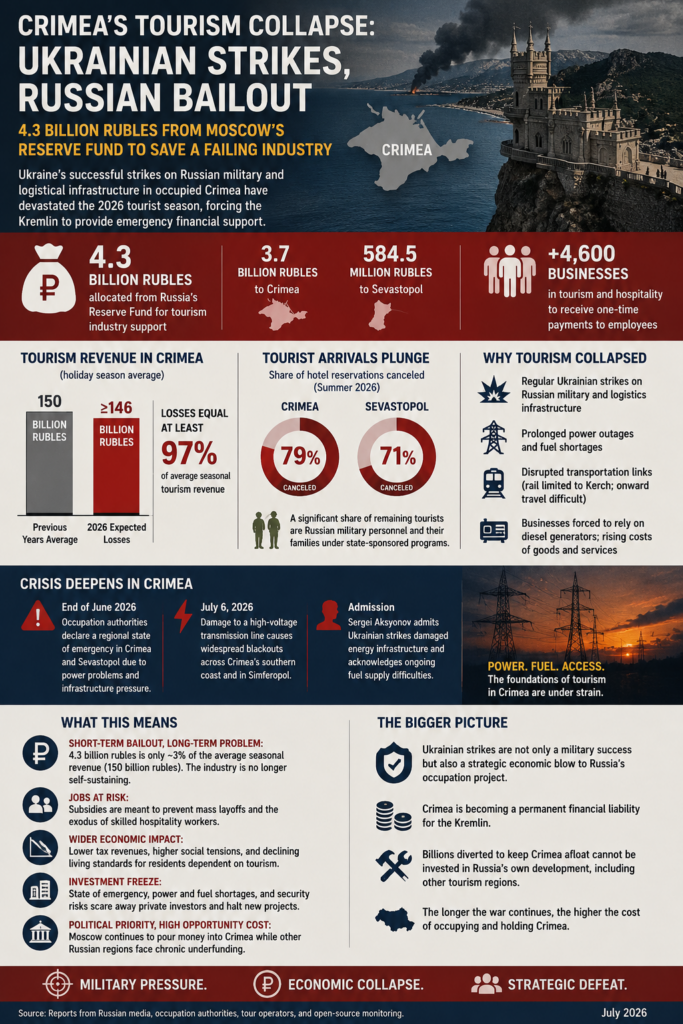
The Russian government has approved the allocation of more than 4.3 billion rubles to support the tourism sector in occupied Crimea and Sevastopol. The funds are intended to finance one-time payments to employees of more than 4,600 tourism and hospitality businesses that have found themselves “in a difficult situation due to the decline in tourist traffic caused by the actions of the Armed Forces of Ukraine.” Crimea will receive 3.7 billion rubles, while the remaining 584.5 million rubles will be allocated to Sevastopol from Russia’s Reserve Fund. In previous years, the peninsula’s tourism industry generated an average of 150 billion rubles during the holiday season. This year, however, losses resulting from the failed tourist season are expected to reach at least 146 billion rubles.
The financial assistance is directly linked to a sharp decline in visitor numbers. Tourist arrivals have fallen significantly as a result of regular strikes by the Ukrainian Defense Forces against Russian military and logistical infrastructure on the occupied peninsula. Earlier, the Association of Tour Operators of Russia appealed to the government to grant Crimean hotels special relief measures, allowing them to postpone guest arrivals or refund customers through the end of 2026.
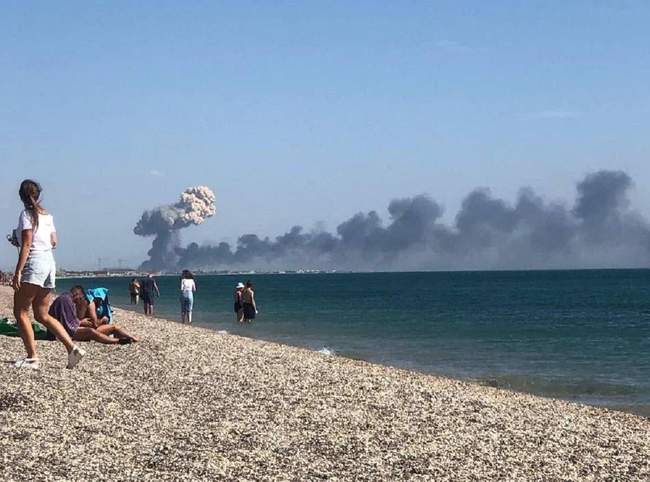
The 2026 summer tourist season in occupied Crimea has been severely disrupted by prolonged power outages, fuel shortages, and deteriorating transportation links. According to the Travelline booking system, approximately 79% of hotel reservations in Crimea and 71% in Sevastopol have been canceled. A significant share of the remaining tourist flow now consists of Russian military personnel and their family members traveling to the peninsula under state-sponsored holiday programs.
Logistical disruptions and repeated strikes against Russian military facilities have effectively limited rail service to the city of Kerch, forcing travelers to arrange onward transportation independently. Local businesses continue operating under frequent electricity shortages by relying on diesel generators, while the costs of goods and services continue to rise.
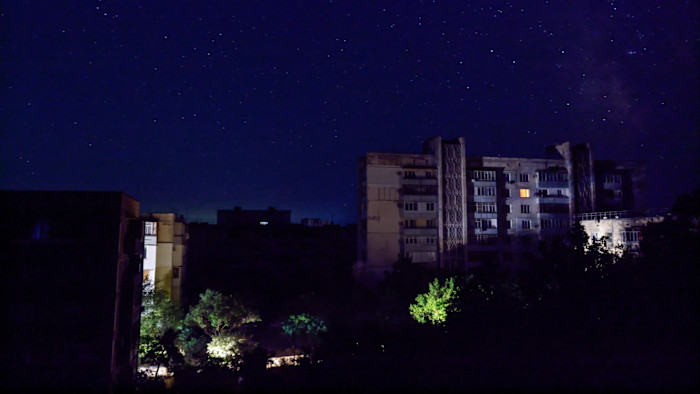
At the end of June 2026, the occupation authorities declared a regional state of emergency in Crimea and Sevastopol because of power supply problems and mounting pressure on critical infrastructure. On July 6, damage to a high-voltage transmission line caused widespread blackouts across Crimea’s southern coast and in Simferopol. The head of the occupation administration, Sergei Aksyonov, acknowledged that Ukrainian strikes had damaged regional energy infrastructure and stated that the fuel supply situation also remained difficult.
The allocation of 4.3 billion rubles from Russia’s Reserve Fund for direct payments to employees in Crimea’s tourism industry effectively represents an acknowledgment by the Russian government that the 2026 holiday season has collapsed as a consequence of successful Ukrainian military operations against Russian military infrastructure on the occupied peninsula. At the same time, the allocated funding represents only about 3% of the tourism sector’s average seasonal revenue of approximately 150 billion rubles. These emergency subsidies demonstrate that the decline in tourist arrivals and the broader infrastructure crisis have reached a level at which the industry is no longer financially self-sustaining and now depends on direct state support.
Crimea’s tourism industry has traditionally relied on a skilled workforce. Faced with a deepening crisis, the Russian government has been forced to subsidize employment in order to prevent a mass exodus of qualified personnel from the hospitality sector. These measures illustrate the severity of the downturn: widespread business closures and the loss of experienced staff would significantly undermine the industry’s long-term recovery potential. The crisis also threatens to reduce tax revenues, increase social tensions, and lower living standards for local residents whose livelihoods depend heavily on tourism.
The emergency allocation of 4.3 billion rubles from the Reserve Fund represents a short-term rescue package for a tourism industry that has lost the capacity to sustain itself because of the dramatic decline in visitor numbers following systematic Ukrainian strikes against Russian military infrastructure in occupied Crimea. The Russian government has effectively assumed responsibility for supporting payrolls at more than 4,600 businesses in an effort to prevent mass layoffs, hotel closures, and broader social instability in a region where tourism remains one of the principal sources of income.
The regional state of emergency, prolonged electricity and fuel shortages, and the need for direct financial assistance from Moscow have become major obstacles to attracting large-scale private investment to Crimea. Investors are generally unwilling to commit capital where fundamental operational and security risks cannot be adequately assessed, effectively freezing new resort and tourism development projects for the foreseeable future.
The decision to allocate billions of rubles from the Reserve Fund to stabilize Crimea’s tourism industry also underscores that the Russian leadership continues to treat the peninsula not as an ordinary federal subject but as a strategically important political and symbolic project. While many other Russian regions continue to face chronic economic difficulties without receiving comparable levels of support, Crimea remains a priority recipient of federal funding despite growing domestic fiscal imbalances.
Redirecting billions of rubles from Russia’s national development resources toward the emergency stabilization of Crimea inevitably comes at the expense of investment in new tourism infrastructure projects elsewhere, including the Caspian region, the Baltic coast, and the Russian Far East under the national tourism development program. The government is increasingly compelled to devote scarce financial resources to maintaining crisis conditions on the occupied peninsula, sacrificing development opportunities for millions of residents in other regions in order to sustain what has become one of the Kremlin’s highest-profile political projects.
The scale of the bailout illustrates the depth of the crisis. Historically, Crimea’s tourism industry generated approximately 150 billion rubles in annual revenue. Expected losses of at least 146 billion rubles indicate that the sector has lost virtually its entire commercial viability. The emergency subsidy—equivalent to only around 3% of average seasonal turnover—is therefore not intended to restore profitability but rather to prevent the immediate collapse of the labor market by temporarily financing wages for employees of more than 4,600 tourism-related enterprises.
The Kremlin’s intervention demonstrates that Crimea’s tourism sector is no longer operating as a market economy but increasingly resembles a state-subsidized strategic industry. Rather than generating sustainable commercial income, hotels, resorts, and hospitality businesses are becoming dependent on continuous federal transfers. This represents a structural transformation of Crimea’s economy from one driven by private demand to one sustained through political subsidies from Moscow.
The dramatic cancellation of hotel reservations—approximately 79% in Crimea and 71% in Sevastopol—also illustrates the growing failure of Russian domestic information management. Despite extensive state propaganda portraying Crimea as safe and prosperous, Russian citizens are increasingly making travel decisions based on perceived security risks rather than official messaging. This suggests that public confidence is becoming progressively more difficult for the Kremlin to shape where personal safety is concerned.
Another notable trend is the changing composition of tourist flows. A growing proportion of visitors now consists of Russian military personnel and their families traveling under government-funded holiday programs.Consequently, civilian tourism is gradually being replaced by state-financed institutional demand, masking the true extent of the collapse in private travel while further increasing the financial burden on the federal budget. This development reinforces the broader militarization of Crimea’s economy, where civilian sectors increasingly depend on defense-related expenditures and state-sponsored consumption.
The declaration of a regional state of emergency because of electricity shortages further demonstrates the vulnerability of the peninsula’s critical infrastructure. Repeated disruptions to the energy system significantly increase operational costs for businesses, many of which are forced to rely on diesel generators. Rising insurance costs, uncertain logistics, fuel shortages, and unstable electricity supplies collectively create conditions under which long-term private investment becomes commercially irrational.
The investment implications extend well beyond tourism. The inability to guarantee uninterrupted electricity, fuel availability, and transport connectivity substantially increases country-risk assessments for any commercial project in Crimea. For both Russian and foreign investors willing to operate under sanctions, the peninsula is increasingly perceived as a high-risk conflict zone rather than an emerging tourism destination. As a result, large-scale private investment is likely to remain frozen unless the underlying security environment fundamentally changes.
From a fiscal perspective, the rescue package highlights growing pressure on Russia’s federal finances. Every ruble allocated to emergency support for Crimea is unavailable for investment in infrastructure, healthcare, education, or tourism development in other Russian regions. Redirecting Reserve Fund resources toward sustaining Crimea therefore increases opportunity costs across the broader Russian economy while reinforcing regional disparities in federal spending.
The political symbolism of the bailout is equally significant. Since its illegal annexation in 2014, Crimea has occupied a unique position within the Kremlin’s domestic legitimacy narrative. Allowing the peninsula’s tourism industry to collapse would undermine one of Moscow’s central political achievements and weaken the image of Crimea as a successful integration project. Consequently, federal authorities appear willing to absorb substantial economic costs to preserve this narrative, even when doing so becomes increasingly inefficient from a purely economic standpoint.
The continued dependence on emergency subsidies suggests that Crimea is evolving into a permanently subsidized territory, where economic performance is increasingly disconnected from market fundamentals. Such a model is fiscally sustainable only as long as Moscow maintains both the political willingness and the financial capacity to finance the peninsula’s deficits. As Russia’s defense expenditures continue to consume an expanding share of the federal budget, maintaining this level of support may become progressively more difficult.
More broadly, the deterioration of Crimea’s tourism sector demonstrates the effectiveness of Ukraine’s strategy of targeting military and logistical infrastructure rather than civilian economic assets directly. By degrading the infrastructure that supports Russia’s military presence on the peninsula, Ukrainian operations generate substantial secondary economic effects that extend into transportation, energy, investment, employment, and regional public finances. The resulting economic pressure forces Moscow to divert increasing budgetary resources toward crisis management instead of military modernization or development elsewhere in Russia.
Ultimately, the emergency bailout highlights a broader strategic reality: Crimea is becoming less an economically productive region than a financial liability whose continued stability depends on sustained federal subsidies. The peninsula’s transformation from a showcase of Russia’s territorial expansion into a heavily subsidized strategic asset underscores the mounting long-term economic costs of maintaining the occupation under conditions of persistent military pressure.
The effectiveness of Crimea’s tourism sector has deteriorated significantly since the start of Russia’s full-scale invasion of Ukraine, although the decline has occurred in distinct phases.
| Year | Tourist arrivals | Operational assessment | Main drivers |
| 2022 | ~6.5 million | Moderate decline | Suspension of flights, Kerch Bridge attack, initial security concerns. Tourist arrivals fell by about 30% from the 2021 record of 9.4 million. |
| 2023 | ~5.0–5.2 million | Lowest post-invasion level | Continued attacks, damaged logistics, insurance risks, reduced accessibility. |
| 2024 | ~6.0 million | Partial recovery | Increased domestic subsidies, rail transport adaptation, state promotion of Crimea as a holiday destination. |
| 2025 | ~6.9 million | Recovery but below pre-war peak | Domestic tourism rebounded despite continuing military risks; official authorities claimed a 15% increase over 2024. |
| 2026 | Estimated collapse | Critical crisis | Ukrainian strikes on military and logistics infrastructure, fuel shortages, blackouts, transport disruptions, cancellation of 79% of hotel bookings in Crimea and 71% in Sevastopol, emergency federal bailout. |