
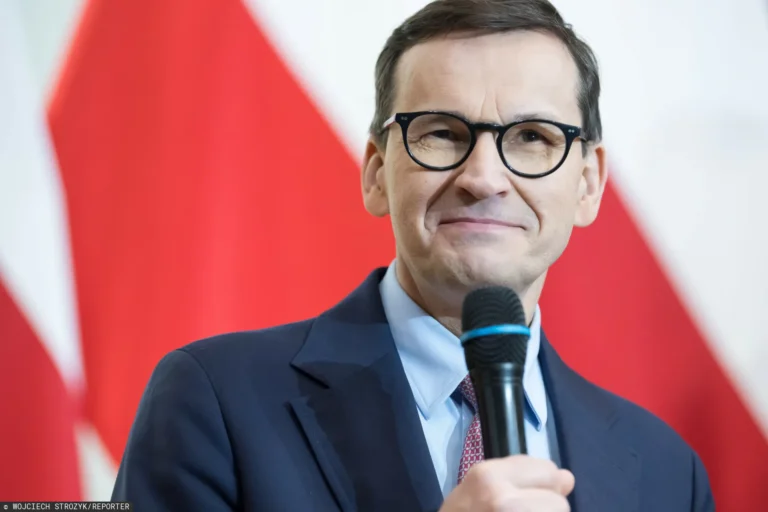
A conflict is deepening within the local structures of Law and Justice (Prawo i Sprawiedliwość, PiS) in Lublin, potentially reflecting a broader struggle over the future configuration of Poland’s right-wing conservative camp. Four city councilors have left the PiS caucus and established a separate Rozwój Plus group, while simultaneously joining the organization of the same name associated with former Prime Minister Mateusz Morawiecki. Although the councilors insist that they have not formally left PiS, the creation of a parallel political structure without the approval of the regional leadership effectively represents an erosion of party discipline and demonstrates the limits of the central party apparatus’s control over local elites.
The developments in Lublin should therefore be viewed not merely as a local personnel dispute but as a potential element of the broader struggle over the future of PiS. Since the party lost power at the national level, competition among its internal factions has intensified over personnel, local structures, and the right to determine the political direction of the Polish right. In this context, Morawiecki has an interest in developing his own network of supporters, which would reduce his dependence on the party apparatus controlled by Jarosław Kaczyński’s circle.
The creation of Rozwój Plus may serve as a form of parallel political infrastructure rather than an immediate alternative to PiS. At the current stage, leaving PiS would be politically risky for Morawiecki: the party’s brand, electoral base, and nationwide organizational network remain considerably stronger than those of any new right-wing conservative project. By building clubs, associations, and local networks instead, Morawiecki can accumulate his own political and personnel resources without immediately provoking an open rupture with Kaczyński.
In this respect, Lublin could become a testing ground. If the model under which politicians formally remain PiS members while moving into structures aligned with Morawiecki is replicated in other cities and voivodeships, it would indicate that the internal struggle is shifting from competition over individual positions to competition for control of the party’s organizational infrastructure.
Particularly significant is the fact that the split is occurring at the level of local government. Local councilors, party branches, and regional activists constitute the mobilization network on which PiS relies during parliamentary, presidential, and local elections. Losing control over this layer of the party could therefore have much more serious consequences for the leadership than isolated public disputes among national politicians.
Morawiecki’s Strategy
Morawiecki’s actions may indicate a strategy of gradually accumulating political autonomy within the Polish right. His objective is probably not the immediate creation of a new political party but rather the establishment of a sufficiently powerful network of lawmakers, local politicians, experts, and business circles to provide him with strong bargaining leverage in a future struggle for leadership of PiS.
This model allows Morawiecki simultaneously to remain within PiS and position himself as the representative of a more modernized, economically oriented, and potentially coalition-friendly center-right. This could become particularly important in the event of a future leadership transition or an intensifying debate over Kaczyński’s political legacy.
Rozwój Plus may therefore function as both a personnel reserve and an organizational platform for Morawiecki. Its real political significance will be determined not by its formal membership numbers but by its ability to attract serving PiS lawmakers, local leaders, and activists without requiring them immediately to leave the party.
Implications for PiS
For the PiS leadership, the most dangerous scenario is not an immediate formal split but rather the gradual fragmentation of the party from within. The emergence of semi-autonomous political networks enables individual factions to retain access to the PiS brand and electorate while becoming increasingly independent of the central leadership.
If the Lublin example spreads to other regions, Kaczyński could face a serious dilemma. Harsh disciplinary action against Morawiecki’s supporters could accelerate their departure and transform internal competition into an open split. At the same time, tolerating parallel political structures would gradually weaken the PiS chain of command.
The significance of the developments in Lublin therefore lies not simply in PiS losing four councilors, but in the establishment of a precedent for political autonomy within the party. If Rozwój Plus develops a network of similar groups across several voivodeships, it would indicate that Morawiecki is moving beyond personal competition with other PiS leaders toward the systematic construction of his own political base.
In the short term, the most likely scenario is that Morawiecki will not break with PiS but will instead construct a “party within the party.” In the medium term, this network could either be used to fight for control of PiS in the post-Kaczyński era or, should Morawiecki’s ambitions be blocked by the party apparatus, serve as the organizational foundation for a separate right-wing conservative political project.
The developments in Lublin should therefore be assessed as an early indicator of a potential restructuring of the Polish right. The central fault line is no longer limited to the confrontation between PiS and the current government; it increasingly concerns the struggle within PiS itself over who will control the party’s structures, electorate, and political legacy after the end of the Jarosław Kaczyński era.
Morawiecki’s Ambitions
As of September 2026, the conflict has already developed beyond a struggle over Morawiecki’s influence within PiS. More than 40 parliamentarians associated with his camp have been expelled from PiS, while Morawiecki is preparing to transform Rozwój Plus into a separate political party. He has openly argued that there is no longer a single hegemon on Poland’s political right.
Morawiecki’s principal strategic ambition is not simply to return to the premiership but to assume the role of the principal systemic leader of Poland’s center-right after Kaczyński.
To achieve this, he is pursuing several objectives simultaneously.
First, he needs to build his own nationwide party machine. Morawiecki’s team had already planned to use the summer parliamentary recess to develop Rozwój Plus structures across Poland, attracting local councilors and politicians. Lublin now demonstrates the practical implementation of this strategy. A similar group has emerged in Skarżysko-Kamienna, while Rozwój Plus representatives have openly predicted further defections by local government politicians.
Second, Morawiecki seeks to capture the more moderate segment of the right-wing conservative electorate from PiS. He has criticized the radicalization of PiS and argued that the party is losing its ability to communicate with younger voters. His prospective political project is therefore aimed at conservative but less radical voters. This distinction is important: rather than creating “another PiS,” Morawiecki appears to be seeking the political space between traditional PiS and the center-right segment of the Polish electorate.
Third, he needs to demonstrate that he—not Przemysław Czarnek, Mariusz Błaszczak, or another potential Kaczyński successor—is capable of returning the Polish right to power. Lublin is particularly symbolic in this context because the local PiS organization is headed by Czarnek, whom the party has previously presented as a candidate for prime minister. The movement of councilors toward Rozwój Plus therefore constitutes an attack not only on the regional PiS organization but also on the political base of one of Morawiecki’s potential rivals for leadership of the right.
Morawiecki is consequently building not merely another faction but an alternative center of gravity for the Polish right. His minimum objective is likely to be a double-digit result in the next parliamentary election; his maximum objective is to become the politician without whom no future right-wing government can be formed. Morawiecki himself has already argued that Poland’s right-wing parties must learn to cooperate because there is no longer a single “hegemon.”
How Kaczyński Is Likely to Respond
Jarosław Kaczyński’s response is likely to remain tough and focused primarily on preventing further personnel migration, rather than reconciling with Morawiecki.
This pattern is already visible. In the spring, Kaczyński warned that activists involved in Rozwój Plus might be denied places on PiS electoral lists. In July, the PiS leadership effectively issued an ultimatum concerning party members’ participation in political associations, while Morawiecki and his supporters indicated that they would not retreat even under the threat of expulsion. Morawiecki reportedly attempted to reach an agreement by presenting Kaczyński with a package of 21 compromise proposals, but the initiative produced no settlement.
Following the developments in Lublin, Kaczyński can therefore be expected to pursue a strategy of political isolation: preventing regional organizations and local councilors from defecting to Rozwój Plus; consolidating PiS around loyal regional leaders, particularly Czarnek; portraying Morawiecki as a politician who is splitting the right and thereby assisting Donald Tusk; limiting opportunities for Morawiecki’s allies to return to PiS electoral lists; and preventing Rozwój Plus from capturing strong local organizations with their own electoral resources.
The narrative that Morawiecki is effectively “helping Tusk” is already being employed. Kaczyński has accused him of fragmenting PiS at a politically unfavorable moment, while figures close to the regional PiS leadership in Lublin have promoted claims of a supposed “silent coalition” between the defecting councilors and Civic Coalition (KO).
Why Kaczyński Can Hardly Afford a Compromise
The central problem for Kaczyński is not Rozwój Plus itself. It is the precedent of disobedience.
If Morawiecki can attract parliamentarians, local leaders, and activists without suffering serious political consequences, other PiS factions will receive a signal that the central apparatus no longer controls politicians’ careers. This could accelerate the erosion of the hierarchical political structure Kaczyński has spent decades building.
The probability of further escalation of the conflict can therefore be assessed at approximately 75–85 percent, while the probability of a return to a stable Kaczyński-Morawiecki alliance is no higher than 10–15 percent.
The Lublin Voivodeship will be particularly important to watch. If Rozwój Plus succeeds in continuing to recruit councilors in territory controlled by Czarnek, this would suggest that Morawiecki is deliberately targeting the personnel base of a potential successor to Kaczyński.
The conflict should consequently no longer be described simply as “Morawiecki versus Kaczyński.” It is becoming a struggle over the architecture of the Polish right after Kaczyński. Morawiecki is attempting to transform Rozwój Plus into a network capable of surviving the current configuration of PiS and becoming an indispensable component of a future right-wing coalition. Kaczyński, by contrast, has a strong incentive to stop the process now because every new “Lublin” diminishes his ability to determine his own political successor.
The Morawiecki-Czarnek rivalry may ultimately prove more consequential for the future of the Polish right than the current personal confrontation between Morawiecki and Kaczyński.
How Morawiecki Could Reshape the Foreign Policy of the Polish Right
If Morawiecki’s project develops into an independent center of the Polish right, its impact on foreign policy could prove even more significant than its domestic political consequences. The reason is that Morawiecki represents a somewhat different model of right-wing foreign policy from Kaczyński’s traditional approach: firmly anti-Russian and Atlanticist, but more pragmatic toward coalition-building in Europe and much more closely connected to economic policy.
The United States as the Principal Security Anchor
For Morawiecki, the strategic center of Polish security remains Washington. In February 2026, he explicitly rejected the prospect of rapid European “strategic autonomy,” describing the United States as the military core of NATO and arguing that the American presence remains critical to deterring Russia.
A Polish right influenced by Morawiecki would therefore likely move toward the hierarchy:
Poland → United States → NATO → Central/Eastern Europe → EU
rather than: Poland → EU → European strategic autonomy.
At the same time, Morawiecki is attempting to add an economic dimension to the military alliance. His concept of an “economic NATO” envisages closer economic integration among the United States, Canada, the United Kingdom, the EU, and other allies as a counterweight to Russia and China.
This could become one of the principal foreign-policy distinctions of the Morawiecki camp.
Ukraine: Continued Support, but Increasingly Conditional
Morawiecki’s approach toward Ukraine is more complex.
Within his geopolitical vision, an independent Ukraine remains a strategic buffer between Poland and Russia. In 2026, Morawiecki has continued to identify Russia explicitly as a fundamental threat to Poland and NATO’s eastern flank.
However, his support for Kyiv could become increasingly transactional.
It would be more closely conditioned by Polish economic and political interests, including the agricultural market, competition in the transportation sector, participation by Polish companies in reconstruction, historical policy, the status of the Polish minority, and Polish companies’ access to the Ukrainian market.
The emerging formula could therefore be summarized as:
“Ukraine must defeat Russia, but Poland should not have to sacrifice its own economic interests in the process.”
This approach would allow Morawiecki to remain strategically supportive of Ukraine while simultaneously competing for voters who have become increasingly critical of unconditional assistance to Kyiv.
At the same time, Poland remains among the countries advocating more active use of frozen Russian assets to finance Ukraine.
Germany: Criticism of Berlin Will Remain, but Become More Pragmatic
This is an area where a significant difference could emerge between Kaczyński’s PiS and a Morawiecki-led right.
Kaczyński has frequently used Germany as an instrument of domestic political mobilization. Morawiecki is also capable of harsh criticism of Berlin, but the economically oriented nature of his political project gives him stronger incentives to adopt a more pragmatic approach.
Significantly, when promoting his concept of an “economic NATO,” Morawiecki has explicitly included Germanyamong its potential participants, alongside Italy, the United Kingdom, and Turkey.
His model could therefore be summarized as:
political competition with Berlin + military cooperation + economic interdependence.
Warsaw and Berlin signed a new defense cooperation agreement in June 2026 covering cybersecurity, the Baltic region, military mobility, space, and emerging technologies.
For Morawiecki, abandoning such mechanisms would be more difficult than employing anti-German rhetoric during domestic political campaigns.
The EU: Not Polexit, but an Attempt to Reshape the Balance of Power
This could become a defining feature of a prospective Morawiecki doctrine.
Politically, it would be more advantageous for Morawiecki not to dismantle the European Union but to reduce the dominance of Berlin and Paris within it.
This explains his interest in the United Kingdom, Italy, Central European countries, the Baltic states, Romania, and potentially Turkey. His “economic NATO” concept effectively seeks to expand the transatlantic system far beyond NATO’s purely military dimension.
A potential alternative to the Franco-German core could therefore be an informal axis:
Washington – London – Warsaw – Rome – Bucharest – Baltic states, with Turkey participating on selected issues.
This would represent a considerably more ambitious concept than the traditional Euroscepticism associated with PiS.
Russia: Little Room for Rapprochement
On Russia, Morawiecki differs fundamentally from parts of the European right.
His foreign-policy project is based on the assumption that the Russian threat is long-term. In February 2026, he portrayed international competition as a confrontation between the West and a Russian-Chinese bloc and described Russia as the principal threat to Poland and NATO’s eastern flank.
Consequently, even if Rozwój Plus seeks cooperation with other European right-wing parties, Morawiecki would find it difficult to accept their pro-Russian elements.
This could potentially make him the center of a distinct Atlanticist wing of the European right: conservative and Eurosceptic, but simultaneously pro-American, pro-NATO, and anti-Russian.
Central Europe Could Become the Principal Arena
Morawiecki could attempt to revive the idea of Poland as the center of a regional bloc of states located between Germany and Russia, while modernizing the concept.
This would not necessarily mean returning to the old Visegrád model, since strategic disagreements over Russia have substantially reduced its effectiveness. A more promising configuration for Warsaw could instead be:
Poland – Baltic States – Ukraine – Romania – Nordic states, with the United Kingdom and the United States serving as external strategic partners.
Ukraine is therefore important to Morawiecki not only as a state Poland supports but also as an element of a future regional security architecture. In 2026, Ukraine’s EU accession negotiations have already advanced to issues involving foreign, security, and defense policy.
The Principal Foreign-Policy Conflict Within the Polish Right Will Not Be “About Russia”
A fundamental disagreement between Kaczyński and Morawiecki over whether Russia represents a threat is unlikely. Both camps proceed from that assumption.
The real disagreement will concern what international system Poland should construct to counter Russia.
Kaczyński tends toward a model based on:
a sovereign nation-state + the United States + NATO, combined with deep skepticism toward Brussels and Berlin.
Morawiecki could offer a more complex model: a strong Poland + the United States/NATO + a coalition of Central and Northern European states + pragmatic use of the EU + a Western economic bloc against Russia and China.
This is where Rozwój Plus could become more than a domestic Polish political project. The internal struggle is already real: Kaczyński has publicly demanded loyalty from PiS members and views Rozwój Plus as a threat to party unity, while Morawiecki has refused to abandon the association. Morawiecki himself has already described the new political reality by arguing that there is “no hegemon” on the Polish right and that right-wing forces must learn to cooperate.
If Morawiecki succeeds in capturing a significant portion of the post-PiS electorate, the Polish right is unlikely to become isolationist. Instead, it could become more transatlantic, economically oriented, and coalition-driven, while remaining hard-line toward Russia, critical of supranational EU integration, and considerably more demanding toward Ukraine on issues involving bilateral Polish interests.
This may ultimately constitute Morawiecki’s principal foreign-policy ambition: to transform Poland from the West’s “eastern flank” into one of the centers that shapes Western policy itself.
Posted inIntelligence ops
More on this story: Closing Russia’s Diplomatic Back Door: Poland Targets Moscow’s Intelligence Infrastructure in Europe