

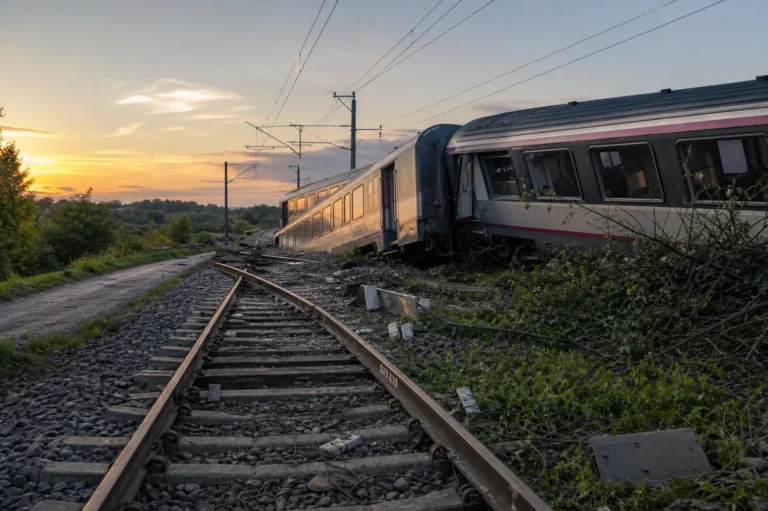
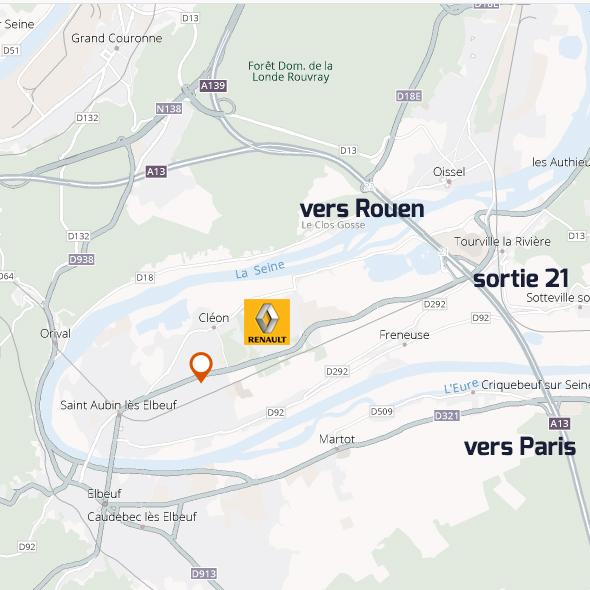
On Friday evening, At 7:45 p.m., between Tourville-la-Rivière and Elbeuf–Saint-Aubin stations, within the commune of Cléon (Seine-Maritime), approximately 15–20 km south of Rouen. AFP highlights an important detail: the site is located on a narrow bend of the Seine, immediately adjacent to the Renault plant in Cléon.a regional TER passenger train traveling between Rouen and Caen derailed in Normandy. The accident occurred near Cléon in the Seine-Maritime department. Forty-four people were injured, including an 18-year-old woman who was in serious condition, while 186 people were aboard the train at the time of the crash. French investigators are examining the possibility of sabotage after a section of rail was found on the tracks; according to AFP, the train struck it, causing the derailment.
The placement of a section of rail on the track, which caused the Normandy train crash, initially pointed to a planned act of sabotage rather than an accidental incident. Given the series of arson attacks, infrastructure damage and sabotage plots uncovered across Europe — in many of which investigators have established or reasonably suspected a Russian connection — possible Russian involvement in the incident in France appeared to be a plausible hypothesis and one that warranted priority examination.
The Normandy accident demonstrated that railway infrastructure remains a high-value potential target for sabotage. Such attacks are designed not only to physically damage tracks and trains, but also to maximize their societal impact through casualties, transport disruption and the perception that the state is unable to fully protect critical infrastructure.
The initial circumstances of the crash gave law enforcement authorities grounds to investigate deliberate interference. The train, traveling at approximately 140 km/h, struck a roughly five-meter section of rail weighing about 300 kilograms that was lying on the track. One carriage overturned and four others derailed. The discovery of such a large foreign object on the track initially made sabotage one of the priority lines of investigation.
Renault Group is directly involved in French defense projects, which makes the proximity of the Cléon derailment to a Renault industrial site more analytically interesting. But I would not yet infer that the Renault Cléon plant itself was a defense-related target.
The major change occurred in 2025–26. At the request of the French Ministry of the Armed Forces/DGA, Renault Group began applying its mass-production expertise to defense programs. Renault says its board approved participation in defense projects in July 2025, provided they are conducted under the French defense ministry, involve European defense partners, use French engineering/industrial sites, and do not undermine its automotive investment.
The most important programs are:
- CHORUS military drone. Renault and French defense-aerospace company Turgis Gaillard established cooperation to develop and industrialize the Chorus drone. Renault is responsible for product/process design and industrialization, while Turgis Gaillard handles aeronautical design, navigation software and testing. Assembly is planned at Renault’s Le Mans plant, with capacity potentially reaching 600 drones per month.
- TOUTATIS remotely operated munition / drone program. In June 2026 Renault announced cooperation with Thales. Renault contributes industrial design and high-volume manufacturing expertise. Renault says it manufactures the drone structure; installation of military payloads would occur after delivery.
- 4 TROOP multi-mission military vehicle. Renault and Thales have also developed a hybrid multi-role vehicle concept for French land forces, integrating Thales military systems into a Renault production vehicle architecture.
There is also an important historical distinction. Renault Trucks Defense is not currently Renault Group. The former Renault military-vehicle business became Arquus in 2018. It had belonged to Volvo Group and was sold in 2024 to John Cockerill Defense. Therefore, older VAB, Sherpa and other Renault-branded military vehicles should not automatically be counted as present-day Renault Group defense production.
What this means for Cléon
This creates a potentially useful KIQ for your Normandy analysis:
Does the Renault Cléon site, or the railway corridor passing it, form part of Renault’s emerging defense-industrial supply chain?
At present, I have evidence that Le Mans is involved in Chorus production, but I have not found evidence establishing that Cléon manufactures components specifically for Renault’s military-drone programs. That distinction is critical.
Cléon is nevertheless a major Renault industrial site specializing in powertrains. So the next step would be to map the CHORUS/TOUTATIS supply chain and determine whether components, engineering, suppliers or rail freight associated with those defense programs pass through Cléon–Rouen–Le Mans.
If such a connection exists, the location of the derailment near the Renault plant would become substantially more interesting from an intelligence perspective. If it does not, the geographic proximity should be treated as coincidental unless other evidence emerges.
However, subsequent investigative findings significantly changed the initial assessment. On the evening of September 12, Rouen public prosecutor Sébastien Gallois said investigators had found no evidence of a deliberate act intended to derail the train, much less grounds to characterize the incident as a terrorist attack. At this stage, therefore, there is insufficient factual evidence to link the crash to Russian sabotage activity.
At the same time, this conclusion does not diminish the strategic significance of the incident itself. On the contrary, the crash vividly demonstrated the consequences that even relatively simple physical interference with railway operations can produce. A single heavy object placed on the tracks can potentially cause mass casualties, paralyze a transport corridor and require the large-scale mobilization of emergency services. In Normandy, around 130 firefighters, five medical teams and 80 vehicles were deployed.
This vulnerability corresponds with previous assessments by the Robert Lansing Institute regarding the evolution of Russian sabotage activity in Europe. In earlier RLI publications, railway routes and freight transport were identified as components of the broader European military and defense-industrial supply chain that could potentially become targets of Russian operations. Such a target set includes manufacturing facilities, warehouses, railway hubs and routes, military sites, aviation and logistics centers, IT systems and freight transportation.
RLI has also highlighted the German case of Dieter S., who was charged by prosecutors in December 2024, including with preparing dangerous interference with railway traffic. According to investigators, his activities included reconnaissance of military freight movements and infrastructure associated with military supplies. The case demonstrated that railways are viewed not merely as a transportation system but also as an integral component of Europe’s military-logistics infrastructure.
The key unit of analysis, therefore, is not an individual train or railway line but the entire European defense supply chain. A Russian sabotage strategy could be aimed less at destroying a particular facility than at disrupting logistics flows, increasing security and insurance costs, delaying military shipments and creating persistent uncertainty about the safety of transport infrastructure.
What makes railways particularly attractive as a potential target is the asymmetry between the resources required by an attacker and the possible consequences. European networks encompass tens of thousands of kilometers of track, bridges, tunnels, switches, cable systems and signaling infrastructure. Maintaining an equally high level of physical surveillance across the entire network is virtually impossible. At the same time, damage to a small number of critical components can produce a disproportionately large impact on transportation.
For Russian intelligence services, such a model offers another advantage: plausible deniability. Physical damage to railway infrastructure can resemble a technical malfunction, vandalism, ordinary criminal activity or the actions of a radical group. Attributing an operation to a state sponsor takes considerably longer than carrying out the sabotage itself. This creates a time gap between an attack and a political response.
The psychological effect is also significant. Sabotage against a freight train can disrupt military logistics, but an attack that endangers passenger traffic can generate far greater public resonance. Casualties, images of overturned carriages, suspended services and fear of using the railway can create the impression that the state is unable to guarantee the security of basic transport infrastructure.
For this reason, the Normandy case should be viewed not as evidence of Russian sabotage but as a stress test that inadvertently demonstrated a scenario RLI had previously warned about. Even if the French investigation ultimately establishes a technical or other non-deliberate explanation for how the section of rail came to be on the track, the scale of the consequences shows how significant the effects of a deliberate operation of a similar type could be.
For European security services, this means moving from protecting individual strategic facilities toward defending the transport system as a network. Particular attention should be paid to sections used simultaneously for passenger services and for the movement of military equipment, ammunition, fuel and other cargo connected to support for Ukraine and the reinforcement of NATO’s eastern flank.
The strategic significance of the Normandy crash, therefore, does not lie in proving that a Russian operation took place. On the contrary, the information currently available does not support such a conclusion. Its importance lies in demonstrating in practical terms a vulnerability that Russian intelligence services could potentially exploit: low-cost interference with railway infrastructure can generate a disproportionately large physical, logistical and psychological effect.RLI’s warnings regarding railway routes, logistics hubs and freight transport as potential elements of the Russian target set therefore remain relevant regardless of the French investigation’s final conclusion about the crash near Cléon.

More on this story: Kremlin operations increase risks for European railways.
More on this story: Rails at Risk: NATO’s Most Exposed States and the Logic of Sabotage