
South Sudan is formally scheduled to hold its first national elections since independence on 22 December 2026. President Salva Kiir’s government insists that the vote will proceed, and in recent months it has amended the peace agreement and transitional constitutional framework to remove two major prerequisites: completion of a permanent constitution and a national population census before polling day.
Yet, as of mid-September, the central question is no longer simply whether South Sudan can physically organize an election. It is whether it can hold an election capable of producing a recognized political outcome without destabilizing the state.
Technically, Juba may still be able to stage some form of voting on 22 December. But a genuinely competitive, nationwide, inclusive and credible election is becoming extremely difficult. The most striking indicator is that, only about three months before polling day, South Sudan still has no electoral register and voter registration has not begun. The National Elections Commission (NEC) confirmed this itself in September.
The deeper problem is political. The 2018 peace settlement was designed around a sequence: peace agreement → security-sector unification → constitution → census → electoral framework → elections → end of transitional power-sharing.
South Sudan is now effectively attempting to reverse that logic: elections first → unresolved constitutional, security and state-building questions afterward.
This creates the possibility that elections will cease to function as an exit from the transition and instead become a mechanism for converting Salva Kiir’s transitional authority into electoral legitimacy while much of the opposition contests the rules of the process.
The statement that elections are “no longer possible” should therefore be qualified. A ballot may still be possible. A credible democratic transition through elections is increasingly improbable under present conditions.
South Sudan has never held a national election as an independent state
South Sudan became independent in July 2011. Salva Kiir has nevertheless remained the country’s dominant political leader throughout the period, without a post-independence national election transferring or renewing power through a competitive democratic process.
Elections have repeatedly slipped—scheduled processes were postponed in 2015, 2018, 2020, 2022 and 2024. The current deadline is December 2026.
This means that the December election carries considerably more political weight than an ordinary presidential contest.
It is supposed to terminate a transitional political system that has lasted for years and replace legitimacy derived from peace agreements and elite power-sharing arrangements with legitimacy derived from voters.
Failure therefore creates two competing legitimacy problems.
If elections are postponed again, Kiir and the transitional elite continue governing without a popular mandate.
But if elections are held under conditions rejected by significant opposition forces, the government may obtain a formal electoral mandate without acquiring broadly recognized political legitimacy.
That second outcome could prove more destabilizing.
The electoral clock has almost run out
The most concrete problem is extraordinarily simple: South Sudan does not yet have voters registered for the election.
On 2–3 September, the NEC was still training electoral officials on voter-registration procedures. The commission explicitly stated that:
“No voter has been registered anywhere in South Sudan.”
Registration is intended to be conducted manually and in person, after which the information will be entered into computer systems.
That leaves roughly three months to accomplish an enormous chain of operations: registration → preliminary voter roll → corrections/challenges → final register → candidate procedures → ballot production → distribution → polling → counting → dispute resolution.
And this must occur across a country with extremely poor transport infrastructure, displaced populations and continuing insecurity.
The problem is therefore not merely that preparations are “behind schedule.” Several sequential processes that normally require months are being compressed into weeks.
RJMEC, the body monitoring implementation of the peace agreement, has consequently described election preparations as significantly behind schedule and warned that critical prerequisites for credible, peaceful and inclusive elections remain unresolved.
There is no contemporary census
South Sudan also lacks the demographic foundation normally used to construct an electoral system.
Its last major population census was conducted in 2008, before independence and before years of civil war and enormous population displacement.
Since then, South Sudan has experienced civil war, ethnic violence, internal displacement, refugee movements, return migration and major demographic changes.
That creates an extraordinarily sensitive question: How many voters live where?
This is not merely technical.
Population determines constituencies and therefore political representation. In South Sudan, constituency boundaries can influence the balance between communities, regions and political networks.
The existing election law envisioned constituency delimitation tied to demographic information. The Sudd Institute identified the contradiction clearly: without a population census, the NEC could not readily allocate the additional constituencies envisaged under the electoral framework.
Kiir’s government has effectively resolved the immediate obstacle by changing the rules. Parliament and the president have removed the requirement that the census be completed before elections.
Legally, this makes an election easier to stage.
Politically, however, it does not answer the underlying question:
on what demographic basis should representation be allocated?
South Sudan is preparing to elect a government before defining the permanent constitutional system it will govern
The second prerequisite removed by the government is the permanent constitution.
The 2018 peace architecture envisaged elections occurring after a permanent constitutional framework had been established.
That has not happened.
International IDEA notes that the prerequisites originally agreed for elections—including a new constitution, census and unification of security forces—have failed to materialize amid political mistrust and lack of implementation.
The government has therefore changed the sequence by decoupling elections from completion of the permanent constitution.
This solves a deadline problem but creates a legitimacy problem.
South Sudan could elect a president and legislature before definitively settling the constitutional distribution of powers under which those elected institutions are supposed to operate.
That leaves future disputes over presidential authority, federal arrangements, state powers and institutional checks potentially unresolved.
In a consolidated democracy, such ambiguities might be resolved judicially.
South Sudan does not possess sufficiently strong and independent institutions to assume that constitutional disputes will remain purely legal disputes.
They can become political—and potentially armed—contests.
The collapse of the Kiir–Machar arrangement is even more serious than the technical problems
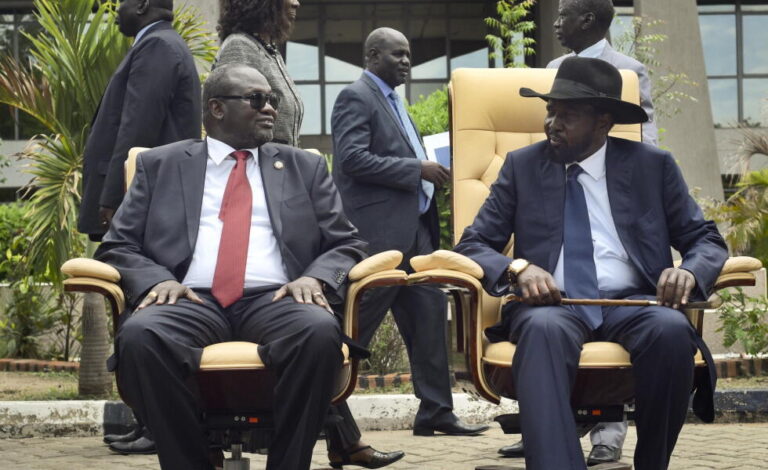
The decisive issue is the deterioration of the political settlement between President Salva Kiir and his longtime rival Riek Machar.
The 2018 Revitalized Agreement was fundamentally an elite peace bargain designed to stop the civil war and incorporate competing armed-political blocs into a transitional government.
Machar became First Vice President.
But renewed fighting in Upper Nile in 2025 led to his detention and criminal prosecution, severely weakening the political foundation on which the transition was constructed. The Africa Center notes that clashes involving forces associated with Machar culminated in his house arrest and serious charges against him and his allies.
This produces an obvious electoral dilemma.
If Kiir contests the election while Machar—or a substantial component of the political-military opposition—is unable or unwilling to participate under accepted conditions, the election risks becoming less a competitive transition than ratification of the existing balance of power.
Opposition actors are already challenging this process. The United People’s Alliance, for example, has rejected the December election timetable, arguing that the legal, constitutional and security conditions required for a credible election have not been established.
The security forces remain part of the political conflict
This is arguably the most dangerous unresolved prerequisite.
The peace agreement envisaged the creation of unified national security forces.
That process remains incomplete.
Instead, parts of South Sudan’s security architecture continue to reflect political, ethnic and personal loyalties. The Africa Center describes the security sector as resembling a collection of forces linked to individual political actors rather than a genuinely unified national institution.
That fundamentally changes the meaning of an election.
In a functioning electoral system: political parties compete → voters choose → security forces protect the process.
In South Sudan there is a danger of: political-military networks compete → armed structures influence territory and voters → disputed results become security confrontations.
This is why security-sector reform was supposed to precede elections. Without it, losing an election may not simply mean losing office. For some elite networks it could mean losing access to state resources, patronage, security protection and military influence.
The incentives to accept defeat are therefore weak.
Displacement makes the electorate itself difficult to define
South Sudan’s wars have produced enormous population movements.
Large numbers of citizens remain internally displaced or refugees, while the war in neighboring Sudan has generated further movements of refugees and returning South Sudanese.
The Africa Center estimates that the Sudan war has pushed approximately 870,000 South Sudanese returnees back into the country while South Sudan has also received hundreds of thousands of Sudanese refugees.
For election administrators this creates difficult questions: Where do displaced South Sudanese register?
Where do they vote?
What constituency do they belong to?
Can refugees abroad vote?
What documentation proves eligibility?
How can registration be conducted in insecure or inaccessible areas?
Without a recent census and existing voter register, these problems become particularly serious.
Money is another constraint—but it is not the fundamental one
The electoral institutions are also underfunded.
The NEC has repeatedly lacked adequate resources, while other institutions involved in the constitutional and political process have reported delayed or insufficient funding.
UNMISS has similarly warned that minimal funding has reached electoral institutions while legal and security preparations remain incomplete.
Money matters enormously because South Sudan presents exceptional logistical difficulties.
But the funding problem can obscure the deeper issue.
South Sudan’s election crisis is not fundamentally logistical. It is political.
With sufficient outside assistance, ballots, registration materials, polling stations and transportation can potentially be organized.
International donors cannot manufacture political consensus between armed competitors.
Why Kiir nevertheless wants the election
This is the central political question.
From Kiir’s perspective, another extension of the transitional government has costs.
Every postponement reinforces the argument that South Sudan is governed by a political elite unwilling to submit itself to voters.
An election offers an alternative source of legitimacy.
Instead of: Kiir = transitional president under an repeatedly extended peace agreement
the political objective becomes: Kiir = elected president of South Sudan.
This would profoundly change his domestic and international position.
It would also allow the government to declare the transitional era formally over.
This helps explain why the government has chosen to remove electoral prerequisites rather than wait until they are completed.
In April, Kiir’s government was already seeking amendments to the 2018 agreement specifically to create a legal route toward elections without first completing the constitution and census.
Those changes have now substantially advanced.
This suggests that Juba’s priority has shifted from: fulfilling the peace agreement before elections
to: altering the peace framework sufficiently to permit elections.
That distinction is strategically important.
Why an election could trigger rather than resolve instability
South Sudan’s political economy makes elections unusually dangerous.
Political office controls access to oil revenues, appointments, security structures, patronage and economic networks.
Consequently, electoral defeat can impose far greater costs on political elites than it does in consolidated democracies.
The political system therefore contains elements of winner-takes-all competition—a problem International IDEA has specifically identified as requiring constitutional reform.
This creates a dangerous sequence:
disputed electoral rules
↓
opposition rejection or boycott
↓
Kiir victory
↓
allegations of illegitimacy
↓
political protests / repression
↓
mobilization of armed networks
↓
localized clashes
↓
risk of broader conflict
The paradox is therefore that elections intended to terminate the transition could instead become the event that destroys what remains of the 2018 peace architecture.
Is it accurate to say elections are “no longer possible”?
Not literally.
The NEC continues to prepare for polling on 22 December 2026, and the government has changed the legal framework specifically to enable the vote.
Therefore, saying that elections are technically impossible would go too far.
A more accurate analytical distinction is:
| Scenario | RLI assessment |
| Some form of election held on 22 December | Still possible |
| Nationwide administratively functional election | Increasingly difficult |
| Free and genuinely competitive election | Low probability under current conditions |
| Election accepted by major political actors | Low probability without new political agreement |
| Election producing a stable democratic transition | Very low under the current trajectory |
The strongest warning sign is the calendar. As of September, voter registration has not even begun.
South Sudan therefore faces a shrinking set of choices.
Three plausible scenarios
Scenario 1 — Election proceeds: ~45%. Kiir’s government pushes forward, registration is rapidly organized, constitutional and census requirements remain deferred, and elections are conducted with substantial opposition objections. Kiir or the SPLM enters the contest with overwhelming institutional advantages. This is the scenario with the greatest risk that an election occurs without resolving the legitimacy crisis.
Scenario 2 — Another negotiated postponement: ~35%. Regional actors, international partners and South Sudanese political factions conclude that the December timetable has become untenable. A further transitional arrangement is negotiated, possibly tied to concrete deadlines for registration, security reform and political dialogue.
Scenario 3 — Electoral process collapses amid a broader political/security crisis: ~20%. Escalating violence, opposition exclusion, institutional paralysis or elite fragmentation makes even a managed December election impossible. This would present the greatest danger of renewed large-scale conflict.
The fundamental obstacle to South Sudan’s December 2026 elections is not the absence of ballot boxes, census data or electoral funding individually.
It is the failure to complete the political transformation that elections were supposed to conclude.
The 2018 peace agreement assumed that South Sudan would first create sufficiently consensual rules and institutions and then ask political competitors to contest power through elections.
Instead, the country is approaching elections while the constitution remains transitional, the census has not been completed, voter registration has not begun, security forces remain insufficiently unified, major political actors dispute the process, and the Kiir–Machar power-sharing settlement has been severely damaged.
The government has responded by removing some prerequisites from the legal timetable rather than completing them.
That may make 22 December legally possible.
It does not necessarily make it politically viable.
South Sudan is approaching the point at which the distinction between “holding an election” and “conducting a democratic transition” becomes decisive. Juba may still possess enough administrative and coercive capacity to stage voting on 22 December 2026. It increasingly lacks the political consensus, institutional preparation and security environment required for the result to function as a broadly accepted transfer of legitimacy. Under these conditions, an election could cease to be the solution to South Sudan’s prolonged transition and instead become the trigger for its next political crisis.
A particularly important indicator to watch over the next 4–6 weeks is therefore not simply whether voter registration begins, but whether Kiir’s government can reach an inclusive political agreement with opposition forces on participation, security guarantees, voter registration and acceptance of results. Without such an agreement, even rapid technical progress by the NEC would not solve the central problem.
More on this story: Polls in South Sudan Unlikely to Prevent Further Violence