
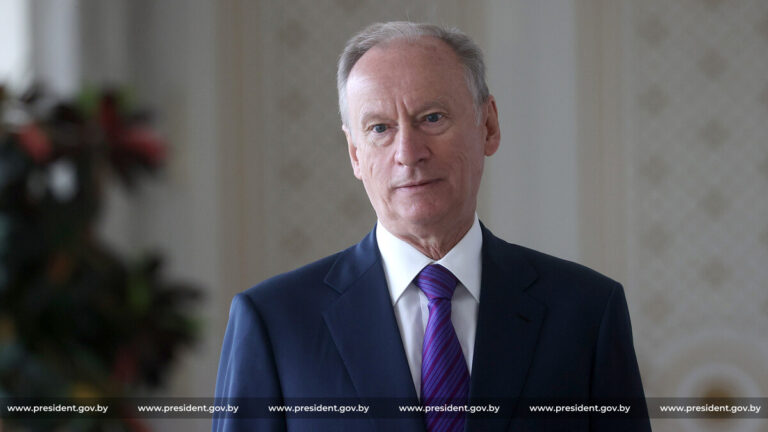
On September 15, 2026, Russian presidential aide and former Security Council Secretary Nikolai Patrushev issued a direct threat against Poland, saying that in the event of a military conflict Moscow would employ “the entire arsenal” of forces and capabilities at its disposal and that Polish statehood could allegedly “cease to exist within two or three days.” Patrushev did not specify whether “the entire arsenal” included nuclear weapons, but the wording deliberately leaves room for such an interpretation.
The statement came in response to remarks by Polish Deputy Prime Minister and Foreign Minister Radosław Sikorski, who was speaking not about Poland’s military superiority over Russia, but about NATO’s advantage in the event of a Russian attack on the Alliance. Sikorski emphasized, in particular, the air power of NATO’s European members, which he said possess around 2,500 military aircraft. He later clarified separately that he was referring to a potential Russia-NATO conflict, not a bilateral Russian-Polish war.
Patrushev therefore effectively substituted a different proposition for Sikorski’s original argument. Instead of discussing the balance of forces between Russia and NATO, he reframed the issue as a “Russia versus Poland” scenario and concluded with a threat to destroy Polish statehood.
This makes the statement more useful to analyze as an operation of strategic intimidation than as a military forecast.
The Threat Is Addressed Not Only to Warsaw
The primary audience for Patrushev’s statement is not Poland’s military leadership. Warsaw understands that an attack on Poland would mean a conflict not only with the Polish Armed Forces but with a NATO member state.
A more important audience is European public opinion.
Moscow is constructing a deliberately simple causal chain: Poland’s military strengthening → confrontation with Russia → uncontrolled escalation → destruction of Poland.
The Kremlin is thus attempting to raise the psychological cost of policies aimed at deterring Russia. The objective is not necessarily to convince Europeans that Poland could realistically be destroyed within 48–72 hours. It is enough to amplify fears that further Polish rearmament, continued support for Ukraine, or a tougher NATO posture could draw Europe into a direct war with a nuclear power.
It is particularly significant that the threat came as Poland was strengthening protection of critical infrastructure and border crossings following Russian strikes near the Polish-Ukrainian border. On September 15, the Polish Defense Ministry announced additional reinforcement of the Dorohusk, Medyka and Korczowa areas.
Patrushev’s message can therefore be read as an attempt to shift the Polish debate from “how much more must be done to deter Russia?” to “could strengthening our defenses itself provoke a catastrophic Russian response?”
From “Kyiv in Three Days” to “Poland in Two or Three Days”
The most striking feature of Patrushev’s statement is its time horizon: two or three days.
It inevitably invites comparison with Russia’s expectation of a rapid Ukrainian collapse at the beginning of the full-scale invasion in 2022.
An important factual qualification is necessary, however. The phrase “take Kyiv in three days” was not an officially announced Kremlin timetable for the military operation. It became shorthand for Russia’s initial concept of operations and expectations of the Ukrainian capital’s rapid fall. Before the invasion, some Western assessments also suggested that Kyiv might fall within roughly 72 hours. Once the invasion began, the nature of the Russian operation—the airborne assault on Hostomel, the rapid advance toward the capital and attempts to paralyze Ukraine’s leadership—confirmed that Moscow expected a much faster political and military outcome than it ultimately achieved.
The Russian plan failed. Three days later Kyiv remained under Ukrainian control, and by late March and early April 2022 Russian forces were compelled to withdraw from northern Ukraine.
This is why Patrushev’s 2026 statement creates a paradoxical information effect.
2022: Russia expects the rapid paralysis of the Ukrainian state → Kyiv does not fall → the war turns into a multi-year conflict.
2026: Patrushev threatens the rapid destruction of Polish statehood → again invokes a 48–72-hour horizon → but this time the target is a NATO member backed by a far more powerful system of alliance guarantees.
It is telling that Sikorski himself has already exploited precisely this weakness in Russian rhetoric in his response to Patrushev, recalling earlier threats that Ukrainian statehood would be destroyed within three days and noting that the war is now in its fifth year.
“Three Days” as a Psychological Construct
Patrushev’s figure should therefore be analyzed not as a genuine operational calculation by the Russian General Staff but as a psychological marker of absolute superiority.
The “two or three days” formula performs several functions at once.
First, it seeks to negate the effectiveness of Poland’s rearmament. Moscow is attempting to create the impression that regardless of how many tanks, air-defense systems, aircraft or long-range weapons Warsaw acquires, Russia still possesses such escalation superiority that Polish resistance would ultimately be futile.
Second, it seeks to cast doubt on NATO’s practical value. If Poland could “cease to exist” within 48–72 hours, the Kremlin-imposed question becomes whether the Alliance would be able to defend it in time. The Russian message is therefore aimed not only at Poland but also at confidence in the collective-defense mechanism.
Third, Patrushev’s phrase “the entire arsenal of forces and capabilities” creates nuclear ambiguity. He does not explicitly threaten the use of nuclear weapons, but neither does he exclude them. This allows Moscow to generate the psychological effect of a nuclear threat without formally declaring an intention to use nuclear weapons.
An Important Difference from Ukraine
The comparison with 2022 should not obscure a fundamental difference.
Ukraine was not protected by NATO’s Article 5 when Russia invaded. Poland is.
Destroying Polish statehood within “two or three days” would therefore imply not simply a Russian-Polish war. It would amount to a large-scale attack on NATO, with the risk of involving other allies and potentially triggering nuclear escalation.
For this reason, Patrushev’s threat should not be interpreted literally as a credible forecast of how long a possible war would last. Its strategic significance lies elsewhere: one of the figures closest to Putin within Russia’s security establishment is publicly placing the destruction of a NATO member state within the permissible space of official Russian rhetoric.
That is more significant than the “two or three days” figure itself.
Moscow Is Trying to Create an Asymmetry of Fear
Patrushev’s statement also illustrates a characteristic feature of Russia’s deterrence strategy.
Sikorski speaks in terms of the material balance of power—the number of aircraft, NATO’s capabilities and the Alliance’s ability to strike Russia’s military-economic infrastructure.
Patrushev responds not with a comparable assessment of capabilities but with a threat to eliminate a state.
This suggests an attempt by Moscow to shift the discussion from conventional balance to escalation dominance.
The Russian message can be summarized as follows:
“You may have more aircraft, a stronger economy and a more powerful alliance, but we are prepared to escalate to a level you are not prepared to reach.”
This asymmetry of fear is one of the principal instruments of Russian strategic coercion.
Why Poland?
The choice of Poland as the target is also unlikely to be accidental.
Warsaw is one of the key centers of support for Ukraine, an important logistics hub for Western military assistance and one of the most active advocates of strengthening NATO’s eastern flank. In September, Russian strikes had already taken place near key transport crossings on the Polish axis; Moscow said it was targeting infrastructure associated with European military cargo.
Patrushev’s threat may therefore pursue a broader objective: increasing the political and psychological cost of Poland’s role as a rear logistics hub supporting Ukraine.
In this context, Poland is not simply another European state from Moscow’s perspective. It is a critical element of the system connecting Ukraine with NATO.
Key Assessment
Patrushev’s statement is not a convincing military forecast of Russia’s ability to eliminate Polish statehood within two or three days. It is more appropriately viewed as an element of strategic intimidation designed to create the impression that any direct confrontation with Russia would automatically escalate to a level at which NATO’s conventional balance of power would cease to matter.
The comparison with Russia’s expectation of a rapid Ukrainian collapse in 2022 makes this rhetoric internally contradictory. Russia has already demonstrated the limitations of the concept of rapidly destroying an adversary politically: an operation designed to paralyze the Ukrainian state quickly turned into a multi-year war.
Yet the failure of 2022 may itself help explain why Moscow now emphasizes “the entire arsenal” in the Polish case rather than conventional military victory. Patrushev effectively shifts the argument from “Russia can win quickly” to “Russia can make the cost of war unacceptable.”
The central signal is therefore not “Poland in three days,” but something broader: Moscow is attempting to convince Europeans that NATO’s military superiority does not guarantee security because Russia is prepared to threaten escalation to an extreme level.
For Warsaw and NATO, this means that the relevant issue is not whether Russia’s “two-day” or “three-day” scenario is credible, but whether collective deterrence remains convincing. If threats of catastrophic escalation begin to affect decisions on defense spending, support for Ukraine or force deployments on the eastern flank, strategic coercion can achieve part of its purpose without ever being carried out.
A threat voiced by Nikolai Patrushev carries a different political weight from a comparable statement by Dmitry Medvedev. Patrushev’s authorship itself increases the signaling significance of the message.
Why Patrushev, Not Medvedev?
Patrushev is not a typical public provocateur within the Russian system. He served as Secretary of the Security Council from 2008 to 2024, previously headed the FSB, and remains a presidential aide and participant in Security Council meetings. His longstanding position and extensive network across the security and intelligence establishment give his statements particular institutional significance.
That is why the claim that Poland could “cease to exist within two or three days” carries a different resonance when voiced by Patrushev. He said Russia would employ “the entire arsenal of available forces and capabilities,” without specifying whether that included nuclear weapons.
Increasing the credibility of the threat. In recent years Medvedev has regularly acted as one of the Kremlin’s most aggressive public commentators. Only days before Patrushev’s statement, he himself threatened that under a certain scenario “Lithuania would disappear from the map of the world” and referred to the possibility of nuclear weapons being used under Russia’s doctrine.
Because such statements from Medvedev have become frequent, the Kremlin retains greater room to distance itself from them as the personal rhetoric of the deputy chairman of the Security Council. That is harder to do with Patrushev. His professional background is directly embedded in Russia’s national-security establishment.
The distinction can therefore be formulated as follows: Medvedev generates noise and maximizes fear; Patrushev gives the threat greater institutional weight.
This is an analytical interpretation, not evidence of a formally confirmed division of roles inside the Kremlin.
The immediate target was Poland’s assessment of the military balance. Patrushev was responding directly to Radosław Sikorski, who had spoken about NATO’s superiority, particularly in air power. His answer was therefore framed not merely as an insult to Poland but as a counterargument about military potential: Sikorski allegedly underestimates Russia; Moscow is not using its full capabilities against Ukraine; and in a war with Poland it would employ “the entire arsenal.”
Patrushev’s construction is more elaborate: “You are misjudging our military potential → the war in Ukraine does not demonstrate it in full → there will be no such restraints in a war with Poland → Polish statehood will be destroyed.”
This logic makes the statement an element of strategic deterrence messaging rather than merely a propagandistic invective.
Russia may be attempting to compensate for the loss of credibility of its conventional deterrence. This is especially relevant after four and a half years of war against Ukraine.
Moscow’s problem is that a threat such as “we will quickly defeat Poland with conventional forces” would appear far less credible after the failure of the opening operation against Ukraine. Patrushev therefore uses a different construction: “the entire arsenal of forces and capabilities.”
The phrase deliberately leaves the boundary between conventional and nuclear capabilities undefined.
The Kremlin therefore does not need to prove that the Russian military could conquer Poland within 72 hours. It is enough to create a different perception: if war begins, Russia will not accept the constraints of a conventional conflict and may escalate to a level intended to make NATO’s conventional military advantage irrelevant.
That is why the word “arsenal” in Patrushev’s statement is more important than “two or three days.”
But There Is Another Important Detail: Medvedev Had Already Threatened Lithuania
This makes the sequence of statements particularly significant.
On September 11, Medvedev said that if Lithuania changed its non-nuclear status, Russia would be forced to respond, claimed that NATO would not protect Vilnius, and said that “Lithuania would disappear from the map of the world.”
On September 15, Patrushev said that in the event of war, “Polish statehood would cease to exist within two or three days.”
Within a matter of days, therefore, two senior representatives of Russia’s security establishment employed almost the same concept: the physical disappearance of a NATO member state.
This is more important than the identity of either individual speaker.
If similar statements are repeated by other representatives of the Russian leadership, that would provide a stronger indicator that this is not a series of isolated emotional remarks but part of a broader communication line: Baltic/Polish military strengthening → NATO may not protect you → confrontation with Russia → destruction of statehood.
Why Patrushev Is Particularly Significant in the Polish Context
There is also a narrower explanation. Patrushev has long represented the worldview of Russia’s security establishment, in which Poland is seen not simply as an unfriendly state but as an important component of U.S. and NATO infrastructure on the Alliance’s eastern flank.
His response to Sikorski may therefore be directed at more than Polish public opinion.
Its audiences are simultaneous:
Warsaw — “further military strengthening will not make you safer”;
NATO — “the Alliance’s conventional superiority does not guarantee a controlled war”;
Western Europe — “Poland’s policy could drag you into catastrophic escalation”;
the Russian domestic audience — “the failure to defeat Ukraine quickly does not mean Russia has lost the ability to destroy a much stronger adversary.”
The last component is especially important in the context of the “Kyiv in three days” parallel.
What is significant is not only the substance of the threat but also the identity of the person delivering it. In recent years the Kremlin has often transmitted comparable statements through Dmitry Medvedev, whose regular escalation rhetoric allows Moscow both to intimidate Western audiences and to preserve a degree of distance between such threats and the Russian president’s formal position. In the Polish case, however, the threat was voiced by Nikolai Patrushev—a former FSB director and longtime Security Council secretary who remains a representative of Russia’s security establishment and participates in Security Council work under Putin. This gives the statement additional signaling weight.
A more important indicator, however, is the sequence of similar statements by senior Russian officials. On September 11, Medvedev said that under a certain scenario “Lithuania would disappear from the map of the world”; on September 15, Patrushev predicted the end of Polish statehood within “two or three days.” Repetition of the formula of the physical disappearance of NATO states may indicate the emergence of a broader narrative of strategic intimidation directed at the Alliance’s eastern flank.
Particularly important is Patrushev’s use of the phrase “the entire arsenal of forces and capabilities.” Unlike an ordinary threat of Poland’s military defeat, this wording deliberately leaves the boundary between conventional and nuclear escalation undefined. Moscow is effectively answering Sikorski’s argument about NATO’s conventional superiority with a threat to change the level of the conflict itself. The Russian signal is not necessarily that Russia could defeat Poland with conventional forces within 48–72 hours, but that in a direct confrontation Moscow threatens to escalate to a level at which NATO’s conventional military advantage would supposedly cease to matter.
In this context, the distribution of roles between Medvedev and Patrushev may be more important than their individual statements. Medvedev normalizes the most radical scenarios in the public sphere; Patrushev, because of his longstanding status within Russia’s security establishment, can give comparable threats greater institutional weight. If this pattern is repeated, it would be more appropriate to assess it as an element of multilayered Russian coercive messaging toward NATO rather than as a series of isolated provocations.If the formula about Poland potentially “disappearing” is subsequently echoed by the Foreign Ministry, the Kremlin, or linked explicitly to Russia’s nuclear doctrine, that would provide much stronger evidence of a coordinated escalation-signaling campaign than Patrushev’s statement alone.

More on this story: Psychological profile of the Secretary of the Russian Security Council