

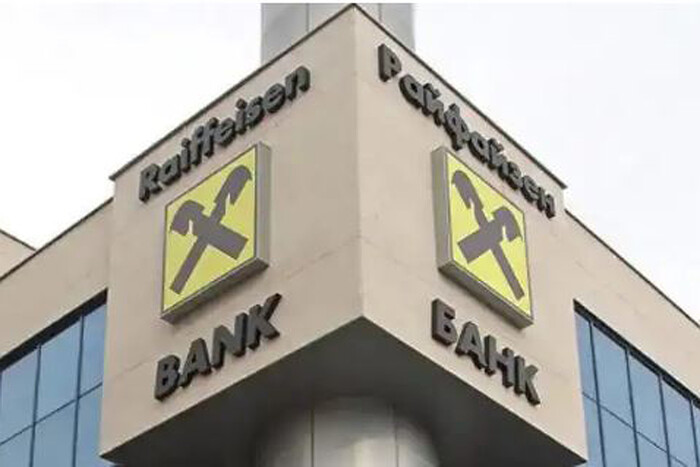
The U.S. investment firm Grizzly Research published a report alleging that Raiffeisen facilitated sanctions circumvention and Russia-related trade worth $1.19 billion. During its investigation, the firm identified customs documents linked to trade in sanctioned goods that contained the contract registration code of Raiffeisen’s Russian subsidiary, JSC Raiffeisenbank. The bank’s management said the Grizzly Research report was misleading and contained factual errors.
After Western banks withdrew from Russia in 2022 and Russian state banks were disconnected from the SWIFT international messaging system, Raiffeisen Bank International’s Russian subsidiary became a major financial hub for Russia’s foreign trade. Payments for raw-material exports and imports, including parallel imports, have passed through the bank. Scrutiny of Raiffeisen over possible sanctions circumvention has intensified because it remains one of the few major unsanctioned Western-owned banking platforms with access to international settlement infrastructure for Russian business. Allegations concerning more than $1 billion in trade have raised questions about whether the bank’s infrastructure was used in purchases of restricted goods for the Russian market. Raiffeisenbank details appearing in customs declarations indicate that the relevant foreign-trade contracts were linked to the bank, although the customs records alone do not establish that Raiffeisen executed the underlying payments. For the Kremlin, preserving such connectivity helps reduce shortages and sustain strategic procurement despite Western restrictions.
Russian restrictions prevent the Austrian bank from rapidly winding down its business and repatriating its funds. Billions of euros in group profits are effectively trapped in Russia, while the sale of the subsidiary is constrained at the official level. The Kremlin keeps the bank within its jurisdiction in order to use its capital while simultaneously complicating coordination of sanctions policy among the United States, the European Union, and Austria.
The Kremlin has effectively turned Raiffeisen Bank International’s Russian subsidiary into a major financial channel supporting foreign trade. The disconnection of state-owned banks from international settlement infrastructure meant that Moscow redirected a significant share of export-import payments toward a bank that had not been placed under sanctions.
Russian importers extensively use Raiffeisen banking details and codes in customs declarations. The continued availability of a functioning European payment network gives Moscow additional opportunities to circumvent financial barriers, helping sustain procurement financing and the import of equipment, raw materials, and components subject to international restrictions.
Moscow has deliberately delayed and obstructed the sale of the European bank’s Russian subsidiary, keeping billions of euros in accumulated profits and capital inside the country. By imposing strict regulatory barriers and restrictions on dividend repatriation, the Kremlin retains significant leverage over the financial institution, potentially enabling it, under the threat of asset confiscation, to pressure the bank’s management to continue international transactions that benefit the Russian economy.
The investigation into Raiffeisen Bank International suggests that its infrastructure may have been used as a financial channel for Russian trade in goods subject to Western sanctions and export controls. According to Grizzly Research, customs records from 2022–2025 identified $1.19 billion in trade involving such goods, including $106.7 million involving products included on the Common High Priority List relevant to Russia’s military-industrial base. This indicates that the continued presence of Western banking infrastructure in Russia creates additional opportunities for sanctions circumvention and helps preserve the Russian economy’s access to critically important imports.
The Kremlin can use the continued operation of a systemically important European bank on Russian territory as a source of leverage within the Western sanctions coalition. By blocking asset sales and repatriation, Russian authorities create conflicting incentives among international institutions, as the United States and the European Central Bank press the Austrian authorities while Vienna seeks to protect domestic financial interests. As a result, the situation can generate public disagreements within the sanctions coalition.
Raiffeisen Bank International’s Russian exposure creates risks for the broader Austrian financial system, because the loss of profits or severe Western measures against the bank could have wider economic effects. This helps explain why Vienna and the Austrian central bank have emphasized financial stability and legal compliance, while maintaining that the bank’s operations in Russia and its control systems comply with applicable law.
Austria’s Raiffeisen Bank International continues to operate in Russia, preserving financial connectivity that may create opportunities for sanctions circumvention.
The researchers also conducted undercover tests of employees at Raiffeisen’s Russian subsidiary. According to the materials they published, prospective customers explicitly mentioned trade with Iran, equipment procurement, and a fund intended to purchase drones for the war. In several cases, Grizzly alleges, employees did not terminate the onboarding process; in one instance, banking details were reportedly reserved for the prospective fund. This is a separate category of evidence that raises questions about the effectiveness of compliance controls, but it likewise does not establish that the test transactions were actually executed.
Grizzly also states that it separately identified $49 million in trade involving at least 33 parties that were already under sanctions at the time of the relevant records. This is a stronger signal warranting further scrutiny, but again, a bank code in a customs record is not a SWIFT payment confirmation or a bank statement.
RBI’s Response
RBI categorically rejects the allegations. According to the bank, some companies that Grizzly links to Raiffeisen were never its customers, while relationships with some others were terminated and accounts blocked before those companies were placed on sanctions lists. RBI also says its compliance systems have repeatedly undergone independent reviews.
This is an important counterargument because it illustrates why customs data alone are insufficient for a definitive conclusion.
What Evidence Is Needed to Establish the Bank’s Actual Role
The critical gap between $1.191 billion in “Raiffeisen-linked trade” and $1.191 billion in “payments processed by Raiffeisen” can be closed only with transaction-level data. The most important evidence would include SWIFT MT103/MT202 or ISO 20022 records, Russian importers’ bank statements, payment orders, correspondent-bank records, transaction IDs, foreign-currency payments tied to specific contracts, and RBI’s internal compliance/AML alerts.
That would make it possible to construct an evidentiary chain: customs declaration → contract /3292/ → Russian importer → Raiffeisen account → payment order → correspondent bank → foreign supplier → specific product.
If such a chain were established for even a significant portion of the $106.75 million in Common High Priority List goods, it would materially change the nature of the case: from a potential compliance vulnerability to a question of specific financial transactions and possible liability. The Grizzly materials published to date do not establish this final step.
The most evidence-based conclusion at present is that Grizzly demonstrated a large-scale link between foreign-trade contracts and JSC Raiffeisenbank’s banking infrastructure, but did not establish that $1.191 billion represents payments actually processed by the bank. Establishing the payment trail remains the key intelligence gap in this case.
Which Russian Companies Are the Largest Beneficiaries of JSC Raiffeisenbank’s International Payment Infrastructure, and Are They Directly or Indirectly Linked to the State, the Defense-Industrial Base, or Sanctioned Entities?
Three distinct categories of beneficiaries should be separated: (1) companies already under sanctions; (2) enterprises linked to Russia’s defense-industrial base or critical industry; and (3) large trading structures that generate foreign-currency revenues for Russia. Based on Grizzly’s published database, the first two groups are the most illustrative. At the same time, code /3292/ establishes a link between a contract and JSC Raiffeisenbank’s registration infrastructure, but not the fact that payment was actually processed through the bank.
Most Significant Companies
Alfa Machinery Group (AMG) is one of the strongest cases. It is a Russian supplier of metalworking equipment. The United States sanctioned AMG on November 2, 2023, for supplying equipment to Russian manufacturers, while the EU added the company to Annex IV in December 2024, subjecting it to enhanced restrictions on dual-use and advanced technology. Grizzly identified approximately $33.95 million in AMG imports that matched the relevant restrictions; roughly $27.46 million was recorded after the U.S. designation. In March 2025, when both AMG and the Chinese supplier Ele Technology were already under U.S. sanctions, a customs record bearing /3292/ listed CNC lathes worth $543,722.
This case is particularly significant because it concerns not ordinary consumer imports but the machine-tool ecosystem—one of the critical choke points in Russian defense production.
Pumori Northwest has an even more direct defense connection. OFAC sanctioned the company on February 23, 2024, explicitly describing it as a major supplier of metalworking equipment and machine tools to Russia’s defense industry. After the designation, in October 2024, Pumori imported a Chinese CNC metal-cutting lathe worth approximately $624,000; the declaration contained /3292/ (the bank code).
Promoil is another supplier of industrial equipment sanctioned by OFAC in November 2023. Grizzly identified approximately $509,000 in equipment, measuring instruments, and components recorded after the designation under references /3292/. These included a turning-and-milling center worth about $462,000. Such equipment is significant because it enables the production of complex, high-precision metal components.
DM Technologies was sanctioned by OFAC on December 12, 2023. According to Grizzly, between October 2024 and March 2025 the company imported approximately $2.31 million in controlled products, including Chinese-made computerized horizontal lathes; the relevant records also contained /3292/.
AMG, Pumori, Promoil, and DM Technologies therefore form a particularly notable group: not a random collection of importers, but a cluster of companies associated with supplies of machine tools and production equipment—the technological base that Russia has difficulty replacing rapidly through domestic production.
Electronics: Polytkem and Itelma
Another important category is electronics.
According to Grizzly, between October 2024 and February 2025 Polytkem imported approximately $773,000 in switches and routers from Celja Group. Commodity code 851762 falls within Tier 2 of the Common High Priority List, a category of components that Western governments have repeatedly identified in Russian weapons systems.
Itelma imported approximately $117,500 in NXP integrated circuits through Yapeng International Trade. These also fell under CHPL codes and contract references /3292/. Grizzly notes that NXP components have previously been found in Russian weapons. This, however, does not establish that these specific chips entered Russia’s defense-industrial supply chain.
Dual-use capability ≠ proven military end-user.
Optics: Art Elv and Navigator
Another notable cluster involves military-relevant optics.
In November–December 2023, Art Elv declared two shipments of 500 InfiRay SAIM SCP19W thermal sights each, with a combined value of approximately $493,000.
Shortly beforehand, Navigator LLC imported 48 Austrian-made optical sights worth approximately $145,000.
All three declarations contained /3292/. The goods were declared as sights for hunting/sporting weapons, although HS 901310 is included on the Common High Priority List.
The intelligence gap is even more important here: the ultimate buyers of Art Elv and Navigator products after their import into Russia must be established. Downstream sales could show whether the products remained on the civilian market or moved to military units, volunteer funds, or Ministry of Defense suppliers.
AURUS: A Direct Link to the Russian State
AURUS LLC is a separate case.
The company manufactures Aurus presidential vehicles, including the armored limousine used by Vladimir Putin. OFAC sanctioned the company in February 2024.
Grizzly identified two shipments in January and March 2025—roughly a year after the designation—of stamped metal parts for vehicle assembly worth approximately $38,000, with references /3292/.
The amount is small, but in terms of the quality of the link to the Russian state, it is one of the clearest cases.
Mayak
Mayak, a Russian wholesaler, was sanctioned by the EU in December 2023 and later by Japan. In November 2024, the company imported Japanese Ricoh digital copying equipment worth approximately $119,000; the record again contained the Russian Raiffeisen transaction code.
This case is less important from a defense-industrial perspective, but it raises another question: did the bank’s compliance system allow continued servicing of foreign-trade contracts after companies had been sanctioned?
The Most Strategically Significant Case May Not Involve the Defense Industry at All: Coral Energy / 2Rivers
This is one of the most important avenues for further investigation.
Grizzly identified links between Raiffeisen and Coral Energy, later renamed 2Rivers. According to data cited by Grizzly, at its peak Coral may have handled as much as 80% of Rosneft’s exports. The United Kingdom later sanctioned 2Rivers, describing it as one of the largest operators of the shadow fleet and a major trader of Russian oil.
In December 2022, customs records showed approximately $31.48 million in technical kerosene sold by Slavyansk ECO to Coral Energy DMCC. The contract reference contained /3292/. Grizzly also cites separate data concerning Raiffeisen lending to Coral traders in May 2024. An important chronological point is that these links predated the group’s UK designation and therefore do not, by themselves, establish a sanctions violation.
The strategic significance is nevertheless substantial: if Raiffeisen supported the financial infrastructure of a major Russian oil-trading chain, the issue extends beyond component imports to the generation of Russia’s foreign-currency revenues.
Among the most significant companies whose foreign-trade records Grizzly Research links to JSC Raiffeisenbank contract code /3292/ are entities under Western sanctions, suppliers of machine tools to Russia’s defense industry, importers of electronics and optics on the Common High Priority List, presidential-car manufacturer AURUS, and structures linked to Russian oil trading. Grizzly identified at least 33 sanctioned parties in RBI-linked records worth $49 million; $44.23 million of that amount overlaps with the broader $1.191 billion sample.
Grizzly’s data point not to a single industry but to at least three functional circuits: oil exports → foreign currency; machine tools/electronics → industrial and potentially military production; optics/components → dual-use and battlefield-relevant supply. If further investigation confirms actual payment trails through JSC Raiffeisenbank, the bank could be analyzed not merely as a foreign-trade channel but as a potential financial junction between Russian export revenues and imports of critical technology. Confirmation of the underlying bank payments remains the key intelligence gap.
Assessment: The Optimal Model Is Functional Financial Quarantine
The most balanced instrument would be a functional financial quarantine for JSC Raiffeisenbank: rather than immediately freezing all RBI assets, progressively deprive the Russian subsidiary of the ability to use Western banking infrastructure to service strategically important foreign-trade transactions.
Such an approach could simultaneously achieve three objectives: increase transaction costs for the Russian economy, complicate imports of critical technologies, and avoid an immediate shock to the RBI parent and the Austrian financial system.
First Level: Ban Payments for Common High Priority Goods
The most targeted instrument would be to prohibit EU banks and other members of the sanctions coalition from processing or corresponding JSC Raiffeisenbank payments where the underlying transaction involves Common High Priority List items, dual-use goods, or other products critical to Russian industry.
Sanctions controls would then operate not only on the principle of “sanctioned company → block,” but also: “critical good + Russia → verify end-user → if verification is absent, block payment.”
This is particularly important given Grizzly Research’s finding of $106.75 million in high-priority goods in the customs records it examined.
The economic effect would be asymmetric: for RBI, it would mean losing part of its Russian fee income; for Russian importers, it would require rebuilding the entire payment chain.
Second Level: Correspondent Banking Restrictions
The next stage could restrict correspondent relationships specifically with the Russian legal entity JSC Raiffeisenbank, rather than with the entire RBI Group.
This distinction is critical.
The sanctions firewall should run between: RBI Vienna | Raiffeisenbank Russia — rather than between: RBI | the global financial system.
Western banks could be prohibited from processing certain categories of international payments for the Russian subsidiary in U.S. dollars, euros, pounds sterling, and Swiss francs.
Raiffeisenbank Russia could formally continue to exist, but its strategic value to Russian foreign trade would fall sharply.
Third Level: Transaction Ban for Designated Russian Clients
The EU already uses a significantly tougher instrument—a full transaction ban with designated Russian banks. By September 2026, this regime covers more than 100 Russian banks as well as selected third-country financial entities that facilitate sanctions circumvention.
The legal architecture for such an approach therefore already exists.
For Raiffeisen, it could initially be applied not to the entire bank but to specific segments of the client base: the defense-industrial base; sanctioned companies; defense suppliers; CHPL importers; shadow-fleet companies; oil traders facilitating circumvention of the price cap; and entities linked to SPFS/A7 and other alternative payment networks.
This would enable a shift from sanctions against individual legal entities toward sanctions against financial networks.
The Strongest Lever Is Not SWIFT but Correspondent Access
Simple disconnection from SWIFT is often overestimated.
SWIFT is primarily a financial messaging system. Russia can partially compensate for losing it through SPFS, Chinese channels, alternative messaging, and other mechanisms.
Access to correspondent accounts and clearing in Western currencies is considerably more important.
An effective measure should therefore target not so much messaging as USD clearing, EUR clearing, correspondent accounts, trade finance, letters of credit, guarantees, and FX conversion.
If a Russian importer cannot convert rubles into foreign currency, transfer the funds through a correspondent bank, and deliver payment to the supplier, possession of a SWIFT code becomes secondary.
Why a Full Blocking Measure Against RBI Should Not Be the Starting Point
It could create disproportionate collateral damage.
RBI reports that, as of mid-2026, its business excluding Russia had €107 billion in customer loans, €708 million in first-half profit, and a CET1 ratio of 15.5%.
The last figure is particularly important: RBI calculates it under a stress assumption in which the Russian subsidiary is deconsolidated and the group loses all equity invested in it.
The financial position of the core group therefore suggests that economic separation from Russia is becoming increasingly feasible without undermining RBI itself.
This creates room for sanctions policy that would have carried substantially greater risk several years ago.
The ECB Has Already Created the Basis for Such a Scenario
As early as April 2024, the ECB required RBI to accelerate the reduction of its Russian business.
The requirements included reducing customer loans in Russia by 2026 to a level approximately 65% below Q3 2023 and substantially reducing international payments originating from Russia.
RBI itself reports that restrictions on lending and deposits took effect in June 2024, with additional measures concerning payments and liquidity placement introduced in September 2024.
A new sanctions mechanism therefore does not need to be built from scratch.
The task is to turn prudential reduction into financial separation.
A Key Figure: €5.5 Billion
In its own documentation, RBI models a scenario in which its Russian subsidiaries are fully deconsolidated without receiving proceeds from their sale.
Under this P/B Zero Deconsolidation Scenario, the group’s CET1 capital would decline by approximately €5.5 billion, while risk-weighted assets would simultaneously fall by around €20 billion.
This is a significant indicator.
It means that even a worst-case separation from Russia is already a scenario incorporated into RBI’s capital management and stress planning.
The argument that a strict financial separation of the Russian subsidiary would automatically trigger a systemic crisis in Austria is therefore less compelling than it was several years ago.
The Preferred Model: A Sanctions Escalation Ladder
The optimal sequence would be: Stage 1 — CHPL/dual-use payment ban → Stage 2 — enhanced due diligence for all Russia-related trade payments → Stage 3 — prohibition of correspondent transactions for designated high-risk clients of JSC Raiffeisenbank → Stage 4 — restrictions on USD/EUR clearing for the Russian subsidiary → Stage 5 — a full transaction ban on JSC Raiffeisenbank if earlier measures fail to achieve the required reduction in operations. RBI Vienna and other banks in the group should not automatically become subject to blocking sanctions.
This creates an important asymmetry: maximum pressure on Russian transaction capability — minimum pressure on Austrian banking stability.
Why This Would Hurt Russia More Than Austria
Moscow does not need Raiffeisen because of its physical branches. Its strategic value lies in the connection it provides between the Russian and international financial systems.
If that connection is severed, Russian companies would be forced to shift toward the yuan, Chinese banks, regional banks in Central Asia, the UAE, cryptocurrencies, A7/SPFS, and other alternative payment systems.
This would not stop Russian trade. But it would create what sanctions are primarily designed to create: friction—more intermediaries, higher fees, longer payment times, greater foreign-exchange risk, higher compliance risk for counterparties, a greater probability of payment freezes, and fewer suppliers willing to work with Russian companies.
Taken together, these effects increase the sanctions-circumvention premium—the price Russia must pay to bypass restrictions.
Key Assessment
The most effective instrument is not the immediate sanctioning of Raiffeisen Bank International as a whole. The optimal model is a financial quarantine of RBI’s Russian subsidiary focused primarily on international payments, correspondent accounts, foreign-currency clearing, and trade finance.
This would separate two things the Kremlin seeks to keep linked: RBI’s capital in Russia and Russia’s access to RBI’s financial infrastructure in the West.
Moscow may continue to block the bank’s assets inside Russia. But that does not mean it must retain access to the Western payment system.
The most asymmetric sanctions model therefore looks like this: Ring-fence the assets. Cut the connectivity. Preserve the Austrian parent. For Russia, this would mean losing one of its last major financial bridges to Europe. For Austria, it would mean a managed reduction of Russian exposure without the need to undermine RBI’s systemically important banking business across Central and Eastern Europe.