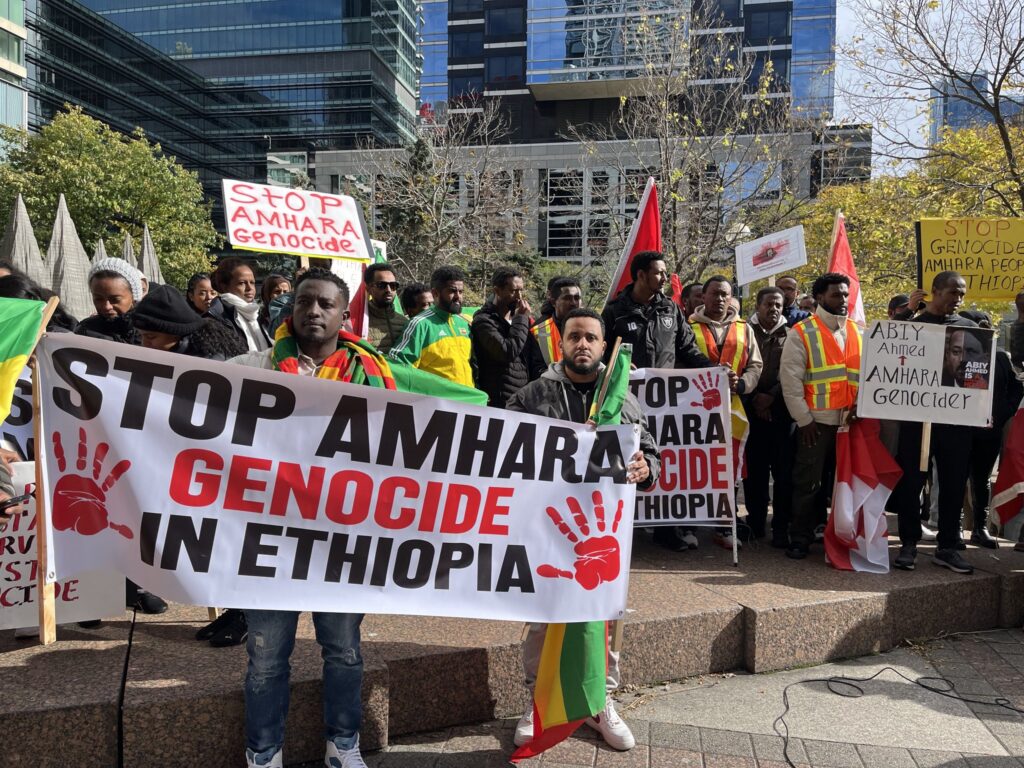

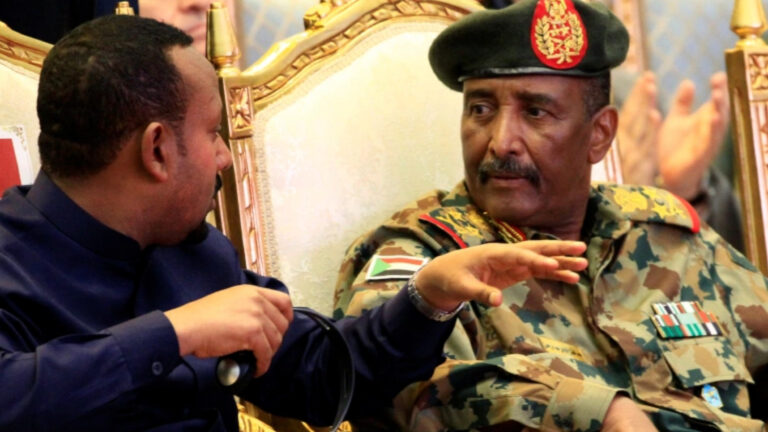
The probability of a direct military confrontation between Sudan and Ethiopia has increased substantially in 2026, although a deliberate, full-scale interstate war remains constrained by the fact that both governments are already engaged in major internal conflicts.
The principal danger is therefore not a planned Ethiopian invasion of Sudan or a Sudanese offensive against Ethiopia. It is conflict convergence: the gradual merging of the Sudanese civil war, Ethiopia’s internal conflicts, the unresolved Al-Fashaga territorial dispute, the Nile/GERD confrontation, and the increasingly polarized regional competition involving Egypt, Eritrea, the United Arab Emirates, Saudi Arabia and other actors.
Relations deteriorated sharply in May 2026 after Sudan accused Ethiopia of facilitating Rapid Support Forces (RSF) drone operations against targets in Sudan. Addis Ababa denied involvement and accused Sudan of supporting forces seeking to destabilize Ethiopia. Sudan recalled its ambassador, while Sudanese Armed Forces (SAF) officials publicly described the alleged Ethiopian involvement as an act of aggression and warned of a possible response. Sources has identified growing Ethiopian links with the RSF, but the specific Sudanese allegations concerning individual drone attacks remain contested.
At the same time, an increasingly dangerous system of opposing alignments is developing.
On one side is an emerging axis centered on the Ethiopian federal government and the RSF, with the UAE playing an important regional role.
On the other is a looser constellation involving the Sudanese Armed Forces, Eritrea, elements of the Tigrayan movement and Egypt, whose interests overlap in opposing different aspects of Addis Ababa’s regional policy.
These alignments should not be understood as two formal military alliances. Their interests frequently diverge. Nevertheless, they create the infrastructure for proxy warfare.
The most dangerous scenario is consequently not: Sudan → war → Ethiopia
but: Sudanese civil war + Ethiopian internal conflicts + Al-Fashaga + GERD + Eritrea–Ethiopia confrontation → proxy escalation → border incident → interstate confrontation.
The Sudan–Ethiopia frontier is becoming one of the places where several wars in the Horn of Africa could intersect.
Key Assessment
Risk of limited Sudan–Ethiopia military confrontation: HIGH AND RISING
Risk of deliberate full-scale interstate war: LOWER, BUT NO LONGER NEGLIGIBLE
Most plausible escalation pathway: PROXY CONFLICT → CROSS-BORDER STRIKE → RETALIATION
The principal constraint remains military capacity.
The SAF is fighting the RSF and associated forces across Sudan. Ethiopia’s National Defense Force (ENDF), meanwhile, must manage renewed instability involving Tigray while continuing to confront the Fano insurgency in Amhara.
Neither government has a strong incentive to open another major conventional front. Recent assessments similarly conclude that capacity constraints make a direct confrontation less likely even as proxy escalation increases the danger of one.
This does not necessarily make the situation safe.
Because both governments have limited capacity for conventional war, they have stronger incentives to use proxies, intelligence networks, cross-border armed groups, logistics corridors and deniable military assistance.
This makes escalation harder to control.
The Central Transformation: Two Civil Wars Are Beginning to Intersect
The Sudanese and Ethiopian crises were previously analyzed largely as separate conflicts.
That distinction is becoming increasingly difficult to sustain.
Sudan’s war began in April 2023 as a struggle between the SAF under Gen. Abdel Fattah al-Burhan and the RSF under Mohamed Hamdan Dagalo, known as Hemedti.
But Sudan’s military landscape has subsequently fragmented dramatically. The Africa Center for Strategic Studies estimates that around 150 militias and armed formations are now active in the conflict, meaning that neither the SAF nor the RSF should be viewed simply as a single military organization. Both operate within broader coalitions of militias, political networks and regional partners.
Ethiopia simultaneously faces several unresolved security crises.
The Pretoria Agreement ended the principal phase of the Tigray war in 2022 but did not resolve major questions surrounding territorial control, demobilization, the political status of the TPLF or relations between Addis Ababa and Asmara.
Meanwhile, the federal government faces the Fano insurgency in Amhara.
The result is an increasingly interconnected security system.
Armed groups fighting one government can seek sanctuary or assistance from the neighboring state.
That creates a classic regional proxy-war dynamic: Addis Ababa supports or facilitates actors hostile to Khartoum → Khartoum supports actors hostile to Addis Ababa → both governments acquire incentives to destabilize the other’s rear areas.
The Immediate Trigger: Ethiopia and the RSF
The most important recent deterioration concerns alleged Ethiopian support for the RSF.
Since late 2025, evidence assessed by SWP indicates that Ethiopia has become an important transit route for supplies reaching the RSF from the UAE. The same assessment cites suspicious cargo flights and satellite evidence connected with Benishangul-Gumuz.
The dispute became substantially more serious in May 2026.
Following RSF drone attacks against infrastructure in central and eastern Sudan, Sudanese authorities accused Ethiopia of facilitating operations from Ethiopian territory.
Sudanese officials subsequently escalated their language.
Al-Burhan warned that Sudan would take necessary measures to protect its territory if investigations established Ethiopian involvement.
The SAF described alleged Ethiopian assistance as a direct act of aggression.
Sudan then recalled its ambassador from Addis Ababa.
Ethiopia denied involvement.
But Addis Ababa also counterattacked politically, accusing Sudan of supporting Ethiopian armed groups—particularly forces connected with the Tigrayan movement.
This is an important escalation threshold.
The dispute is no longer primarily: Sudan versus RSF.
It risks becoming: Sudan versus RSF + alleged external support infrastructure.
If Khartoum concludes that Ethiopia is functioning as a logistical sanctuary for the RSF, Ethiopian territory could eventually be viewed by the SAF as part of the operational battlespace.
That would dramatically increase the possibility of cross-border strikes.
Ethiopia’s Possible Interest in the RSF
Addis Ababa has several reasons to maintain channels with the RSF, even if that does not mean Ethiopia controls RSF strategy.
First, the RSF provides leverage against the SAF.
Relations between the SAF and Ethiopia deteriorated sharply during the Tigray war, when Sudan retook most of the disputed Al-Fashaga area.
Second, the SAF has historically maintained links with the TPLF and other Ethiopian opposition actors.
Third, the RSF can serve as a counterweight to Sudanese pressure along Ethiopia’s western frontier.
Fourth, Ethiopia maintains close strategic relations with the UAE, which has been widely associated with support networks benefiting the RSF.
The resulting alignment is therefore partly based on the traditional regional principle: the enemy of my adversary can become a useful partner.
Sudan’s Counter-Leverage: Tigrayan Forces
Sudan possesses a corresponding instrument of pressure against Ethiopia.
The SAF has longstanding relations with elements of the Tigrayan movement.
During the Tigray war, Sudan provided sanctuary to refugees and maintained contacts with Tigrayan actors. More recent reporting indicates that Tigrayan fighters based in eastern Sudan have fought alongside the SAF. Chatham House also identifies reinforced relationships among the TPLF, Eritrea and the SAF amid deteriorating relations with Addis Ababa.
Addis Ababa therefore increasingly sees Sudan not merely as a neighboring state but as a potential rear area for hostile Ethiopian armed organizations.
Of particular concern is the presence in Sudan of Army 70, a Tigrayan armed group linked to the TPLF, which Ethiopia views as a security threat.
This creates an increasingly symmetrical proxy structure: Ethiopia → RSF versus Sudan → Tigrayan armed networks.
The more institutionalized these relationships become, the less important the original bilateral disputes become.
The proxy conflict can acquire its own momentum.
Al-Fashaga: The Territorial Dispute That Never Disappeared
Behind the new proxy confrontation lies a much older dispute.
Al-Fashaga is an agriculturally valuable border region between Sudan’s Gedaref state and Ethiopia’s Amhara and Tigray regions.
The territory has long been claimed by Sudan but was cultivated extensively by Ethiopian—particularly Amhara—farmers under informal arrangements.
The balance changed dramatically in 2020.
When Ethiopia became absorbed in the Tigray war, the SAF moved into Al-Fashaga and re-established Sudanese military control over most of the disputed territory.
Thousands of Ethiopian farmers were displaced.
Sudan insists that sovereignty over Al-Fashaga has already been settled and that Ethiopia must recognize the existing border before agricultural arrangements can be discussed.
Many Ethiopian actors reject this interpretation.
Chatham House has identified Al-Fashaga as one of the principal unresolved issues driving bilateral distrust, alongside the GERD and the consequences of the Tigray war.
The issue is particularly dangerous because it combines three factors: territory + agriculture + ethnic nationalism.
And the Ethiopian constituency most directly affected is Amhara.
The Fano Factor
The Amhara dimension makes Al-Fashaga particularly volatile.
Fano is not a single centralized organization but a network of Amhara nationalist armed formations currently fighting Ethiopia’s federal government.
Yet Amhara nationalists also maintain strong historical claims regarding territories along Ethiopia’s western and northwestern frontier.
This creates a complicated triangle: Ethiopian federal government versus Fano
Versus Sudan.
Addis Ababa and Fano may be enemies internally while simultaneously opposing Sudanese control over territory historically cultivated by Amhara communities.
This creates the possibility of unusual tactical alignments.
A border crisis could temporarily cause Ethiopian actors who are fighting each other domestically to converge around territorial nationalism.
Alternatively, Sudan or Eritrea could seek to cultivate Fano factions as instruments of pressure against Abiy Ahmed’s government.
GERD: The Strategic Dispute Behind the Border Conflict
The second major interstate issue is the Grand Ethiopian Renaissance Dam.
For Ethiopia, GERD is simultaneously: a development project, a source of electricity, a symbol of sovereignty, and one of the central achievements of the Ethiopian state.
For downstream Egypt, the Nile is an existential strategic resource.
Sudan’s position has historically been more complex because GERD can provide benefits, including regulated water flows and electricity, while also creating concerns over dam safety and water management.
But Sudan’s alignment with Egypt has become increasingly important.
This means a Sudan–Ethiopia confrontation could rapidly become connected to the wider Egypt–Ethiopia Nile dispute.
The danger is not necessarily that Sudan would attack GERD.
The danger is that Addis Ababa could begin interpreting Sudanese military activities near the Ethiopian frontier through the lens of Egyptian strategy.
In other words: Sudanese pressure may be interpreted as Egyptian pressure by proxy.
That perception alone could influence Ethiopian military planning.
Egypt: The Most Important External Actor on Sudan’s Side
Cairo has several reasons to favor a strong relationship with the SAF.
The first is GERD.
The second is the Red Sea.
The third is Egypt’s preference for conventional state institutions over the proliferation of autonomous paramilitary forces.
The fourth is Ethiopia’s growing regional influence.
Egypt therefore represents one of Sudan’s most important strategic partners.
A serious Ethiopia–Sudan crisis would consequently be unlikely to remain entirely bilateral.
Even without direct Egyptian participation, intelligence cooperation, military assistance, air-defense support, training and diplomatic backing could alter Ethiopia’s threat perception.
The central Ethiopian concern would be the possibility of strategic encirclement: Egypt → Sudan → Eritrea
along Ethiopia’s northern and western approaches.
Eritrea: The Actor That Could Transform the Conflict
Eritrea may be the most dangerous variable.
Relations between Addis Ababa and Asmara have deteriorated sharply since the end of the Tigray war.
The two countries had fought together against the TPLF.
The Pretoria Agreement altered that relationship.
Eritrea was excluded from the negotiations, while subsequent disputes over Tigray and Ethiopia’s renewed drive for access to the Red Sea further widened the gap.
Eritrea has since developed closer relations with the SAF.
Recent analysis describes a growing alignment between Asmara and al-Burhan, driven partly by Eritrea’s deteriorating relationship with Ethiopia.
This creates an exceptionally dangerous geography.
Ethiopia could face pressure from: Sudan in the west, Eritrea in the north, Tigrayan forces internally/northwest,Fano in Amhara.
Addis Ababa could interpret cooperation among these actors as an emerging containment architecture.
Whether such a coordinated architecture actually exists is less important than whether Ethiopian decision-makers believe it does.
The UAE Dimension
On the other side stands the UAE.
Abu Dhabi has developed extensive economic, political and security relationships throughout the Horn of Africa and Red Sea region.
Ethiopia is an important UAE partner.
The UAE has also been repeatedly linked in international reporting and analysis to support networks for the RSF, though Abu Dhabi has denied allegations that it supplies weapons to the force.
This creates a broader geopolitical alignment identified by Chatham House:
Ethiopia / UAE / Somaliland versus a looser network involving
SAF / Eritrea / Egypt / Tigrayan actors, with Saudi and Turkish interests intersecting parts of that alignment.
These are not formal blocs.
But the emerging pattern matters because local conflicts increasingly overlap with competition among Middle Eastern powers.
The Two Emerging Camps
The developing security architecture can therefore be represented approximately as follows.
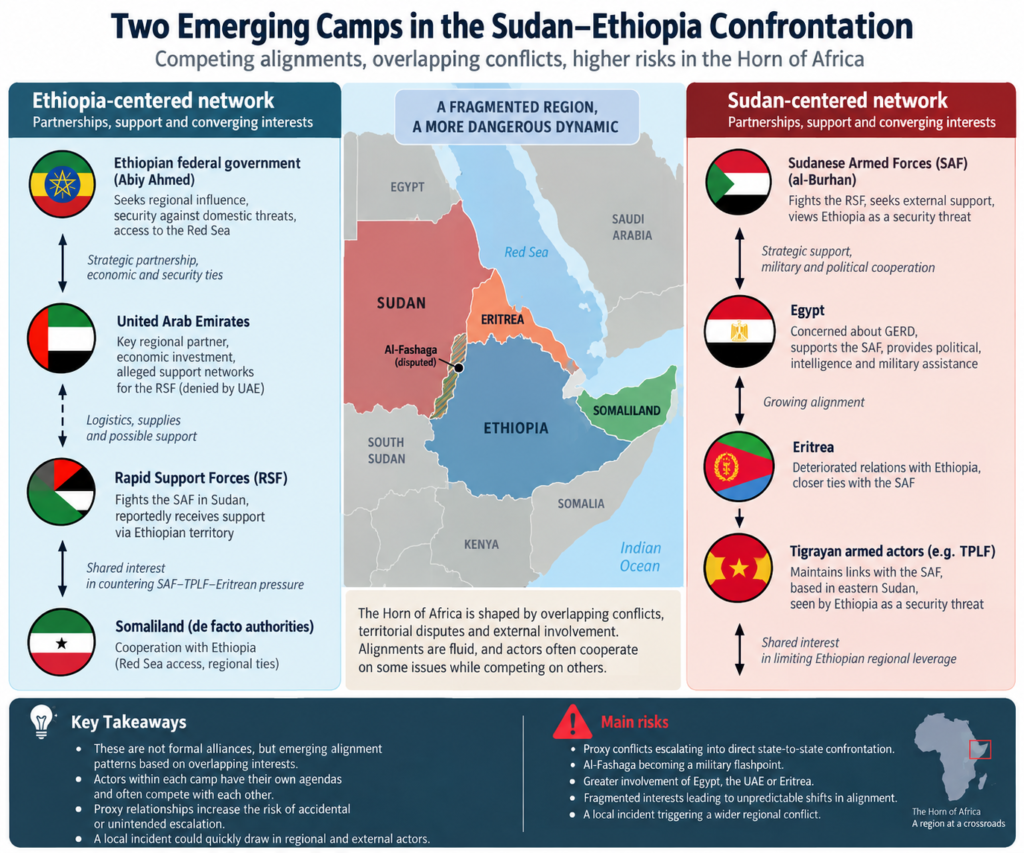
Ethiopia-centered network
Abiy Ahmed government / ENDF
↓
ties with UAE
↓
growing links or logistical interaction with RSF
↓
interest in weakening SAF–TPLF–Eritrean pressure.
Sudan-centered network
SAF / al-Burhan
↓
cooperation with Egypt
↓
growing alignment with Eritrea
↓
links with Tigrayan armed actors
↓
shared interest in limiting Ethiopian regional leverage.
But neither camp is internally coherent.
Fano is hostile to Abiy but may oppose Sudan over Al-Fashaga.
The TPLF has its own objectives.
Eritrea distrusts both Ethiopia and elements of the Tigrayan movement.
Egypt’s priority is the Nile.
The SAF’s priority is defeating the RSF.
The UAE’s priorities extend far beyond Sudan.
This fragmentation simultaneously reduces the likelihood of a centrally planned regional war and increases the danger of uncontrolled escalation by proxies.
Why Neither Sudan nor Ethiopia Currently Wants Full-Scale War
A conventional war would be extraordinarily costly for both.
Sudan is already fighting for the survival of the state.
The SAF must allocate forces against the RSF across multiple theaters, while eastern Sudan—including Gedaref and Port Sudan—is strategically vital to the government’s survival. SAF-aligned armed groups are already deployed throughout the east.
Ethiopia faces similar constraints.
The ENDF must manage: the Fano insurgency, the unstable Tigray settlement, tensions with Eritrea, and multiple peripheral security problems.
Opening another conventional front against Sudan would impose substantial logistical and military costs.
This creates strong deterrence against deliberate interstate war.
But it also creates an incentive to fight indirectly.
The Most Dangerous Escalation Pathway
The most plausible path to war does not begin with a declaration of war.
It begins with a drone.
For example: RSF launches a major drone attack against an SAF strategic facility.
↓
2. Sudanese intelligence concludes that the drone was launched, controlled or supplied through Ethiopian territory.
↓
3. Khartoum demands that Addis Ababa shut down the infrastructure.
↓
4. Ethiopia denies involvement.
↓
5. SAF conducts a limited strike against a suspected RSF logistics site inside Ethiopia.
↓
6. ENDF responds against Sudanese forces near the border.
↓
7. Fighting spreads toward Al-Fashaga.
↓
8. Eritrea increases military pressure on Ethiopia.
↓
9. Ethiopia accuses Sudan of coordinating with Eritrea and the TPLF.
↓
10. A proxy conflict becomes an interstate war.
The critical threshold is therefore not necessarily a large troop movement.
It is the first acknowledged cross-border kinetic strike by one state against the other.
Al-Fashaga Could Become the Battlefield Even If It Is Not the Cause
A future Sudan–Ethiopia confrontation might begin over RSF drones or Tigrayan armed groups.
But Al-Fashaga would provide an obvious geographical battlefield.
Troops already understand the terrain.
Both sides possess historical claims and military narratives concerning the area.
Nationalist constituencies can easily be mobilized around it.
The dispute therefore functions as a ready-made escalation arena.
This distinction is important:
Al-Fashaga may not cause the next crisis, but it could become the place where the crisis turns into war.
Probability Assessment
A precise numerical probability should be treated cautiously because the trajectory depends heavily on decisions by multiple armed actors and on allegations that remain difficult to verify.
Nevertheless, the current indicators support the following qualitative assessment for the next 6–12 months:
Full-scale Sudan–Ethiopia conventional war — LOW TO MODERATE RISK
Both states have powerful incentives to avoid it because their militaries are heavily committed internally.
Limited direct border confrontation — MODERATE AND RISING RISK
Al-Fashaga, accusations surrounding RSF operations, and Sudanese support for Ethiopian opposition actors provide multiple possible triggers.
Intensified proxy conflict — HIGH RISK
This is the most plausible trajectory because it provides both governments with leverage while limiting the immediate cost of direct confrontation.
Cross-border drone/airstrike incident — SIGNIFICANT ESCALATION RISK
This represents the most credible mechanism through which proxy warfare could cross the threshold into direct state-to-state conflict.
The decisive variable will be whether Addis Ababa and Port Sudan maintain a tacit distinction between supporting proxies and directly attacking each other’s territory.
Once that distinction collapses, escalation becomes considerably more difficult to contain.
Indicators to Watch
The strongest warning indicators would be a Sudanese military buildup in Gedaref and Al-Fashaga; deployment of additional Ethiopian forces toward the Sudanese frontier; construction or expansion of drone infrastructure in western Ethiopia; confirmed RSF use of Ethiopian territory; SAF strikes against logistics infrastructure across the border; increased Egyptian military deployments or air-defense assistance in eastern Sudan; Eritrean mobilization near Ethiopia; greater cooperation among SAF, Eritrean and Tigrayan actors; Ethiopian evidence of Sudanese weapons reaching Tigrayan or Fano forces; evacuation of diplomats; closure of border crossings; and increasingly explicit official language describing the neighboring government rather than its proxies as the enemy.
The most important indicator is attribution.
As long as Sudan describes the RSF as the principal adversary and Ethiopia describes Tigrayan or other armed groups as the principal adversaries, escalation can remain indirect.
If either government begins publicly defining the other state itself as a belligerent, the strategic environment changes substantially.
Strategic Assessment
The risk of war between Sudan and Ethiopia should not be assessed primarily through the conventional question of whether al-Burhan or Abiy Ahmed intends to attack the other.
There is currently little strategic logic for either government deliberately choosing a major interstate war.
Sudan’s civil war increasingly intersects with Ethiopia’s internal conflicts. Ethiopia’s relationship with the RSF intersects with Sudan’s relationship with Tigrayan actors. Al-Fashaga supplies a territorial battlefield. GERD introduces Egypt. Ethiopia’s Red Sea ambitions introduce Eritrea. UAE involvement in the region connects these local rivalries to broader Middle Eastern competition.

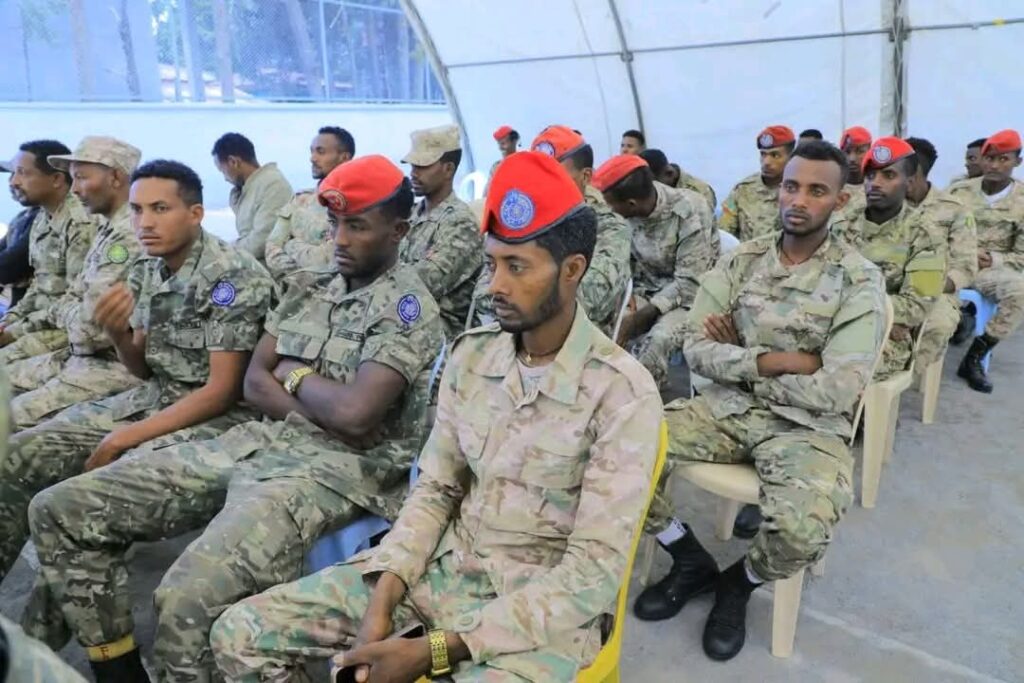
More on this story: Reasons and prospects for the Amhara Rebellion