
The leak of A7’s internal documents reveals the emergence of a parallel mechanism for international settlements in which export revenues from Russian oil provided the foreign-currency liquidity needed to pay for imports into Russia, including military and dual-use goods.
The key lies in the connection among three elements: Rosneft as the generator of export revenues; Coral Energy/2Rivers as the external trading interface; and A7 as the clearing and payments infrastructure that allowed those revenues to be converted into payments to foreign suppliers.
Key Findings
Documents obtained by the Financial Times indicate that A7 moved at least $6.9 billion through the international banking system between late 2024 and August 2025. The FT identified around 100 companies that actually executed payments and references to roughly another 100 entities in internal documents. The network extended across the UAE, Hong Kong, Kyrgyzstan, Indonesia and European jurisdictions.
Rosneft was not fully blocked by OFAC during the period covered by the leak. The United States imposed blocking sanctions on the company itself only on October 22, 2025, although restrictions affecting Rosneft and Russia’s energy sector had existed in various forms since 2014. It is therefore more accurate to describe the arrangement as a mechanism for monetizing Russian oil revenues under sanctions and restrictions on the Russian oil sector, rather than to suggest that every transaction described by the FT constituted payment for oil from an already OFAC-blocked Rosneft.
By contrast, the intermediary 2Rivers – formerly Coral Energy – was placed under British sanctions on December 17, 2024. British authorities explicitly described 2Rivers as one of the key intermediaries in Russian oil trading. The EU later concluded that 2Rivers facilitated exports of Russian oil, including Rosneft oil, concealed its actual origin and controlled a significant share of vessels in Russia’s “shadow fleet.”
How the Oil-Revenue Collection and Use Scheme Worked
Based on the FT documents, the mechanism can be reconstructed approximately as follows: Rosneft → traders/affiliated companies → foreign oil buyer → dirhams/yuan → A7 offshore company → international bank/SWIFT → foreign supplier → goods → Russia.
At the same time, a second, ruble-denominated leg of the settlement could operate inside Russia: Russian importer → rubles → A7/Russian financial circuit.
The foreign currency did not necessarily have to return physically to Russia. It could remain in the UAE, China, Hong Kong or another jurisdiction and be used to meet the external obligations of Russian clients.
In this way, oil exports were transformed into a kind of offshore liquidity pool.
Stage 1. Oil Sales
The principal external trader mentioned in the documents was Coral Energy, later renamed 2Rivers. According to the FT materials, A7 received foreign currency from 16 companies linked to Rosneft, most of which were also connected to Coral. One A7 employee explicitly described Coral as Rosneft’s trader “from which we receive yuan.”
This is consistent with the EU’s later assessment: its sanctions decision on 2Rivers explicitly states that the group facilitated the supply and export of Russian oil, particularly Rosneft oil, and concealed its true origin.
The trader therefore functioned as a buffer between the Russian producer and the international buyer.
Formally, A7 is headed by Ilan Shor, the Moldovan businessman based in Russia. As of 2026, Reuters identifies him as A7’s CEO; he publicly represents the company and its international expansion.
The control structure, however, is broader:
- Ilan Shor – co-founder, CEO and key public figure. A7’s initial ownership structure was 51% Shor / 49% PSB (Promsvyazbank). Shor is also listed as chief executive of the subsidiary A7 Agent. Promsvyazbank is a Russian state-owned bank focused on servicing the defense sector. OFAC explicitly states that A7 and its subsidiaries are owned by Shor and Promsvyazbank.
- Petr Fradkov, head of PSB, plays an important institutional role in the system. In August 2026, he said that A7 served about 15,000 regular business clients and processed up to 2,000 cross-border payments a day. VEB.RF also appears in A7’s financial architecture: PSB’s stake was pledged to VEB.RF as collateral for A7 loans. This points to the involvement of another state financial institution. A7’s internal materials obtained by the FT mention senior executive Stanislav Lazarev. According to the documents, it was Lazarev who discussed with colleagues the possibility of receiving from Rosneft the equivalent of roughly $12 billion in yuan. The FT describes A7 as Shor’s structure, created with the support of the state-owned PSB.
Stanislav Lazarev is one of A7’s key operational executives, responsible for corporate business/sales and cross-border settlements. A7 internal documents obtained by the FT show his involvement in discussions about a large source of yuan liquidity from Rosneft. Open professional databases contain a profile of a Moscow banker with the same name and experience at Raiffeisenbank, but the identity of that individual as the A7 executive has not been independently confirmed.
An investigation by Proekt alleged that Roman Abramovich and businessman Viktor Kharitonin may have links to A7. A source for the outlet described Abramovich as A7’s “protector and sponsor,” while companies associated with Kharitonin allegedly provided A7 with multibillion-ruble loans. Abramovich’s representative categorically denied any connection, ownership stake or involvement in arrangements concerning A7. The allegation should therefore be treated as an unconfirmed version rather than an established fact.
A7 is difficult to regard as an ordinary private business belonging to Shor: 49% is owned by the state-controlled PSB, financing/collateral involving VEB.RF is present, and the infrastructure itself is closely tied to PSB. OFAC explicitly characterizes A7 as a Russian cross-border settlement platform used to evade sanctions.
According to open-source information, Ilan Shor’s intelligence-service connection is far better documented with the FSB. Much of the evidence concerns the FSB’s Fifth Service -the Service for Operational Information and International Relations – which traditionally operates across the post-Soviet space. A Washington Post investigation based on intercepted materials and information from Ukrainian, Moldovan and Western sources described Shor as an important component of FSB operations in Moldova. According to the newspaper, FSB documents referred to him as “the young one.” The FSB directed substantial funds toward a network of Moldovan politicians and influence operations in which Shor played a central role.
This is consistent with later information from Moldova’s SIS. The service said that an operational command center had been established in Moscow to interfere in Moldova’s elections and referendum, and that the Russian side designated Shor to lead the relevant network, providing it with financial, media, personnel, logistical and technical resources as well as counterintelligence support.
The last detail is particularly significant. Providing counterintelligence support to a political network abroad fits the FSB’s profile more closely than an ordinary Kremlin relationship with a political ally.
The working model is: Kremlin → FSB/Fifth Service → Shor → political, financial and influence networks in Moldova.
After Shor moved to Russia, his role appears to have expanded. He is no longer merely an operator on the Moldovan track. Through A7, Shor became embedded in a much larger state-linked financial infrastructure. A7 was created with the participation of the state defense bank PSB and is now one of the major operators of Russian cross-border payments. Reuters identified Shor as A7’s CEO in June 2026.
Ilan Shor is a Russian proxy and financial-political operator whose best-documented intelligence-service connection leads to the FSB and its operational infrastructure in the post-Soviet space.
The key question is whether, after the creation of A7, Shor remained an asset/operator of the FSB’s Fifth Service or whether his financial infrastructure came under broader interagency Kremlin control involving PSB, the FSB, the Presidential Administration and other security services.
The Most Important Resource Is Not Oil, but Foreign Currency
After 2022, Moscow faced a specific problem: Russia could continue selling enormous volumes of raw materials, but using the foreign currency earned from those sales became more difficult because of sanctions on banks, restrictions on correspondent accounts and scrutiny of international payments.
A7 effectively addressed the spatial disconnect between exports and imports.
For example: a buyer of Russian oil pays not a Russian bank but an intermediary company in the UAE → the foreign currency does not return to Russia → A7 uses it to pay a Chinese supplier → the Russian buyer of the goods settles with A7 in rubles inside Russia.
As a result, a direct international payment from Russia to China may never take place.
Instead, two internally balanced flows effectively occur: oil buyer → offshore pool → Chinese supplier, and Russian importer → A7 → Russian financial circuit.
This resembles multilateral clearing, but organized through a network of nominally independent legal entities.
Why Rosneft May Have Been Critical to A7
Every parallel payment system faces a fundamental problem: where can it obtain a steady supply of hard currency?
Russian importers need yuan, dirhams, dollars and euros to make purchases abroad. Oil companies, by contrast, continuously generate precisely those currencies.
The two flows naturally complement one another.
Particularly striking is a reference in A7’s internal correspondence to Rosneft’s intention to provide the equivalent of $12 billion in yuan. The figure should be treated as a claim from the leaked material rather than as a fact confirmed by bank records, but its scale helps explain why the oil sector could become the financial foundation of the system.
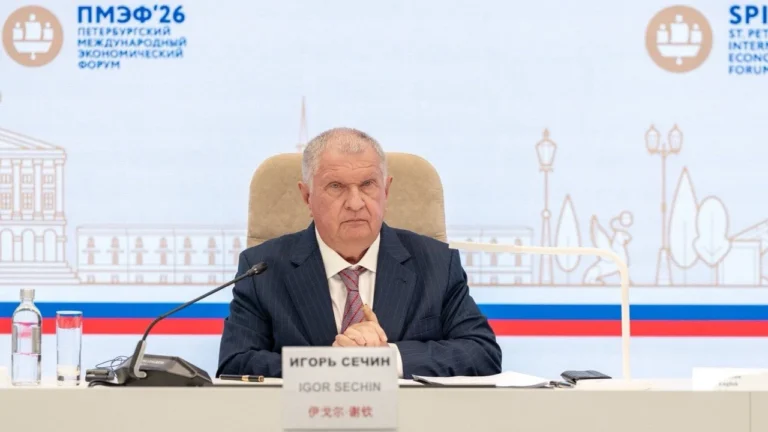
It is also notable that in September 2026 Igor Sechin publicly said that Russian-Chinese settlements were already conducted almost entirely in rubles and yuan and stressed the need to develop clearing infrastructure and correspondent accounts.
This does not in itself prove a link to A7, but it illustrates the broader strategic context: the yuan has become one of the principal currencies of Russian foreign trade.
The Dirham as an Intermediate “Bridge”
The second critical currency is the UAE dirham.
The FT documents indicate a significant role for First Abu Dhabi Bank. Seventeen A7-linked entities held accounts there and made more than $1.8 billion in outbound payments. Particularly important was the bank’s ability, through correspondent relationships, to convert dirhams into dollars, euros and yuan.
The scheme could therefore operate according to the following logic:
Russian oil → trader → buyer → AED → UAE shell company → conversion of AED into CNY/USD/EUR → payment to supplier.
The UAE was therefore important not only as a center for oil trading. It also provided a means of transforming oil revenues into universally usable international liquidity.
A7 Did Not Really Replace SWIFT – It Found a Way Back Into It
A7 positioned itself as an alternative to the Western financial system. In practice, according to the FT, much of its effectiveness came from re-entering the traditional banking system through foreign companies.
- For example, $1.1 billion reached accounts at Standard Chartered in Hong Kong, $273 million moved through DBS, Citigroup clients received $74 million, Deutsche Bank clients about $18 million, and 17 A7 entities made more than $1.8 billion in outbound payments through accounts at First Abu Dhabi Bank.
Slightly more than half of the flows identified by the FT ultimately reached accounts at Chinese banks.
The essence of the scheme was to conceal the real principal and the purpose of the payment from bank compliance systems.
The “Document Factory” Was a Central, Not Auxiliary, Component
A7 needed not only shell companies but also a plausible explanation for every payment.
The FT describes what amounted to an industrial-scale system for producing false invoices → fictitious contracts → altered customs codes → false descriptions of goods → corporate seals → alternative buyer/seller identities.
One particularly revealing example involved the purchase of 500 night-vision sights worth 3.6 million yuan. According to the FT documents, A7 employees discussed how to disguise the goods in the paperwork; one proposed description was tempered glass.
A7 therefore performed at least three functions simultaneously: a clearing system + a trade-based money-laundering network + a procurement facilitator.
This combination made the system substantially more consequential than an ordinary cryptocurrency platform.
Why USDT and A7A5 Matter
Cryptocurrency was another layer of the system, but the leak suggests that it was neither the only channel nor necessarily the principal one.
The FT identified A7 accounts through which billions of dollars’ worth of Tether/USDT were sold to Russian buyers. The documents also refer to a meeting between Ilan Shor and Coral representatives who, according to Shor, conducted settlements in USDT.
Separately, A7 developed the ruble-backed A7A5 token. In 2025, the U.S. Treasury determined that the asset had been created for A7 clients and that its infrastructure was linked to Garantex/Grinex and Kyrgyzstan’s Old Vector. OFAC characterizes A7 as a cross-border settlement platform used to evade sanctions.
The architecture therefore appears multilayered: oil → fiat → shell companies → SWIFT
in parallel with oil/foreign currency → USDT → cryptocurrency transfer, and rubles → A7A5 → domestic/cross-border settlement.
This creates redundancy: blocking one channel does not stop the entire system.
8. Links to Russia’s Military-Industrial Complex
The most serious aspect is that oil money ceases to be merely revenue for the Russian budget.
Within the structure described above, it can directly finance external procurement.
Schematically: Russian oil exports → foreign-currency revenues → A7 offshore pool → Chinese/Asian manufacturer → optics / electronics / components / equipment → Russia / Russian customer.
This eliminates the need first to repatriate foreign currency to Russia, move it through a Russian bank, and then attempt to send it abroad again.
It reduces the number of points at which sanctions controls can detect the Russian origin of a transaction.
Particularly important is A7’s institutional connection to Promsvyazbank, which the United States blocked in February 2022; the U.S. Treasury describes it as a state-owned bank reoriented toward financing Russia’s defense industry and major defense contracts.Promsvyazbank
The Scheme May Have Continued After Sanctions Were Imposed on Rosneft
The FT leak ends in August 2025. Full U.S. blocking sanctions against Rosneft were imposed on October 22, 2025.
The documents therefore reveal, in effect, a pre-sanctions architecture that had already been established before the United States blocked Rosneft.
If, before October 2025, the chain buyers → trader → A7 was already operating as a foreign-currency circuit separated from Rosneft, then after Rosneft itself was added to the SDN List Moscow did not need to build a new system from scratch. It only needed to increase the distance between Rosneft and the final financial payment – through traders, shipowners, nominal sellers and shell companies.
This is an analytical hypothesis, not a fact established by the FT.
2Rivers May Be Only the Visible Part of a Much Larger Network
In its sanctions justification, the EU states that the 2Rivers/Coral network included affiliated entities such as Nord Axis and Bellatrix Energy and continued to operate despite changes in name and formal ownership structure.
The United Kingdom went further: in February 2026, its sanctions package included a large number of companies linked to Tahir Garayev and the Coral Energy/2Rivers environment.
Tahir Gadir oglu Garayev is an Azerbaijani oil trader and founder of Coral Energy, later renamed 2Rivers Group. The trading infrastructure he created became one of the key channels for selling Russian oil, particularly Rosneft crude, and a source of foreign-currency liquidity that, according to the FT materials, entered the A7 circuit.
Garayev is an Azerbaijani citizen born in January 1980. Sanctions documents list an address in Geneva. In 2010, he founded Coral Energy, a commodity trader operating through Dubai, Geneva and other international centers.
Coral Energy was not created as a Russian sanctions-evasion instrument. It was established in 2010 as an international commodity trader. Azerbaijan’s state oil company was looking for traders capable of finding international buyers for Azerbaijani oil. Coral’s initial business focused on the Black Sea–Mediterranean region and trading a limited range of petroleum products. After Etibar Eyyub joined in 2014, the company gradually became integrated into Russian oil trading. This ready-made international infrastructure became particularly valuable after 2022, when Western traders withdrew from the Russian market and Moscow needed intermediaries between Rosneft, foreign buyers, banks and the shipping system.
In 2010, the logic was commercial: oil producer → independent trader → international market → end buyer.
This is a standard commodity-trading business. The trader assumes responsibility for finding buyers, financing cargoes, freight, insurance, currency risks, storage and resale.
An important chronological detail is that Etibar Eyyub, who later became a central figure in Coral’s Russian business, joined the company only in 2014. According to a Wall Street Journal investigation, it was Eyyub who developed Coral’s business in Russia. Before the full-scale war, Coral was already trading oil from Rosneft and other Russian producers. Reuters found that in 2021–2022 Russian oil accounted for roughly a quarter of Coral’s trading volume.
This means Russia had access to a ready-made trading channel before the introduction of the oil embargo and price cap.
Until the end of 2023, Garayev effectively controlled Coral through the corporate chain: Tahir Garayev → Novus Middle East DMCC → Vetus Investments → Coral Energy.
In 2023–2024, the ownership structure was reorganized. Coral managers Talat Safarov, Ahmed Kerimov and Anar Madatli first acquired 60% and later the remaining 40%. Reuters reported in June 2024 that the management buyout had been completed and that Garayev had formally exited the company’s equity.
Garayev formally left the ownership structure, but subsequent sanctions authorities and investigations continued to link him to the network.
In June 2026, the EU personally added him to its sanctions list. The Council of the EU’s wording is specific: through a network of companies, Garayev facilitated the transportation and export of Russian oil, “in particular from Rosneft,” while concealing its actual origin. The EU also said that the 2Rivers network controls and operates a significant number of vessels in Russia’s “shadow fleet.”
The United Kingdom imposed personal sanctions on Garayev on May 9, 2025, citing his ownership/control or directorial role in Coral Energy/2Rivers and the company’s activity in an energy sector of strategic importance to the Russian government.
The connection between his network and Russian oil exports is therefore recorded in the sanctions justifications of both the EU and the United Kingdom.
To understand the network, it is important to distinguish between Garayev and Etibar Eyyub.
Garayev was Coral’s founder and corporate architect.
Eyyub appears more as an operational oil trader and a point of contact with the Russian side. Recent FT investigations link Eyyub’s network to a vast cluster of companies that continued moving Russian oil after U.S. sanctions were imposed on Rosneft and Lukoil. The FT identified around 450 companies linked through domain and email infrastructure; approximately $90 billion worth of Russian oil passed through the corresponding system.
Garayev
↓
creation of Coral Energy
↓
Coral / 2Rivers
in parallel
Etibar Eyyub
↓
operational relationships with Russian oil companies
↓
network of traders / shell companies / tankers
↓
Rosneft and other Russian exports
The Network Did Not Disappear After Sanctions
On February 24, 2026, the United Kingdom sanctioned a new group of companies it considers linked to Garayev. These included, for example, Brightpath Trade Ventures, Castleton Corporation FZE and Energopole ENP FZCO. The British sanctions justification explicitly links these entities to Garayev and Coral/2Rivers.
The FT established that traders linked to Rosneft -and mostly to Coral/2Rivers -supplied A7 with foreign currency generated by sales of Russian oil. At the same time, European sanctions authorities now explicitly describe Garayev’s network as infrastructure that facilitated exports of Rosneft oil.
The working model can therefore be represented as follows:
Rosneft
↓
Russian oil
↓
Coral / 2Rivers / affiliated traders
↓
buyers in India, China and other countries
↓
AED / CNY / other foreign-currency revenues
↓
offshore companies
↓
A7
↓
SWIFT / banks / USDT / alternative settlement channels
↓
foreign suppliers for Russian clients
This is why Garayev is more important than merely being the “owner of an oil trader.” He stands at the origin of the trading segment of an infrastructure capable of converting physical Russian oil into foreign currency outside Russia.
The next, potentially even more important line of inquiry is Etibar Eyyub. His role deserves separate examination – including his relationship with Igor Sechin, Nord Axis, Bellatrix, Coral/2Rivers and the newer network of roughly 450 companies. This may show who, at the operational level, connected Rosneft to the trading network that subsequently supplied foreign currency to A7.
This points to a model in which, instead of a single trader, there is a cluster of legal entities among which contracts, tankers, bank accounts, oil cargoes, foreign-currency revenues and nominal ownership can be shifted.
Sanctioning an individual company therefore does not necessarily eliminate the function that company performed.
The FT materials suggest that A7 became more than a tool for bypassing banking sanctions: it became a mechanism for converting Russia’s trade surplus into offshore payment liquidity.
In such a system, oil has a dual significance.
It is simultaneously a source of revenue for the Russian state and a source of foreign currency for a parallel procurement system.
The second function may be the more important one.
If a Russian oil company generates billions of yuan or dirhams in accounts outside Russia, the money does not necessarily need to be returned to Russia. It can circulate within an external circuit, paying for Russian imports. A7 merely matches the two sides of the system – a Russian holder of rubles and a Russian holder of foreign currency.
In this sense, oil revenues become a reserve currency for Russia’s sanctions-constrained economy.
The use of SWIFT, USDT, A7A5, Chinese banks, Emirati accounts and hundreds of shell companies should not be viewed as separate schemes. They are different rails within a single payment architecture.
The FT investigation points to Russia’s transition from ad hoc sanctions evasion to an integrated system in which oil exports generate foreign-currency liquidity, A7 performs clearing, a network of offshore companies conceals the Russian principal, and international banking and cryptocurrency infrastructure delivers funds to foreign suppliers.
Possible title: “Oil as the Currency of War: How Rosneft, 2Rivers and A7 Built a Parallel International Payments System.”