

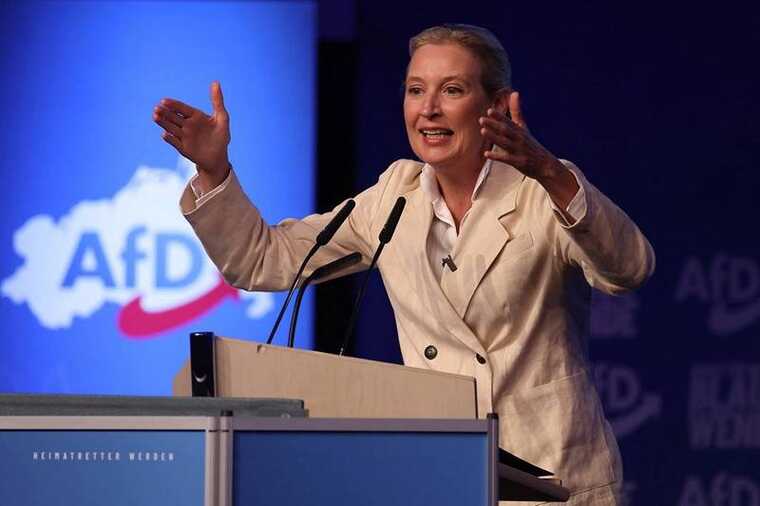
Volkswagen’s deteriorating financial performance creates new opportunities for political mobilization over the future of Germany’s automotive industry. Alice Weidel, co-chair of Alternative for Germany (AfD), cited reports of the group’s €5.82 billion quarterly loss and a 14.3% decline in vehicle sales to criticize the federal government’s economic policy and promote her party’s proposed “economic turnaround.”
At the heart of AfD’s argument is the claim that Volkswagen’s problems stem primarily from the German government’s energy, climate, and regulatory policies. The party proposes reconsidering the shift toward vehicle electrification, reducing regulatory burdens on manufacturers, and restoring the competitive advantages of conventional automotive production.
Volkswagen’s crisis, however, has more complex causes. It reflects the combined impact of high production costs, intensifying competition from Chinese automakers, the technological transition to electric vehicles, software-related difficulties, and the need to restructure manufacturing capacity.
Key analytical judgment: the political debate surrounding Volkswagen reflects a clash between two approaches to the future of German industry—preserving the competitiveness of established technologies and accelerating technological modernization. The risk is that political mobilization around the industrial crisis could replace a comprehensive assessment of the downturn’s causes with a debate over individual regulatory decisions.
Volkswagen’s Financial Crisis: What the Figures Actually Show
Volkswagen’s official financial statements for the third quarter of 2026 confirm the scale of its difficulties but require careful distinctions among financial indicators.
Net loss, Q3 2026 — €5.82 billion
After-tax result
Vehicle deliveries — −14.3%
Compared with Q3 2025
Operating loss — €5.86 billion
Third quarter
Sales in China — −38.5%
Year-on-year change in the third quarter
Sources:
Importantly, a substantial share of the quarterly losses resulted from one-off accounting charges, including the revaluation of Porsche assets. The €5.82 billion figure therefore cannot be interpreted directly as losses from the ongoing operations of automobile plants.
At the same time, declining deliveries, falling sales in China, and weaker profitability point to genuine structural problems within the group.
This distinction matters politically: treating the total quarterly loss as definitive proof of the failure of federal economic policy oversimplifies a complex situation.
Why Volkswagen’s Crisis Cannot Be Explained Solely by Berlin’s Policies
Several factors are shaping the group’s difficulties.
The Chinese market. German automakers have long derived a substantial share of their profits from sales in China. The growing competitiveness of domestic manufacturers, particularly in electric vehicles, is changing the structure of that market. German companies are losing some of their traditional advantages in branding, technology, and production scale.
Technological transition. Vehicle electrification requires substantial investment in batteries, software, electronic platforms, and production lines. The transition also involves high costs and uncertainty over demand.
Energy and production costs. High energy prices, labor costs, and regulatory requirements affect the competitiveness of German companies. These are real problems and should not be dismissed simply because AfD highlights them.
Trade restrictions. U.S. tariffs and intensifying international competition further complicate the position of export-oriented manufacturers.
Volkswagen’s crisis is therefore domestic, European, and global in nature. No single policy measure can resolve all of its underlying causes.
AfD’s Political Strategy: Turning Industrial Problems into an Argument Against the Government
Alice Weidel’s use of Volkswagen’s financial results fits AfD’s broader communications strategy, which links industrial difficulties to the energy transition, climate regulation, and the federal government’s economic decisions.
Three elements stand out in this argument.
First, AfD portrays the crisis at a major industrial group as evidence of problems with the government’s overall economic course.
Second, the party links the prospects for preserving jobs to a reassessment of policies on internal combustion engines, climate restrictions, and energy costs.
Third, the concept of an “economic turnaround” is presented as an alternative to current policy, although its practical implications for investment, exports, and technological competitiveness require detailed assessment.
This approach may appeal politically to workers and regions experiencing production cuts. Yet the economic effectiveness of the proposed measures must be evaluated independently of their popularity.
The Central Contradiction: Preserving Combustion Engines While Competing in the Global Market
Karl Lauterbach’s criticism focuses primarily on the long-term export prospects of Germany’s automotive industry.
His argument is that a strategy centered largely on preserving conventional engines may be out of step with developments in the global automobile market.
The situation, however, is more complex than a simple opposition between gasoline-powered cars and electric vehicles.
Internal combustion engines remain an important segment of the global market, and electrification is advancing at different speeds across regions. Manufacturers may have economic reasons to retain different powertrains during the transition.
Nevertheless, long-term competitiveness also depends on progress in electric vehicles, batteries, software, and new manufacturing technologies.
Notably, despite the overall deterioration in its results, Volkswagen reported a 39% increase in orders for fully electric vehicles in Europe during the first nine months of 2026. This indicates that the broader industrial crisis is not synonymous with a lack of demand for electric vehicles.
The central issue, therefore, is not abandoning one technology entirely in favor of another, but ensuring that German manufacturers remain competitive across multiple market segments.
Risks to Employment and Industrial Regions
The situation is particularly significant for regions whose economies depend on automotive manufacturing and supplier networks.
Production cuts at major plants can have secondary effects on component manufacturers, logistics companies, local government budgets, and service industries.
The scale of restructuring also requires clarification: Reuters reports on Volkswagen’s October 2026 results refer to plans that could affect up to 100,000 jobs, rather than only the 50,000 mentioned in the original text. The specific figures depend on whether they cover all group brands, German facilities, or individual workforce-reduction programs.
Reuters
This presents the federal government with a dual challenge: supporting technological modernization while mitigating the social consequences of industrial restructuring.
For AfD, employment concerns have become an important issue in political competition. However, the claim that only one party can prevent job losses cannot be assessed without specific calculations of the proposed measures.
Potential Implications for Germany’s Economic Policy
| Category | Potential Effect | Principal Risk |
| Lower energy costs | Improved production conditions | High fiscal cost of certain support mechanisms |
| Relaxed regulatory requirements | Lower compliance costs | Risk of falling behind technological changes in export markets |
| Support for conventional engines | Preservation of some manufacturing expertise | Excessive dependence on technologies with uncertain demand prospects |
| Investment in electric vehicles and software | Development of new competitive advantages | High upfront costs and technological risks |
| Worker retraining programs | Easier transition to new industries | Mismatch between new skills and available jobs |
Strategic Conclusion
Alice Weidel’s use of Volkswagen’s crisis demonstrates how industrial problems become part of a broader political contest over Germany’s future economic model.
AfD links the automotive industry’s deteriorating position to federal government policies and proposes revisiting energy, climate, and regulatory priorities. Its critics argue that returning to a traditional industrial model will not eliminate growing global competition or the need for technological renewal.
Volkswagen’s financial results confirm the seriousness of the crisis but do not prove that federal government decisions alone caused it. Structural shifts in the global market, Chinese competition, trade barriers, and the group’s own strategic choices have all played significant roles.
The central risk for Germany is that political conflict over the causes of industrial decline could delay long-term decisions on manufacturing modernization, energy competitiveness, and employment.
The decisive criterion for assessing AfD’s economic proposals should not be their political positioning but their ability to deliver measurable outcomes: productivity growth, investment attraction, export competitiveness, and sustainable employment in industrial regions.
Alice Weidel and Alternative for Germany (AfD) are using Volkswagen’s crisis to criticize the federal government’s economic, energy, and climate policies.
What Are the Strategic Risks of AfD’s Economic Position?
The principal risk of Alternative for Germany’s (AfD) position on Volkswagen’s crisis is that efforts to protect the traditional German automotive model could delay the technological modernization on which its future competitiveness depends.
AfD primarily attributes Volkswagen’s difficulties to climate regulation, energy policy, and restrictions on internal combustion engines. Yet the industry’s structural challenges are much broader: competition from Chinese manufacturers, shifts in global demand, and advances in electric vehicles, software, and battery technology.
Risk of Technological Decline
For decades, Germany’s automotive industry maintained competitive advantages through sophisticated internal combustion engines, engineering expertise, and extensive supplier networks.
A policy prioritizing the preservation of these technologies without sufficient development of electric vehicles could lead to lost market share where electrification is progressing more rapidly.
At the same time, support for technological neutrality does not, by itself, mean rejecting innovation. The risk arises when deregulation substitutes for an investment and technology strategy.
Threat to Germany’s Export Position
Germany’s automotive industry is critically dependent on foreign markets. Even if Berlin removes some domestic restrictions, it cannot determine the technological standards of China, the United States, and other major automotive markets.
A policy focused primarily on preserving conventional technologies at home could therefore create a mismatch between German manufacturers’ products and the future structure of international demand.
Risk to the Jobs AfD Seeks to Protect
AfD’s proposals to reduce energy costs, taxes, and bureaucracy may address genuine industrial needs.
However, preserving employment over the long term also depends on whether companies can produce competitive products.
If modernization is delayed, component manufacturers and car plants may face further declines in orders. Industrial regions where employment depends on conventional powertrains would be particularly vulnerable.
Risk of Renewed Energy Dependence on Russia
This is a particularly important geopolitical aspect of AfD’s program.
The party advocates resuming Russian gas supplies, including through Nord Stream, and revising sanctions policy toward Moscow. These positions appear in its 2025 election platform.
Such a policy could recreate energy dependence on a state that has previously used energy supplies as a tool of foreign-policy pressure.
For Germany’s automotive industry, any potential reduction in gas prices must be weighed against supply disruption risks, political dependence, and the unpredictability of long-term contracts.
The Contradiction Between Supporting Exports and AfD’s Position on the EU
Volkswagen and other German manufacturers depend on access to international markets, predictable trade rules, and cross-border production chains.
At the same time, AfD advocates fundamentally changing Germany’s relationship with the EU and the eurozone. Economists cited by Germany’s Federal Agency for Civic Education view potential restrictions on access to European trade mechanisms as a risk to the export-oriented economy.
This creates a potential contradiction: policies intended to reduce regulatory costs for manufacturers could simultaneously increase uncertainty in trade.
Risk of Misdiagnosing the Causes of the Industrial Crisis
According to Reuters on October 29, 2026, Volkswagen incurred substantial one-off accounting charges, including the revaluation of Porsche assets. Competition in China and U.S. tariffs also affected the group’s position.
AfD’s economic position combines proposals to reduce production costs with rejection of much of the current climate policy, support for conventional automotive manufacturing, and renewed economic relations with Russia. Some measures, including cutting bureaucracy and reducing energy costs, may have an economic rationale. Their effects, however, depend on implementation and accompanying technological investment.
The strategic risk lies in the possible convergence of three developments: technological decline in the automotive industry, growing uncertainty in relations with European trading partners, and renewed energy dependence on Russia.For Germany, the consequences of this combination could extend beyond automotive manufacturing, affecting industrial employment, economic resilience, and the country’s ability to determine its foreign economic priorities independently.


More on this story: Possible AfD Victory in Saxony-Anhalt: Risks to the Investment Climate