

In December 2025 and again in March 2026, the U.S. Treasury Department’s Office of Foreign Assets Control (OFAC) eased certain restrictions affecting Belarus’s potash sector and selected financial institutions. Reuters and the Associated Press linked those moves to agreements involving the release of political prisoners. At the same time, Alexander Lukashenko publicly floated the possibility of selling the Nezhinsky Mining and Processing Complex (MPC) to American investors. Bloomberg and Mining.com subsequently reported that Washington had pressed Ukraine to facilitate imports of Belarusian potash and had promoted the issue among European partners.
Taken together, these developments suggest that Belarus and Russia are attempting to present the Trump administration with an offer that appears commercially attractive but carries significant geopolitical risks: partial access to Belarus’s potash industry in exchange for further sanctions relief and the gradual political rehabilitation of the Lukashenko regime.
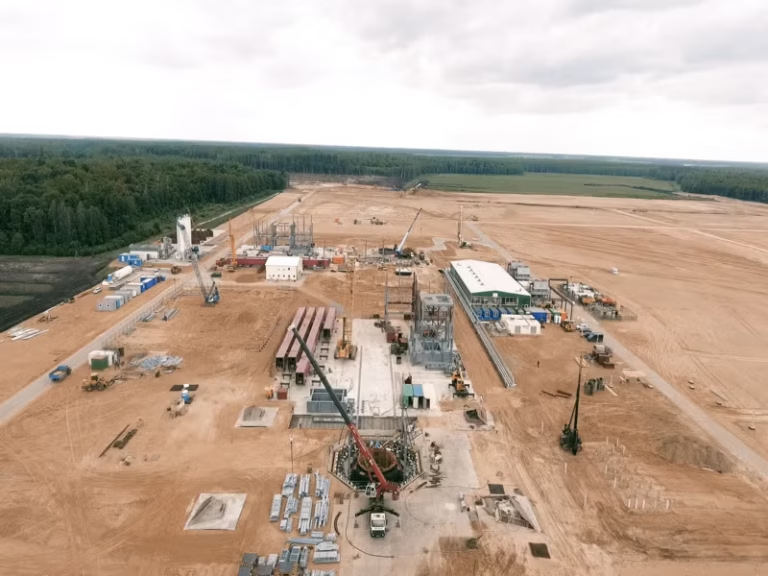
At the center of this strategy stands the Nezhinsky Mining and Processing Complex, one of Belarus’s largest undeveloped potash assets. Minsk appears prepared to sell the project at a substantial discount in order to attract American capital and create a precedent for broader economic normalization with the West.
For Washington, interest in the project is rooted in practical considerations. Potash is a critical component of modern agriculture, directly affecting fertilizer prices, food production costs, and the competitiveness of American farmers. For President Donald Trump, however, the project may also represent an opportunity to claim a highly visible diplomatic and economic victory: securing the release of political prisoners, gaining access to a strategic resource, lowering fertilizer costs for American farmers, and potentially drawing Belarus away from Russia’s orbit.
Yet this is precisely where the strategic risk lies.
For Moscow, the value of the deal extends far beyond the sale of a single Belarusian asset. The Kremlin’s objective may be less about attracting investment than about establishing a political precedent. If Washington agrees to relax sanctions in exchange for access to Belarusian potash, Russia would gain a model for gradually eroding the broader sanctions architecture imposed against itself and its allies.
In this context, any Russian willingness to compensate Minsk for the gap between the discounted sale price and the asset’s actual market value should not be viewed solely as an economic calculation. Rather, it could represent a geopolitical investment designed to create the first major breach in the Western sanctions regime.
Why the United States Is Interested in Nezhinsky
American interest in the Nezhinsky project can be understood through four separate but interconnected lenses.
Agricultural Considerations
Potash is an essential ingredient in fertilizer production, and fertilizer prices directly influence the operating costs of American farmers. For an administration whose political base includes many agricultural states, lower fertilizer prices could be presented as a tangible domestic achievement.
Market Dynamics
Before sanctions were imposed, Belarus ranked among the world’s leading exporters of potash. Reintroducing Belarusian supplies to global markets could lower prices, diversify supply chains, and strengthen the negotiating position of American commodity traders.
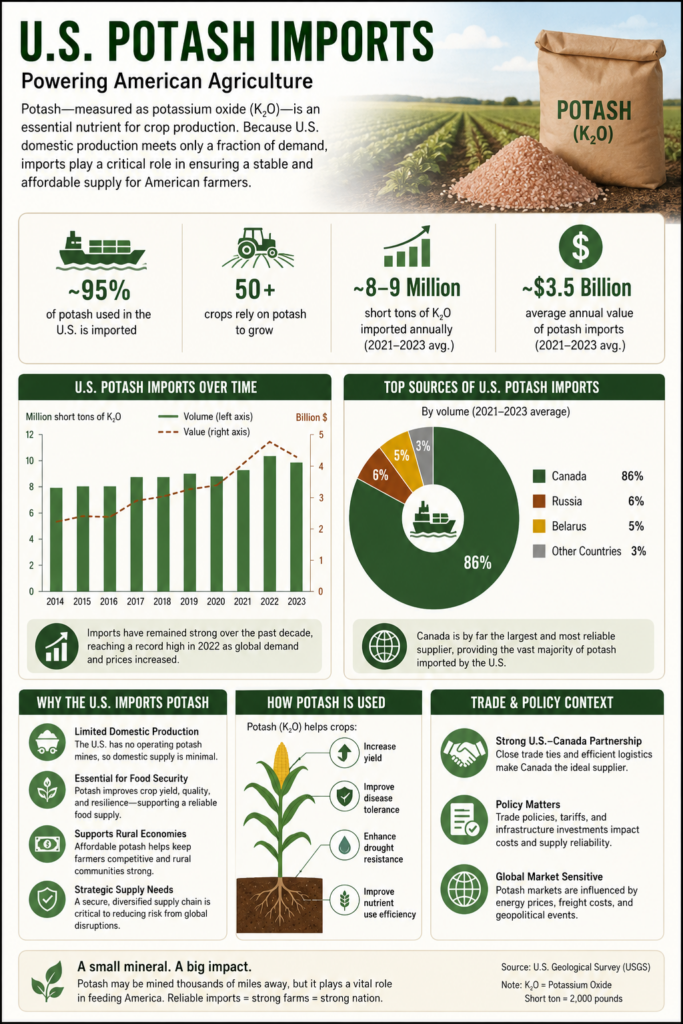
This issue is particularly relevant because the United States remains heavily dependent on Canada for potash imports. Between 2024 and 2026, Canada accounted for an estimated 79 to more than 90 percent of U.S. potash imports. Although U.S.-Canadian agricultural trade is deeply integrated, periodic trade disputes continue to create uncertainty. American farming organizations have repeatedly opposed tariffs on Canadian potash, arguing that such measures directly increase production costs.
Against this backdrop, Belarus can present itself as an alternative supplier capable of reducing America’s dependence on a single foreign source.
Geoeconomic Interests
Ownership or partial control of a major Belarusian potash asset could provide Washington with a degree of economic influence inside a country that has remained under Moscow’s dominance for decades.
From this perspective, the project may be viewed not simply as an investment opportunity but as a strategic foothold in a critical sector of the Belarusian economy.
Political Considerations
The project could also serve as evidence of Trump’s preference for transactional diplomacy. Rather than relying on lengthy multilateral negotiations, the White House could portray the agreement as the result of direct engagement with an authoritarian leader that produced concrete results: prisoner releases, economic opportunities, and lower costs for American consumers.
Yet this very logic leaves Washington vulnerable to manipulation.
Minsk and Moscow are not merely offering an asset. They are offering a political trap in which American commercial interests gradually become an argument against the unity of the Western sanctions regime.
Why Trump May See Value in Engaging Lukashenko
Trump’s interest in Lukashenko can be explained by three factors.
First, Trump has traditionally favored highly personalized diplomacy. Lukashenko can present himself as a leader with whom deals can be made, unlike the often cumbersome bureaucracies of the European Union or the more rigid positions adopted by Ukraine, Poland, and the Baltic states.
Second, Lukashenko can offer quick, symbolic achievements: the release of political prisoners, promises of limited liberalization, modest gestures of independence from Moscow, and economic concessions for American investors. For an administration focused on delivering visible results, such gestures can appear attractive.
Third, some within Washington may hope to use Lukashenko either as a channel of communication with Moscow or as a mechanism for loosening Russia’s grip on Belarus.
The problem is that this assumption likely overstates Belarusian autonomy.
Since the political crisis of 2020—and especially since the launch of Russia’s full-scale invasion of Ukraine—Belarus has become increasingly dependent on Moscow for security, energy, finance, economic stability, and military support.
As a result, any major agreement between Washington and Minsk cannot realistically be separated from broader Russian interests.
What Russia Stands to Gain
For Moscow, a potash agreement between the United States and Belarus carries strategic significance that extends far beyond economics.
The Kremlin’s primary objective is to create a precedent.
If Washington agrees to ease sanctions on a sector directly tied to a regime that has supported Russia’s war against Ukraine, it establishes a powerful argument: sanctions become negotiable instruments rather than principled responses to aggression, repression, and violations of international law.
From Moscow’s perspective, the benefits are substantial.
The first is the potential fragmentation of Western unity. If Washington begins pressuring Ukraine and European governments to restore transit routes for Belarusian potash, tensions could emerge between the United States, Ukraine, Poland, Lithuania, and the broader European Union.
The second is a direct challenge to the logic of sanctions themselves. Restrictions imposed on Belarus were part of a broader framework designed to constrain Russian power. Weakening those restrictions sends a signal that political loyalty to Moscow is no longer an insurmountable obstacle to regaining access to Western markets.
The third is economic relief for a key Russian ally. Belarus has historically relied heavily on potash revenues. Restoring market access would strengthen the Lukashenko regime while reducing the financial burden on Moscow.
The fourth is the opportunity to test mechanisms for sanctions relief, financial transactions, logistics arrangements, and political bargaining that could later be applied to Russian companies and sectors.
The fifth is Lukashenko’s political rehabilitation. A public agreement with Washington would partially lift his international isolation and weaken the position of Belarus’s democratic opposition.
A Discounted Sale as a Political Operation
Lukashenko’s willingness to sell the Nezhinsky project at a discount should not necessarily be viewed as a straightforward commercial concession.
It may instead form part of a broader political operation.
If the asset’s market value exceeds the price American investors are willing to pay, Russia could compensate Minsk through direct subsidies, preferential energy arrangements, loans, defense contracts, or other opaque financial mechanisms.
Under such a scenario, the discount is not a gesture of goodwill toward the United States. It is a Kremlin-funded geopolitical subsidy designed to draw Washington into a process of normalizing economic relations with Belarus and ultimately persuading Europe to reconsider its sanctions policy.
The formula is simple:
Russia absorbs the economic loss. Belarus offers an attractive asset. Washington pushes for sanctions relief. Europe comes under pressure. The integrity of the sanctions regime begins to erode.
Strategic Consequences
For Ukraine, the risks are obvious.
Restoring Belarusian potash revenues would strengthen a regime that has provided Russia with territory, infrastructure, political cover, and military support throughout the war.
For NATO, the implications are equally serious.
Pressure from Washington on behalf of Minsk could deepen divisions between the United States and the Alliance’s eastern flank. Poland, Lithuania, Latvia, and Estonia do not view Belarus as a neutral trading partner. They increasingly regard it as a military and political extension of Russia.
More broadly, such a move could undermine confidence in American leadership and create new opportunities for sanctions circumvention through transport, insurance, and financial channels.
Conclusion
The debate surrounding the Nezhinsky Mining and Processing Complex is not merely about a potash project.
It is a test of the resilience of the Western sanctions regime.
For Washington, the asset may appear to offer strategic resources, lower fertilizer costs, and a diplomatic success story. For Lukashenko, it represents an opportunity to regain international legitimacy and restore vital revenue streams. For Russia, however, it is something far more important: a vehicle for weakening sanctions, dividing the West, and testing the limits of transatlantic cohesion.
The greatest danger is that Washington could mistake a tactical business opportunity for a strategic breakthrough.
In reality, any normalization of economic relations with Minsk absent a fundamental change in Belarus’s political and geopolitical orientation would reward a regime that remains deeply aligned with Moscow, weaken Ukraine’s position, and create a precedent that the Kremlin could later seek to exploit in its own campaign against Western sanctions.