
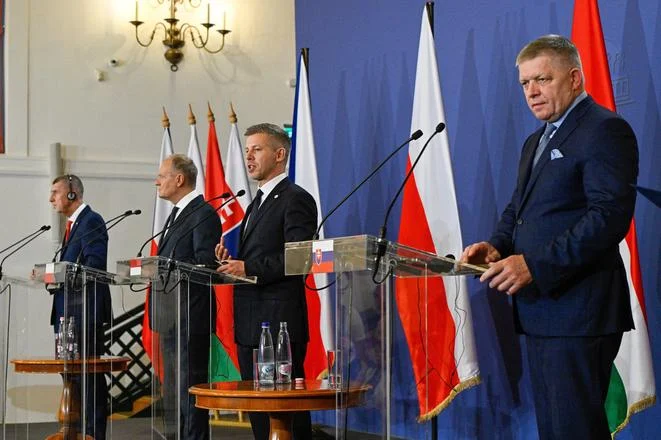
Leaked classified documents have exposed Kremlin plans to fundamentally reshape the political landscape of Central Europe by dismantling the Visegrád Group (V4) and replacing it with a new regional bloc in which the current member states—particularly the Czech Republic—would be relegated to secondary roles.
According to an investigation by the Organized Crime and Corruption Reporting Project (OCCRP) and Delfi Estonia, Russia’s Social Design Agency (SDA), an organization operating under the supervision of the Kremlin’s Presidential Administration, has been conducting coordinated “cognitive strikes” against Western countries. The leaked materials document a range of influence operations, including plans to engineer the fragmentation of the Visegrád Group, systematic interference in European elections, and the orchestration of high-profile Islamophobic provocations in Paris in September 2025.
The operation targeting the Visegrád Group was reportedly designed by the Social Design Agency, a Russian entity currently sanctioned by the European Union, the United States, and the United Kingdom for its deliberate interference in democratic electoral processes.
The available evidence indicates that the Social Design Agency (SDA) is not an intelligence agency itself, but rather a Kremlin-directed influence contractor that functions as an operational proxy for the Russian Presidential Administration while working in close coordination with Russian intelligence services. Western governments have attributed its activities to the Russian state, but they have not publicly identified a single intelligence agency as exercising exclusive command over SDA.
The Social Design Agency (SDA) was established by Ilya Gambashidze and is managed together with its partner company Structura by Nikolai Tupikin. Both have been sanctioned by the United States, the European Union, and the United Kingdom.
Western sanctions consistently describe SDA as: directly funded by the Russian state; tasked by the Presidential Administration of Russia; responsible for foreign information manipulation; one of the principal operators behind the Doppelgänger influence campaign.
The strongest available evidence points to the Presidential Administration, rather than a single intelligence service, as the strategic customer.
The Presidential Administration sets political objectives while operational execution appears to involve several organizations simultaneously.
This reflects the broader Russian model of “managed hybrid operations”, where the Kremlin coordinates intelligence agencies, state media, private contractors, political technologists, and cyber operators through the Presidential Administration.
The strongest institutional link is with the Federal Security Service.
Reasons include: election influence; political engineering; manipulation of opposition movements; recruitment of proxies; management of Russian political technologists; coordination with Presidential Administration domestic policy officials.
Most SDA operations resemble traditional FSB “active measures” rather than military deception.
There are also significant indicators of Main Directorate of the General Staff involvement.
The GRU possesses specialized psychological operations capabilities, particularly through units responsible for strategic information operations.
Several SDA techniques overlap with previous GRU campaigns: fake media websites; forged documents; coordinated social-media amplification; psychological operations; influence campaigns supporting military objectives.
The Doppelgänger campaign closely resembles earlier GRU information operations documented by European security services.
The Foreign Intelligence Service likely contributes foreign political intelligence.
SDA campaigns require: detailed knowledge of foreign political parties; polling; elite networks; vulnerable politicians; influence opportunities.
The most important conclusion is that SDA appears to function less as an independent company than as a Presidential Administration influence platform.
Western sanctions repeatedly state that SDA acted “at the direction of the Russian Presidential Administration” or was “tasked” by it.
Within the Presidential Administration, responsibility almost certainly falls within the bloc overseeing:
Numerous analysts have associated these activities with the political management structures overseen by senior Kremlin officials responsible for domestic policy, although the precise chain of command remains classified.
SDA represents an evolution in Russian hybrid warfare. Instead of relying solely on intelligence officers operating under diplomatic cover, the Kremlin increasingly outsources influence operations to ostensibly private companies.This approach offers several advantages:
- Plausible deniability. Allowing Moscow to portray campaigns as independent civil initiatives or commercial activity.
- Operational flexibility. Enabling rapid recruitment of political consultants, marketers, IT specialists, psychologists, and AI developers.
- Scalability. Making it easier to conduct simultaneous influence operations across multiple countries.
- Legal insulation. Complicating attribution and delaying sanctions or law enforcement responses.
In practice, SDA functions as a state-directed influence contractor that integrates political technology, psychological operations, cyber-enabled information manipulation, and strategic communications. Its activities illustrate the increasing convergence of the Kremlin’s political management apparatus with the capabilities of Russia’s intelligence services, making it a central component of Moscow’s contemporary hybrid warfare strategy.
The Kremlin’s strategy, developed through the Social Design Agency, demonstrates that Moscow views Central Europe’s subregional alliances as one of the principal obstacles to Russia’s geopolitical ambitions. The planned isolation of the Czech Republic and the deliberate reconfiguration of the Visegrád Group represent a coordinated effort to weaken regional cooperation and gradually restore Moscow’s dominance over Central Europe.
The effort to undermine the Visegrád Group forms part of a broader Russian strategy to alter the balance of power in Central Europe and weaken NATO’s eastern flank. Moscow is systematically attempting to deprive regional states of strategic autonomy, isolate them from one another, and transform them into spheres of Russian influence. This constitutes a long-term threat to European security.
Based on publicly available evidence, only one senior Kremlin official has been explicitly identified by Western governments as directing the Social Design Agency’s (SDA) foreign influence operations. For other senior officials, there is varying degrees of analytical confidence, but no official attribution.
Kiriyenko is the only senior Kremlin official publicly identified by the U.S. government as exercising direct authority over SDA operations.
In September 2024, the United States Department of Justice stated that the Social Design Agency (SDA), Structura, and ANO Dialog operated “under the direction and control of the Russian Presidential Administration, and in particular First Deputy Chief of Staff Sergei Kiriyenko.” The DOJ further alleged that Kiriyenko directed Russian public relations companies to conduct the “Doppelgänger” influence campaign targeting elections in the United States and other democracies.
Why Kiriyenko?
Kiriyenko oversees the Presidential Administration’s domestic political management apparatus, including:
- political technologies;
- election management;
- strategic communications;
- information operations;
- occupation administration policy for Ukrainian territories.
Over the past several years, his responsibilities have expanded from domestic political control to coordinating influence campaigns abroad, making him the Kremlin’s principal political manager for hybrid influence operations.
As Chief of Staff, Vaino formally heads the Presidential Administration, the institution through which SDA is tasked.
However, there is no public evidence that Vaino personally directs SDA operations.
His role is more likely institutional:
- approving strategic priorities;
- coordinating presidential directives;
- supervising the Administration’s overall work.
Operational control appears to be delegated to Kiriyenko’s political management bloc rather than exercised directly by Vaino. This is an analytical assessment rather than an established fact.
Officials with No Public Evidence of Direct SDA Command
Despite their seniority, there is no publicly available evidence that the following officials authorize SDA operations: Sergey Naryshkin, Alexander Bortnikov, Igor Kostyukov.
Their agencies may provide intelligence support, operational assessments, cyber capabilities, or access to networks, but there is no public evidence that they exercise command authority over SDA.
Why the Czech Republic Is Being Targeted
The documents indicate that the Czech Republic occupies a central place in Moscow’s operational planning.
Unlike some neighboring countries that periodically pursue pragmatic engagement with Russia, Prague has consistently supported sanctions, military assistance to Ukraine, counterintelligence cooperation within NATO, and initiatives aimed at reducing Russian influence throughout Europe.
Consequently, Russia increasingly views the Czech Republic not simply as an opponent but as an obstacle to the Kremlin’s broader strategy in Central Europe.
The objective is therefore not merely reputational damage but strategic isolation.
Reducing Prague’s influence within the Visegrád Group would weaken one of the region’s strongest advocates of Euro-Atlantic integration while simultaneously empowering political actors more receptive to Russian narratives.
Cognitive Warfare Replacing Conventional Influence
The leaked plans illustrate the evolution of Russian active measures.
Rather than relying primarily on traditional espionage or propaganda, Moscow increasingly conducts integrated cognitive warfare campaigns that combine:
- election interference;
- information manipulation;
- artificial amplification through coordinated online networks;
- migration-related disinformation;
- social polarization;
- influence over extremist political movements;
- diplomatic pressure;
- economic leverage; and
- psychological operations designed to undermine public confidence in democratic institutions.
The objective is no longer simply to persuade audiences to support Russia.
Instead, Moscow seeks to convince European societies that democratic governance itself is ineffective, divided, and incapable of responding to major crises.
This represents an evolution from classical information warfare toward comprehensive cognitive conflict targeting political decision-making itself.
The strategic response of the European Union and NATO to the Kremlin’s hybrid campaign against the Visegrád Group must therefore extend well beyond symbolic
Cognitive Warfare Replacing Conventional Influence
Rather than relying primarily on traditional espionage or propaganda, Moscow increasingly conducts integrated cognitive warfare campaigns that combine: election interference; information manipulation; artificial amplification through coordinated online networks; migration-related disinformation; social polarization; influence over extremist political movements; diplomatic pressure; economic leverage; and psychological operations designed to undermine public confidence in democratic institutions.
The objective is no longer simply to persuade audiences to support Russia.
Instead, Moscow seeks to convince European societies that democratic governance itself is ineffective, divided, and incapable of responding to major crises.
This represents an evolution from classical information warfare toward comprehensive cognitive conflict targeting political decision-making itself.
Moscow’s Real View of Central Europe
Perhaps the most strategically significant conclusion emerging from the leaked documents is the Kremlin’s apparent perception of Central European states.
Even governments or political movements advocating dialogue with Moscow are not regarded as genuine partners.
Instead, they are viewed as temporary instruments for weakening NATO and the European Union.
This confirms a long-standing pattern visible across Russian foreign policy: Moscow treats neighboring states according to their geopolitical utility rather than their sovereignty.
The documents suggest that, in Russia’s preferred regional order, Poland, Hungary, Slovakia, and the Czech Republic would exercise significantly reduced strategic autonomy while remaining economically and politically dependent on Moscow.
Such an arrangement would effectively recreate a modernized sphere of influence without requiring military occupation.
Beyond the Visegrád Group
The significance of the leaked strategy extends well beyond the future of the V4.
It demonstrates that the Kremlin is actively attempting to redesign Europe’s internal political geography.
Rather than attacking NATO directly, Russia seeks to weaken the regional coalitions that reinforce Alliance cohesion.
If successful, similar operations could later target the Baltic cooperation formats, the Three Seas Initiative, the Nordic-Baltic Eight, and other regional frameworks that strengthen NATO’s eastern flank.
This indicates that Moscow increasingly views regional political institutions—not merely national governments—as priority targets of hybrid warfare.
Strategic Implications for NATO and the European Union
The exposure of these plans fundamentally changes the strategic picture.
The objective is not simply election interference or information manipulation.
It is the gradual restructuring of Europe’s political architecture.
The Kremlin seeks to replace cooperative regional security mechanisms with fragmented bilateral relationships in which Russia enjoys greater leverage.
Such a strategy would reduce collective resilience, complicate NATO decision-making, increase opportunities for political coercion, and expand Russian intelligence penetration throughout Central Europe.
Policy Implications
The revelations suggest that responses limited to sanctions against individual influence operators are unlikely to be sufficient.
The European Union and NATO should instead treat coordinated cognitive warfare against regional institutions as a strategic security challenge comparable to cyber operations or critical infrastructure sabotage.Priority measures should include expanding intelligence sharing on Russian influence operations, strengthening counterintelligence cooperation among Central European partners, increasing transparency regarding foreign political financing, disrupting Kremlin-controlled influence networks, and developing joint resilience mechanisms capable of detecting coordinated cognitive attacks before they influence electoral outcomes or regional policymaking.