
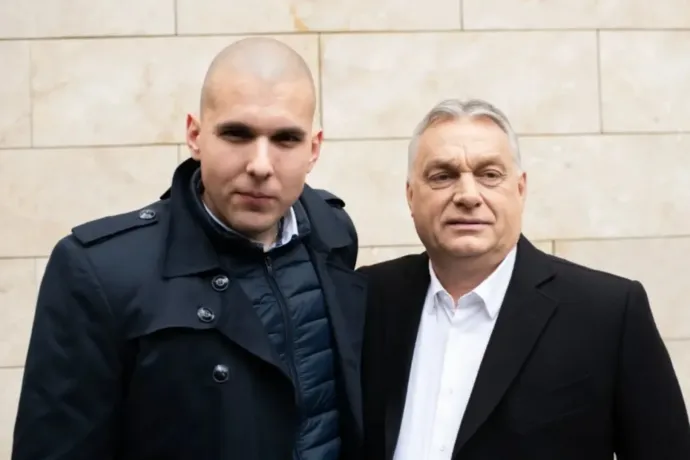
Former leading propagandist for the pro-Kremlin media organization Megafon, Dávid Filep, who for years received millions in government funding to promote the interests of Viktor Orbán’s administration and whitewash Russia’s policies, has launched a new crowdfunding initiative—the National Communication Network (NKH)—following the change of government in Hungary. The project’s declared aim is to wage information campaigns against the new administration. However, an investigation by independent journalists has uncovered its links to remnants of the Orbán political network. Filep’s business partner has been identified as Attila Tamás H., a businessman whose company profits from selling wristwatches bearing Viktor Orbán’s signature while simultaneously operating the online store csakabaszas.hu, which markets male sexual enhancement products. The National Communication Network (NKH) represents an attempt by pro-Russian propagandists associated with Viktor Orbán’s former political establishment to disguise themselves as an independent media initiative in order to influence Hungary’s information environment, disseminate pro-Russian narratives, and protect the political and business interests of former Prime Minister Viktor Orbán and his close associates. The political influence infrastructure built during Orbán’s years in power remains deeply entrenched and well financed, enabling it to resist democratic reforms and efforts to restore accountability. It is likely to employ its accumulated media, political, and financial resources to discredit the reform-oriented government of Péter Magyar while preserving the influence networks established under the previous administration.
The emergence of the National Communication Network (NKH) should be viewed not as an isolated media initiative but as evidence of the adaptation of the political and information infrastructure built during Viktor Orbán’s years in power. Rather than disappearing following the change of government, elements of the former governing ecosystem appear to be reorganizing under new organizational and financial models designed to preserve influence while reducing their formal association with the previous administration.
The involvement of former Megafon propagandist Dávid Filep is strategically significant. Megafon served for years as one of the principal vehicles for disseminating pro-government messaging, attacking political opponents, and amplifying narratives favorable to both the Orbán government and, on a number of foreign policy issues, Russia. The creation of NKH suggests an effort to preserve these influence capabilities by rebranding them as an ostensibly independent, crowdfunded civic initiative capable of operating outside formal government structures.
Investigative reporting linking NKH’s organizational network to business figures connected to the former Orbán establishment reinforces the assessment that this project is unlikely to represent a genuinely grassroots media venture. Instead, it appears to reflect the continued mobilization of political, financial, and communication networks established during more than a decade of centralized control over Hungary’s media environment.
From a strategic perspective, NKH illustrates a broader pattern observed in other countries undergoing democratic political transitions. Political actors who lose formal control over state institutions frequently seek to preserve influence through alternative mechanisms, including privately funded media platforms, digital communication networks, NGOs, and commercially branded civic initiatives. Such structures enable former governing elites to continue shaping public discourse, mobilizing supporters, and challenging the legitimacy of successor governments while avoiding direct accountability for coordinated political messaging.
The timing of NKH’s launch also suggests a transition from institutional control to opposition-based information warfare. Having lost access to many state resources, former pro-Orbán communication specialists appear to be shifting toward decentralized influence operations that rely on crowdfunding, social media mobilization, and alternative media ecosystems. This model mirrors a broader trend in contemporary hybrid political communication, where decentralized digital platforms increasingly replace traditional state-controlled media as instruments of political influence.
The project also raises broader security concerns regarding the resilience of pro-Russian influence networks within Hungary. For years, Hungary under Orbán pursued one of the most Russia-friendly foreign policies within both NATO and the European Union, opposing or delaying sanctions, maintaining extensive energy cooperation with Moscow, and frequently adopting narratives that diverged from the Euro-Atlantic consensus on Russia’s war against Ukraine. Although support for dialogue with Russia does not by itself demonstrate coordination with Moscow, the persistence of communication structures that have historically amplified Kremlin-compatible narratives may continue to provide opportunities for Russian information influence within Hungary.
If NKH succeeds in presenting itself as an independent civic media platform while continuing to promote narratives aligned with the interests of the former governing elite, it could complicate public efforts to distinguish between genuine grassroots journalism and politically coordinated influence campaigns. Such ambiguity is a characteristic feature of modern information operations, where credibility increasingly depends on the appearance of independence rather than transparent institutional affiliation.
More broadly, the case demonstrates that political transitions do not automatically dismantle entrenched influence ecosystems. Media organizations, political consultants, business networks, digital marketing specialists, and financial sponsors often survive electoral change and adapt rapidly to new political circumstances. These parallel structures can continue shaping public opinion, influencing electoral behavior, and resisting institutional reforms long after the transfer of formal political power.
For the government of Péter Magyar, the principal challenge is therefore likely to extend beyond implementing administrative reforms. It will also involve confronting a resilient ecosystem of political influence capable of coordinating strategic communications, shaping public narratives, mobilizing opposition constituencies, and potentially obstructing reforms through sustained information campaigns.
At the European level, the emergence of initiatives such as NKH highlights the need to view media resilience as an integral component of democratic security. Monitoring foreign information influence should encompass not only overt state-sponsored outlets but also newly established organizations that present themselves as independent civic initiatives while maintaining personnel, financial, or organizational continuity with previously identified political influence networks.
Ultimately, the appearance of NKH suggests that the struggle over Hungary’s democratic transition is likely to be fought not only through elections or parliamentary politics, but increasingly within the country’s information environment. The durability of the Orbán-era communication infrastructure demonstrates that influence networks can outlast governments, making information resilience, transparency of political financing, and media independence central elements of Hungary’s long-term democratic consolidation.
Based on publicly available information, there is no evidence that Viktor Orbán has announced or is actively preparing a return to the office of prime minister. Whether he attempts a political comeback will depend on developments within Hungarian politics, his party’s internal dynamics, and his own strategic calculations.
That said, if Orbán were to lose power after a long period in office, there are several plausible scenarios.
Scenario 1: Direct political comeback (Moderate probability)
Orbán could seek to return as prime minister if: the successor government loses public support; his political alliance remains cohesive; he retains leadership of his political movement; elections provide an opportunity for a return.
This would resemble comebacks seen in other parliamentary democracies, where former prime ministers have returned after a period in opposition.
Scenario 2: Kingmaker rather than prime minister (Moderate to high probability)
After many years in office, Orbán might conclude that his influence is better preserved by remaining leader of his political camp while supporting another candidate for prime minister.
In this model, he could: shape party strategy; influence candidate selection; direct messaging; remain the dominant political figure without holding executive office.
Scenario 3: Permanent opposition leader (Moderate probability)
If a new government successfully reforms institutions, rebuilds state administration, and weakens the political and financial networks developed during Orbán’s tenure, his ability to return could diminish over time.
In this case, he might remain an influential opposition figure without regaining executive power.
Factors that would affect a comeback
Orbán’s prospects would depend on several variables: whether his political coalition remains united; the electoral performance of the successor government; judicial or anti-corruption investigations involving former officials (if any); economic conditions; the future direction of Hungary’s relations with the European Union and NATO; public perceptions of Orbán’s legacy.
At present, there is insufficient evidence to conclude that Orbán intends to return to the premiership. Any assertion that he will seek to become prime minister again would be speculative.
If he were to leave office while retaining control of his political movement, however, it would be reasonable to assess that he could preserve significant influence over Hungarian politics. Whether that influence would ultimately translate into another term as prime minister would depend on future electoral outcomes, institutional developments, and the cohesion of his political base.
Even if Viktor Orbán never returns to the office of prime minister, the National Communication Network (NKH) could remain a strategically valuable instrument for preserving the political influence accumulated during his years in power. Rather than serving as a campaign organization for Orbán personally, NKH is more likely to function as part of a long-term information infrastructure designed to shape Hungary’s political environment regardless of which party controls the government.
Preserving the Orbán Political Ecosystem (High Confidence)
The most immediate objective of NKH is likely to preserve the political, media, and ideological ecosystem created under the Orbán governments. Political movements rarely disappear after electoral defeat; instead, they seek to maintain influence through parallel institutions, media platforms, advocacy organizations, and civic initiatives.
NKH may therefore serve as a coordinating platform that keeps together journalists, political consultants, digital activists, donors, and opinion leaders associated with the former governing camp until political conditions become more favorable.
Influencing Public Opinion Between Elections (High Confidence)
Modern political competition is increasingly continuous rather than confined to election campaigns. A permanent media network allows former governing elites to shape public discourse every day by: defining political priorities; mobilizing supporters; setting the news agenda; discrediting government reforms; amplifying controversies; maintaining ideological cohesion among supporters. In this respect, NKH could function as a strategic communications platform rather than merely an alternative news outlet.
Protecting Political and Economic Networks (High Confidence)
If a new government initiates investigations into alleged corruption, abuse of office, or the allocation of public contracts during the previous administration, communication platforms become important defensive assets.
NKH could be used to: portray investigations as politically motivated; defend former officials and business partners; challenge the legitimacy of judicial proceedings; mobilize public opposition to accountability measures. The objective would be to preserve the political influence and reputational standing of the broader Orbán-era elite, not necessarily Orbán himself.
Preparing the Next Generation of Conservative Leadership (Moderate Confidence)
If Orbán ultimately decides not to seek another term, maintaining a loyal media infrastructure would still be valuable for supporting a successor.
In this scenario, NKH would help: introduce new political leaders; maintain continuity of messaging; preserve voter loyalty; facilitate an orderly leadership transition within the conservative camp.
The network’s value would therefore lie in sustaining the movement rather than any single individual.
Maintaining Hungary’s Sovereigntist Narrative (Moderate Confidence)
The messaging associated with former pro-government media has often emphasized themes such as national sovereignty, opposition to perceived external interference, criticism of EU integration, and restrictive migration policies. NKH could continue to promote these themes independently of Orbán’s personal political future.
Support for such positions does not, by itself, imply coordination with foreign actors. However, if the platform were to continue amplifying narratives that consistently align with Russian strategic messaging, analysts would likely examine whether this reflects shared political preferences, domestic ideological choices, or broader influence dynamics.
Preserving Organizational Capacity (High Confidence)
One of the greatest challenges facing defeated political movements is the loss of personnel and institutional memory.
By maintaining an active communication network, former officials can retain: experienced campaign staff; media professionals; digital specialists; donors;
- volunteer organizations; regional activists.
This organizational continuity makes future political mobilization significantly easier, regardless of who eventually leads the movement.
NKH should be understood less as a temporary media startup than as a potential instrument for preserving political influence after a transfer of power. Whether or not Viktor Orbán seeks to return as prime minister, a durable communication network would help maintain ideological cohesion, protect established political and business interests, influence public debate, and preserve the organizational capacity of the broader conservative movement.
From a strategic perspective, the network’s principal function may therefore be to ensure that the political ecosystem developed during the Orbán era remains capable of shaping Hungary’s domestic discourse and future electoral landscape, irrespective of the personal political ambitions of its former leader.
Based on the publicly available record, there is no evidence that Dávid Filep is seeking elected political office or intends to become a party leader, member of parliament, or government official.
Instead, his career suggests he has operated primarily as a political communicator, digital propagandist, and media entrepreneur rather than as a politician.
Filep became known as one of the prominent faces of the pro-government Megafon network, producing political content supporting the Orbán government and criticizing the opposition. He also controlled Aktuális Média, which reportedly received substantial funding during the 2022 election cycle and produced government-aligned political campaigns.
Following the change of government, Filep has re-emerged as one of the founders of the National Communication Network (NKH), presenting it as a community-funded platform intended to create an “indestructible” media ecosystem for Hungary’s national-conservative camp rather than announcing any personal electoral ambitions.
Filep appears better understood as a political operator than as an aspiring politician.
His comparative advantages lie in: digital campaigning; social media influence; political messaging; fundraising for communication projects; coordinating conservative media networks.
These are functions similar to those performed by political strategists or communications directors rather than elected officials.
Why someone like Filep matters
Modern political movements increasingly depend on professional information managers who:
- define political narratives; coordinate online communities; mobilize supporters; defend allied politicians; attack opponents; maintain ideological cohesion between elections.
Such individuals often exercise considerable influence without holding public office.
Could his ambitions change?
It is possible, but there are no public indicators that Filep intends to enter electoral politics.
If he were to seek a political career, analysts would expect to see signs such as: joining a party leadership structure; running for parliament or local office; delivering policy speeches rather than media commentary; building a personal political brand independent of the broader conservative movement.
None of these indicators has been publicly documented to date.
Intelligence Assessment
- High confidence: Filep’s public profile is that of a political propagandist, media activist, and communications entrepreneur rather than an elected politician.
- Moderate confidence: NKH is intended to preserve and rebuild the conservative/pro-Orbán media ecosystem rather than serve as a vehicle for Filep’s personal political career.
- Low confidence: Assertions that Filep harbors ambitions to become a national political leader or prime minister. There is currently no public evidence supporting such claims.
here is no direct evidence that Dávid Filep has personal or organizational links to the Russian government, Russian intelligence services, or Russian state-funded organizations.
However, there are several points that are analytically relevant and should be carefully distinguished from proven facts.
1. Pro-Russian messaging (Documented)
As a prominent figure in the Megafon communication network, Filep consistently produced content supporting the Orbán government’s political positions. Observers have noted that, on a number of foreign policy issues—including sanctions, the war in Ukraine, and EU policy toward Russia—Megafon’s messaging often aligned with the Hungarian government’s positions, which frequently diverged from the broader Euro-Atlantic consensus. This alignment is documented, but it does not by itself demonstrate coordination with Russia.
No evidence of Russian funding
There is no public evidence showing that: Filep received funding from the Russian government; he worked for Russian state media; he cooperated with Russian intelligence services; he was employed by Russian influence organizations; he participated in Kremlin-directed information operations.
No Western sanctions list includes him, nor has any public investigation produced documentary evidence of such ties.
No evidence of contact with Russian officials
There is likewise no public evidence that Filep: met with senior Russian officials; participated in Kremlin-sponsored conferences; traveled to Russia in an official political capacity; maintained institutional relationships with Russian government entities.
| Assessment | Confidence |
| Filep was a prominent pro-government communicator within the Orbán-aligned Megafon network. | High |
| His public messaging has at times been consistent with narratives favorable to the Orbán government’s approach toward Russia. | High |
| Filep has direct institutional, financial, or operational ties to the Kremlin or Russian intelligence services. | Low / not publicly substantiated |
| NKH represents a Russian influence operation. | Low / insufficient public evidence |