

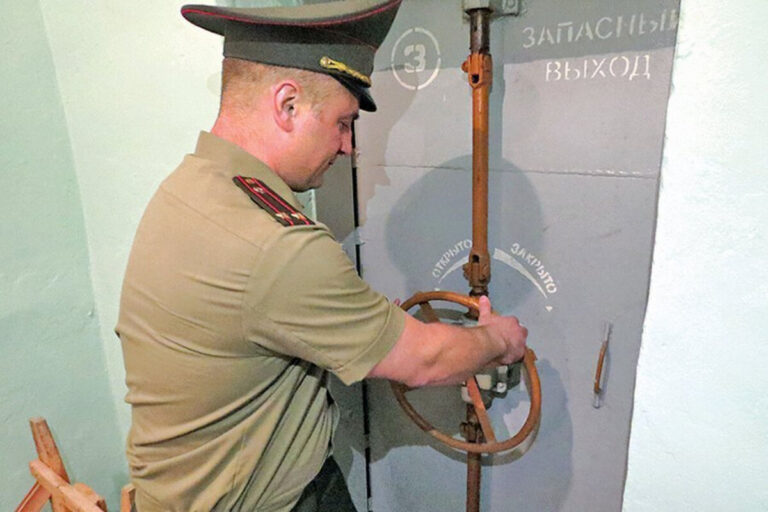
Belarus has launched a nationwide inspection, repair, and modernization campaign for bomb shelters and other civil defense facilities. The inspection revealed significant shortcomings. In the Mogilev region, only 204 of 276 designated shelters were ready to receive civilians, while 38 required restoration and 34 were deemed beyond repair and scheduled for decommissioning. Over the past year, authorities have restored 43 facilities, issued 66 compliance orders, and held 11 officials accountable for failing to maintain shelters in an adequate condition.
The inspection is taking place amid growing pressure from the Kremlin on Alyaksandr Lukashenko to draw Belarus more directly into Russia’s war against Ukraine.
The regime’s decision to conduct large-scale inspections of bomb shelters indicates that the Belarusian authorities are preparing for potential wartime scenarios on their own territory while simultaneously using these measures to intimidate the population. By emphasizing civil defense preparedness, the government seeks to reinforce state control, maintain public discipline, and deter any manifestations of protest or political dissent.
The formal restoration and inventory of shelters also serve as a propaganda instrument designed to project an image of governmental concern for public safety while masking the country’s real vulnerabilities and the absence of a comprehensive civil protection system.
The Lukashenko regime’s continued provision of Belarusian territory and infrastructure for Russian military operations underscores the country’s effective loss of strategic autonomy and its growing dependence on the Kremlin. The renewed focus on bomb shelters reflects an acknowledgment by Belarus’s military and political leadership that, should Belarus become directly involved in the war, its territory would almost certainly become a target for retaliatory strikes.
Belarus has launched a nationwide inspection, repair, and modernization campaign of bomb shelters and other civil defense infrastructure, reflecting a broader shift toward wartime preparedness. The inspection exposed significant deficiencies in the country’s civil defense network. In the Mogilev region, only 204 of 276 designated shelters were certified as operational, while 38 required restoration and 34 were deemed beyond repair and scheduled for decommissioning. During the past year, authorities restored 43 facilities, issued 66 compliance orders, and held 11 officials administratively responsible for failing to maintain shelters in acceptable condition.
The initiative comes amid sustained Russian efforts to deepen Belarus’s military integration into the Kremlin’s war against Ukraine. Since 2022, Belarus has served as a strategic rear area for Russian operations by providing territory, airfields, logistics infrastructure, training facilities, and missile launch sites. The renewed emphasis on civil defense indicates that Minsk is increasingly preparing not only to support Russian military operations but also to manage the domestic consequences of a potential expansion of the conflict.
From an intelligence perspective, the large-scale inspection of bomb shelters represents more than a routine civil defense exercise. It signals that the Belarusian leadership considers the possibility that the country’s territory could become directly exposed to military escalation. This assessment reflects an implicit recognition within the Lukashenko regime that Belarus would likely become a legitimate military target should it become more deeply involved in Russian combat operations against Ukraine.
At the same time, the campaign serves important domestic political objectives. The Lukashenko regime has consistently used security crises to reinforce authoritarian control and justify expanded state authority. Publicized inspections of shelters, emergency preparedness exercises, and civil defense messaging contribute to a climate of perceived external threat, encouraging public compliance while discouraging political dissent. Rather than solely improving emergency preparedness, these measures reinforce the narrative that the state alone can guarantee national security under conditions of permanent external danger.
The restoration and inventory of shelters also perform a significant propaganda function. By highlighting government activity in the civil defense sector, authorities seek to project an image of competence and readiness while diverting attention from longstanding structural deficiencies in Belarus’s emergency management system. The campaign creates the appearance of comprehensive preparedness without necessarily addressing broader shortcomings in civil protection, evacuation planning, medical resilience, or continuity-of-government capabilities.
More broadly, the initiative illustrates Belarus’s continuing erosion of strategic autonomy. The country’s military planning has become increasingly synchronized with Russian operational requirements, while Belarusian infrastructure is progressively incorporated into Moscow’s regional force posture. Civil defense preparations therefore reflect not only domestic security planning but also Belarus’s role as an operational rear area within Russia’s broader military strategy against Ukraine and NATO.
The inspection campaign should therefore be viewed as an indicator of three parallel developments: growing expectations of prolonged regional military confrontation, increasing concern within the Belarusian leadership about the vulnerability of its own territory, and the continued consolidation of Belarus into Russia’s military-strategic architecture. Although the shelter modernization program does not by itself indicate an imminent Belarusian entry into the war, it constitutes another observable indicator that Minsk is preparing state institutions and the population for the possibility of conflict extending onto Belarusian territory.
The 2026 inspections are the first publicly documented nationwide, systematic inspection-and-restoration campaign since Russia’s full-scale invasion of Ukraine, but they are not the first inspections ever conducted.
The chronology is roughly as follows:
Before 2022
Belarus maintained a Soviet-era civil defense system under the Ministry for Emergency Situations (MES), and protective structures were subject to routine technical inspections, particularly at: strategic industrial enterprises; military facilities; nuclear-related infrastructure; large state institutions.
These inspections were primarily administrative and maintenance-oriented. There is no public evidence that Minsk conducted a nationwide political campaign to inventory and modernize shelters comparable to the current effort.
2022–2024
Following Russia’s invasion of Ukraine and Belarus’s role as a staging area, authorities began paying greater attention to civil defense: local authorities updated shelter registries; some municipalities repaired selected shelters; civil defense exercises became more frequent; public guidance on emergency preparedness increased.
However, these activities remained localized rather than nationwide, and there is no indication of a centrally coordinated inspection campaign covering the country’s entire shelter network.
2025
Prosecutors in several regions—notably Mogilev—began more rigorous inspections of shelter maintenance, identifying widespread deficiencies. These inspections were largely supervisory and exposed that many facilities had deteriorated significantly since the Soviet period.
Current Campaign)
The campaign launched in early 2026 differs in both scale and intent: nationwide inventory of civil defense facilities; restoration and modernization of shelters; administrative penalties against officials; systematic readiness assessments; integration with broader mobilization activities and military exercises.
The key analytical point is not that Belarus suddenly discovered its bomb shelters, but that routine civil defense maintenance has evolved into a centrally coordinated national preparedness program.
Compared with previous years, the 2026 campaign is distinguished by: national scope rather than isolated regional inspections; political visibility, with state media highlighting preparedness; administrative enforcement, including disciplinary action against officials; synchronization with military mobilization measures; timing amid increased Russian pressure on Minsk.
Taken together, these indicators suggest that the shelter inspections are part of a broader shift toward wartime contingency planning rather than merely overdue infrastructure maintenance. While this does not necessarily indicate an imminent Belarusian entry into the war, it is consistent with preparations for a prolonged period of heightened military risk and with Belarus’s deeper integration into Russia’s regional military posture.
The most plausible explanation is that Belarusian authorities assess that the probability of military activity affecting Belarusian territory has increased.
Several developments support this assessment: Belarus continues to host Russian military infrastructure, logistics hubs, aircraft, and training facilities. Ukrainian long-range strike capabilities have expanded significantly since 2024, increasing the potential vulnerability of military facilities inside Belarus if they are used to support Russian operations. Russia and Belarus have deepened military integration through the Union State, joint exercises, and regional force grouping, making Belarus a more credible military target in the event of escalation.
From Minsk’s perspective, even without directly entering combat, Belarus has become strategically exposed.
Assessment 2: Preparation for Prolonged Regional Conflict (Moderate–High confidence)
Rather than preparing for an immediate war, the inspections likely reflect planning for a prolonged period of elevated military risk.
Civil defense modernization fits broader trends including: reserve preparedness; territorial defense improvements; continuity-of-government planning; protection of critical infrastructure;emergency response modernization.
This would be consistent with a government planning horizon extending several years rather than weeks.
Assessment 3: Russian Pressure and Military Integration (Moderate confidence)
The timing suggests Russian influence probably contributed to the decision.
Russia has consistently encouraged Belarus to: harmonize defense planning; improve mobilization systems; strengthen rear-area resilience; integrate military logistics.
However, there is no public evidence that Moscow explicitly ordered the shelter campaign. The available evidence supports influence rather than direct command.
Assessment 4: Regime Security and Internal Control (Moderate confidence)
The campaign also serves domestic political purposes.
Civil defense inspections allow the regime to: reinforce narratives of external threat; justify emergency powers; increase bureaucratic discipline; strengthen central oversight of regional authorities; maintain public compliance.
Authoritarian governments frequently use emergency preparedness campaigns to reinforce regime legitimacy and administrative control.
Assessment 5: Recognition of Belarus’s Strategic Vulnerability (Moderate confidence)
One of the most important implications is psychological.
For years Minsk portrayed Belarus primarily as a secure rear area.
A nationwide shelter modernization campaign implicitly acknowledges something different:
Belarusian leaders now appear to recognize that the country’s territory could become a legitimate military target if Russia’s war expands or if Belarus plays a more direct operational role.
This represents a notable shift in official preparedness, even if public messaging continues to emphasize defensive intentions.
Less likely explanations
Imminent Belarusian entry into the war (Low confidence)
The shelter inspections alone do not indicate that Belarus is preparing to launch offensive operations against Ukraine.
Other indicators—such as large-scale force mobilization, offensive troop concentrations, or preparations for cross-border operations—would be expected before reaching that conclusion.
Pure infrastructure maintenance (Low confidence)
While many shelters genuinely required repair, the nationwide scale, political attention, and timing make it unlikely that the campaign is merely a delayed maintenance effort.
The available evidence suggests that the shelter modernization campaign is best understood as a multi-purpose resilience initiative driven by overlapping military and political considerations rather than by a single trigger.
Belarusian state propaganda has not presented the shelter inspections primarily as a response to technical deficiencies. Instead, they are embedded within a broader information campaign portraying Belarus as a peaceful state surrounded by increasingly aggressive external adversaries. Several recurring narratives are evident.
“NATO is preparing aggression against Belarus”
The dominant message is that NATO’s military activities near Belarus—including deployments in Poland and the Baltic states, exercises, and force modernization—constitute preparations for offensive action rather than deterrence. Within this framework, civil defense measures are portrayed as prudent and defensive responses to an increasingly hostile security environment.
Intelligence implication: The shelter campaign reinforces the official claim that Belarus is reacting to external threats rather than contributing to regional instability.
“Ukraine is becoming an operational threat”
State media increasingly argue that Ukraine, backed by Western intelligence and weaponry, could expand military operations onto Belarusian territory. Official messaging has emphasized alleged Ukrainian border provocations, drone incidents, sabotage threats, and the possibility of strikes against Belarusian military infrastructure.
Within this narrative, restoring bomb shelters is presented as responsible preparation for possible Ukrainian attacks rather than evidence of Belarus preparing offensive operations.
“The West is conducting hybrid warfare”
Belarusian propaganda links civil defense to a wider concept of “hybrid aggression,” claiming Belarus faces:
- Western sanctions;
- intelligence operations;
- cyberattacks;
- sabotage;
- information warfare;
- support for the Belarusian democratic opposition.
This narrative broadens the concept of civil defense beyond military attack, portraying the country as under continuous multidomain pressure from Western states.
“Lukashenko guarantees stability”
Domestic propaganda consistently depicts Alyaksandr Lukashenko as the guarantor of peace, stability, and national security. Shelter inspections are therefore framed as evidence of a competent government protecting its citizens while neighboring countries allegedly descend into militarization and instability.
The emphasis is less on the shelters themselves than on demonstrating that state institutions remain effective and prepared.
“Belarus seeks peace, but must be ready”
A recurring theme is that Belarus does not seek war but must prepare because external actors are allegedly increasing regional tensions. This allows the government simultaneously to portray itself as peaceful while justifying higher military readiness, expanded civil defense, and closer military cooperation with Russia.
Narrative Architecture
Taken together, the shelter inspections reinforce a coherent state narrative:
NATO militarization → Ukrainian provocations → Western hybrid warfare → Belarus under threat → Government preparedness → Lukashenko as protector of national stability
This sequencing shifts public attention away from Belarus’s own role in supporting Russian military operations and instead presents the country as a potential victim of external aggression.
From an information operations perspective, the shelter campaign serves four complementary objectives:
- External legitimization: portraying Belarus as a defensive state responding to an increasingly hostile regional environment.
- Domestic psychological conditioning: familiarizing the public with wartime preparedness and making emergency measures appear routine.
- Regime legitimacy: demonstrating that Lukashenko’s government is actively protecting the population against alleged NATO and Ukrainian threats.
- Strategic alignment with Kremlin narratives: reinforcing Russian messaging that NATO expansion, rather than Russia’s invasion of Ukraine, is the principal driver of regional insecurity.
Although the campaign is presented publicly as a civil defense initiative, its messaging suggests it also functions as a strategic communication tool designed to normalize prolonged militarization, strengthen regime resilience, and justify Belarus’s continued integration into Russia’s military-security architecture.
if the program is analyzed from a military-operational perspective, several regions appear more strategically significant than others.
| Region | Strategic relevance | Assessment |
| Gomel Oblast | Border with Ukraine; Russian troop staging area in 2022; logistics routes to Kyiv and Chernihiv; Mozyr refinery | Very High |
| Brest Oblast | Polish border; Bug River crossings; rail corridors; Suwałki approach; NATO frontier | High |
| Minsk (city and oblast) | National command-and-control; government continuity; military headquarters; strategic communications | High |
| Mogilev Oblast | Logistics hub linking central and eastern Belarus; military industry; Russian reinforcement corridor | Moderate–High |
| Vitebsk Oblast | Baltic operational direction; Latvian border; approaches toward Pskov and Smolensk | Moderate |
| Grodno Oblast | Lithuanian and Polish borders; Suwałki Gap; western military district | Moderate |
What the available evidence shows
The best-documented activity has occurred in Mogilev Oblast, where authorities disclosed detailed inspection statistics, restoration plans, and enforcement measures. Most of the facilities slated for restoration are concentrated in Mogilev city and Bobruisk, suggesting these urban-industrial centers received early attention.
Beyond Mogilev, publicly identified modernization projects include:
- Minsk – modernization of protected facilities used by state institutions, including infrastructure associated with government communications and the National Bank.
- Brest – modernization of a shelter serving municipal wastewater treatment infrastructure.
- Mogilev – repairs at major industrial enterprises and inspections of additional industrial shelters.
These projects indicate that authorities are prioritizing critical infrastructure and government continuity, not only public shelters.
Do repairs correspond to likely military axes of operation?
Although there is no evidence that funding has been officially distributed according to operational directions, the observed pattern broadly corresponds to Belarus’s principal strategic vulnerabilities.
Southern Axis (Ukraine) — Highest operational significance
The Gomel region remains Belarus’s most strategically exposed area because it: borders northern Ukraine; hosts key rail and road logistics; contains the Mozyr refinery; has hosted Russian deployments since 2022; remains central to any contingency involving Ukraine.
Separate military reporting also indicates continued development of military infrastructure, border facilities, and emergency preparedness in Homiel (Gomel) Oblast.
Western Axis (Poland/Lithuania)
Brest and Grodno occupy the frontier with NATO.
If Belarus anticipated: missile strikes, sabotage, hybrid attacks, or escalation involving the Suwałki Corridor, civil-defense readiness in these oblasts would be operationally important.
Central Axis (Minsk)
Protecting Minsk is essential for: government continuity, national command-and-control, emergency communications, strategic decision-making.
The modernization of hardened facilities in Minsk is therefore consistent with continuity-of-government planning rather than merely civilian protection.
Eastern/Central Logistics (Mogilev)
Mogilev connects: Russia, Smolensk, Orsha, Minsk, Bobruisk, making it a key logistics corridor for reinforcement, mobilization, and industrial support.
The concentration of inspections around Mogilev and Bobruisk is therefore consistent with protecting important transportation and industrial nodes rather than reflecting an immediate operational threat.
Intelligence Assessment
Current evidence suggests the shelter modernization campaign is not concentrated exclusively along one anticipated battlefield, but instead follows a critical infrastructure protection model. The observed pattern indicates priority is being given to:
- Government continuity (Minsk);
- Industrial resilience (Mogilev, Bobruisk);
- Strategic infrastructure (telecommunications, banking, utilities);
- Border and logistics regions (Brest and likely Gomel).
This distribution is consistent with preparations for a multi-domain contingency—including missile strikes, drone attacks, sabotage, or broader regional escalation—rather than preparations for a specific offensive operation. It also reflects Belarus’s increasing integration into Russia’s military support architecture while preserving the flexibility to sustain state functions under crisis conditions.
Belarus’s shelter-modernization campaign is primarily a precautionary civil-defense and state-resilience initiative, but it is also a meaningful indicator that Minsk assesses the probability of Belarusian territory becoming involved in the war—through strikes, sabotage, drone operations, or renewed Russian use of Belarusian infrastructure—as significantly higher than before.
It is not, by itself, strong evidence that Lukashenko has decided to send Belarusian troops into Ukraine.
Probability judgment
| Interpretation | Assessed likelihood |
| Civil defense, infrastructure resilience and continuity of government | 65–75% |
| Preparation for deeper indirect participation—Russian basing, logistics, drone support and military production | 40–55% |
| Preparation for renewed Russian operations launched from Belarus | 20–30% |
| Preparation to deploy Belarusian combat formations into Ukraine within 6–12 months | 10–20% |
These possibilities are not mutually exclusive: the same shelters can protect civilians and officials while Minsk expands its logistical or operational support to Russia.
Why the campaign is more than routine maintenance
The reported activity appears systematic. According to documents publicized by BELPOL, Belarus has been inventorying, repairing and modernizing protective structures across different regions; in Mahiliou Oblast alone, 43 facilities had reportedly been restored in 2026, while inspections generated dozens of corrective orders and administrative cases. This indicates centralized enforcement rather than isolated municipal maintenance.
The campaign also occurs alongside broader preparedness measures: surprise combat-readiness inspections; short-notice reservist training; civil-defense and alert-system activity; protection of government and critical infrastructure; closer integration of Belarusian industry and military infrastructure with Russia’s war effort.
This combination suggests that Minsk is preparing for wartime consequences, even if it is not preparing for an immediate Belarusian offensive.
Why it does not yet indicate a decision to enter the war
The most important contrary evidence is the absence of the military preparations normally required before committing ground forces.
As of June 2026, independent monitoring found that the Belarusian military presence near Ukraine remained limited and stable. There was no major Russian force concentration, permanent Russian air deployment, or other clear formation of an offensive grouping on Belarusian territory.
Ukraine’s commander-in-chief also assessed in late June that a renewed threat from the north was more likely to originate from Russia’s Bryansk region than through Belarus, and he played down the immediate likelihood of Belarus again serving as the main axis of attack.
Belarus continues to support Russia through access to territory, bases, training grounds, industry and military cooperation, but Lukashenko has so far avoided deploying regular Belarusian formations into Ukraine.
Shelter repairs therefore reveal risk perception, not necessarily offensive intent.
Minsk’s likely threat assessment
The underlying assessment probably contains four elements.
Belarus can no longer assume territorial sanctuary
Belarusian territory has already been used to support Russia’s invasion. If Minsk permits renewed Russian attacks, drone operations, missile activity or large-scale deployments from Belarus, Ukrainian strikes against enabling infrastructure become more plausible.
Ukraine has publicly warned that facilities in Belarus could be targeted if the country enters the war directly. Such warnings give Minsk a practical reason to restore shelters even while attempting to avoid direct intervention.
2. Russia may draw Belarus deeper into the conflict without requesting Belarusian ground troops
The more likely escalation route is incremental:
military production → logistics support → Russian basing → drone or communications support → border pressure → possible renewed launchpad role.
This model allows Moscow to expand Belarus’s contribution while Lukashenko formally maintains that Belarusian troops are not participating. Analysts have specifically warned that focusing only on the deployment of Belarusian soldiers overlooks these less visible forms of involvement.
3. Minsk is preparing for multiple forms of attack
Shelters are relevant not only to a conventional invasion. They provide resilience against:
- missiles and drones;
- attacks on military-industrial facilities;
- sabotage of critical infrastructure;
- radiological emergencies;
- escalation around Russian nuclear or missile deployments;
- disruption of government command and communications.
The national distribution of the work is more consistent with a broad resilience program than with preparation for one specific offensive axis.
4. The program strengthens regime security
Civil-defense modernization also protects government institutions, command facilities and strategically important enterprises. It enables the regime to impose administrative discipline, normalize emergency procedures and portray Lukashenko as protecting Belarus from alleged NATO and Ukrainian threats.
Thus, the campaign serves both national preparedness and continuity of authoritarian rule.
Indicators that would change the assessment
The judgment should shift toward imminent direct participation only if shelter modernization is accompanied by several of the following:
- creation of a large Belarusian offensive grouping near Ukraine;
- mass mobilization extending beyond routine training cycles;
- deployment of field hospitals, blood supplies and casualty-evacuation assets;
- transfer of ammunition and fuel from strategic reserves to southern Belarus;
- establishment of forward command posts;
- removal of substantial numbers of armored vehicles from storage;
- large Russian formations returning to Belarusian training grounds;
- preparation of rail networks for sustained troop movement;
- evacuation planning for settlements near the Ukrainian border;
- restrictions on leave and demobilization for Belarusian units;
- coordinated Russian-Belarusian air and missile operations from Belarusian territory.
Several isolated indicators would still be ambiguous. A synchronized cluster would constitute a much stronger warning.
Bottom line
The shelter campaign is an observable indicator that Minsk perceives a materially higher risk of Belarus becoming exposed to the war. It also supports preparation for a deeper enabling role within Russia’s military system.
However, the current evidence does not show that Belarus has crossed from precautionary preparation into operational preparation for deploying its army against Ukraine.
The most likely Belarusian strategy remains:prepare the state for the consequences of escalation, expand support to Russia where politically survivable, but avoid committing Belarusian ground forces unless coercion from Moscow or an uncontrolled military incident removes Lukashenko’s room for maneuver.
More on this story: Covert Mobilization in Belarus: Strategic Logic Behind the Reserve Call-Up

More on this story: UAV Incident in Minsk: A Russian Provocation to Draw Belarus into the War?