

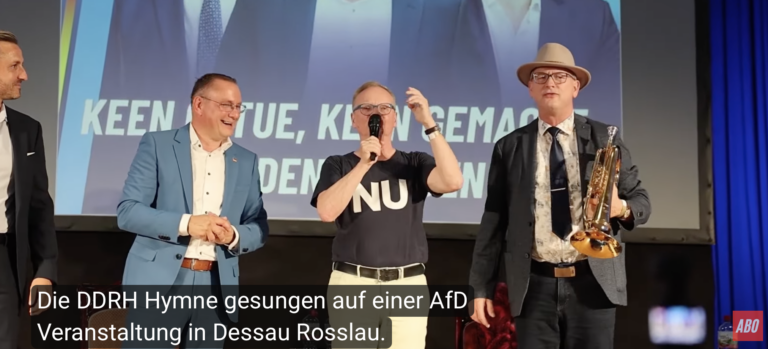
At a party event in Dessau-Roßlau, AfD co-chair Tino Chrupalla and the party’s lead candidate in Saxony-Anhalt, Ulrich Siegmund, joined the audience in singing the anthem of the former German Democratic Republic (GDR). Instead of performing the German national anthem as originally planned to conclude the event, entertainer Uwe Steimle began singing the East German anthem, “Auferstanden aus Ruinen” (“Risen from Ruins”). Chrupalla and Siegmund smiled and sang along with the audience. Thorsten Frei, Head of the Federal Chancellery from the Christian Democratic Union (CDU), described the incident as “highly unusual,” particularly when “political representatives do so with an obvious political message.”
The decision by senior AfD leaders to publicly perform the former East German anthem represents a form of political symbolism aimed at appealing to segments of the electorate in eastern Germany that retain a degree of nostalgia for aspects of life in the former GDR. In the context of the upcoming regional elections in Saxony-Anhalt, such symbolism can be interpreted as part of a broader populist strategy designed to mobilize voters through historical identity, regional grievances, and dissatisfaction with the political establishment.
The performance also carries broader political implications. By invoking one of the principal symbols of the former East German state, AfD risks reinforcing historical and regional divisions that German reunification sought to overcome. While attitudes toward the GDR remain complex—particularly in parts of eastern Germany where some citizens express nostalgia for elements of everyday life under the former system—the anthem remains closely associated with an authoritarian state that lacked political pluralism and fundamental civil liberties. Consequently, the event is likely to be viewed by many Germans, particularly in the western federal states, as an attempt to politicize a controversial chapter of German history.
More broadly, the incident reflects AfD’s continued reliance on historical symbolism to differentiate itself from mainstream political parties. By reviving emotionally charged symbols from Germany’s divided past, the party reinforces its anti-establishment identity and appeals to voters who perceive themselves as marginalized within contemporary German politics. Critics argue that this strategy deepens societal polarization by reopening historical fault lines that have persisted since reunification.
From a geopolitical perspective, some analysts contend that such symbolic gestures may also align with narratives promoted by Russia that emphasize divisions within German society and question the political legacy of post-Cold War European integration. While singing the former GDR anthem does not in itself demonstrate political alignment with Moscow, repeated use of historical narratives that resonate with Russian information campaigns may contribute to perceptions that AfD’s messaging overlaps with broader Kremlin efforts to highlight political fragmentation and weaken Western cohesion.
The public performance of the former East German anthem by senior AfD leaders represents considerably more than a symbolic reference to Germany’s communist past. It reflects a calculated political strategy aimed at exploiting regional identity, historical memory, and dissatisfaction among voters in eastern Germany ahead of the regional elections in Saxony-Anhalt. By invoking one of the principal symbols of the former German Democratic Republic (GDR), AfD seeks to transform historical nostalgia into political capital while reinforcing its broader anti-establishment narrative.
The timing of the event is particularly significant. Saxony-Anhalt remains one of AfD’s strongest electoral bases, where dissatisfaction with Berlin’s political establishment, economic transformation following reunification, immigration policy, and support for Ukraine remains comparatively higher than in western Germany. The use of GDR symbolism therefore serves as an emotional mobilization tool directed primarily at older East German voters and younger generations who increasingly perceive the GDR through a selective lens emphasizing social security and stability rather than political repression.
Unlike traditional far-right movements that reject communist symbolism outright, AfD increasingly appropriates selected elements of East German historical identity to construct a broader narrative of eastern German victimhood. The message is not a rehabilitation of communist ideology but rather the assertion that eastern Germans have remained “second-class citizens” since reunification. This narrative allows AfD to merge nationalist politics with regional identity and socioeconomic grievances, thereby expanding its electoral appeal beyond its traditional conservative base.
From a strategic communications perspective, the performance also challenges one of the central pillars of post-1990 German political identity—the successful reunification of East and West Germany. By deliberately replacing the anthem of the Federal Republic with that of the GDR during an official political event, AfD implicitly questions the dominant narrative that reunification produced a fully integrated national identity. Instead, the party reinforces the perception that Germany remains politically, economically, and culturally divided.
This strategy is particularly effective because historical memory remains one of the strongest determinants of political behavior in eastern Germany. Rather than debating contemporary policy issues alone, AfD increasingly frames elections as a struggle over historical recognition and cultural identity. Such symbolism strengthens emotional engagement while reducing political discourse to questions of belonging, memory, and perceived injustice.
From Moscow’s perspective, this messaging offers significant strategic value regardless of whether AfD coordinates directly with Russian actors. Russian information operations have consistently sought to amplify political divisions within Germany by emphasizing disparities between eastern and western federal states, questioning the legitimacy of Germany’s post-Cold War political order, and portraying the Federal Government as detached from the interests of ordinary citizens. AfD’s use of GDR symbolism objectively reinforces several of these narratives by highlighting internal German divisions and challenging the political consensus that has underpinned Germany’s Euro-Atlantic orientation since reunification.
Importantly, the Kremlin benefits less from any specific policy proposal advanced by AfD than from the broader political polarization generated by such symbolic acts. Public controversies surrounding historical memory divert political attention from Germany’s external security challenges while deepening ideological confrontation within German society. For Russia, weakening political cohesion inside Europe’s largest economy represents a strategic objective in itself because domestic fragmentation reduces Berlin’s ability to lead European responses to Russian aggression.
The incident also demonstrates the evolution of contemporary populist strategy. Rather than advocating explicit geopolitical realignment toward Russia, AfD increasingly relies on symbolic politics capable of generating extensive media attention while remaining sufficiently ambiguous to avoid direct political accountability. The performance of the GDR anthem allows the party simultaneously to appeal to eastern German nostalgia, provoke mainstream political opponents, dominate public debate, and reinforce its anti-establishment identity without formally endorsing the former communist regime.
Ultimately, the significance of the event lies not in the anthem itself but in its political function. Historical symbolism has become an increasingly important instrument through which AfD seeks to redefine German national identity, consolidate electoral support in eastern Germany, and challenge the post-Cold War political consensus. Whether intentionally or not, these narratives overlap with broader Russian strategic interests by accentuating societal polarization, undermining confidence in Germany’s political institutions, and complicating the country’s ability to maintain a unified domestic consensus on European security and continued support for Ukraine
The incident entered the Russian-language information space quickly.
A Russian-language video account identified in search results as ATEO Breaking circulated the footage with a framing that AfD leaders had sung the GDR anthem “instead of” the anthem of modern Germany. That wording exaggerates the sequence: Chrupalla initially tried to redirect Steimle, and the current German anthem was subsequently sung.
This constitutes amplification, but it does not by itself establish state direction. ATEO and similar Russian-language aggregators often reproduce sensational European political content without providing evidence of formal coordination.
\ The story is exceptionally compatible with existing Kremlin narratives.
The footage can support several established themes: eastern Germans remain alienated from the western political establishment; reunification failed to overcome Germany’s East–West divide; the AfD represents “authentic” eastern German sentiment; German elites suppress alternative historical identities; the “peace camp” is culturally and politically distinct from the pro-Ukraine establishment.
A coordinated campaign suspected of links to Moscow was already exploiting precisely this divide in July 2026, using fake media covers and AI-generated reports alleging that “the West hates the East” and that eastern Germans face discrimination.
The available evidence suggests that the Dessau-Roßlau incident was portrayed by some Russian-language and pro-Kremlin online actors as symbolic evidence that eastern Germany retains a distinct historical and political identity. However, there is not yet evidence that this became a coordinated flagship narrative across all major Russian state media.
The symbolism naturally reinforced an existing Kremlin narrative
For years, Kremlin messaging has emphasized that: eastern Germans have different historical experiences than western Germans; reunification produced “second-class citizens” in the East; Berlin ignores eastern interests; eastern Germans are more skeptical of NATO, sanctions, and support for Ukraine.
The Dessau-Roßlau footage fit these themes unusually well because: the event occurred in former East Germany; the audience voluntarily joined the DDR anthem; the gathering focused on “peace,” another theme frequently linked by Russian messaging to opposition to military support for Ukraine; the incident occurred shortly before the Saxony-Anhalt election.
Russian-language framing emphasized “another Germany”
Early Russian-language posts did not simply report that the DDR anthem was sung.
Instead, they highlighted that: AfD leaders sang the East German anthem; eastern Germans allegedly reject the political culture of Berlin; historical continuity with the GDR remained visible.
Some posts misleadingly implied that the DDR anthem replaced Germany’s national anthem altogether, although contemporary reporting shows the German national anthem was sung afterward.
This framing strengthens the impression of two competing German political identities.
The narrative matches previous influence operations
Researchers have already documented Russia-linked campaigns before the Saxony-Anhalt election exploiting themes such as: “the West discriminates against eastern Germans”; reunification failed; eastern Germans are politically marginalized; Berlin suppresses eastern voices.
The Dessau incident could therefore function as supporting evidence for an already established narrative rather than requiring a new disinformation campaign.
Important distinction
The evidence does not show that the participants themselves intended to communicate that eastern Germany remains politically separate.
Domestic reporting indicates: Uwe Steimle unexpectedly began singing the DDR anthem; Chrupalla initially attempted to redirect him to the German national anthem; many attendees nevertheless joined in; the German national anthem was subsequently sung.
The interpretation that the episode demonstrates a distinct eastern German political identity primarily comes from subsequent framing, not necessarily from the participants’ stated intentions.
Intelligence implication
The strategic value of the Dessau-Roßlau incident lies less in nostalgia for the GDR than in its usefulness as visual confirmation of a long-running narrative: that Germany is not politically or culturally unified. For influence operations, authentic events that appear to validate pre-existing themes are often more persuasive than fabricated stories because they require only selective framing rather than invention.
Comparative profile: AfD voter vs. DDR sympathiser
The two groups overlap, especially in eastern Germany, but they are not equivalent. An AfD voter is defined by a present-day electoral choice. A “DDR sympathiser” is better understood as someone who retains a broadly positive, nostalgic, or defensive view of aspects of East Germany—often called Ostalgie. That sympathy can coexist with support for the AfD, BSW, Die Linke, CDU, or political non-participation.
| Dimension | Typical AfD voter | Typical DDR sympathiser |
| Core identity | National-conservative, anti-establishment, increasingly party-political | Eastern German, biographical, cultural or social identity |
| Geography | Disproportionately located in eastern Germany, but increasingly nationwide | Predominantly born, raised, or socialised in the former DDR |
| Gender | More likely male | More evenly distributed; nostalgia is not primarily male |
| Age | Broad age coalition; strong among working-age adults and, in 2025, also younger voters | More likely middle-aged or older with personal DDR memories, though inherited nostalgia exists among younger easterners |
| Education | Often vocational or intermediate education; not limited to the least educated | Highly mixed; includes workers, professionals, pensioners and former state employees |
| Occupation | Strong among workers, manual employees, self-employed tradespeople and economically insecure groups | Often associated with people whose status, profession or social world was disrupted after 1990 |
| Economic position | Not necessarily poor, but frequently feels economically vulnerable or downwardly mobile | Often compares present insecurity with remembered DDR employment and welfare guarantees |
| Primary grievance | Immigration, political elites, cultural change, government competence, sovereignty | Loss of status, recognition, social continuity and eastern representation |
| View of reunification | May see post-1990 Germany as dominated by detached western elites | Usually accepts unity but believes eastern experiences and achievements were devalued |
| View of the DDR | Often selectively positive, but not necessarily deeply informed or personally attached | Distinguishes between the authoritarian state and positively remembered everyday life |
| Democracy | Higher-than-average dissatisfaction with liberal-democratic institutions | Can be democratically committed while remaining critical of how unification was managed |
| Immigration | Usually strongly restrictive and culturally assimilationist | No uniform position; nostalgia does not automatically imply anti-immigration attitudes |
| Russia | More receptive than average to Russia-friendly, anti-sanctions and anti-Ukraine-aid positions | Frequently retains cultural familiarity with Russia, but attitudes range from affection to hostility |
| Foreign policy | Sovereigntist, anti-NATO tendencies, sceptical of military support for Ukraine | Often peace-oriented and sceptical of confrontation, partly shaped by DDR socialisation |
| Preferred political style | Confrontational, anti-elite, punitive and system-challenging | Recognition-seeking, socially protective, sometimes paternalistic |
| Emotional driver | Anger and protest | Nostalgia, humiliation, loss and desire for recognition |
| Political objective | Replace or radically transform the current political establishment | Restore dignity, social security and legitimacy to eastern experience |
The typical AfD voter
The current AfD electorate is disproportionately male, eastern German, working-class or vocationally trained, although the party has expanded far beyond its original demographic base. The AfD performed particularly strongly among workers and voters who felt the government had lost control over migration, security and the economy. It also attracted younger voters in the 2025 federal election, meaning that the stereotype of an elderly nostalgic electorate is increasingly inaccurate.
The central psychological profile is not simply material poverty. Many supporters experience: loss of political control; distrust of established parties and media; fear of cultural displacement; resentment toward metropolitan elites; a belief that dissenting opinions are delegitimised.
Research connects AfD support with anti-elite populism, anti-immigration attitudes and lower tolerance for political or social ambiguity, although individual-level effects are not absolute.
The typical DDR sympathiser
The DDR sympathiser is generally motivated less by ideological commitment to communism than by a positive memory of social life under the DDR. The most frequently remembered advantages are: employment security; affordable housing and childcare; predictable social structures; local solidarity; comparatively narrow income differences; a sense of personal usefulness and social recognition.
Positive assessments of everyday life under the DDR have remained relatively persistent among parts of the eastern German population. These views often coexist with recognition that the DDR lacked political freedom and operated as an authoritarian state.
Many DDR sympathisers are therefore not seeking restoration of the SED regime. Their attitude is closer to: “The political system was repressive, but not everything in our lives was worthless.”
This group often objects to narratives that reduce four decades of personal biography to dictatorship, surveillance and failure.
Where the groups overlap
The strongest overlap occurs around status loss and eastern marginalisation.
Both groups may believe that: western German elites dominate institutions; eastern biographies receive insufficient respect; reunification involved absorption rather than equal merger; eastern Germans remain underrepresented in senior positions; mainstream parties contact the East mainly during election campaigns; sanctions, energy policy and aid to Ukraine impose disproportionate costs on ordinary citizens.
This overlap helps the AfD convert cultural memory into contemporary protest. The party does not need voters to support the former communist system. It only needs to connect eastern grievances with its broader argument that the present Federal Republic is controlled by an unresponsive establishment.
Where they diverge
Social protection versus market nationalism
Many DDR nostalgics favour a strong welfare state, public ownership and extensive social guarantees. AfD economic policy contains internal contradictions: its eastern “social-patriotic” wing uses welfare language, while other parts of the party favour tax reduction, deregulation and economically liberal policies.
Collective solidarity versus exclusionary identity
DDR nostalgia often centres on remembered solidarity among neighbours, colleagues and families. AfD rhetoric frequently redefines solidarity in national or ethnic terms—social benefits should primarily serve Germans.
Biographical memory versus symbolic appropriation
For older DDR sympathisers, the anthem, institutions and social practices are personal memories. For younger AfD activists, DDR symbols can instead serve as tools of rebellion against Berlin, NATO, liberalism or western dominance. The symbolism may be borrowed without genuine attachment to socialist ideology.
Political destination
A DDR sympathiser may vote for BSW or Die Linke because of welfare, peace and redistribution. An AfD voter is more likely to prioritise immigration, national identity, punishment of political elites and opposition to liberal cultural change.
Four overlapping subgroups
The socially nostalgic pensioner
Remembers employment security, childcare and community positively. Politically may support BSW, Die Linke, AfD or abstain. Immigration may be secondary.
The post-unification loser
Experienced unemployment, occupational downgrading or institutional displacement after 1990. May interpret the AfD as revenge against the parties associated with transformation.
The younger inherited-identity voter
Has no substantial personal memory of the DDR but inherits family narratives about humiliation, deindustrialisation and western dominance. More likely to express this identity through AfD-style nationalism than through socialist nostalgia.
\ The nationalist Ostalgic
Combines positive memories of social order with hostility toward immigration, NATO, the EU and liberal elites. This subgroup represents the strongest AfD–DDR-sympathiser overlap.
The AfD voter is primarily a political protest and identity voter. The DDR sympathiser is primarily a memory, recognition and social-security constituency.
The overlap is best expressed as:
DDR sympathy + perceived post-1990 humiliation + distrust of institutions + migration concern = elevated probability of AfD support.
But DDR sympathy alone is a weak predictor. Many eastern Germans who retain positive memories of the DDR reject the AfD, while many AfD voters—particularly younger voters and western Germans—have no meaningful connection to the DDR.The AfD has partly transformed Ostalgie from a social memory into a political grievance. It presents itself as the defender of eastern dignity, but selectively removes the DDR’s socialist and internationalist elements while retaining themes of order, sovereignty, social protection and resistance to western elites. The result is not a revival of DDR ideology; it is an eastern German grievance identity repackaged within contemporary nationalist populism.

More on this story: AfD, Russian Influence, and the Growing Risk of Ethnic Polarization in Germany

Posted inGovernance Intelligence ops