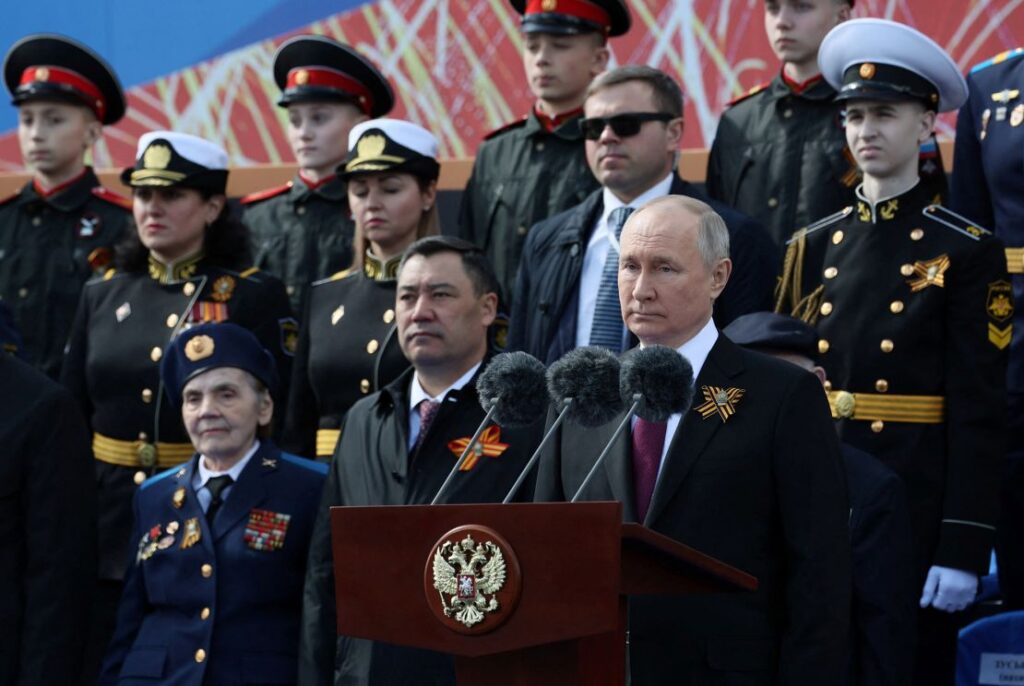

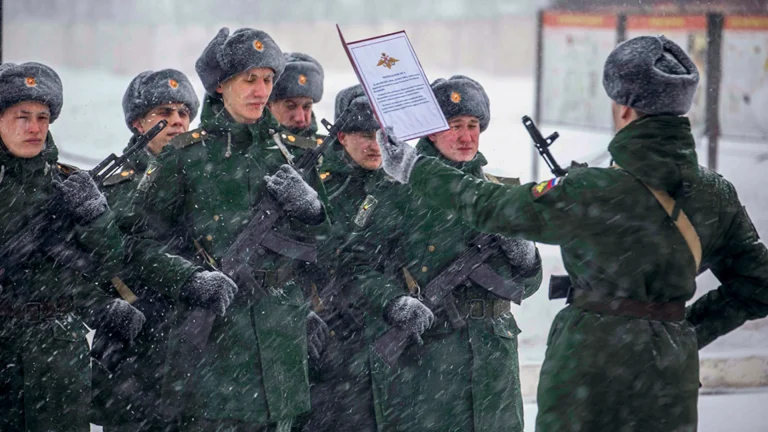
The Kremlin is making a concerted effort to avoid even using the word “mobilization,” despite Russia’s growing need for manpower.
As of August 25, 2026, official denials have taken on the character of a coordinated information campaign. Dmitry Medvedev has dismissed reports of mobilization as a “provocation,” arguing that contract recruitment is sufficient to meet the military’s needs. Other Russian officials have made similar statements, while Dmitry Peskov again described reports that preparations for mobilization were underway as “information fabrications.” At the same time, Western and Ukrainian assessments point to recruitment problems and signs of preparatory measures, although this does not prove that Putin has already decided to launch a new mobilization. (RTVI)
The Kremlin Fears Not Mobilization as a Military Instrument, but Its Political Consequences
The main reason for the Kremlin’s reluctance to announce another wave of mobilization is that it would undermine one of the fundamental pillars of Russian domestic policy since 2022: the public can support the war without having to participate in it personally.
For several years, Moscow has effectively sought to divide Russian society into two groups. The first directly sustains the war effort: contract soldiers, mobilized personnel, volunteers, prisoners, residents of poorer regions, and foreign recruits. The second-and much larger-group can support the war symbolically while continuing to live relatively normal everyday lives.
Mass mobilization would destroy this informal bargain between the Kremlin and the population.
In 2022, the announcement of partial mobilization brought the war directly into Russian households for the first time. It triggered protests, fear, a mass exodus of men abroad, and exposed the administrative chaos of Russia’s mobilization system. According to OSW, mobilization forced many Russians to recognize that their country was fighting a real war that required their personal participation; it also reduced the available workforce and increased government spending. (Bloomberg)
That experience is essential to understanding the Kremlin’s current behavior.
Mobilization Turns Abstract Support for the War Into Personal Risk
For Putin’s authoritarian system, there is a fundamental difference between asking:
“Do you support the war?”
and:
“Are you-or your son-prepared to go to the front tomorrow?”
The contract recruitment model allows the Kremlin to maintain this distance. An individual formally chooses to sign a military contract in exchange for increasingly large financial incentives. The state can concentrate recruitment in regions and among social groups where those financial incentives are most effective.
Mobilization changes the logic:
voluntary financial choice → state coercion → personal threat → potential resentment toward the state.
For the Kremlin, therefore, a contract soldier is politically much cheaper than a mobilized soldier, even if the former costs the state considerably more financially.
Mobilization Is Particularly Dangerous in Russia’s Major Cities
The contract system enables the Kremlin to distribute the burden of the war both socially and geographically.
A new large-scale mobilization would inevitably increase the risk of drawing residents of Moscow, St. Petersburg and other major cities into the war-groups that are generally more economically productive, better integrated into the information environment, and politically more significant.
This is why the Kremlin finds it preferable to pay very large signing bonuses to volunteers from the regions rather than create a situation in which hundreds of thousands of families receive mobilization orders regardless of their wishes.
Current assessments indicate that Russian regions are already increasing payments to attract contract soldiers, while the pace of voluntary recruitment is becoming increasingly difficult to reconcile with battlefield losses and the military’s planned manpower requirements. (Institute for the Study of War)
A New Mobilization Would Amount to an Indirect Admission That the Current Military Model Is Insufficient
For years, the Kremlin has maintained that Russia has enough volunteers.
Medvedev himself claimed that during the first half of 2026 approximately 200,000 people signed military contracts, another 16,000 joined as volunteers, and around 40,000 were recruited into the Unmanned Systems Forces. He cited these figures specifically to argue that mobilization was unnecessary. (Critical Threats)
If the Kremlin were to announce another mass call-up after making such statements, an obvious question would arise:
If there are enough volunteers, why is mobilization necessary?
A new mobilization wave would therefore amount to an indirect admission of one or more facts that the Kremlin would prefer not to acknowledge: Russian losses are exceeding the contract recruitment system’s ability to replace them; future offensive plans require substantially more troops; or the voluntary recruitment model is approaching the limits of its capacity.
The Third Problem Is the Economy
A mobilized soldier is not merely one additional soldier.
He is also one fewer worker in the civilian economy.
Russia must simultaneously supply its armed forces, expand defense production and sustain civilian industries. Removing hundreds of thousands of working-age men from the economy would further aggravate an already serious labor shortage.
Mobilization therefore creates a double effect:
more manpower for the front + less manpower for the economy.
If some potential mobilization targets again attempt to leave the country, the actual loss of labor would be even greater. Labor shortages and additional government expenditure were among the economic consequences of the 2022 mobilization. (OSW – Centre for Eastern Studies)
The Fourth Problem: Mobilization Is Dangerous Ahead of Elections
This factor is particularly important for understanding Medvedev’s statements.
Russia is due to hold State Duma elections in September 2026. Medvedev explicitly linked reports of mobilization to an alleged attempt to “destabilize” the situation ahead of the elections. (Critical Threats)
In doing so, the Kremlin itself effectively demonstrated how politically sensitive the issue is.
Even within a tightly controlled electoral system, the Kremlin needs high turnout, a predictable result, an absence of panic, and a public image of social stability.
Mobilization immediately before the vote could shift the information agenda from:
“stability + victories + control”
to:
“draft notices + casualties + fear + people fleeing the country.”
Therefore, if the Kremlin is indeed considering another call-up, the period after the State Duma elections would be politically much more convenient. (Reuters)
Why Medvedev Is So Categorical in Denying Mobilization
Medvedev’s statements should not be interpreted solely as information about Russia’s military plans.
They also perform a domestic reassurance function.
The message is effectively:
“There will be no mobilization → the army has enough volunteers → the situation is under control → citizens do not need to change their behavior.”
The Kremlin therefore needs to prevent not only mobilization itself, but even public expectations that mobilization is imminent.
Panic could begin before any decree is issued: potential recruits might start leaving the country, moving money abroad, avoiding formal employment, or seeking ways to obtain exemptions.
The experience of 2022 demonstrated how rapidly information about mobilization alone can alter public behavior. (Al Jazeera)
Medvedev’s denials may therefore have a preventive objective: avoiding anticipatory mobilization behavior-a situation in which the population begins behaving as though mobilization has already been announced.
Denying Mobilization Does Not Mean That Preparations Are Not Underway
The Kremlin can simultaneously:
seek to avoid mobilization → publicly deny it → prepare the infrastructure needed in case it becomes necessary.
There is no contradiction between these three positions.
Recent reports point to tests of mobilization readiness and a series of legislative and administrative measures that could facilitate a future call-up. ISW also assesses that the ultimate decision remains Putin’s personally and will depend on his assessment of both the battlefield situation and the regime’s domestic stability. (The Wall Street Journal)
Therefore:
“The Kremlin is seeking to create the capability to conduct mobilization while postponing for as long as possible the moment when it is forced to use that capability.”
Mobilization May Be Putin’s Indicator of Last Resort
The Russian leadership may require hundreds of thousands of additional troops to continue the war, but the political cost of compulsory recruitment is sufficiently high that the Kremlin is prepared to rely on increasingly expensive and less efficient alternatives: large regional payments, recruitment in poorer regions, the enlistment of socially vulnerable groups, and foreign recruits.
The Kremlin’s willingness to pay an increasingly high price for every volunteer contract soldier may therefore itself serve as an indicator of how strongly Moscow wants to avoid compulsory mobilization.
The Kremlin fears mobilization not primarily as a military mechanism, but because it could destroy the social contract under which most Russians are able to support the war without personally participating in it.
A new mobilization would amount to a political admission that the voluntary contract model is no longer capable of fully replacing losses or providing the manpower necessary for future military plans.
Mobilization would simultaneously create a military resource and an economic problem by removing hundreds of thousands of men from an already strained labor market.
The September elections create a particularly unfavorable political window. The categorical denials by Medvedev and other officials may therefore be aimed primarily at preventing pre-election panic.
Medvedev’s denials should not automatically be interpreted as evidence that mobilization planning does not exist.It is entirely rational for the Kremlin to prepare the state apparatus for a possible call-up while simultaneously postponing the political decision to implement it.
Most importantly, another mobilization would be the moment when the Kremlin was forced to bring the war out of television screens and directly into Russian homes once again. Moscow is trying to postpone that political transition for as long as the battlefield situation allows.
Key Intelligence Questions
Primary KIQ: What level of imbalance between Russian battlefield losses and voluntary recruitment would the Kremlin consider sufficiently dangerous for the political risks of a new mobilization to become smaller than the military risks of continuing to postpone it?
Second KIQ: Is the period following the State Duma elections a genuine decision window for Putin, or will the Kremlin attempt to get through the remainder of 2026 without formally announcing mobilization, replacing it instead with covert coercive recruitment?
The Post-Election Decision Window
The period immediately following the State Duma elections on September 18–20, 2026, appears to be the most logical decision window for Putin. This does not, however, mean that a formal decision to launch another mobilization wave has already been made.
The Kremlin will most likely attempt to proceed through as much of 2026 as possible without publicly announcing mobilization. Instead, it is likely to rely on an intermediate model: intensified contract recruitment, administrative pressure on regions and enterprises, expansion of the digital military registry, recruitment of socially vulnerable groups, and a gradual narrowing of opportunities to evade military service.
However, if the ratio between battlefield losses and recruitment deteriorates sharply in the autumn, the period immediately after the elections would offer the Kremlin the lowest political cost for a formal mobilization decision. (Institute for the Study of War)
Why the Post-Election Period Is a Genuine Window
Before the vote, the Kremlin has a strong incentive to avoid any measure that could shift the public mood from “stability” to “draft notices and fear.”
Medvedev has explicitly linked mobilization rumors to alleged attempts to destabilize Russia before the September elections. That rhetoric itself illustrates the political toxicity of the issue. (Institute for the Study of War)
After September 20, this immediate constraint disappears.
The Kremlin will have several months without a nationwide electoral cycle, while the new State Duma is likely to be even more militarized and loyal to the wartime political agenda. There are indications that the authorities are seeking to bring a significant number of war veterans into parliament, which could make it easier to provide political legitimacy for more coercive measures. (Critical Threats)
At the same time, another mobilization would recreate the risk of mass emigration, panic and labor losses seen in 2022.
The Russian economy is already experiencing labor shortages, and removing hundreds of thousands of additional men from civilian employment would aggravate the problem. OSW has pointed to the combined impact of Russia’s demographic crisis, battlefield losses, the movement of workers into the military and defense industry, and the emigration of skilled personnel. (OSW – Centre for Eastern Studies)
Formal mobilization would also constitute an indirect admission that the current voluntary recruitment system is failing. According to data analyzed by ISW, Russian contract recruitment in 2026 is lagging behind target levels and may be insufficient to compensate for losses at the required rate. (Institute for the Study of War)
This gives the Kremlin a powerful incentive to pursue “mobilization without mobilization.”
What Covert Coercive Recruitment Could Look Like
Rather than a single presidential decree, a gradual combination of instruments should be expected:
stricter regional quotas for contract soldiers; pressure on major enterprises to provide a specified number of recruits; expansion of the categories of people eligible for military contracts; use of the digital military registry; pressure on debtors, prisoners, the unemployed and other vulnerable groups; fewer legal grounds for deferment; and administrative restrictions on travel or movement for certain categories of citizens.
There are already indications of this approach.
OSW has reported, for example, that large enterprises in the Ryazan region received demands to provide a specified number of contract recruits. This demonstrates how formally voluntary recruitment can gradually become administratively coercive while remaining legally classified as “contract service.” (OSW – Centre for Eastern Studies)
What Could Force Putin to Move to Open Mobilization
Three principal triggers stand out.
First – a sustained negative manpower balance: monthly battlefield losses consistently exceeding voluntary recruitment.
Second – a major operational objective for 2027: one requiring substantially more troops than the contract recruitment system can provide.
Third – a serious battlefield setback: one that threatens Russia with losing the initiative or territory.
Russian sources cited by CTP have already suggested that either a significant battlefield failure or a breakdown in recruitment could trigger mobilization after the elections. (Critical Threats)
Why Preparatory Measures Matter
The strongest indicator is that, according to Western assessments, Russia is already testing its mobilization readiness, including accommodation, food supplies, weapons, regional logistics and administrative mechanisms.
The Wall Street Journal has reported that a decision is expected after the parliamentary elections, although the Kremlin denies this. (The Wall Street Journal)
This does not mean mobilization is inevitable.
It means something different: the Kremlin wants to have the instrument ready if the contract recruitment model ceases to function quickly enough.
Assessment
The most likely scenario is that Russia reaches the end of 2026 without formally announcing another mobilization but sharply intensifies covert and increasingly coercive recruitment.
The second most likely scenario is a partial or selective mobilization after the elections, structured in a way intended to avoid repeating the political shock of September 2022.
The least likely scenario is an immediate, large-scale nationwide mobilization involving hundreds of thousands of people-unless Russia suffers a significant deterioration in the battlefield situation.
The period following the State Duma elections therefore represents a genuine decision window for Putin, but not necessarily the date of an inevitable mobilization.
The Kremlin is more likely first to attempt a form of “hidden mobilization” – recruitment made as coercive as possible without formally declaring mobilization.
An open mobilization decree would become Putin’s instrument of last resort if battlefield losses, operational plans for 2027, or the failure of contract recruitment made further postponement militarily more dangerous than the domestic political consequences of issuing the order.
The most important indicators in September and October will therefore not be the rhetoric of Medvedev or Peskov, but rather a sharp expansion of recruitment quotas, reductions in deferments, changes to exit regulations, activation of the digital military registry, and intensified testing of mobilization logistics across Russia’s regions.Those measures will reveal whether the Kremlin is moving from contingency planning to execution preparation.