
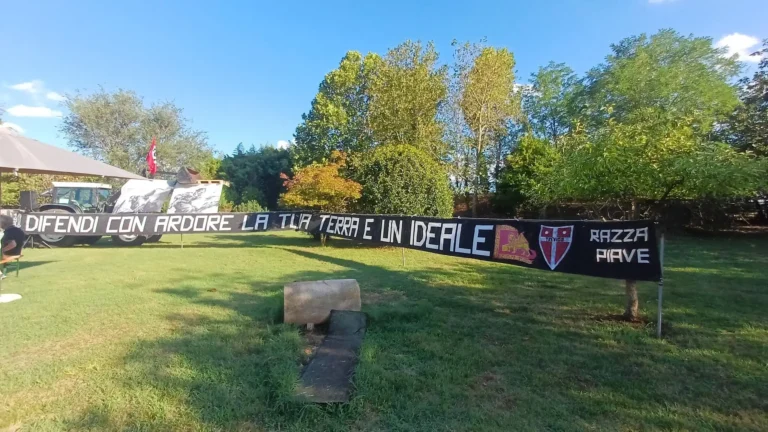
n the municipality of Vedelago, in the Veneto region, a “Squadrismo Summer Fest” was held — an event featuring symbols and rhetoric associated with Italian fascism. On social media, former local councilor Gio Formaggio posted photographs from the festival, referring to participants as his “comrades from Treviso,” while banners displayed the phrase “razza Piave” (“Piave race”) — an expression carrying distinctly ethnonationalist and potentially fascist connotations in the context of the event.
The local branch of ANPI — the National Association of Italian Partisans — described the event as a “dark and unconstitutional initiative,” arguing that the normalization of fascist symbols and terminology should not go unanswered by the authorities. ANPI also demanded explanations from politicians and officials who attended the festival, warning that dangerous radical ideas could be legitimized under the guise of “folkloric” events.
The popularization and normalization of fascist symbols, slogans and terminology is unacceptable, even when organizers attempt to present such events as tributes to tradition or as political folklore. If festivals of this kind are allowed to proceed without an adequate public and political response, they risk becoming systemic and contributing to the popularization of far-right ideology.
Such events are particularly concerning against a backdrop of economic difficulties, social discontent and a broader decline in trust in state institutions — conditions that can make segments of society more receptive to far-right narratives. Tolerance of neo-fascist rhetoric under such circumstances could create fertile ground for further radicalization, increased support for far-right parties and the gradual legitimization of anti-democratic ideas.
From Radical Subculture to Political Normalization
The Squadrismo Summer Fest in Veneto is significant because of its use of historically charged symbolism and, more importantly, because it transfers elements of fascist political culture from a marginal milieu into the format of a public social event. The festivalization of radical ideology — through music, symbols, humor, historical allusions and informal social interaction — can lower the social barrier to the use of terminology and imagery that, in other contexts, would be regarded as explicitly neo-fascist.
The very name “Squadrismo” is particularly revealing. Historically, squadrismo refers to the movement of fascist paramilitary squads, the squadristi, which used political violence against socialists, trade unionists and other opponents of the fascist movement in the early 1920s. The use of this term as the brand of a contemporary festival can therefore hardly be regarded as politically neutral.
At the same time, a single event is not sufficient evidence of the systematic fascistization of Veneto or Italian society more broadly. More significant indicators would include the recurrence of such events; the number and composition of participants; the presence of serving politicians; links between organizers and neo-fascist organizations; and the movement of individuals between festival, party-political and paramilitary environments.
The principal risk is the potential mainstreaming of a radical political vocabulary.
The process may unfold gradually:
historical allusion → “folklore” → ironic use → social habituation → political legitimization.
This is why claims by organizers or participants that such references represent “tradition,” “provocation” or “political folklore” do not necessarily diminish their significance. On the contrary, ambiguity can be functionally useful: a radical audience recognizes the historical and ideological code, while the same imagery can be presented to the wider public as a joke, a local tradition or an innocuous historical reference.
In such a model, symbols can function as dog whistles — signals whose meaning is readily understood within a particular political milieu but remains sufficiently ambiguous to allow the sender to deny radical intent.
The term razza carries substantial historical baggage in contemporary Italian political discourse. When combined with the local identity of Veneto and the Piave, it can potentially promote the idea of a distinctive regional community defined through ancestry, blood, territory and historical continuity.
The Presence of Politicians Is the Most Important Indicator
If serving or former representatives of political parties and local government attend events of this kind, their presence carries greater political significance than that of radical activists themselves.
A politician’s participation can create the following mechanism:
marginal milieu → contact with politicians → public visibility → legitimacy → access to mainstream politics.
The key question, therefore, is not simply who organized the festival, but which political networks intersect there.
If representatives of parliamentary parties, municipal authorities, youth organizations or parliamentary staff systematically appear at such events, the festival could function not merely as an ideological gathering but as a networking hub between the radical subculture and legal politics.
Veneto Matters as a Political Environment
Economic difficulties and declining trust in institutions can increase the susceptibility of certain groups to radical rhetoric.
A more complete causal chain would be:
economic insecurity + distrust of institutions + migration pressures + local identity politics + an organized radical milieu → more favorable conditions for the spread of anti-establishment and ethnonationalist rhetoric.
In such an environment, historically fascist symbols can be repackaged not as an explicit return to Mussolini’s regime, but as elements of a broader discourse centered on order, tradition, territorial identity, anti-communism, migration and opposition to “elites.”
The Greatest Risk Is Not the Restoration of Historical Fascism
The contemporary threat is unlikely to take the form of a literal recreation of Italian fascism as it existed between the 1920s and 1940s.
A considerably more realistic risk is the selective rehabilitation of its symbolic and political vocabulary without formal acceptance of fascist doctrine as a whole.
This allows radical milieus to use historical symbols as markers of identity while simultaneously denying that they support fascism as a political regime.
Such “normalization by fragmentation” may be more effective than overt fascist propaganda: society is not asked to accept the entire ideology at once, but rather individual symbols, concepts and historical myths.
The Squadrismo Summer Fest should therefore be regarded primarily as a potential indicator of the normalization of a radical political code rather than as self-sufficient evidence of a broader rise of neo-fascism in Italy. The decisive question is whether the event forms part of a broader and durable network.
The main danger posed by such festivals is that they reduce the social distance between marginal radical environments and mainstream politics. The participation of politicians and public officials is therefore especially significant.
The festival format itself may also matter. Turning ideology into a social event makes radical symbols appear less threatening at the everyday level and potentially facilitates their normalization among audiences that do not belong to organized neo-fascist environments.
The use of historically charged concepts can also provide plausible deniability. Organizers can simultaneously signal to radical audiences while denying a fascist interpretation when addressing the wider public.
The most alarming indicator would therefore not be an increase in fascist symbolism per se, but rather the emergence of a durable personnel bridge between these milieus and parliamentary parties, municipal authorities, youth organizations and other legitimate political institutions.
The central KIQ (Key Intelligence Question) is therefore:
Is the Squadrismo Summer Fest an isolated subcultural event, or is it part of a broader infrastructure facilitating networking, recruitment and the gradual transfer of neo-fascist ideas and personnel from radical environments into mainstream politics?
A second KIQ should be:
Who is behind the organization, financing and information promotion of the festival, and do its organizers have personnel links to CasaPound, Forza Nuova, Fiamma Tricolore, Veneto Fronte Skinheads or the structures of parliamentary right-wing parties?
Roberto Vannacci, Futuro Nazionale and the Cultural Recoding of Fascism
The case of Roberto Vannacci and Futuro Nazionale points to the normalization of certain elements of the fascist political code within contemporary populist and ethnonationalist discourse. This distinction is important: most Vannacci voters do not necessarily want to restore Mussolini’s regime, but parts of Italian society have become considerably more tolerant of authoritarian rhetoric, historically charged symbolism and ideas of ethnocultural homogeneity.
This already has electoral significance. Ipsos put Futuro Nazionale at 6 percent in late June 2026, while an August Winpoll survey placed it at 7.8 percent, which would put the party ahead of both Forza Italia and Lega. Reuters cited a July YouTrend estimate of 7.6 percent. This is therefore no longer merely a marginal neo-fascist subculture, but a potentially significant player on the Italian right.
Vannacci Is Not Offering a Restoration of Fascism, but Its Cultural Recoding
An explicit slogan such as “bring fascism back” would remain politically toxic. Individual components of the historical radical-right worldview, however, can be translated into contemporary political language:
race → identity
empire → national greatness
authoritarianism → strong government
xenophobia → border protection
ethnic homogeneity → remigration
patriarchy → traditional family
anti-democratic politics → struggle against elites
fascist symbolism → historical memory / provocation.
The Futuro Nazionale statute explicitly emphasizes Roman law, Greek thought, “Roman and chivalric heroism,” Christian civilization, opposition to gender ideology, woke ideology, cancel culture and “immigrationism.” Remigration is presented not simply as an electoral proposal but as a policy deriving from the defense of Italy’s borders and national identity.
This is precisely why Futuro Nazionale can function as a bridge organization — connecting the historical radical right with voters who would never join an openly neo-fascist organization.
Vannacci Uses a “Dog Whistle + Plausible Deniability” Mechanism
His handling of symbols associated with the Xª MAS is particularly revealing.
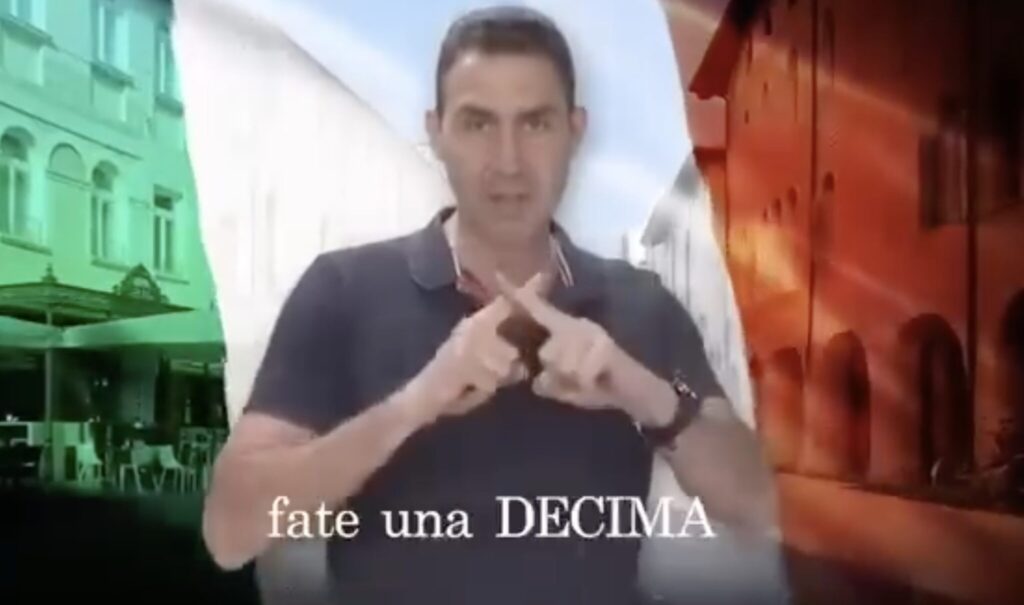
During the European Parliament campaign, Vannacci urged supporters to write decima on their ballots — the “tenth mark,” or X — which was immediately interpreted as an allusion to the Xª MAS. He later used the phrase cameratesco saluto. Yet such formulations consistently leave room for alternative explanations: military history, humor, wordplay or patriotism rather than fascism.
The mechanism can be described as:
historical symbol → controversy → denial of radical meaning → media amplification → repetition → habituation → normalization.
A scandal is therefore not necessarily a political failure for Vannacci. It may form part of his communications model.
He Is Expanding the Boundaries of Permissible Discourse
This is one of the most important effects.
A position that five years ago might have been associated with CasaPound or another marginal milieu becomes the subject of routine television debate after it is repeatedly articulated by a member of the European Parliament, a former general and the leader of a party polling at 6–8 percent.
This is the Overton-window effect:
taboo → provocation → debate → permissible position → normal political proposal.
The Italian press has already described Vannacci’s strategy in terms of shifting the confine del dicibile — the “boundary of what can be said.”
Remigration is particularly revealing. A concept that developed within the European identitarian milieu has now entered Futuro Nazionale’s formal political vocabulary and become a subject of national political debate.
There Is Genuine Demand for an Authoritarian Political Product
Vannacci did not create this demand from scratch.
A poll published in late 2025 suggested a troubling shift in attitudes toward Italy’s fascist past: 8 percent of respondents considered a return to a Ventennio-style model the best solution for Italy, while another 14 percent considered fascism an acceptable solution for a limited period. Openness to such ideas was particularly pronounced among respondents identifying with the political right. At the same time, 58 percent believed that the quality of Italian democracy had deteriorated.
These figures do not mean that 22 percent of Italians are fascists. They point instead to a more consequential trend: for part of society, the democratic taboo against authoritarian solutions is weakening.
Vannacci is entering precisely this political space.
Vannacci Converts Social Discontent Into Identity Politics
The problem cannot be reduced to economic crisis alone.
A more precise causal model would be:
economic stagnation + low social mobility + migration + demographic pessimism + distrust of political institutions + perceived loss of status → demand for simplified identity politics.
Vannacci offers an exceptionally simple explanation for complex problems: there is supposedly a “normal” Italy whose natural order is being destroyed by migration, woke culture, gender politics, Brussels, liberal elites and demographic change.
This explanation is politically effective because it converts economic or social frustration into a cultural conflict between “us” and “them.”
Vannacci Is Filling the Space to Meloni’s Right
This is another fundamental reason for his rise.
Since taking office, Giorgia Meloni has substantially institutionalized Fratelli d’Italia: Atlanticism, support for Ukraine, cooperation with the EU and pragmatic relations with Washington and Brussels.
This has brought Meloni international legitimacy, but it has simultaneously opened political space to her right.
Vannacci can tell these voters: Meloni has become the establishment; we remain the authentic right.
His party accordingly presents itself as the vera destra — the “true right.” AP has described Vannacci as a competitor seeking to capitalize on dissatisfaction within the conservative camp.
The numbers support this mechanism. According to Ipsos, more than 20 percent of Lega voters from the European elections are now prepared to support Futuro Nazionale; approximately 8 percent of Fratelli d’Italia voters are also moving toward Vannacci. Another 9 percent of his potential electorate consists of former abstentionists.
The Image of the General Plays an Important Role
Vannacci is selling not only an ideology but also a model of leadership.
A former general can symbolize:
discipline → order → strength → hierarchy → national service → willingness to say “forbidden things.”
In a society where part of the population regards the political class as weak, bureaucratic or detached from reality, this image can be highly effective.
His military biography therefore functions as a credibility multiplier for authoritarian political discourse.
Younger Voters Have a Different Historical Distance From Fascism
Another trend deserves separate examination.
For generations born 60–80 years after Mussolini, fascism is increasingly less a matter of personal or family memory and increasingly a collection of symbols, memes, videos and cultural codes.
Although Futuro Nazionale’s core support comes from middle-aged men, Vannacci enjoys noticeable backing among some younger, anti-immigration urban voters; overall, his party performs better among young people than the parties of the governing coalition.
This creates the risk of the dehistoricization of fascism: the symbol becomes detached from the historical consequences of the regime and is transformed into an element of anti-establishment identity.
Vannacci Matters Not Because He Can “Restore Fascism”
The more important strategic risk is different.
Vannacci can make individual components of a worldview that previously remained outside mainstream politics politically normal, without labeling them fascist.
The process can be described as:
historical fascism → fragmentation → rebranding → normalization → mainstreaming.
Individual components — ethnocultural homogeneity, demographic anxiety, the traditional family, the cult of strength, remigration, historical military symbolism and anti-elite rhetoric — are extracted and assembled into a new political proposition without formally proclaiming continuity with fascism.
This is precisely why Futuro Nazionale may prove more important to the transformation of the Italian right than traditional neo-fascist organizations: it can carry elements of their political vocabulary to a substantially broader audience.
The growing popularity of fascist symbolism in contemporary Italy should therefore not be interpreted simply as society returning to historical fascism. A more likely process is the selective rehabilitation and decontextualization of individual symbols, myths and political concepts associated with it. Vannacci has been successful precisely because he translates this material from the language of historical fascism into that of contemporary identity politics — sovereignty, remigration, the traditional family, security and the protection of national identity.
In this respect, the most revealing indicator will not be the number of people openly describing themselves as fascists. Far more important will be tracking how many political concepts that until recently remained on the fringes of neo-fascist and identitarian milieus migrate into the programs, rhetoric and electoral campaigns of the parliamentary right.
The central KIQ is:
Is the rise of Futuro Nazionale a manifestation of temporary protest voting, or is Vannacci creating a new and durable segment of the Italian right in which the post-fascist historical code, European identitarian discourse and contemporary right-wing populism are merging into a new political identity?
Is “Vannaccismo” Becoming a Durable Political Force?
As of August 2026, there are more indications that Futuro Nazionale is developing into a durable new segment of the Italian right than that it represents merely a short-lived protest surge. The party has yet to face its principal test — the 2027 national election — and it would therefore be premature to speak of the definitive institutionalization of “Vannaccismo.”
Its Growth Is Already Moving Beyond a Typical Protest Bounce
If Futuro Nazionale were merely Vannacci’s personal protest vehicle, one might expect a rapid surge following the party’s creation followed by gradual decline. So far, the opposite dynamic is visible.
Ipsos put the party at 6 percent in June, YouTrend at 7.6 percent in July, and Winpoll at 7.8 percent in mid-August. In the latest survey, it had overtaken both Lega and Forza Italia and emerged as the second-largest force on the right after Fratelli d’Italia.
That matters: support is not disappearing after the initial media effect. For now, it appears to be consolidating.
The Strongest Argument for Durability Is the Structure of Its Electorate
The Ipsos data are particularly revealing.
Among current Futuro Nazionale supporters, approximately 31 percent previously voted for Fratelli d’Italia, 25 percent for Lega, while more than a third come from among former abstentionists. More than 20 percent of those who voted for Lega in the 2024 European Parliament elections are now prepared to support Vannacci; among former FdI voters, the figure is around 8 percent.
This means Vannacci is not simply redistributing votes within the far-right milieu.
He is simultaneously mobilizing three groups:
disillusioned Lega voters + the more radical wing of Meloni’s electorate + former abstentionists.
The third category is especially important. If a party can not only take voters from neighboring parties but also politically activate people who previously did not vote, this is one indicator that a new electoral segment is being formed.
Vannacci Has Filled a Genuine Structural Niche to Meloni’s Right
This is probably the main reason the project may prove durable.
After coming to power, Giorgia Meloni was compelled to transition from protest politics to statecraft. Her approach toward the EU, NATO, the United States and Ukraine became considerably more pragmatic.
This created a vacuum on the right.
Vannacci offers voters who believe Meloni has become too moderate a clear alternative:
FdI = institutional right
Lega = weakened populist right
Futuro Nazionale = uncompromising “true right.”
This is how Vannacci positions himself politically — as the representative of the vera destra. AP has similarly portrayed him as a new challenger to Meloni from the right.
Consequently, even if Vannacci’s personal popularity declines, the political niche he has identified may remain.
The Most Important Shift Is From the “Vannacci Phenomenon” to an Organization
There is a strong indicator of institutionalization here.
Futuro Nazionale is building territorial structures on the foundations of the previously established Team Vannacci network and the Il Mondo al Contrario movement. By spring, reports indicated more than 200 local committees and approximately 12,000 members; other party figures referred to 300 committees and more than 14,000 registered supporters.
More importantly, political personnel have begun to migrate into the party.
In Chiavari, for example, the founding committee was established by former representatives of Fratelli d’Italia. Its coordinator explicitly explained the move by saying that they could no longer find their right-wing ideals in FdI but had found them in Vannacci.
This is fundamentally different from ordinary protest voting.
The model is becoming:
popular leader → voters → activists → local committees → politician defections → territorial organization → party institutionalization.
The further FN advances along this chain, the less dependent it will become exclusively on Vannacci’s personal charisma.
Vannacci Is Building Not Merely a Party, but a Distinct Political Identity
This may be the most important aspect.
His political product is not simply a copy of historical neo-fascism. It synthesizes at least three traditions:
Post-fascist historical code — military heroism, hierarchy, national greatness, tradition and symbolic historical allusions;
European identitarianism — ethnocultural identity, demographics, remigration and the opposition between native populations and migration;
Contemporary right-wing populism — opposition to elites, Brussels, woke ideology, gender politics and supranational institutions.
FN’s program, published in August, indicates that these ideas are already being transformed from a collection of provocative Vannacci statements into a formalized party doctrine: sovereignty, remigration, the traditional family, criticism of European integration and a reassessment of relations with Moscow.
This represents an important transition:
Vannacci the personality → Vannaccismo the ideology.
This Also Explains the Importance of Fascist Symbolism
The historical fascist code does not necessarily perform a programmatic function here. Rather, it serves an identity-signaling function.
It allows some supporters to recognize one another as representatives of the “true right,” while the party can formally present itself as democratic, conservative and sovereigntist.
A two-layer political identity may therefore be emerging:
Outer layer: sovereignty, security, family, borders, remigration;
Inner historical-cultural layer: camerati, Decima, Mussolini, squadrismo, military-nationalist symbolism and nostalgic references.
The interaction between these two layers requires further investigation. The existence of the second does not automatically mean that all FN voters are neo-fascists.
The Most Dangerous Scenario for Meloni Is Not Vannacci at 15 Percent, but a Stable 7–10 Percent
Vannacci does not need to become Italy’s dominant political force.
If Futuro Nazionale stabilizes at approximately 7–10 percent, it could become a pivotal party on the Italian right.
Reuters has already highlighted this problem: almost two-thirds of Vannacci’s voters support a coalition with the center-right bloc, while a majority of FdI voters also view such an alliance positively.
This creates a dilemma for Meloni.
If she isolates Vannacci, she risks losing voters on her right flank.
If she co-opts him, parts of his political vocabulary acquire additional legitimacy.
If she begins copying his positions in an effort to win those voters back, Vannacci achieves part of his objective even without entering government: he shifts the entire right-wing political spectrum in his direction.
His actual influence should therefore be measured not only by FN’s polling numbers but also through policy contagion — the extent to which other right-wing parties begin adopting his themes and terminology.
What Could Derail the Project
FN remains a young and heavily personalized political party. It faces risks including internal conflicts, weak personnel selection, excessive radicalization, scandals within local branches and an inability to transform online popularity into an effective party machine.
One issue will be particularly important: whom the party recruits into its structures.
If FN absorbs significant numbers of personnel from marginal neo-fascist organizations, this could simultaneously strengthen its activist base and create a serious problem of reputational toxicity for Vannacci.
Personnel links with CasaPound, Forza Nuova, Fiamma Tricolore and related milieus are therefore among the strongest indicators for assessing the party’s future trajectory.
Futuro Nazionale increasingly resembles not a temporary personal protest project but the formation of a new radical segment of the Italian right. Its novelty lies not in reproducing historical fascism, but in synthesizing a post-fascist cultural code, European identitarian discourse and contemporary populist sovereigntism. Vannacci is transferring that synthesis from a subcultural milieu into mass electoral politics.
The central test in 2026–2027 will therefore not simply be FN’s polling numbers. The critical indicator will be whether “Vannaccismo” can outlive Vannacci himself as a media personality: whether local elites emerge; whether the movement develops a personnel reserve and youth milieu; whether a stable party identity takes shape; and whether its political concepts begin reproducing themselves independently of the general’s direct involvement.
If that happens, the issue will no longer be merely the “Vannacci phenomenon,” but a structural transformation of the Italian right.