
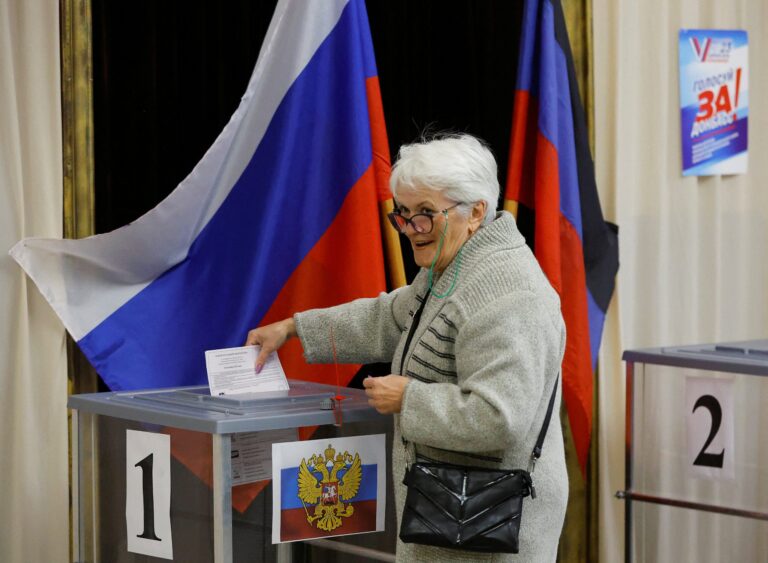
On September 18–20, 2026, Russia is holding elections to the ninth convocation of the State Duma. For the first time since the start of the full-scale invasion, Moscow is incorporating the occupied territories of Ukraine into the federal parliamentary electoral cycle under the new configuration created after Russia’s declared annexation of parts of the Donetsk, Luhansk, Zaporizhzhia, and Kherson regions.
The significance of this decision extends far beyond the vote itself.
The elections should be viewed as the next stage in Russia’s strategy of institutionalizing annexation. Moscow is systematically seeking to transform military control over Ukrainian territory into a system of Russian administrative, legal, and political jurisdiction.
The mechanism can be summarized as follows: occupation → passportization → “referendums” → declared annexation → Russian legislation → regional elections → federal parliamentary representation.
The Kremlin’s objective is therefore not merely to demonstrate alleged support for Russia among residents of the occupied territories. More important is the construction of an institutional framework that makes these territories increasingly difficult to disentangle from the Russian state system.
After the elections, Moscow will be able to claim that the occupied territories not only have Russian passports, administrations, laws, and regional authorities, but are also represented by deputies in the federal parliament.
At the same time, the voting itself is taking place under martial law, amid a Russian military presence, a repressive environment, coercive passportization, and the absence of conditions for free political competition. Russia’s Central Election Commission has introduced special procedures for these territories, including voting outside polling stations and mobile voting.
For the Kremlin, therefore, the key outcome of the elections is not to determine the population’s political preferences.
The principal outcome is the very participation of the occupied territories in Russia’s federal political system.
From Occupation to Institutionalized Annexation
Since 2022, Russian policy toward the occupied territories of Ukraine has passed through several successive stages.
The first was the establishment of military control.
The second was the creation of occupation administrations and the replacement of Ukrainian state institutions with Russian or Russian-controlled structures.
The third was the accelerated passportization of the population.
The fourth was the series of so-called referendums organized by Russia in September 2022, after which Moscow declared parts of four Ukrainian regions incorporated into the Russian Federation.
This was followed by the next stage: the administrative normalization of annexation through the extension of Russian legislation, taxation, education, banking rules, social benefits, the party system, and electoral procedures.
The 2026 parliamentary elections continue this logic.
Ukraine’s Central Election Commission characterizes Russian electoral procedures in the occupied territories as an instrument for legitimizing the occupation, illegally extending Russian jurisdiction, and forcibly integrating the territories into Russia’s political and legal space.
The elections should therefore be viewed not in isolation but as part of a long-term sequence: military occupation → administrative control → passportization → pseudo-referendum → declared annexation → regional political institutions → representation in the State Duma → institutional normalization of annexation.
In this sense, Russia is attempting to move from a situation in which a territory is visibly occupied to one in which it outwardly functions as an ordinary part of the Russian state system.
Why Federal Elections Matter More Than Previous Local Votes
Previous Russian electoral procedures in the occupied territories primarily served to form local governing bodies.
State Duma elections carry a different level of political significance.
A State Duma deputy formally represents a territory not at the regional but at the federal level.
Moscow is therefore creating a new political construct: territory → Russian electoral district → Russian voters → deputy → federal parliament.
This enables the Kremlin to portray the occupied regions not as territories under temporary military control but as politically integrated entities whose populations allegedly participate in forming Russia’s central government.
It is at this point that elections become an instrument of annexation.
Eleven Districts as a Political Map of Russian Jurisdiction
Russia has created 11 single-member electoral districts across the occupied Ukrainian territories.
This is an important but often underestimated aspect of the process.
An electoral district is not merely a technical unit. It means that Moscow defines the population of the territory concerned as part of the Russian electorate and incorporates it into the system of federal representation.
Russia is thus effectively superimposing its own electoral geography on internationally recognized Ukrainian territory.
The map of electoral districts becomes another administrative layer of annexation, alongside Russian courts, passports, tax authorities, schools, party structures, and security agencies.
Elections Under Martial Law
The mechanism through which Russian authorities are organizing the vote is particularly revealing.
On June 17, Russia’s Central Election Commission decided to hold elections in the Donetsk, Luhansk, Zaporizhzhia, and Kherson regions following consultations with the Russian Ministry of Defense, the FSB, and the heads of the occupation administrations.
The very involvement of the Defense Ministry and the FSB in determining whether elections can be held exposes a fundamental contradiction in the process.
Russia simultaneously claims that these are ordinary Russian regions while requiring separate coordination with the security agencies to organize voting there because martial law remains in force.
The special procedures are even more revealing.
Russia’s Central Election Commission authorized voting on September 18–20 outside regular polling stations, including in residential courtyards, public areas, and other designated locations. Group voting is also permitted in settlements where no polling premises are available or where transport connections are difficult.
In a normal electoral environment, such mechanisms can be used to improve access to voting.
Under military occupation, however, they create the opposite problem: they sharply reduce opportunities for independent observation and increase voters’ dependence on the occupation administration.
Voting as a Test of Loyalty
For the Kremlin, the important question may be not only whom the population votes for, but who agrees to participate in Russian elections at all.
Participation itself carries political significance.
The Russian administrative system gains an opportunity to distinguish between those actively integrating into the new system and those who seek to avoid it.
Particularly important groups include public-sector employees, personnel of occupation administrations, education workers, employees of state enterprises, pensioners, and holders of Russian passports.
Turnout can therefore perform two functions simultaneously.
For external audiences, it can be presented as evidence of supposed political integration.
For the occupation administration, participation may serve as an indicator of the extent to which the population has been drawn into Russia’s institutional system.
This is why analysis should focus not only on the official results but also on the mechanisms used to mobilize voters.
The Passport Becomes a Political Instrument
The elections also mark an important transformation in Russia’s passportization policy.
At the first stage, the Russian passport served as a tool of administrative integration.
It provided access to social benefits, employment, healthcare, education, and other services controlled by the occupation authorities.
The passport now acquires an additional function.
It turns a resident of occupied Ukrainian territory into a formal participant in the Russian political system.
The chain is as follows: Russian passport → Russian voter → Russian electoral district → Russian candidate → State Duma deputy → claim of political representation.
Passportization and elections are therefore not separate processes.
They are different stages of the same integration strategy.
Why the Kremlin Needs High Turnout
In ordinary elections, turnout reflects the degree of political mobilization among the population.
In the occupied territories, it carries additional propaganda value.
High official turnout would allow Moscow to construct a simple narrative: the population received Russian passports → the population participates in Russian elections → the population recognizes the Russian state.
Under international law, such a causal chain does not alter the status of occupied territory.
Within Russia’s information system, however, it can be used as purported evidence that the integration process has been completed.
One of the most important indicators after the elections will therefore be not only the result of United Russia, but also the official turnout.
A comparison between the occupied territories and neighboring Russian regions will be particularly revealing.
Exceptionally high figures could indicate that the occupied territories are being used to demonstrate maximum political loyalty.
United Russia as an Institutional Mechanism of Integration
United Russia plays a particular role in this process.
For the Kremlin, the party performs a much broader function than merely contesting elections.
It is one of the mechanisms through which personnel from the occupied territories are integrated into Russia’s vertical of power.
Through the party system, local collaborationist elites can be incorporated into federal political networks.
At the same time, Moscow can deploy Russian administrators, political operatives, and officials to the occupied territories.
Elections as an Instrument of Personnel Control
This may be one of the campaign’s less visible functions.
The occupation administrations emerged under wartime conditions and were often assembled from heterogeneous groups: former Ukrainian officials, local collaborators, security personnel, representatives of separatist structures, and officials sent from Russia.
Federal elections allow the Kremlin to conduct a form of political selection.
Loyal and controllable figures gain an opportunity to move to the federal level.
Unreliable or overly autonomous local groups may gradually lose influence.
The elections may therefore serve not only as a mechanism for legitimizing territorial control but also as an instrument for restructuring local elites.
Why the Kremlin Needs Deputies from the Occupied Territories
After the elections, Moscow will acquire another argument for its political construction of annexation.
Until now, the Kremlin could claim:
“the population voted in a referendum”;
“the population received Russian citizenship”;
“the territories were incorporated into the Russian Constitution.”
Now an additional layer appears: “the population elected its representatives to the federal parliament.”
This could acquire particular significance in the event of future negotiations over the war.
Moscow could potentially seek to frame any discussion of returning the territories to Ukraine not as a question of ending an occupation, but as a question of changing the status of territories that Russia considers its own federal subjects and that already have “elected representatives” in the State Duma.
There is currently insufficient evidence to conclude that future negotiations are the direct reason for holding the elections in this format.
Nevertheless, creating representation for the occupied territories in the federal parliament objectively expands the number of Russian institutions the Kremlin can use to portray integration as supposedly complete.
The Political Significance of the Elections for Putin
The 2026 elections have another distinctive feature.
They are the first State Duma elections since the start of the full-scale invasion of Ukraine.
On September 16, Vladimir Putin himself linked the forthcoming vote to the war, calling on Russians to demonstrate unity, support for the military, and resilience in the face of external pressure.
The Kremlin is therefore partly turning the parliamentary elections into a political plebiscite on the resilience of the system during wartime.
Within this construct, the occupied territories perform a particular symbolic function.
They are intended to demonstrate a tangible outcome of the war.
The propaganda narrative can be summarized as follows: Russia fought → Russia acquired territory → the territory became Russian → its population votes → the population elects Russian deputies → annexation has become normality.
The participation of the occupied territories may therefore be politically more important to the Kremlin than the number of deputies they actually send to the State Duma.
From “Referendum” to Normalization
This marks an important dividing line between 2022 and 2026.
The so-called referendums of 2022 were intended to create a formal justification for annexation.
The 2026 elections perform a different function.
They are intended to normalize its consequences.
In 2022, Moscow sought to argue: “These territories want to be part of Russia.”
In 2026, the message changes: “These are already ordinary Russian regions participating in ordinary Russian elections.”
This is a significant evolution.
The Kremlin is moving from the legitimization of annexation to the normalization of annexation.
Yet the Organization of the Elections Demonstrates the Opposite
This is where the central contradiction in the Russian model emerges.
If these territories are ordinary Russian regions, why does holding elections there require consultations between the Central Election Commission, the FSB, and the Ministry of Defense?
Why is a special electoral regime required?
Why permit voting in courtyards and other improvised locations?
Why restrict information about polling stations and election commissions?
Why conduct voting under martial law?
Russia is attempting to sustain two mutually contradictory propositions at the same time:
“these are normal Russian regions”
and “these are territories where elections require a special military-security regime.”
This contradiction is one of the weakest points in Russia’s narrative of completed integration.
The Elections and the Future of the Occupation
If newly elected deputies from the occupied territories receive prominent positions in the State Duma, its committees, or party structures, or become active participants in foreign-policy messaging, this could indicate a transition to the next phase.
Moscow may seek to create the image not merely of occupied territories, but of political entities that supposedly have their own voice within the federal system.
What Should Be Examined After the Vote
The most important indicators will be official turnout, United Russia’s result, differences between the occupied territories and neighboring Russian regions, the share of early and mobile voting, the number of invalid ballots, the geography of anomalously high turnout, and the profiles of the elected deputies.
It will be particularly important to establish who exactly becomes a deputy from the occupied territories.
If a significant share of the mandates goes to figures directly connected to Russian federal structures, this would strengthen the hypothesis that autonomous local elites are gradually being replaced by a political administration controlled from Moscow.
If local collaborators predominate, this may point to a different model: their co-optation and transformation into part of the federal political vertical.
Key Assessment
The September 18–20, 2026 parliamentary elections in the occupied territories of Ukraine should be viewed not as a standalone propaganda exercise, but as an element of a much broader Russian strategy.
Its purpose is gradually to transform the fact of military occupation into a system of institutional dependence that Moscow seeks to portray as irreversible.
In this model, each successive step reinforces the previous one:
passportization creates Russian citizens;
Russian citizenship creates Russian voters;
Russian voters create Russian constituencies;
Russian constituencies produce State Duma deputies;
State Duma representation creates the appearance of political integration.
The most important factor is the very fact that Russian authorities will portray the population of the occupied territories as part of the federal electorate.
Moscow is attempting to shift perceptions of these territories from “territories occupied by Russia” to “Russian regions whose status is no longer politically negotiable.”
From the standpoint of international law, Russia’s organization of its own elections does not alter Ukraine’s sovereignty over the occupied territories. From the perspective of Russia’s long-term strategy, however, it creates an additional institutional layer that the Kremlin can use to complicate any future revision of the status quo.
The 2026 elections are therefore less an attempt to determine the population’s political will than an attempt to turn occupation into administrative normality.
Russia is no longer merely controlling Ukrainian territory by military force. It is constructing an institutional architecture designed to make that control resemble ordinary domestic governance.This is precisely where the strategic significance of the State Duma elections in the occupied territories of Ukraine lies.