
Protests in Düsseldorf and Erftstadt
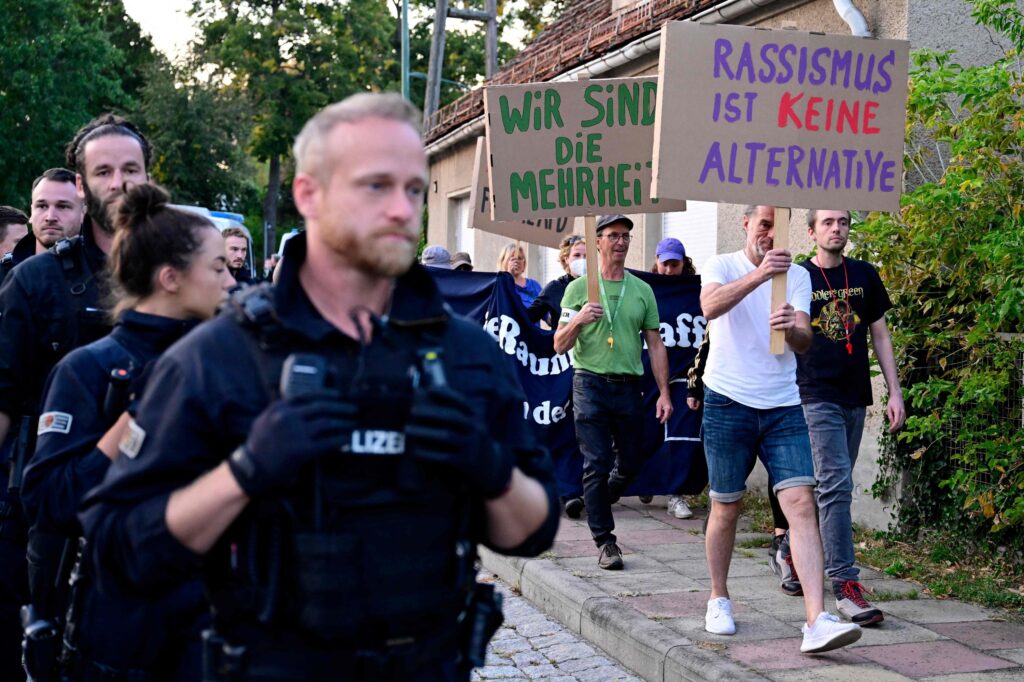
In Düsseldorf, a district convention of Alternative für Deutschland (AfD), held in the assembly hall of St. Benedict School, triggered a protest in which, according to police, more than 200 people took part. Participants included parents and representatives of local civic initiatives. The protesters objected not only to AfD’s politics but also to the use of school premises for a party event. Particular dissatisfaction stemmed from the fact that the venue was an educational institution attended by children of different backgrounds, including those from migrant families.
The municipal authorities explained that the premises had been made available under the principle of equal treatment of registered political parties. At the same time, the protest around the school highlighted a broader issue: the formal political neutrality of public and educational institutions is increasingly colliding with a public debate over the limits of such neutrality when political forces are involved whose statements some citizens regard as xenophobic or incompatible with democratic values.
An even more politically significant demonstration took place on September 20, 2026, in Erftstadt-Lechenich. According to police, around 300 people gathered in the market square. Organizers and participants demanded not merely the political isolation of AfD but the initiation of a procedure to examine whether the party could be banned. The demonstration was supported by numerous civic initiatives and party organizations, including Erftstadt für Demokratie, Omas gegen Rechts, Volt, Die Linke, the Pirate Party and Bündnis 90/Die Grünen.
The shift from the slogan “against AfD” to the demand for an “AfD-Verbot” is the most important indicator. It suggests that, for part of Germany’s active civil society, the debate surrounding AfD is gradually moving from ordinary interparty competition into the sphere of defending the constitutional order.
At the same time, the protesters’ demand does not mean that the legal grounds for banning AfD have already been established. In the German system, a political-party ban is an exceptional constitutional procedure with a high evidentiary threshold, and only the Federal Constitutional Court can issue the final decision. Political mobilization in favor of banning AfD and the legal prospects of such proceedings therefore need to be considered separately.
The protests in Düsseldorf and Erftstadt also demonstrate another trend: AfD’s growing strength is generating counter-mobilization among its opponents. The party’s rise can therefore have a dual effect. On the one hand, it broadens AfD’s electoral base and normalizes some of its political propositions. On the other, it stimulates broader civic coalitions organized around the defense of democratic institutions, minority rights and resistance to radical political tendencies.
Migration policy and the wider political conflict
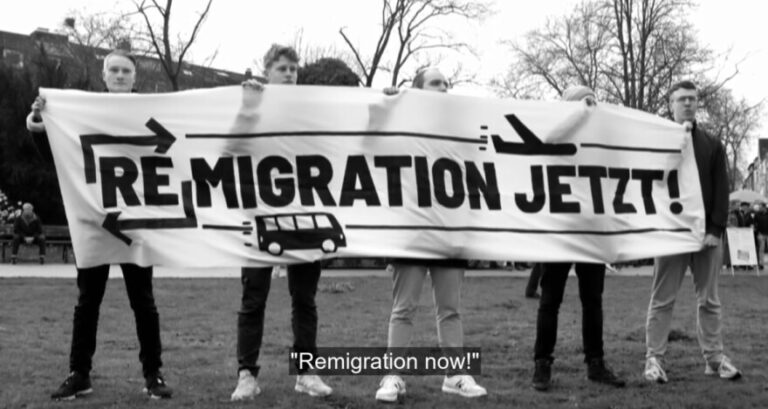
Migration policy occupies a special place in this confrontation. In its federal election program, AfD uses the term “Remigration” for a package of measures that includes, among other things, stepped-up deportation of people required to leave the country, review of protection status once the grounds for asylum have ceased to exist, easier removal of foreigners convicted of serious crimes, and expanded incentives for voluntary return.
The assertion that AfD officially plans to deport “millions of legal migrants” would therefore require separate evidence and should not be presented as an established fact. Nevertheless, political ambiguity surrounding the concept of remigration, more radical statements by individual figures on the right, and the general intensification of anti-immigration rhetoric can create a sense of insecurity among parts of the population of foreign origin.
The political significance of this issue extends far beyond migration policy. People of foreign origin are part of Germany’s labor market, education and health-care systems, industry, logistics, construction and services. Any large-scale change to residence rules, naturalization or foreigners’ access to the labor market could therefore have economic as well as social consequences.
The protests in Erftstadt and Düsseldorf should thus be understood not as isolated local events but as manifestations of broader political polarization around AfD. The central line of conflict is increasingly not only migration but the limits of what is permissible in German democracy: should AfD primarily be treated as a legal opposition party whose positions must be contested at the ballot box, or are there sufficient constitutional grounds to consider proceedings aimed at banning it?
Key Assessment
The most important signal is not the size of individual protests but the changing character of anti-AfD mobilization. Some civic initiatives are moving from opposition to particular statements and party events toward demands for the use of mechanisms provided by the Basic Law to protect the constitutional order.
This could deepen political polarization. Supporters of a ban view it as a possible instrument for defending democracy, while AfD and its supporters can use the debate itself as evidence of what they portray as the political exclusion of the party and its voters.
The strategic question for Germany is therefore not only AfD’s future but whether the democratic system can simultaneously preserve political pluralism, protect the constitutional order and prevent the conflict surrounding the party from developing into a long-term divide between increasingly mobilized political camps.
Where the comparison between AfD and the NSDAP begins
The useful comparison is not between the parties “as a whole,” but between specific elements of their doctrines: their understanding of Volk, citizenship and ethnocultural belonging; their attitudes toward pluralism, minorities and parliamentary democracy; and the concept of Volksgemeinschaft.
The latter was particularly important in the 2017 NPD case. The Federal Constitutional Court found that the NPD sought an authoritarian national state based on an ethnically defined Volksgemeinschaft that denied equal human dignity to those who did not belong to it. The Court found this concept incompatible with the Basic Law.
The central question for examining AfD is therefore: does AfD’s political conception contain elements of an ethnically defined Volksbegriff that conflict with the principles of equal human dignity and equal political participation regardless of origin? That is the formulation with genuine constitutional significance.
Why is AfD not banned “for Nazism”?
Germany does not in practice have a general law banning any “Nazi ideology” as such. The Federal Constitutional Court has stated that the Basic Law does not contain a universal “anti-Nazi principle” that would allow right-wing extremist or even National Socialist views to be prohibited solely because of their content. Freedom of expression extends even to dangerous and anti-democratic convictions until statutory boundaries are crossed.
Criminal law instead prohibits specific conduct. Section 86 of the Criminal Code concerns propaganda material of prohibited unconstitutional organizations, while Section 86a concerns the use of their symbols. Exceptions exist for education, science, art, historical reporting and related purposes.
In simplified form: nationalist or even neo-Nazi opinion does not automatically equal a prohibited party; prohibited Nazi symbols or certain propaganda are matters of criminal law; and an unconstitutional political party is subject to the separate procedure under Article 21 of the Basic Law.
Where the real legal risk for AfD arises
Article 21(2) of the Basic Law allows a party to be banned if, by reason of its aims or the behavior of its adherents, it seeks to undermine or abolish the freiheitliche demokratische Grundordnung – the free democratic basic order – or to endanger the existence of the Federal Republic of Germany. Only the Federal Constitutional Court can decide this.
The history of the NSDAP is highly relevant to this architecture. Article 21 is one of the mechanisms of Germany’s wehrhafte Demokratie – a democracy capable of defending itself. It was designed in part in light of the Weimar experience, when the National Socialists used lawful democratic instruments and institutions before dismantling democracy.
In 2024, the Federal Constitutional Court again emphasized that a party can be unconstitutional even if it pursues its goals exclusively by legal means and does not use violence. This reflects German constitutional law’s response to the strategy sometimes described as a “legal revolution.”
It is therefore unnecessary to prove that a party is preparing a putsch or creating an SA-style organization. The question is whether systematic party activity is directed toward transforming or dismantling the fundamental principles of the constitutional order.
The precedent especially relevant to AfD
In 1952, the Federal Constitutional Court banned the Sozialistische Reichspartei (SRP). The Court treated it as a successor organization to the NSDAP and ordered its dissolution. It was a classic early application of Article 21(2).
The 2017 NPD case established a more complex standard. The Court concluded that the NPD pursued unconstitutional aims, sought an ethnically defined Volksgemeinschaft, acted systematically to realize those aims and was ideologically related to National Socialism. Yet it did not ban the party because it found insufficient indications that the NPD had a realistic possibility of achieving those aims.
This criterion potentially makes any debate about AfD legally different from the old NPD case. Where a party has substantially greater political capabilities, the question of potentiality rests on a different factual basis. But whether all Article 21 criteria are met in AfD’s case can be determined only by the Constitutional Court on the evidence; it does not follow automatically from the party’s popularity or from radical statements by individual members.
AfD is not automatically subject to prohibition because some elements of its ideology may resemble elements of the NSDAP. German constitutional law does not ban a party merely for “neo-Nazi” or radical-right beliefs. Such ideological affinity can, however, become relevant evidence in an Article 21(2) proceeding if it is established that the party systematically seeks to undermine human dignity, political equality, democracy or the rule of law.
From NSDAP to AfD: Where German Constitutional Law Draws the Line
The German debate over a possible ban of Alternative für Deutschland inevitably returns the country to a fundamental question embedded in the Basic Law after the fall of the Third Reich: how far should a democracy tolerate a political force that uses democratic procedures but may seek to alter the fundamental principles of democracy itself?
The experience of the NSDAP shaped the concept of wehrhafte Demokratie. Yet German law deliberately sets an exceptionally high threshold for banning a political party. Ideological similarity to National Socialism can be evidentiary, but it is not an independent legal ground for prohibition. The Federal Constitutional Court confirmed this in the 2017 NPD case.
The historical lesson of the NSDAP lies not only in racism, antisemitism or totalitarian ideology. For postwar constitutionalists, the mechanism by which the Nazis came to power was equally important. The NSDAP contested elections, operated in parliament and used the institutions of the Weimar Republic while simultaneously seeking to replace pluralist democracy with a one-party dictatorship.
For this reason, the Basic Law rejected a model of democracy that must remain passive toward forces directed at its destruction. Article 21(2) allows a party to be prohibited when its aims or the conduct of its adherents are directed against the free democratic basic order. The key principle is that legality of methods does not by itself make an anti-constitutional political objective constitutional.
From the NSDAP to the SRP: the first postwar red line
The early decades of the Federal Republic demonstrated that this constitutional architecture was not merely theoretical. In 1952, the Federal Constitutional Court banned the Sozialistische Reichspartei, which was viewed as a political successor to the National Socialist tradition. The decision demonstrated the new Federal Republic’s willingness to apply wehrhafte Demokratie to organizations seeking to restore a political model incompatible with the new constitutional order.
Subsequent case law, however, gradually established a much higher evidentiary threshold. The German state must respond not simply to political radicalism or historically objectionable views; it must establish the constitutionally relevant threat according to the applicable legal criteria.
NPD: the most important precedent for the AfD debate
The 2017 NPD case provides the most useful legal framework for contemporary debate. The Constitutional Court reached an exceptionally strong conclusion about the NPD: it sought to replace the existing constitutional order with an authoritarian national state organized around an ethnically defined Volksgemeinschaft. The Court found that this conception violated the human dignity of people who did not fit the ethnic definition of “the people,” denied their equality and was incompatible with the democratic principle. It also found systematic activity aimed at realizing those goals.
Yet the NPD was not banned. The reason was Potentialität – the potential capacity to realize the unconstitutional project. The Court found insufficient concrete and weighty indications that the NPD had a realistic possibility of achieving its aims. A party ban, it stressed, is an exceptional preventive instrument and is applicable only when achievement of the unconstitutional goals is not practically hopeless.
This produces a useful formula: anti-constitutional ideology + systematic action + potentiality = possible party prohibition. The first element alone is insufficient.
Die Heimat: Germany’s intermediate mechanism
After the unsuccessful attempt to ban the NPD, the Basic Law was supplemented by a mechanism allowing the state to respond to unconstitutional parties even where they are too weak to pose a realistic threat of taking power.
In January 2024, the Constitutional Court excluded Die Heimat – the former NPD – from state financing for six years. The Court again found that the party sought to replace the existing constitutional order with an authoritarian state built around an ethnic Volksgemeinschaft and that its conception violated the human dignity of people who did not belong to that ethnic community.
For exclusion from state financing under Article 21(3), however, Potentialität is not required. What must be demonstrated is qualified and systematic activity directed against the free democratic basic order.
Germany therefore has a two-level system: Article 21(2) – unconstitutional aims + active struggle + potential capacity for success may lead to prohibition; Article 21(3) – unconstitutional aims + qualified systematic activity may lead to exclusion from public financing even without proof of potential success.
Where does AfD fit into this system?
This is precisely where comparisons with the NSDAP must be used with maximum caution. AfD cannot legally be defined as a “new NSDAP” simply because of radical migration policies, nationalist rhetoric or statements by individual members. Nor can the statements of one politician automatically be attributed to the entire party without establishing their relevance to party doctrine and practice.
The constitutional question is different: is there a sufficiently systematic political conception within AfD that denies fundamental principles of human dignity, equal citizenship and democratic pluralism, and does the party act in a planned way to realize such a project?
This is where the concepts of Volk and Remigration, and the party’s attitude toward German citizens of migrant origin, become particularly important.
The key red line: the ethnic Volk
The NPD precedent shows that one of the most important legal tests is the question: who counts as a full member of the German political people?
The Constitutional Court found the NPD’s conception unconstitutional not simply because it was nationalist. The problem was its ethnic definition of Volksgemeinschaft, which led to the effective denial of equal human dignity and equal rights to those who did not meet the ethnic criterion.
For any proceeding concerning AfD, it would therefore be potentially important to establish whether its conception of Remigration means only the enforcement of immigration law against foreigners without a right to remain, or whether it forms part of a broader conception under which German citizens of certain origins are regarded as less legitimate members of the political nation.
These are fundamentally different legal situations. The first may constitute a hard-line immigration policy within the democratic process. The second potentially reaches the principles of equal human dignity and political equality of citizens – the constitutional core protected by the Basic Law.
The AfD paradox compared with the NPD
The criterion of Potentialität creates a potentially important distinction between AfD and the NPD. In 2017, the NPD was found to pursue unconstitutional goals but was too politically weak to be banned because the Court saw no realistic path toward implementation.
For any substantially more influential party, assessment of Potentialität would necessarily rest on a different factual basis: parliamentary representation, organizational capacity, social influence, ability to shape the political agenda and other real means of influence.
That does not mean the criterion is automatically satisfied in AfD’s case. A strong electoral result does not make a party unconstitutional. Unconstitutional aims and systematic activity aimed at their realization must first be established. Only then does political capacity become relevant to Article 21(2).
Ideological similarity to the NSDAP: evidence, not a verdict
In the NPD case, the Constitutional Court articulated an especially important principle: Wesensverwandtschaft mit dem Nationalsozialismus – essential affinity with National Socialism – cannot replace the requirements of Article 21(2). Such affinity can nevertheless be an indicator that a party pursues unconstitutional aims.
Accordingly, what matters legally when comparing AfD with the NSDAP is not the swastika, historical analogy or the generic label “far right,” but concrete questions: Is the nation defined ethnically or civically? Is equal human dignity recognized for all citizens? Is political pluralism accepted? Is the legitimacy of opposition recognized? Is equal political participation guaranteed regardless of origin? Are democratic institutions regarded as permanent rules of political competition or merely as instruments for acquiring power?
The answers to these questions, rather than the historical analogy itself, determine the constitutional significance of the evidence.
Key Assessment: the constitutional line
The line NSDAP → SRP → NPD/Die Heimat → AfD illustrates the evolution of Germany’s wehrhafte Demokratie. After 1945, the Federal Republic created a system allowing democracy to defend itself against political organizations directed toward its destruction, while simultaneously setting an exceptionally high evidentiary threshold so that the mechanism would not become an instrument for suppressing unwanted opposition.
Similarity between individual elements of AfD rhetoric or ideology and historical National Socialism therefore does not in itself create legal grounds for banning the party. The Federal Constitutional Court would require evidence that the relevant positions form part of a political conception directed against the free democratic basic order, that the party actively and systematically works to realize those aims and – for a full ban under Article 21(2) – that there are concrete and weighty indications of a potential ability to achieve them.
The central question for any future legal debate about AfD is therefore not “How similar is AfD to the NSDAP?” but “Does AfD cross the same constitutional red lines that the Basic Law, drawing on the experience of the NSDAP, made inviolable: human dignity, equality of political citizens, democratic self-determination and the pluralistic character of the state?”
That is where German constitutional law draws the line between radical but protected political opposition and an organized political force against which the state may employ the mechanisms of wehrhafte Demokratie.
Elements of AfD rhetoric that can be compared with components of NSDAP ideology
Some elements of AfD’s program and political rhetoric can be compared with certain components of NSDAP ideology. But overlap in individual themes – migration, demography, national identity and family – does not mean the two parties are identical. For a legally meaningful comparison, the Federal Constitutional Court’s framework directs attention above all to the ethnic Volksbegriff, inequality among citizens, racism and antisemitism, the Führerprinzip and attitudes toward parliamentary democracy.
Volk and national identity are the most important area of comparison. The NSDAP treated the German nation primarily as an ethnic-biological community, in which citizenship by itself did not make a person a full member of the Volksgemeinschaft. The crucial question for AfD is therefore not simply its defense of “German culture,” but whether it differentiates among German citizens according to ethnic origin.
This is the fundamental boundary. A demand to restrict immigration is not in itself National Socialist. But a conception under which a naturalized citizen can never, because of origin, become a full member of the German people approaches the constitutional problem identified by the Court in the NPD case.
Remigration: a partial functional parallel, but not an equivalent
AfD uses Remigration to describe policies for the return of foreigners who do not have a right to remain, stronger deportation enforcement and review of certain migration statuses. This is not, in itself, equivalent to the racial policy of the NSDAP.
The constitutional red line would arise if evidence showed that Remigration also meant systematically excluding German citizens of migrant origin from the political nation or depriving them of equal status because of their ancestry. This was central in the NPD case: the Court found that the NPD’s ethnic conception of Volksgemeinschaft effectively assigned a lower status even to naturalized Germans whom the party did not regard as ethnic Germans.
The analytical test is therefore: Remigration of non-citizens without a legal right of residence can be a hard-line immigration policy. Remigration or exclusion based on ethnicity irrespective of citizenship raises a potential issue under Articles 1 and 20 of the Basic Law.
Demography, family and Geburtenpolitik
There is also thematic overlap here, but a major difference in substance. AfD places considerable emphasis on the traditional family, birth rates and demographic reproduction of the German population. The NSDAP likewise treated demography as a strategic question of state.
National Socialist demographic policy, however, was racial-biological. It combined encouragement of births among those whom the regime regarded as “racially desirable” with eugenics, forced sterilization and persecution of people the state defined as undesirable.
The formula “AfD supports traditional families, therefore AfD equals NSDAP” would therefore be historically incorrect. A legally significant parallel would arise only if demographic policy were tied to biological or ethnic ranking of human beings.
Cultural homogeneity versus multiculturalism
AfD sharply criticizes multiculturalism and emphasizes a German Leitkultur. There is a thematic parallel here with the National Socialist rejection of a pluralistic society, but a boundary is again necessary: Leitkultur plus assimilation does not equal Volksgemeinschaft.
The constitutional issue arises when cultural integration becomes ethnic immutability – when a person, regardless of citizenship, language, integration or self-identification, is deemed incapable of becoming an equal German because of ancestry. The Constitutional Court found such a model in the NPD and regarded it as incompatible with human dignity and equal political participation.
Islam: a thematic but not direct historical parallel
AfD takes a very hard line on political Islam and “Islamization” and proposes substantial restrictions in this field. It would be an overstatement to compare this directly with the NSDAP’s antisemitism. National Socialist antisemitism was a racial doctrine in which Jewish ancestry defined the individual regardless of religious practice.
For AfD, the constitutional question is therefore not whether Islam may be criticized, but whether Muslim German citizens are recognized as equal members of the political people. In the NPD case, systematic denial of equal status to minorities was one of the central anti-constitutional elements identified by the Court.
Distrust of the existing political establishment
A rhetorical similarity can be identified here. The NSDAP portrayed the Weimar party system as a corrupt and illegitimate System. AfD also uses anti-establishment rhetoric and sharply criticizes traditional parties and political elites.
By itself, however, this is a weak parallel. Anti-establishment rhetoric is common among democratic populist parties of different ideological orientations. The red line lies elsewhere: whether a party recognizes the legitimacy of parliamentary opposition, alternation of power through elections, judicial independence, political pluralism and the equal right of all citizens to participate in the political process.
In the NPD case, the Court found an intention to replace parliamentary democracy with an authoritarian Nationalstaat. No equivalent conclusion about AfD can simply be assumed; it would have to be demonstrated from the party’s program and conduct.
Where the comparison ends
This is essential if the comparison is not to become one-sided. The NSDAP had fundamental characteristics that cannot simply be transferred to AfD’s official program: the Führerprinzip; one-party dictatorship; abolition of parliamentary democracy; racial legislation; biological antisemitism; eugenics; systematic political violence; territorial expansionism and Lebensraum.
The most legally significant area of possible overlap between contemporary radical-right discourse and the National Socialist tradition therefore lies not in anti-immigration policy as such, but in the conception of the political people. If citizenship ceases to be sufficient for equal membership in the German political nation and ancestry becomes a criterion for determining the “real German,” the political conception approaches the ethnic Volksbegriff that the Federal Constitutional Court has already found incompatible with human dignity and democratic equality.
Björn Höcke: “relative homogeneity of the Staatsvolk”
In June 2023, Höcke wrote of “eine relative Homogenität des Staatsvolkes” – “a relative homogeneity of the state people” – which, in his formulation, is a basis of a functioning democracy.
This is a significant example. The Basic Law defines the Staatsvolk through citizenship, while Höcke’s formulation raises an additional question about its “homogeneity.” In the NPD case, the Federal Constitutional Court drew the red line where ethnic belonging begins to determine a person’s right to be an equal part of the political people.
The overlap with the NPD test is therefore substantial at the conceptual level, although this quotation by itself does not establish discrimination among citizens.
Höcke: Volk as “ancestry, language, culture and shared history”
The Higher Administrative Court of North Rhine-Westphalia cited another formulation in which Höcke described Volk as a “dynamische Einheit aus Abstammung, Sprache, Kultur und gemeinsam erlebter Geschichte” – a dynamic unity of ancestry, language, culture and a commonly experienced history. He described Volk as a central point of orientation for political thought and action.
The parallel with the NPD test is stronger here. The Constitutional Court found that the NPD likewise defined Volk through Abstammung, Sprache, Geschichte and Wertvorstellungen. The problem was not the use of these concepts in isolation but the NPD’s further conclusion that people outside the ethnic community should not possess equal political status.
The overlap is therefore strong with respect to an ethnocultural definition, but not identical with respect to legal consequences.
Höcke: the threat of the “end of the German people”
In 2022, Höcke spoke about schools without children whom he characterized as German and connected multiculturalization and demographic decline with a possible “Ende dessen … was wir deutsches Volk nennen” – the end of what we call the German people.
The important element is the logic: a change in ethnodemographic composition is framed not merely as social transformation but as the disappearance of the Volk. This approaches the ethnodemographic logic examined by the Constitutional Court in the NPD case, although the statement alone does not imply a demand to deprive naturalized citizens of rights.
Höcke: “Volkstod durch Bevölkerungsaustausch”
An even stronger formulation is “Volkstod durch den Bevölkerungsaustausch” – “death of the people through population replacement.” Here demography becomes an existential conflict between ethnocultural groups. This has a notable conceptual similarity to the logic of an ethnically homogeneous Volksgemeinschaft, although it is not equivalent to the NPD’s program.
Höcke in 2024: becoming “a minority in one’s own country”
In August 2024, Höcke stated: “Unser Volk ist … multikulturalisiert und überfremdet” and warned that Germans could become a “minority in their own country.”
This construction is important because immigration is described not through citizenship, legality or integration, but through the numerical relationship between demographic groups. In the terminology of the NPD judgment, it approaches the question of whether Volk is a civic community of Staatsangehörige or an ethnic Gemeinschaft.
Höcke and Martin Sellner: “preserving ethnocultural identity”
Höcke positively recommended a book by Martin Sellner and summarized its central objective as “Erhalt der ethnokulturellen Identität” – preservation of ethnocultural identity – together with a warning about Germans becoming a minority.
This goes beyond ordinary anti-immigration rhetoric because the concept of ethnokulturelle Identität places ethnic continuity of the population at the center of the political project. For the Federal Constitutional Court’s test to apply, however, a further evidentiary step is required: whether this implies that citizens of different origins should receive a lower status or leave the country.
Alice Weidel: “These are not Germans” – Passdeutsche
One of the most serious examples concerns a 2019 statement by Alice Weidel about criminal suspects who held German citizenship: “Das sind keine Deutschen!” – “These are not Germans!” She instead referred to them as Passdeutsche / Deutsch-Türken.
The Higher Administrative Court of North Rhine-Westphalia treated use of the term Passdeutsche as one indicator of a possible distinction between formal citizenship and “real” Germanness. This approaches the central NPD test closely. The Federal Constitutional Court found the NPD unconstitutional in its aims because it did not recognize naturalized Germans as full members of the Volk and thereby separated Staatsangehörigkeit from Volkszugehörigkeit.
Weidel: a different and directly contrary position on Remigration
In January 2024, Weidel explained Remigration much more narrowly: people without a right to remain should be deported, while wrongfully naturalized criminals and other categories she identified should lose citizenship that had been improperly obtained. At the same time, she explicitly included law-abiding citizens of migrant origin in the common Gemeinwesen.
AfD’s official position went further: “Alle Deutschen … sind Teil unseres Staatsvolks.” – all Germans are part of our Staatsvolk.
This is a substantial difference from the NPD. The NPD officially pursued an ethnically defined Volksgemeinschaft. AfD’s official federal position expressly denies such a distinction and recognizes all German citizens as members of the Staatsvolk. The tension between formal party declarations and statements by individual leading figures would therefore be central to any constitutional proceeding.
René Springer: “millions” for Remigration
After the Correctiv controversy, AfD member René Springer wrote: “Wir werden Ausländer in ihre Heimat zurückführen. Millionenfach.” – “We will return foreigners to their homeland. By the millions.”
He subsequently specified categories that included not only people already legally required to leave Germany, but also foreigners unable to support themselves over the long term, refugees once the basis for protection had ended, and people whom he described as refusing integration.
This shows that, at least in Springer’s formulation, Remigration is broader than the deportation of people who are already under a legal obligation to leave. He also explained the objective with the phrase “Für den Erhalt unserer Identität” – “for the preservation of our identity.” Mass return is thus connected to preservation of collective identity rather than solely to enforcement of immigration law. This is where migration enforcement begins to move toward identity policy.
Alexander Gauland: “Bevölkerungsaustausch”
Former AfD co-chair Alexander Gauland stated: “Der Bevölkerungsaustausch in Deutschland läuft auf Hochtouren.” – “Population replacement in Germany is running at full speed.”
This concept differs fundamentally from an ordinary demand to reduce immigration. It frames migration as the replacement of one people by another. For the Volksgemeinschaft test, the decisive follow-up question is therefore who belongs to the Volk after an immigrant acquires German citizenship.
Christina Baum: “Biodeutsche” and a “light-skinned” people
AfD member Christina Baum offered an even stronger example: “Ich bin der Lobbyist der ‘Biodeutschen’!” – “I am the lobbyist for ‘biological Germans’!” She went on to describe the group she represented as autochthonous Germans who were “hellhäutig” – light-skinned – and whose families had lived in the country for centuries.
This is no longer merely a cultural definition. The use of skin color as a marker of a political group moves toward a biologization of the Volksbegriff. Among the statements examined, this is one of the closest in structure to what the Federal Constitutional Court described as an ethnic definition of Volksgemeinschaft.
The two competing concepts of Germany inside the AfD debate
In 2024, the Higher Administrative Court of North Rhine-Westphalia considered whether sufficient factual grounds existed to suspect AfD of anti-constitutional activity. The court examined statements by Höcke, Weidel, Baum, Krah and others. It regarded the use of Passdeutsche as particularly significant because the term can imply that a person is legally a German citizen but, because of ancestry, is not recognized as a “real” German.
The most significant parallel between part of AfD’s discourse and the doctrine the Federal Constitutional Court found unconstitutional in the NPD case therefore lies not in demands for deportation or immigration restrictions themselves, but in the possible division between Staatsbürger and ethnisches Volk.
Statements invoking Passdeutsche, Biodeutsche, Abstammung, demographic homogeneity and Bevölkerungsaustausch can function as evidentiary indicators of an ethnocultural Volksbegriff. At the same time, AfD’s official federal position expressly rejects such a distinction and recognizes all German citizens as equal members of the Staatsvolk.The central evidentiary question in any potential Article 21(2) proceeding would therefore be which of these two concepts actually defines the aims and conduct of the party as a whole.
More on this story: AfD, Russian Influence, and the Growing Risk of Ethnic Polarization in Germany