

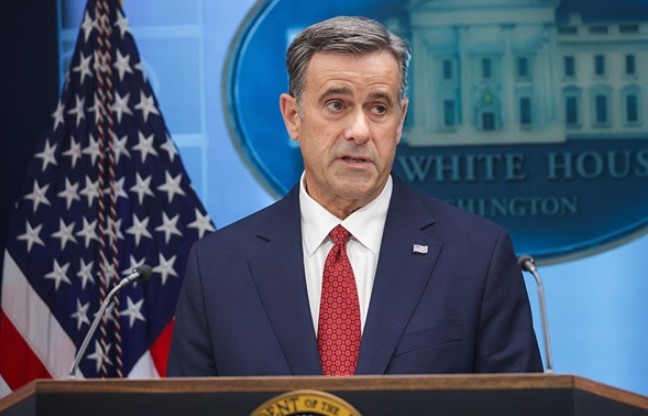
CIA Director John Ratcliffe’s position on Ukraine reveals a fundamental contradiction in U.S. security policy: Washington recognizes Russia as a strategic threat but retains the option of restricting critically important intelligence support to a country directly resisting Russian aggression.
Particularly revealing was an investigation published by The Atlantic on October 24, 2026. According to the publication’s sources, Ratcliffe would not try to persuade President Donald Trump to reverse a decision to stop sharing intelligence with Ukraine, even if the CIA had serious objections.
At the same time, under Ratcliffe’s leadership, the CIA continues to support Ukraine, including by providing intelligence on Russian attacks and cooperating with Ukrainian intelligence services.
This creates three strategic problems.
Dependence of intelligence cooperation on White House political decisions. Even a long-standing partnership can be curtailed at short notice. Uncertainty about U.S. deterrence of Russia. Moscow may interpret Washington’s willingness to pressure Ukraine as evidence of limited U.S. readiness to bear costs for European security. Risk to NATO. European allies must assess not only U.S. military capabilities but also the political predictability of decisions to use them.
Ukraine, however, is not a NATO member. Thus, a potential halt in intelligence sharing with Kyiv would not itself constitute a violation of Article 5 of the North Atlantic Treaty. The problem lies in the impact such a decision would have on allies’ confidence in the United States.
What Demonstrates the Contradictions in Ratcliffe’s Position?
The central contradiction is that the CIA director can simultaneously understand the danger of Russian aggression, support Ukrainian intelligence services, and be prepared to implement a political decision that would limit Ukraine’s ability to defend itself.
This does not necessarily mean Ratcliffe holds pro-Russian views. Rather, it suggests a model in which the head of an intelligence agency places implementation of presidential decisions above publicly defending his own professional assessments.
What Lies Behind Ratcliffe’s Attitude Toward Russia?
Available facts do not establish that Ratcliffe is sympathetic to the Kremlin. His position is better explained by a combination of political loyalty to Trump, a pragmatic approach to negotiating with an adversary, and his own understanding of U.S. national security priorities.
Political Loyalty to Trump
Ratcliffe built his political reputation as one of Trump’s defenders during disputes over investigations into Russian interference in the 2016 election.
In May 2025, he instructed the CIA to review the methodology of the intelligence assessment of Russian interference in U.S. presidential elections. This was officially presented as a review of analytical procedures, but raised concerns about possible politicization of intelligence.
This political background helps explain why Ratcliffe might avoid an open confrontation with the president even when the White House position conflicts with the assessments of some members of the intelligence community.
Desire to Avoid Direct Conflict with Russia
During his confirmation process in January 2025, Ratcliffe emphasized the danger of uncontrolled escalation with a nuclear power.
At the same time, he acknowledged the growing threat posed by Russia and its cooperation with China, Iran, and North Korea.
His approach therefore does not necessarily imply trust in Moscow. He may believe that channels for negotiation must remain open even with an adversary.
The problem arises when efforts to avoid escalation begin to constrain Ukraine’s ability to inflict military and economic losses on Russia.
Special Relations with Russian Intelligence Services
On August 25, 2026, Ratcliffe visited Moscow and held talks with the leadership of Russian intelligence services.
According to The New York Times, he conveyed to FSB Director Alexander Bortnikov an assessment of Russia’s unfavorable military and economic situation and urged Moscow to negotiate. According to the newspaper, however, he did not issue specific threats concerning the consequences of continuing the war.
CNN, CBS News, and Radio Free Europe/Radio Liberty separately reported that Ratcliffe warned Russia against military action against NATO countries, particularly the Baltic states.
These contacts can be explained by three motives: crisis communication, an effort to influence the Kremlin’s assessments, and a desire to maintain a negotiating channel independent of Witkoff’s and Kushner’s diplomatic contacts.
An important caveat: the CIA director’s contacts with Bortnikov or Naryshkin do not themselves prove political affinity with Moscow. Similar channels existed under previous U.S. administrations.
Why Does This Situation Pose a Problem for NATO?
The most important question is whether U.S. political leaders can use critical intelligence capabilities as leverage not only against Ukraine but also against allies.
Article 5 of the North Atlantic Treaty obliges member states to assist an ally subjected to armed attack. However, each state determines what measures it considers necessary. The treaty does not automatically require deployment of U.S. armed forces in every case.
This makes Washington’s political will crucial to effective deterrence.
Three Possible Consequences
First — reduced predictability of U.S. intelligence support.
If intelligence sharing with Ukraine depends on the president’s attitude toward Ukrainian military operations, European allies may fear similar political conditions during a crisis with Russia.
This is especially relevant to the Baltic states and Poland, for which U.S. satellite surveillance, early-warning capabilities, and strategic intelligence are important elements of defense planning.
Second — the risk of Kremlin miscalculation.
In August 2026, CNN reported U.S. intelligence assessments suggesting that Putin might believe the United States would be reluctant to enter another military conflict.
If Moscow interprets differences between the CIA and the White House as weakness in U.S. leadership, the risk of provocations against NATO could increase.
Third — weakening confidence in the professional independence of U.S. intelligence.
In The Atlantic, former CIA employee Julia Kerley accused Ratcliffe of failing to adequately protect analysts from political pressure. This is her assessment, not an established finding of systematic intelligence manipulation.
For NATO, the question is whether the U.S. intelligence system will be able to provide allies promptly with assessments that may contradict the White House’s political expectations.
Is Ratcliffe Pro-Russian?
Publicly available facts allow three explanations of his behavior to be considered.
The central contradiction is not Ratcliffe’s sympathies toward Russia but his willingness to subordinate the practical use of intelligence capabilities to the president’s political priorities.
This could affect European security even in the absence of any pro-Russian motivation.
Strategic Conclusion
John Ratcliffe’s position demonstrates the vulnerability of the U.S. model of intelligence partnership, in which even professional recognition of the Russian threat does not guarantee uninterrupted support for a country resisting aggression.
His willingness to implement a possible Trump decision to end intelligence assistance to Ukraine does not prove sympathy for Moscow. But it points to the limitations of institutional mechanisms designed to protect long-term security cooperation from abrupt political changes.
For European allies, the key risk is that the existence of U.S. intelligence and military capabilities can no longer automatically be equated with Washington’s political willingness to employ them in a particular crisis.
This does not mean that the United States will inevitably fail to honor its Article 5 commitments. It does, however, create uncertainty that Moscow could exploit to test Alliance unity.
The most important conclusion for NATO is the need to strengthen Europe’s own strategic intelligence, satellite surveillance, and early-warning capabilities while preserving transatlantic cooperation.
Europe’s ability to continue defensive operations in the event of political restrictions on U.S. support will be a decisive factor in the credibility of deterrence against Russia.
Key Assessment: There are substantial grounds to assume that Russian leaders regard differences between the Trump administration’s political priorities and the professional assessments of U.S. intelligence as a potential vulnerability in NATO’s deterrence system. However, there is insufficient direct evidence that the Kremlin has reached precisely this conclusion on the basis of CIA Director John Ratcliffe’s position.
For Moscow, what matters is not the mere existence of differences between the White House and the CIA but the possibility that the U.S. president might decline to use available military and intelligence capabilities if doing so conflicts with his political objectives.
Under this logic, Ukraine becomes an indicator for the Kremlin of Washington’s willingness to accept risks for the security of European partners.
There is, however, a fundamental distinction: Ukraine is not a NATO member, whereas an attack on Poland, Lithuania, Latvia, or Estonia would directly engage U.S. treaty commitments and the Alliance’s collective defense mechanisms.
U.S. Intelligence Has Already Detected a Shift in Russian Assessments
The most significant confirmation emerged on August 27, 2026.
According to The Washington Post, new U.S. intelligence indicated that the Kremlin perceived the United States as weakened by the war against Iran and saw an opportunity to increase pressure on U.S. interests and allies in Europe. These assessments preceded Ratcliffe’s August 25 visit to Moscow.
CBS News also reported a change in Russia’s risk calculations. According to U.S. officials, Putin might have become more inclined to authorize provocations on NATO territory to test Alliance unity and the Trump administration’s willingness to respond.
Thus, intelligence reporting indicates that Moscow views U.S. vulnerability as a strategic opportunity. But the sources primarily connect this to the war against Iran, U.S. resource constraints, and political uncertainty, rather than to any proven conflict between the White House and the CIA.
Why Ratcliffe’s Behavior May Reinforce the Kremlin’s Doubts
During his August visit, Ratcliffe reportedly warned Moscow against actions targeting the Baltic states, according to Politico and The Wall Street Journal.
Trump, meanwhile, publicly downplayed the importance of the trip and said he did not expect a Russian attack on NATO territory.
For Russia’s leadership, this difference in public signals could be particularly significant.
CIA Signal
Russian escalation against NATO represents a real threat that must be deterred.
White House Signal
The president does not consider a Russian attack on NATO a realistic near-term prospect.
Possible Kremlin Interpretation
A professional threat assessment will not necessarily determine the U.S. president’s final decision.
This is an analytical reconstruction of possible Russian perceptions, not a documented Kremlin conclusion.
The Atlantic’s October 24, 2026 report is particularly important. It portrays Ratcliffe as a leader who supports intelligence cooperation with Ukraine but who, according to the publication’s sources, would implement a presidential decision to end it.
Moscow may therefore conclude that even recognition of a threat within the CIA does not guarantee a corresponding response from Washington.
How Might the Kremlin Test U.S. Willingness to Defend NATO?
Rather than large-scale offensive operations, the most revealing actions would be those that test the speed and coordination of the allies’ response.
For example, in the event of a cyberattack on critical infrastructure, Moscow could test the willingness to mount a collective response to an operation whose attribution remains uncertain. This would test collective response mechanisms. In the event of sabotage against transport and energy infrastructure, Moscow could determine whether such incidents would bring tangible consequences for Russia. This would create a risk of normalizing hybrid attacks. By violating airspace, Moscow could gauge the speed of military and political reactions, increasing the risk of incidents. If Moscow undertook a limited border provocation, it could assess whether Washington was prepared to support an ally under ambiguous circumstances, threatening the Alliance’s political unity.
These scenarios correspond to the types of threats examined in U.S. intelligence assessments and a Belfer Center study from February 2026. They do not, however, prove that Moscow has decided to carry out any specific operation.
Why Ukraine Is a Key Indicator for the Kremlin
For Russia’s leadership, the war against Ukraine provides an opportunity to observe how much U.S. decisions depend on the president’s political priorities.
If Washington restricts assistance to Ukraine despite its own intelligence agencies’ assessments of the Russian threat, the Kremlin may assume that similar political logic will influence decisions concerning European allies.
Such a conclusion would have important limitations, however. Unlike Ukraine, the Baltic states are protected by Article 5, and NATO has integrated command structures and allied forces on its eastern flank.
U.S. decisions regarding Ukraine therefore cannot be mechanically extrapolated to the likelihood of American military intervention in the event of an attack on a NATO member.
What Could Deter Moscow from Testing NATO?
Not all available evidence indicates that Russia is preparing for direct confrontation.
In late August, European officials told Bloomberg that they saw no signs of imminent Russian preparations for a conventional military attack on NATO countries. Baltic representatives also said Ratcliffe’s visit had not changed their assessments of the immediate threat.
Russian leaders must also consider the risk that a provocation intended to elicit a limited response could instead consolidate NATO and compel Trump to demonstrate resolve.
This is crucial: perceiving the United States as weakened does not mean the Kremlin is confident that Washington will fail to respond.
Overall Assessment
Moscow likely regards Washington’s political unpredictability as one factor that could weaken U.S. deterrence in Europe. Reports of U.S. intelligence assessments from August 2026 support this conclusion.
However, there is insufficient open-source evidence that differences between Trump and Ratcliffe have become the decisive factor in Russian calculations.
The greatest danger for NATO is the possibility that the Kremlin concludes that the United States has the military capacity to defend its allies but that its political willingness to do so may depend on the circumstances of a particular crisis.
The gap between U.S. military capabilities and perceptions of its political resolve could create conditions for Russian miscalculation and dangerous escalation on the Alliance’s eastern flank.