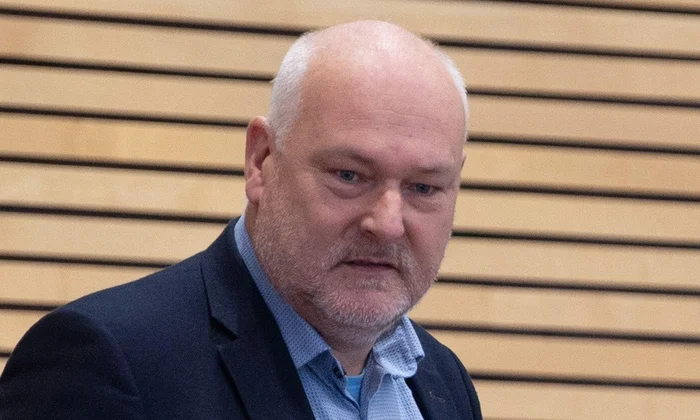

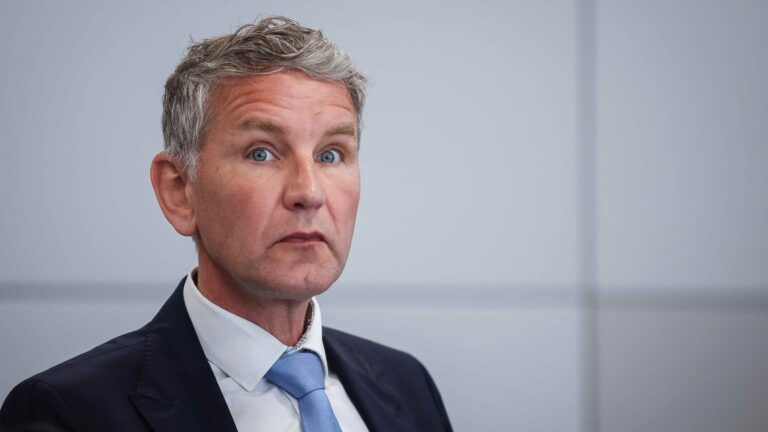
The statement by the leader of the Thuringia branch of the Alternative for Germany (AfD), Björn Höcke, claiming a supposed mental and cultural “difference” between East and West Germans has triggered a wave of criticism and exposed divisions within the party itself. In an interview with a Swiss newspaper, Höcke argued that West Germans had become fully influenced by American culture, while the situation in eastern Germany was fundamentally different.
In response, AfD federal co-chair Tino Chrupalla quickly emphasized that the party represents all Germans and must not allow itself to be divided internally. Alice Weidel, for her part, pointedly reminded the public that Höcke himself grew up in the western state of Rhineland-Palatinate.
The controversy surrounding Höcke’s remarks has highlighted deep-seated ideological tensions and internal contradictions within AfD. It demonstrates that a significant segment of the party continues to be dominated by radical figures who deliberately exploit sensitive issues related to Germany’s historical legacy in order to fuel social divisions and mobilize a radicalized, anti-establishment, and anti-Western electorate.
Höcke’s comments reveal the persistence of a worldview within parts of AfD that seeks to frame German society through the lens of cultural and political confrontation rather than national cohesion.
The narrative that western Germany has fallen under the influence of American culture closely mirrors themes frequently promoted by Russian influence operations targeting Germany. Such narratives are designed to deepen internal divisions, undermine transatlantic ties, and weaken public support for Western institutions.
The fact that one of AfD’s most influential regional leaders publicly echoed a core message of Russian propaganda once again underscores the ideological and psychological affinity between the party’s radical wing and the Kremlin’s broader anti-Western agenda.
The incident also illustrates the growing challenge faced by AfD’s federal leadership as it attempts to balance electoral pragmatism with the increasingly radical positions advanced by some of its most prominent eastern German representatives.
More broadly, the dispute highlights the existence of competing visions within AfD: one seeking to expand the party’s appeal nationwide, and another embracing a more confrontational identity rooted in cultural grievance, anti-Americanism, and narratives that often align with Russian strategic messaging.
The episode is likely to reinforce concerns among Germany’s mainstream political parties and security institutions regarding the continued influence of radical and pro-Russian currents within segments of AfD, particularly in eastern Germany, where such narratives have historically found greater resonance.
The statement by the leader of the Thuringia branch of the Alternative for Germany (AfD), Björn Höcke, claiming a fundamental mental and cultural divide between East and West Germans has sparked significant controversy and exposed deeper ideological fractures within the party. In an interview with a Swiss newspaper, Höcke argued that West Germans had become fully shaped by American culture, while eastern Germans had preserved a distinct mentality and worldview.
While AfD federal leaders, including Tino Chrupalla and Alice Weidel, attempted to distance themselves from Höcke’s remarks, the controversy is significant not only because of its domestic implications but also because it echoes political technologies previously employed by Russian strategists in other countries, most notably during Ukraine’s 2004 presidential election.
Historical Parallel: Ukraine’s 2004 Presidential Election
During the 2004 presidential campaign in Ukraine, Russian political consultants working for the campaign of then-candidate Viktor Yanukovych, including political technologist Marat Gelman, actively promoted narratives emphasizing alleged civilizational, cultural, and linguistic differences among Ukrainians. One of the most controversial concepts associated with that period was the notion of Ukraine being divided into different “grades” or “types” of citizens (“three sorts of Ukrainians”), portraying western, central, and eastern regions as fundamentally different communities with incompatible political preferences and identities.aAd
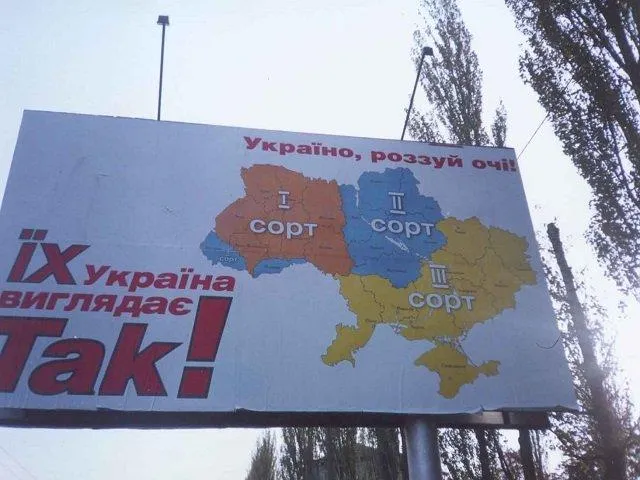
The objective was not merely electoral mobilization. Rather, it sought to: deepen existing regional cleavages; weaken the emergence of a unified civic identity; portray political competition as a struggle between irreconcilable cultural camps; create long-term social polarization that could be exploited by Moscow.
Subsequent events demonstrated that these narratives became an important component of Russia’s broader strategy toward Ukraine, culminating in the exploitation of regional identities during the 2014 aggression against Ukraine.
Similarities with Höcke’s Narrative
Although Germany’s political environment differs substantially from Ukraine’s in 2004, Höcke’s rhetoric follows a remarkably similar logic.
Both narratives: divide a nation into allegedly distinct mental or cultural communities; suggest that one part of the country possesses a more authentic national identity than another; portray external influence (the West, the United States, or liberal institutions) as having corrupted part of the nation; encourage political mobilization based on grievance and identity conflict rather than policy debates.
In the Ukrainian case, the divide was framed as East versus West Ukraine. In Höcke’s formulation, it becomes East versus West Germany. In both instances, the political objective is to transform geographic and historical differences into enduring political fault lines.
Alignment with Russian Influence Narratives
The claim that western Germany has become culturally subordinated to the United States closely mirrors themes regularly promoted by Russian state media and influence networks. For decades, Kremlin messaging has portrayed Europe as an entity that has lost its sovereignty and become a “vassal” of Washington. Germany occupies a central place in this narrative because Moscow views German-American relations as a cornerstone of the European security architecture.
Russian influence operations have consistently attempted to weaken transatlantic solidarity; foster anti-American sentiment; encourage regional and cultural fragmentation within European states; support political actors willing to challenge the post-Cold War European order.
Against this backdrop, Höcke’s remarks are noteworthy because they reproduce a key element of Kremlin strategic communications: the idea that national revival requires emancipation from alleged American cultural domination.
The controversy surrounding Höcke’s comments highlights the continued presence of a radical ideological current within AfD that increasingly relies on identity-based polarization. The parallels with political technologies used by Russian strategists in Ukraine are unlikely to be coincidental. Rather, they reflect a broader pattern whereby narratives designed to divide societies along regional, cultural, or historical lines are adapted to local political contexts.
The Ukrainian experience demonstrates that such narratives should not be dismissed as mere electoral rhetoric. When repeatedly amplified, they can erode national cohesion, undermine trust between regions, and create opportunities for external actors seeking to weaken democratic states from within.
The comparison between Ukraine in 2004 and Germany today does not imply identical circumstances. However, it illustrates how political messaging that emphasizes supposedly irreconcilable internal identities has long been a hallmark of Russian influence operations. The fact that similar themes are now being articulated by one of AfD’s most influential regional leaders raises important questions about the extent to which elements of the party’s radical wing have absorbed narratives that align with Moscow’s strategic interests.
The controversy surrounding Höcke’s remarks represents more than an internal AfD dispute. It reflects the re-emergence of a political technique long associated with Russian influence operations: the deliberate construction of internal identity divisions for political mobilization. The parallels with the narratives promoted by Russian strategists during Ukraine’s 2004 presidential election suggest that the underlying objective remains unchanged—to weaken national unity by convincing citizens that they belong to fundamentally different and competing political communities.
There are strong indications that the Kremlin views East-West identity tensions in Germany as a useful instrument for weakening both German national cohesion and transatlantic unity.
Russia’s approach toward Germany has historically focused less on creating entirely new divisions than on exploiting existing social, political, and historical fault lines. The enduring differences between eastern and western Germany—stemming from four decades of separation during the Cold War—provide a particularly attractive target for such influence efforts.
For Moscow, East-West tensions in Germany offer several strategic advantages. Russian influence operations have consistently sought to reinforce perceptions that eastern Germans are politically, economically, and culturally marginalized by western elites.
The objective is to increase distrust toward Berlin-based institutions; undermine confidence in mainstream political parties; strengthen anti-establishment movements; portray Germany as an internally fragmented state rather than a cohesive political nation.
This approach mirrors Russian influence techniques previously employed in Ukraine, Moldova, Georgia, and the Baltic states, where regional identities were politicized to weaken national consensus.
The narrative advanced by Höcke—that western Germany has become excessively influenced by American culture—closely aligns with longstanding Kremlin messaging.
Russian strategic communications routinely portray the United States as Germany’s de facto controller; NATO as an instrument of American domination; Germany’s political elite as subordinated to Washington.
By encouraging eastern Germans to view themselves as culturally distinct from the more pro-transatlantic West German political mainstream, Moscow seeks to weaken support for: NATO commitments; military assistance to Ukraine; sanctions against Russia; U.S. military presence in Germany.
The Kremlin does not necessarily need a pro-Russian government in Berlin to achieve its objectives. Often, a fragmented political environment is sufficient.
Russian strategy frequently favors political actors that: challenge the political center; polarize public debate; question sanctions and support for Ukraine; advocate strategic distancing from the United States.
In this context, narratives emphasizing East-West German differences serve as force multipliers for broader anti-establishment sentiment.
Since the full-scale invasion of Ukraine in 2022, Russian state media and influence networks have repeatedly amplified themes such as:“East Germans understand Russia better than West Germans”; “The former GDR population is more realistic about Moscow”; “Western German elites are imposing foreign values on the East”; “Germany has become a vassal of the United States.”
These narratives are particularly visible on Russian state outlets such as RT and Sputnik, as well as through pro-Kremlin social media ecosystems targeting German audiences.
The Kremlin’s current approach bears striking similarities to the political technologies employed by Russian strategists during Ukraine’s 2004 presidential election.
At that time, Russian political consultants working for Viktor Yanukovych promoted narratives depicting eastern and western Ukrainians as fundamentally different political communities. The goal was not merely electoral victory but the creation of a durable societal divide that could later be exploited for geopolitical purposes.
The same operational logic can be observed in Germany today: emphasize regional identities; politicize historical experiences; frame one part of the nation as more authentic than another; present external alliances as sources of national decline; weaken societal consensus on foreign and security policy.
The Kremlin almost certainly views East-West identity tensions in Germany as a viable and low-cost instrument for weakening national cohesion and transatlantic unity. Russia’s objective is unlikely to be the creation of a formal territorial or constitutional split. Rather, Moscow benefits from a Germany that is politically polarized, internally distrustful, and less capable of sustaining a coherent leadership role within NATO, the European Union, and support for Ukraine.
From a Russian strategic perspective, every debate that reframes Germans as members of competing regional identities rather than a unified political nation contributes to that objective. The controversy surrounding Björn Höcke’s remarks is therefore significant not because it threatens Germany’s integrity directly, but because it reinforces narratives that align closely with long-standing Kremlin efforts to fragment Western societies from within.
Germany is the economic engine of Europe and the central pillar of the EU. From a Russian strategic perspective, Berlin is more valuable as: a weakened leader of Europe; a divided political system; a state reluctant to support NATO initiatives; a country questioning sanctions and military support to Ukraine.
A formally divided Germany would create enormous uncertainty, potentially triggering: stronger NATO cohesion; emergency EU integration measures; increased U.S. military involvement; a security mobilization across Europe.
These outcomes would run contrary to Russian interests.
Looking at Russian actions since the early 2000s, one can identify a recurring pattern.
Russia has supported narratives that: emphasize regional identities; question national unity; encourage federalization or autonomy; portray central governments as illegitimate.
This occurred in: Ukraine (East-West divide); Moldova (Transnistria, Gagauzia); Georgia (Abkhazia, South Ossetia); Bosnia and Herzegovina (Republika Srpska); Spain (Catalonia, through media amplification); Belgium (Flemish-Walloon tensions).
Under this framework, Germany could eventually become another target if circumstances became favorable.
Former East Germany possesses several characteristics that Russian strategists may perceive as exploitable: lower trust in federal institutions; stronger anti-establishment voting patterns; greater skepticism toward NATO; more favorable attitudes toward Russia than in western Germany; historical memory of the GDR and Soviet presence.
Russian media have long portrayed eastern Germans as “the other Germany”—more pragmatic, more sovereign, and less “Americanized.”
This is remarkably similar to Russian narratives about: southeastern Ukraine before 2014; Russian-speaking populations in the Baltics; Gagauzia in Moldova.
The Ukrainian Analogy Is Worth Considering
When Russian political consultants such as Marat Gelman and Gleb Pavlovsky worked on behalf of Viktor Yanukovychin 2004, their immediate objective was not the breakup of Ukraine.
The goal was: Win the election. Create a durable East-West political divide. Weaken a unified Ukrainian civic identity. Increase Moscow’s leverage.
A decade later, those same fault lines became one of the foundations exploited during the annexation of Crimea and the war in Donbas.
This illustrates an important principle of Russian political warfare:
The objective is often not immediate separatism. The objective is to cultivate identities and grievances that can be activated later if conditions become favorable.
What Could Change Moscow’s Calculus?
If Germany experienced: a prolonged economic crisis; major migration-related unrest; severe constitutional disputes; EU institutional breakdown; sustained political deadlock then a more ambitious Russian strategy could emerge.
In such a scenario, narratives about: “Eastern German interests,” “Prussian identity,” “Berlin elites,” “Western occupation through NATO,” could evolve from propaganda themes into political mobilization tools.
Key Judgment
Today, the Kremlin likely sees East-West identity tensions primarily as a means of weakening Germany’s ability to act as a cohesive leader of Europe, not as a direct pathway to territorial disintegration.
However, the historical record of Russian influence operations suggests that Moscow frequently nurtures regional grievances long before they become strategically useful. The same political technologies used in Ukraine in 2004 were initially designed to create electoral polarization, not state fragmentation. Yet they later provided Moscow with exploitable fault lines during moments of crisis.
For that reason, statements such as Höcke’s are analytically significant not because they threaten Germany’s territorial integrity today, but because they normalize the idea that Germans belong to fundamentally different political and cultural communities—a concept that has repeatedly appeared in Russian influence campaigns across Europe and the post-Soviet space.
Russian state media and pro-Kremlin platforms amplify Björn Höck disproportionately compared with most German mainstream politicians, although not necessarily more than other German figures who challenge the transatlantic consensus, such as AfD leaders, Sahra Wagenknecht, or selected anti-establishment commentators.
The key issue is not simply the volume of coverage but the nature of amplification. Russian information ecosystems tend to selectively promote German politicians whose statements can be used to support strategic narratives about NATO, the United States, sanctions, migration, EU integration, or the war in Ukraine.
Höcke is particularly valuable to Russian propaganda because he frequently touches on themes that overlap with long-standing Kremlin messaging: criticism of American influence in Europe; opposition to Germany’s military support for Ukraine; skepticism toward liberal democratic institutions; emphasis on national identity and cultural sovereignty;criticism of Germany’s post-war political consensus; narratives about a disconnect between elites and ordinary citizens.
Unlike many mainstream German politicians, Höcke often provides statements that can be presented by Russian media as evidence that opposition to Berlin’s and Brussels’ policies is growing inside Germany itself.
How Russian Media Typically Use Höcke
Russian outlets such as RT, Sputnik, and various pro-Kremlin Telegram channels generally employ three methods:
Only specific remarks are highlighted—typically those concerning: NATO; Ukraine; sanctions; migration; relations with Russia; criticism of U.S. influence.
More controversial domestic statements are often ignored unless they can be used to demonstrate “German political chaos.”
Russian media frequently present politicians such as Höcke as proof that: “many Germans disagree with their government”; “German society is turning against support for Ukraine”; “the political establishment no longer represents ordinary citizens.”
This creates the impression that Russian positions enjoy growing support inside Europe.
A particularly notable aspect is the portrayal of eastern Germany.
Russian media regularly suggest that: East Germans better understand Russia; eastern Germany preserved greater political independence; former GDR citizens are less influenced by the United States; eastern Germans are more skeptical of NATO.
This framing makes Höcke especially useful because he is strongly associated with Thuringia and eastern German political dynamics.
Russian media attention toward German politicians can broadly be divided into categories.
High Amplification
- Björn Höcke
- Alice Weidel
- Tino Chrupalla
- Sahra Wagenknecht
These figures are frequently cited when criticizing sanctions, NATO policy, migration policy, or support for Ukraine.
Moderate Amplification
- regional AfD leaders;
- selected members of the Bundestag;
- business representatives advocating renewed economic engagement with Russia.
Negative Coverage
Politicians strongly associated with support for Ukraine or NATO are generally portrayed negatively, including: Friedrich Merz, Annalena Baerbock, Boris Pistorius.
These figures are often depicted as serving American interests or escalating confrontation with Russia.
The argument that western Germans have become culturally “Americanized” while eastern Germans have preserved a different mentality is particularly attractive from the Kremlin’s perspective because it combines several Russian narratives simultaneously: Germany is internally divided. American influence has weakened European sovereignty. Eastern Germans remain more independent-minded. Germany’s political elite does not represent all Germans.
This resembles earlier Russian messaging toward Ukraine, where differences between eastern and western regions were emphasized and politicized. The objective is not necessarily to advocate territorial separation but to encourage the perception that a nation consists of competing identities rather than a unified political community.
Russian state media and pro-Kremlin platforms do not necessarily amplify every statement made by Höcke, but they consistently elevate those remarks that support Kremlin strategic narratives. Compared with mainstream German politicians, Höcke receives disproportionately favorable and often uncritical attention because his rhetoric frequently aligns with Russian messaging on national sovereignty, anti-Americanism, NATO skepticism, and internal societal divisions.The significance of Höcke’s recent comments lies less in their immediate domestic impact and more in the fact that they provide Russian information operators with a ready-made narrative portraying Germany as culturally fractured and increasingly divided between competing political identities. Such themes have long been central to Moscow’s influence operations across Europe and previously formed a key component of Russian political technologies employed in Ukraine before the Orange Revolution and again prior to 2014.
More on this story: AfD, Russian Influence, and the Growing Risk of Ethnic Polarization in Germany