
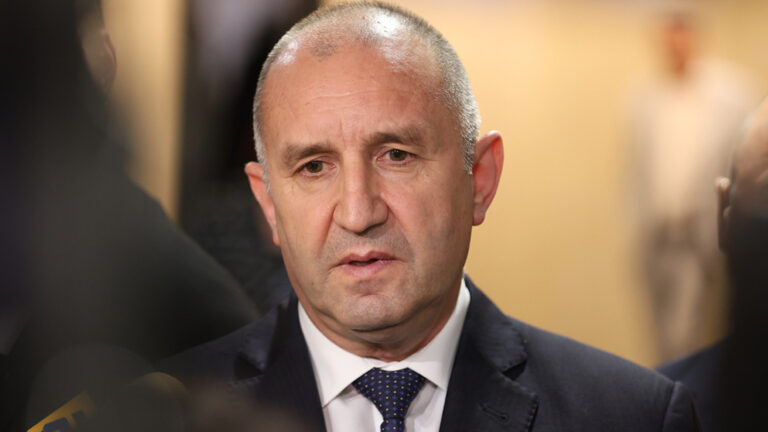
The Prime minister of the Republic of Bulgaria Rumen Radev stated that he had received an invitation from French President Emmanuel Macron to join the “Coalition of the Willing,” but affirmed that Bulgaria would not participate in the coalition, which advocates continued financial and military assistance to Ukraine.
Radev justified his position by arguing that the conflict between Russia and Ukraine should be resolved not through military means but through a strong diplomatic initiative capable of bringing an end to the escalation. Responding to questions regarding the proposed European “Freya” ballistic missile defense coalition and whether Bulgaria was interested in joining it, Radev stated that all matters related to Bulgaria’s collective security are addressed within the frameworks of NATO and the European Union.
Radev’s call for a “strong diplomatic mission” instead of continued military assistance to Ukraine reflects a fundamental geopolitical misconception. Suspending military support effectively deprives the victim of aggression of its ability to defend itself, transforming diplomacy into an instrument of Kremlin coercion rather than conflict resolution. Such an approach implicitly promotes peace at the expense of Ukraine’s territorial integrity and sovereignty.
While Radev insists that Bulgaria’s security is guaranteed through NATO and the European Union, his position simultaneously undermines the efforts of both organizations to counter the Russian military threat on NATO’s eastern flank. In practice, this represents an attempt to “sit on two chairs”—to benefit from NATO’s collective security umbrella while avoiding a proportional contribution to safeguarding stability in the Black Sea region.
Diplomacy without the withdrawal of Russian forces from Ukrainian territory risks becoming a mechanism through which Moscow gains time to rebuild its military capabilities, replenish resources, and prepare for renewed aggression. Such an outcome would undermine regional security as a whole, with direct implications for the Black Sea theater, where instability could increasingly affect Moldova, Romania, and, ultimately, Bulgaria itself.
Russia’s ongoing military activities have already disrupted maritime security by threatening commercial shipping, damaging port infrastructure, and expanding the danger posed by drifting naval mines throughout the Black Sea basin. Against this backdrop, Sofia’s restrained approach risks leaving Bulgaria increasingly exposed to the broader security consequences of Russia’s military operations in the region.
Radev’s position closely aligns with narratives actively promoted by the Kremlin. From Moscow’s perspective, Bulgaria represents a potential weak link within both NATO and the European Union, while Radev’s statements are exploited by Russian propaganda to reinforce claims that Europe lacks a unified position on supporting Ukraine. Such narratives are intended to weaken the cohesion and political resolve of Western democracies in confronting Russian aggression.
Radev’s rhetoric reflects a policy that presents itself as advocating peace and diplomacy but, in practice, risks advancing strategic objectives favorable to Moscow. This approach may weaken Bulgaria’s credibility as a reliable NATO ally, undermine the European Union’s Common Security and Defence Policy, and create additional opportunities for Russia to exploit divisions within the Euro-Atlantic community.
As long as Russia continues to pose a systemic challenge to European security, maintaining unity and close coordination among EU and NATO members remains essential for preserving stability, deterring further aggression, and ensuring the long-term security of the European continent.
Analytical Assessment: Why Rumen Radev’s Position Repeatedly Aligns with Russian Strategic Objectives
Rumen Radev presents his opposition to continued military assistance for Ukraine as a pragmatic policy rooted in diplomacy, de-escalation, and the avoidance of further military confrontation. However, regardless of his stated intentions, the practical consequences of this position closely correspond to Russia’s long-standing strategic objective of reducing Western military support for Ukraine. The Kremlin has consistently sought to replace sustained military assistance with negotiations conducted before Russia withdraws its forces, thereby increasing the likelihood that Moscow could preserve territorial gains while rebuilding its military capabilities.
Several factors likely explain Radev’s repeated adoption of positions that converge with Russian strategic interests.
First, Bulgaria’s historical, cultural, and economic ties with Russia continue to shape parts of the country’s political landscape. Russian influence has traditionally extended through energy dependence, political networks, business interests, media narratives, and segments of Bulgarian society that maintain favorable perceptions of Moscow. Although Bulgaria has significantly reduced its energy dependence since 2022, these long-standing relationships continue to influence domestic political discourse.
Second, Radev appears to prioritize short-term domestic political stability over long-term strategic deterrence. Public opinion in Bulgaria remains more divided on military support for Ukraine than in many Central and Northern European countries. By advocating negotiations rather than expanded military assistance, Radev appeals to constituencies concerned about economic costs, energy prices, inflation, and the risk of regional escalation. His rhetoric therefore serves important domestic political objectives while simultaneously aligning with Russian information narratives.
Third, Radev appears to subscribe to a realist interpretation of European security. His public statements frequently suggest that military victory is unlikely and that negotiations represent the only sustainable solution. This perspective assumes that continued military assistance merely prolongs the conflict and increases human and economic costs. Critics argue that this assessment overlooks the deterrent effect of sustained military support and underestimates Russia’s willingness to exploit negotiations to consolidate battlefield gains.
Fourth, Bulgaria’s geopolitical position contributes to a cautious strategic culture. As a Black Sea state with comparatively limited military capabilities, Sofia has traditionally sought to avoid becoming a frontline actor in confrontations involving Russia. This cautious posture encourages support for collective NATO security guarantees while limiting unilateral initiatives that could expose Bulgaria to greater political, economic, or military pressure.
Fifth, Radev’s rhetoric reflects broader strategic narratives promoted by Moscow. Russian information campaigns consistently advocate immediate ceasefires, negotiations without prior Russian withdrawal, reduced Western military assistance, and recognition of what they describe as the “new geopolitical realities.” Although these arguments are also advanced by actors who are not aligned with the Kremlin, their cumulative effect objectively advances Russian strategic interests by reducing pressure on Moscow while constraining Ukraine’s ability to restore its territorial integrity.
This convergence between Radev’s political messaging and Russian strategic objectives does not by itself demonstrate coordination with the Kremlin. It does, however, create significant political opportunities for Russian diplomacy and information operations. Moscow routinely amplifies statements by European leaders that question military support for Ukraine in order to reinforce narratives portraying NATO and the European Union as divided and politically exhausted.
From the Kremlin’s perspective, Bulgaria occupies disproportionate strategic importance. It is a Black Sea NATO member situated near critical maritime infrastructure and energy corridors linking Southeastern Europe with the broader Euro-Atlantic community. Any indication that Sofia is reluctant to support collective measures against Russia can therefore be leveraged to weaken perceptions of Alliance cohesion.
For Russia, Radev’s statements provide three strategic advantages. First, they offer propaganda material demonstrating apparent divisions within NATO and the European Union. Second, they encourage political forces elsewhere in Europe advocating reduced support for Ukraine. Third, they complicate efforts to maintain unified allied messaging regarding long-term military assistance and deterrence.
Ultimately, the strategic significance of Radev’s position lies less in Bulgaria’s individual military contribution than in its political symbolism. Russian strategy increasingly relies on exploiting differences among democratic allies rather than achieving direct military victories. Public disagreement from senior leaders within NATO member states is therefore valuable to Moscow because it supports the broader objective of eroding allied unity, weakening deterrence, and encouraging negotiations on terms more favorable to Russia.
The available evidence does not establish that Rumen Radev is acting on behalf of Russia. However, his consistent advocacy for reducing military assistance, prioritizing negotiations before Russian withdrawal, and emphasizing de-escalation over deterrence repeatedly produces outcomes that align with the Kremlin’s strategic objectives. Whether driven by domestic political considerations, strategic realism, or a desire to minimize Bulgaria’s exposure to regional confrontation, the practical effect of this policy is to strengthen Russia’s diplomatic position while complicating efforts to maintain a unified Euro-Atlantic response to the war in Ukraine.
Comparative Analysis: Rumen Radev’s Position Versus Slovakia and Hungary During the Orbán Era
Although Bulgaria, Slovakia, and Hungary are all NATO and EU member states, their approaches toward Russia and the war in Ukraine differ significantly in both scope and strategic intent. What unites them is skepticism toward prolonged military support for Ukraine and a preference for negotiated conflict resolution. What distinguishes them is the degree to which this skepticism has been translated into state policy.
Bulgaria: Strategic Ambiguity
Rumen Radev promotes diplomacy as the preferred mechanism for ending the war and has repeatedly questioned the effectiveness of continued military assistance to Ukraine. His position reflects a cautious strategic culture rooted in Bulgaria’s historical ties with Russia, domestic political divisions, and concerns about becoming more deeply involved in regional confrontation.
However, Bulgaria’s institutional policy has remained considerably more aligned with NATO and EU decisions than Radev’s rhetoric might suggest. Successive Bulgarian governments have approved military assistance, participated in NATO deterrence measures, strengthened Black Sea security cooperation, and supported successive EU sanctions packages against Russia. Consequently, Bulgaria’s official foreign policy has generally remained consistent with Euro-Atlantic priorities despite Radev’s more cautious public messaging.
In this sense, Radev functions primarily as a political voice advocating restraint rather than as the architect of Bulgaria’s overall security policy.
Slovakia: Selective Resistance
Under Prime Minister Robert Fico, Slovakia adopted a more explicit political campaign against further military assistance to Ukraine. Unlike Bulgaria, where rhetoric has not fundamentally altered government policy, Slovakia translated campaign promises into concrete decisions by suspending new state-funded military aid while continuing humanitarian assistance and allowing commercial defense exports.
Fico consistently framed his policy around several themes: opposition to military escalation; prioritization of negotiations; protection of Slovak economic interests; criticism of EU sanctions; resistance to deeper Western involvement in the conflict.
Despite this rhetoric, Slovakia has remained firmly integrated within NATO structures, continued to participate in Alliance missions, and has not attempted to obstruct NATO’s collective defense planning.
The Slovak model therefore represents selective policy divergence rather than comprehensive strategic realignment.
Hungary: Strategic Obstruction
Hungary under Prime Minister Viktor Orbán represented the most comprehensive challenge to the Western consensus on Russia.
Unlike Bulgaria or Slovakia, Hungary has systematically incorporated its Russia policy into broader national strategy. Budapest has repeatedly: delayed or threatened to block EU sanctions negotiations; opposed collective financial assistance for Ukraine; maintained high-level political engagement with the Kremlin; expanded bilateral energy cooperation with Russia; criticized NATO’s long-term strategy toward Ukraine; used unanimity requirements within the EU as negotiating leverage.
Orbán presents Hungary as pursuing an independent “peace policy,” but this approach has frequently placed Budapest in direct opposition to common EU and NATO positions.
Rather than simply advocating negotiations, Hungary has sought to reshape European policy by slowing or modifying collective decisions concerning Russia and Ukraine.
Comparative Strategic Motivation
The three leaders appear motivated by different strategic calculations.
Radev’s approach is primarily defensive. His objective appears to be minimizing Bulgaria’s exposure to regional instability while preserving NATO security guarantees. His rhetoric reflects caution rather than geopolitical revisionism.
Fico’s policy is largely driven by domestic political considerations. His messaging appeals to voters concerned about inflation, energy prices, and war fatigue while emphasizing Slovak sovereignty and economic interests.
Orbán’s policy is considerably broader. His government promoted a long-term vision of a multipolar Europe characterized by greater national sovereignty, reduced influence of Brussels, and pragmatic cooperation with non-Western powers, including Russia and China. Russia therefore occupies a structural place within Hungary’s foreign-policy strategy rather than serving solely as an issue of conflict management.
Russian Strategic Value
From Moscow’s perspective, these three countries provide different levels of strategic utility.
Bulgaria contributes primarily to information operations. Statements by Radev can be cited as evidence that support for Ukraine is weakening within NATO, even though Bulgaria continues to implement most Alliance decisions.
Slovakia provides political validation for Kremlin narratives that military assistance prolongs the war and that negotiations should replace continued arms deliveries. Nevertheless, Bratislava has generally avoided obstructing NATO’s institutional functioning.
Hungary offers the greatest strategic value because it possesses the institutional capacity to delay EU decisions requiring unanimity. Budapest’s repeated use of veto threats allows Moscow to portray the European Union as divided while complicating collective decision-making on sanctions, financial assistance, and long-term support for Ukraine.
Comparative Assessment
Among the three cases, Hungary presented the most sustained strategic challenge to Euro-Atlantic cohesion because its policies combine political rhetoric with repeated institutional obstruction. Slovakia occupies an intermediate position, coupling anti-war rhetoric with selective policy restrictions while remaining committed to NATO membership. Bulgaria represents the least disruptive model: although Radev’s public statements frequently align with themes promoted by Russian diplomacy, Bulgaria’s governments have generally continued to support NATO, EU sanctions, and practical assistance to Ukraine.
The principal difference lies in the relationship between rhetoric and policy implementation. Radev’s statements often generate political narratives that Russia can exploit, but Bulgaria’s institutional behavior has remained largely aligned with Euro-Atlantic commitments. Slovakia has translated some political rhetoric into specific policy changes while stopping short of challenging NATO’s strategic framework. Hungary, by contrast, has integrated its Russia policy into a broader strategy that repeatedly uses EU institutional mechanisms to influence or delay collective Western responses.
Accordingly, Bulgaria currently represents a case of strategic ambiguity, Slovakia one of selective resistance, and Hungary one of institutional obstruction. These three models differ in degree rather than kind, but they produce progressively greater opportunities for Russia to weaken allied cohesion and complicate Western decision-making.
If Bulgaria were perceived by its allies as consistently undermining collective security while benefiting from NATO’s security guarantees, the most realistic responses would be political, financial, and institutional, rather than punitive measures in the military sense. Because Bulgaria is both an EU and NATO member, there are no simple mechanisms to “punish” it for expressing a different policy preference, and many decisions require consensus.
A graduated response could include:
| Instrument | Possible measure | Practical feasibility |
| Diplomatic | Increased political pressure in NATO and EU forums; requests for public clarification of Bulgaria’s position | High |
| Reputational | Public reporting comparing allies’ contributions to Ukraine, NATO missions, and defense spending | High |
| Defense cooperation | Reduced leadership opportunities in selected multinational initiatives or lower priority for new cooperative projects | Moderate |
| Financial | Closer scrutiny of EU funds where rule-of-law or legal conditions are implicated (not simply because of foreign-policy disagreements) | Limited and context-dependent |
| Intelligence | Restricting access to particularly sensitive intelligence on a need-to-know basis if concerns arise about security or information protection | Possible in specific circumstances |
| Industrial | Favoring allies with stronger policy alignment in future defense-industrial partnerships or joint procurement | Moderate |
Diplomatic pressure
The first response would likely be sustained diplomatic engagement rather than sanctions. Allies could: request explicit support for NATO deterrence measures; seek commitments to implement agreed sanctions and export controls; encourage stronger participation in Black Sea security initiatives; increase peer pressure through NATO ministerial meetings and EU councils.
This approach seeks to maintain alliance cohesion while encouraging policy alignment.
Defense and intelligence cooperation
If an ally is viewed as less reliable on certain issues, partners may become more selective in sharing highly sensitive intelligence or involving that ally in specific projects. This does not mean suspending NATO’s Article 5 commitments; rather, it can involve practical decisions about information sharing or leadership roles where trust is especially important.
Economic and defense-industrial incentives
Rather than “punishment,” allies can use incentives: prioritize cooperative defense projects with governments that make larger collective contributions; encourage greater investment in NATO capability targets; link participation in some voluntary multinational defense initiatives to demonstrated commitment and interoperability.
Reputational pressure
Governments are often sensitive to comparisons with their peers. Publishing transparent data on: defense spending, military assistance, implementation of sanctions, participation in NATO operations can create domestic and international pressure without undermining alliance unity.
What is not realistic
Some proposals are unlikely to be feasible or compatible with NATO/EU rules solely because a member advocates negotiations with Russia: suspending NATO membremoving Article 5 protections; imposing broad economic sanctions on an allied government; automatically withholding EU funding absent an applicable legal basis; excluding a member from core NATO decision-making.
Such measures would face significant legal, political, and institutional obstacles and could weaken alliance cohesion.
If Russia escalates near Estonia, Finland, or Poland
A significant escalation by Russia on NATO’s northeastern flank would likely increase pressure on all allies—including Bulgaria—to demonstrate solidarity. That pressure would probably take the form of requests to: support additional NATO force deployments; increase defense spending and readiness; contribute personnel or capabilities to alliance missions; endorse stronger sanctions and export controls; participate in joint deterrence and resilience measures.
In that scenario, the political cost of appearing reluctant to support collective measures could rise substantially, but allies would still generally seek to strengthen cohesion rather than isolate a member state.
Key judgment
The most effective response to policy divergence within NATO is generally graduated diplomatic pressure, transparency, and incentive-based cooperation, not punitive measures that risk fracturing the alliance. Allies typically reserve stronger restrictions for cases involving concrete security concerns—such as breaches of classified information, failure to meet legal obligations, or proven sanctions evasion—rather than differences in political rhetoric alone.
If one assumes a second Trump administration broadly consistent with its previously stated foreign policy preferences—greater burden-sharing by allies, skepticism toward prolonged overseas commitments, and a focus on NATO members contributing more to collective defense—the reaction to Rumen Radev’s statement would likely depend on whether Bulgaria’s position is seen as merely rhetorical or as obstructing Alliance objectives.
The comparison with Italy’s reported reluctance to participate in military operations against Iran is instructive, but the two issues would probably be viewed differently in Washington. Participation in military operations outside NATO’s treaty obligations is generally seen as a sovereign decision. By contrast, a NATO member reducing support for Ukraine or weakening allied deterrence against Russia could be interpreted as affecting the Alliance’s core European security interests.
A likely analytical assessment would be:
How a Trump Administration Could Respond to Rumen Radev’s Position
Although Donald Trump has frequently argued that European allies should assume greater responsibility for their own security and has expressed skepticism toward open-ended military commitments, his administration has simultaneously emphasized burden-sharing and credible deterrence against geopolitical competitors. Consequently, Washington’s reaction to Rumen Radev would probably be driven less by his call for diplomacy itself than by whether Bulgaria’s policies were perceived as weakening NATO’s collective deterrence against Russia.
Bulgaria’s Credibility Within NATO
A Trump administration would likely distinguish between two separate issues: refusing to participate in voluntary military coalitions outside NATO’s treaty obligations; and undermining Alliance cohesion regarding Russia.
The first would probably be accepted as a sovereign political decision. The second could attract significantly greater scrutiny if Washington concluded that Bulgarian policies encouraged Russian strategic objectives.
Russia represents NATO’s principal long-term strategic challenge in Europe. Consequently, statements by allied leaders questioning military assistance to Ukraine or advocating negotiations before Russian withdrawal could be interpreted as affecting NATO’s overall deterrence posture.
Therefore, Washington would probably treat Bulgaria’s Russia policy as strategically more consequential than disagreements over optional military operations in the Middle East.
Rather than pursuing public confrontation, a Trump administration would more likely employ targeted political leverage.
Washington could argue that if Bulgaria prefers diplomatic engagement over military support for Ukraine, Sofia should compensate through: higher defense spending; accelerated military modernization; greater participation in NATO force deployments; expanded Black Sea surveillance; increased logistical support for Allied operations.
The underlying message would be straightforward: Allies may choose different approaches toward Ukraine, but every ally must make a meaningful contribution to collective deterrence.
The White House could privately encourage Sofia to align more closely with NATO consensus while avoiding public criticism that might strengthen anti-American narratives inside Bulgaria.
Washington has traditionally preferred private diplomatic engagement with allies before escalating disagreements publicly.
Should Bulgaria consistently oppose Allied initiatives, Washington could gradually reduce Sofia’s influence in: regional security planning; multinational defense initiatives; strategic consultations; leadership roles within selected NATO projects.
This would not constitute formal punishment but would diminish Bulgaria’s ability to shape Alliance policy.
The United States might become more selective in sharing particularly sensitive intelligence if concerns emerged regarding political reliability or protection of classified information.
Such adjustments would likely be limited to specific operational areas rather than affecting NATO’s collective-defense commitments.
President Trump has consistently argued that wars should end through negotiation where possible. Consequently, Radev’s general call for diplomacy would not necessarily provoke criticism.
However, Washington would likely ask three practical questions: Does diplomacy increase pressure on Russia or reduce it? Does diplomacy strengthen NATO deterrence or weaken it? Does diplomacy create incentives for further Russian military coercion?
If negotiations were viewed as allowing Russia to consolidate territorial gains without meaningful concessions, many U.S. officials—even within an administration favoring negotiations—could conclude that such an approach ultimately undermines long-term stability.
The strategic calculus would change significantly if Russia simultaneously intensified military pressure near Estonia, Finland, or Poland.
In such circumstances, Washington would expect every NATO ally to demonstrate visible political solidarity. Public statements advocating reduced military support for Ukraine during a period of heightened Russian pressure could be interpreted as sending mixed signals regarding Alliance resolve.
Rather than questioning Bulgaria’s NATO membership, a Trump administration would more likely increase expectations for: stronger public support for deterrence; expanded Bulgarian military contributions; closer alignment with Allied messaging; enhanced Black Sea security cooperation.
Strategic Assessment
The Trump administration would probably judge Bulgaria less by rhetorical appeals for diplomacy than by measurable contributions to Alliance security.
If Sofia continued to meet NATO capability targets, increase defense spending, strengthen Black Sea deterrence, and avoid obstructing NATO decision-making, Washington would likely tolerate political differences over Ukraine.
However, if diplomatic rhetoric were accompanied by reduced military contributions, resistance to NATO initiatives, or positions perceived as weakening collective deterrence while Russia escalated pressure against the Alliance, Bulgaria could increasingly be viewed as an unreliable security partner. Under those circumstances, the United States would likely rely on political leverage, selective reductions in strategic cooperation, and intensified burden-sharing demands rather than formal punitive measures.A Trump administration would probably not seek to punish Bulgaria simply for advocating diplomacy. Instead, it would assess whether Bulgaria’s actions strengthen or weaken NATO’s deterrence posture. The decisive factor would not be Rumen Radev’s rhetoric itself, but whether Bulgarian policy translates into diminished Allied capability, reduced burden-sharing, or increased opportunities for Russia to exploit divisions within the Alliance.