
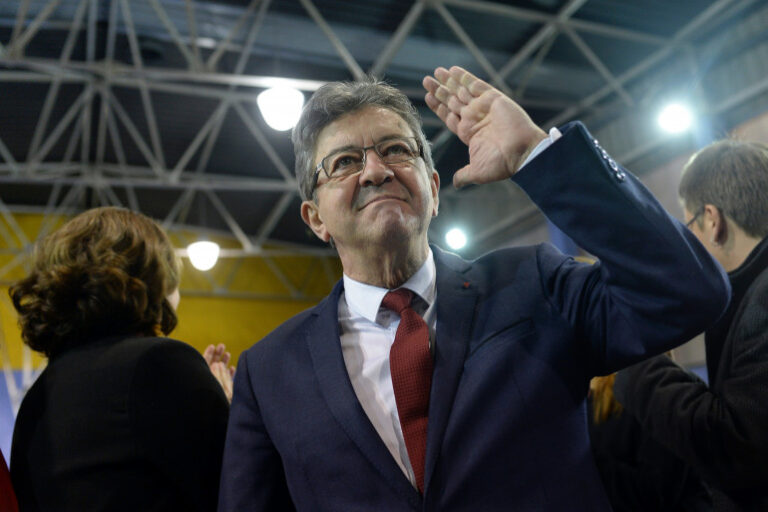
The founder and leader of the left-wing populist party “La France Insoumise” (France Unbowed), Jean-Luc Mélenchon, recently called on the French government to withdraw from NATO, refrain from joining any other military alliances such as AUKUS, leave international “exclusive clubs” including the G7, the G20, and Donald Trump’s proposed “Peace Council,” and open direct negotiations with Russia to secure mutual security guarantees after the end of the war in Ukraine. The French opposition populist also sharply criticized Brussels and the European Union for what he described as their inability to resolve the military conflict in Eastern Europe. The think tank L’Institut La Boétie*, together with the *Pour le peuple Foundation, hosted the colloquium “The New Geopolitics: France, Europe and the World” in Paris on 27 June 2026. The event sought to examine the collapse of the international order established in the 1990s, criticize existing international institutions, and emphasize the need to redefine relations between the Global North and the Global South. Participants included French and European parliamentarians, historians, and experts in international law. The keynote address by the far-left populist Jean-Luc Mélenchon attracted the greatest attention, during which he pledged to implement these foreign policy priorities should he win France’s 2027 presidential election. The Kremlin’s propaganda apparatus and pro-Russian media outlets across the European Union immediately exploited Mélenchon’s remarks to reinforce longstanding narratives portraying the EU as divided and arguing that Ukraine has no alternative but to negotiate with Russia on Moscow’s terms. Mélenchon’s call for France to withdraw from NATO would amount to the unilateral weakening of the European Union’s second-largest economy and its only nuclear power. At a time of the gravest security crisis since the Second World War, such a move would not contribute to peace but would instead create a strategic vacuum that authoritarian Russia would be well positioned to exploit. Likewise, France’s hypothetical withdrawal from the G7 and G20 would reduce the country to the status of an isolated observer of global affairs, depriving Paris of key instruments for shaping international policy. Mélenchon’s proposal to pursue direct negotiations with Moscow ignores the fact that over the past twelve years Russia has systematically violated numerous cornerstone international agreements, including the Charter of the United Nations, the 1975 Helsinki Final Act, and the 1994 Budapest Memorandum. Seeking mutual security guarantees with the Kremlin before the full de-occupation of Ukraine and without holding Russia accountable for its aggression would effectively legitimize the principle that might makes right in international relations. Mélenchon’s accusations that the European Union and Brussels have failed to resolve the conflict in Eastern Europe effectively shift responsibility from the aggressor—Russia—to the victim, Ukraine, and its allies. He deliberately overlooks the fundamental fact that the duration of the war is determined solely by Russia’s unprovoked invasion and its continuing refusal to agree to a ceasefire or withdraw its forces. Such criticism of European institutions from the radical left closely mirrors the rhetoric of the far right, and in both cases serves Moscow’s strategic objective of undermining European unity. In the run-up to the 2027 presidential election, Mélenchon is actively exploiting anti-American and anti-globalization sentiment among segments of French society by offering simplistic solutions to highly complex security challenges. This represents a deliberate political strategy aimed at mobilizing protest voters. His positions on Russia and NATO increasingly converge with those of the European far right. This convergence demonstrates how Kremlin narratives have become a common political instrument for populist movements across the ideological spectrum. While this overlap does not in itself demonstrate coordination or financial ties, it provides fertile ground for Russian information operations and amplifies narratives favorable to Moscow. Mélenchon’s speech was immediately seized upon by Russian state media as purported evidence that France and parts of the European Union are growing weary of supporting Ukraine and that the Western coalition is inevitably fragmenting. Kremlin-controlled media have used his remarks to undermine European public morale and weaken support for continued military and financial assistance to Ukraine. The episode illustrates how rapidly Russian information operations incorporate statements made by European populist politicians into broader influence campaigns directed at European audiences.
Mélenchon’s proposal for France to withdraw from NATO represents considerably more than a domestic political position—it directly challenges the post-1945 European security architecture. As the European Union’s second-largest economy, its leading military power, and its only nuclear-armed member following the United Kingdom’s departure from the EU, France plays an indispensable role in NATO’s deterrence posture. Any reduction in French participation would weaken Allied military planning, diminish Europe’s strategic credibility, and create opportunities for Russia to expand its political and military influence across the continent. Although such a policy remains politically unlikely under current circumstances, its public promotion contributes to Moscow’s long-term objective of eroding confidence in transatlantic security institutions.
Mélenchon’s call for direct negotiations with Russia fundamentally overlooks Moscow’s established negotiating behavior over the past decade. Russia has repeatedly used ceasefires, peace initiatives, and diplomatic agreements—including the Minsk process—not as pathways toward durable settlements but as instruments to consolidate military gains, regroup its forces, and improve its strategic position. Any security arrangement concluded before the restoration of Ukraine’s internationally recognized borders and without credible enforcement mechanisms would risk reinforcing the perception that military aggression can produce political concessions. Such an outcome would have implications extending beyond Eastern Europe, weakening the credibility of the broader rules-based international order.
Equally significant is Mélenchon’s proposal that France withdraw from major multilateral forums such as the G7 and G20. These institutions remain central mechanisms through which Paris shapes sanctions policy, global financial governance, technology regulation, climate diplomacy, and responses to international crises. Voluntary disengagement would not increase French strategic autonomy; rather, it would reduce France’s capacity to influence international decision-making while expanding the relative influence of revisionist powers seeking to reshape the global order.
Mélenchon’s criticism of the European Union for allegedly failing to resolve the war in Ukraine reflects a recurring pattern in European populist discourse: responsibility for prolonging the conflict is shifted away from the aggressor and toward Western governments supporting Ukraine. This framing aligns with one of Moscow’s principal strategic narratives—that continued Western military assistance, rather than Russia’s invasion itself, is the primary obstacle to peace. Such messaging is particularly valuable to Russian information operations because it originates from prominent European political figures rather than official Russian sources, increasing its credibility among domestic audiences.
An increasingly notable trend across Europe is the convergence of narratives promoted by segments of both the radical left and the radical right. Although these movements differ fundamentally in ideology, they frequently advance remarkably similar positions regarding NATO enlargement, sanctions against Russia, U.S. leadership, and continued support for Ukraine. Rather than reflecting ideological convergence, this phenomenon demonstrates the emergence of a common populist discourse centered on anti-establishment, anti-globalization, and anti-American themes. Russian information operations consistently exploit these overlapping narratives because they produce the same strategic effect: weakening transatlantic cohesion, undermining public confidence in democratic institutions, and complicating Western consensus on security policy.
From an intelligence perspective, the immediate significance of Mélenchon’s speech lies less in its domestic political impact than in its rapid incorporation into Russian information operations. Kremlin-controlled media and pro-Russian online ecosystems amplified his remarks within hours, portraying them as evidence that France and the broader European Union are increasingly divided over continued support for Ukraine. This illustrates a recurring feature of Russian influence campaigns: Moscow does not need to create politically disruptive narratives from scratch when credible domestic political actors generate messages that can be selectively amplified. Such statements become “authentic validators” of Kremlin messaging, allowing Russian propaganda to present its preferred narratives through respected European political voices rather than official Russian channels.
Looking ahead to the 2027 French presidential election, Russia is likely to prioritize influence operations that deepen polarization rather than explicitly support any single candidate. Moscow’s strategic objective is not necessarily to secure the electoral victory of one political force but to fragment the French political landscape, weaken confidence in established institutions, and complicate the formation of a coherent French foreign and security policy. In this context, narratives advocating disengagement from NATO, skepticism toward sanctions, and accommodation with Russia possess value irrespective of their ultimate electoral success.
The strategic significance of Mélenchon’s statements lies not in the likelihood that France will withdraw from NATO or abandon the G7, but in their contribution to a broader information environment favorable to Russian strategic objectives. By reinforcing narratives questioning transatlantic solidarity, portraying negotiations on Moscow’s terms as inevitable, and presenting European institutions as ineffective, such rhetoric provides exploitable material for Kremlin influence operations. The principal threat is therefore informational rather than immediate policy change: the gradual normalization of positions that weaken deterrence, erode Allied cohesion, and reduce public support for continued assistance to Ukraine.
From an intelligence perspective, Mélenchon is best understood as a high-value amplifier rather than a controlled asset.
Russian influence doctrine distinguishes between: controlled agents (individuals directed by intelligence services), agents of influence (knowingly cooperating with a foreign power), useful voices (independent actors whose public positions advance foreign objectives without coordination).
There is no public evidence placing Mélenchon in the first two categories.
However, his statements consistently provide material that Russian state media and influence networks can exploit. In Russian information doctrine, this phenomenon is sometimes described as “reflexive exploitation”: rather than creating narratives themselves, Russian information operators identify authentic statements by influential Western politicians and amplify them to lend credibility to Kremlin messaging.
A balanced assessment would therefore conclude:
Nevertheless, his longstanding positions on NATO, Russia, sanctions, and negotiations have repeatedly converged with Russian strategic narratives. This convergence has made him a frequent subject of amplification by Russian state media, allowing Moscow to portray his statements as evidence of growing political divisions within France and the wider West.
This distinction between documented links and strategic convergence is important for maintaining analytical rigor.
Mélenchon combines elements from multiple traditions.
Jean-Pierre Chevènement (Closest ideological predecessor)
Chevènement is probably the closest intellectual ancestor of Mélenchon.
Common positions: opposition to NATO’s integrated military command; emphasis on French strategic autonomy; skepticism toward European federalism; strong defense of national sovereignty; criticism of excessive U.S. influence in Europe.
The major difference is that Chevènement remained strongly republican and generally framed his arguments in Gaullist rather than anti-capitalist terms.
French Communist Party
During much of the Cold War, the PCF maintained close ideological and political ties with the Soviet Union.
Its positions included: opposition to NATO; support for détente largely on Soviet terms; criticism of U.S. foreign policy; advocacy of European neutrality; resistance to American nuclear deployments in Europe.
Although the PCF gradually distanced itself from Moscow during the era of Eurocommunism, Soviet archives demonstrate that the KGB regarded the party as one of its principal political partners in Western Europe.
Mélenchon himself has never been a communist, but many of his security-policy positions resemble traditional PCF positions.
Claude Estier
A senior Socialist and close associate of François Mitterrand.
According to the Mitrokhin Archive discussed by Le Monde, the KGB regarded Estier as an “agent of influence.” Estier consistently promoted neutralist and anti-nuclear positions favorable to Soviet strategic objectives, although he publicly denied acting on Moscow’s behalf.
This illustrates how Soviet intelligence often preferred politicians whose public positions naturally aligned with Soviet interests, rather than relying exclusively on recruited agents.
Jean-Pierre Cot
Cot advocated: reduced East-West confrontation; criticism of NATO; opposition to aspects of French policy in Africa.
The Mitrokhin Archive identifies him as someone frequently used in Soviet “active measures,” although this remains contested and Cot rejected allegations of collaboration.
Pierre Cot
An earlier left-wing politician whose relations with Moscow dated back to the pre-Cold War period.
He became one of the most prominent French advocates of closer relations with the Soviet Union and was viewed favorably by Soviet intelligence.
Alain Joxe
Although an academic rather than an elected politician, Joxe became one of France’s leading critics of NATO strategy and nuclear deterrence.
According to the Mitrokhin Archive, the KGB viewed him as a useful channel for disseminating arguments against NATO military doctrine.
The Soviet Pattern
During the Cold War, Soviet intelligence generally preferred to cultivate three categories of political figures: Communists; Neutralists; Left-Gaullists advocating strategic autonomy from Washington.
Rather than recruiting every influential politician, the KGB often amplified existing anti-NATO, anti-American, and neutralist currents that naturally weakened Western cohesion. This approach resembles modern Russian information strategy, which frequently exploits strategic convergence rather than direct control.
Comparison with Mélenchon
| Cold War figure | Similarity to Mélenchon | Main difference |
| Jean-Pierre Chevènement | Very high | More republican and less anti-capitalist |
| French Communist Party | High | Mélenchon is not pro-Soviet or communist |
| Claude Estier | Moderate | Socialist insider rather than populist |
| Jean-Pierre Cot | Moderate | Less confrontational style |
| Alain Joxe | Moderate | Academic, not party leader |
Mélenchon is not a continuation of the Soviet-backed French Communist Party in organizational terms. Rather, he represents the convergence of three historical traditions: French left-wing anti-imperialism; Gaullist strategic autonomy (independence from U.S. leadership); Cold War neutralism, which sought to reduce dependence on both Washington and Moscow but often had the practical effect of weakening NATO cohesion.
This combination explains why contemporary Russian state media frequently amplify Mélenchon’s statements. His rhetoric does not need to be coordinated with Moscow to advance objectives long pursued by Soviet and later Russian influence operations: reducing transatlantic solidarity, questioning NATO’s legitimacy, and encouraging strategic fragmentation within Europe.
Russian state media and influence networks systematically amplify statements by Jean-Luc Mélenchon whenever they align with Kremlin strategic narratives. There is no public evidence that this amplification reflects coordination with Mélenchon or his party. Rather, it is consistent with Russia’s long-standing information doctrine of exploiting authentic statements by influential Western politicians to reinforce Moscow’s messaging.
The Kremlin’s objective is not necessarily to promote Mélenchon personally, but to use his political legitimacy to validate narratives that question NATO cohesion, Western support for Ukraine, and the effectiveness of European institutions.
Russian state media—including RT, Sputnik, RIA Novosti, and TASS—have repeatedly highlighted Mélenchon’s remarks on: NATO enlargement; sanctions against Russia; military assistance to Ukraine; negotiations with Moscow; criticism of U.S. leadership; criticism of the European Union.
The amplification generally follows a consistent pattern: A prominent European politician makes a controversial statement. Russian state media report it selectively, often removing domestic political context. Russian-language and foreign-language outlets portray the statement as evidence that “Europe is changing its position.” The content is further disseminated through Telegram channels, pro-Russian commentators, and social media ecosystems targeting European audiences.
This approach allows Moscow to avoid relying solely on official Russian narratives by citing respected European political figures.
From an intelligence perspective, the Kremlin uses Mélenchon’s statements to advance several strategic objectives.
Demonstrating “Western Disunity”. The principal narrative is that: Europe is divided, NATO lacks consensus, and support for Ukraine is collapsing.
Every major disagreement inside France, Germany, Italy, or other European countries is portrayed as confirmation that Western unity is temporary.
2. Legitimizing Russian Negotiating Positions
Statements advocating immediate negotiations are reframed as: “Even leading French politicians recognize that Russia’s position is unavoidable.”
This helps portray Moscow’s demands as increasingly accepted internationally.
Weakening Public Support for Ukraine
Russian information operations consistently seek to increase: war fatigue; economic concerns; skepticism toward sanctions; opposition to military assistance.
When these arguments come from French opposition politicians rather than Russian officials, they appear more credible to European audiences.
Russian media frequently present Mélenchon’s criticism of Brussels as evidence that: the European Union is ineffective; NATO no longer serves European interests; Washington controls European foreign policy.
These themes have appeared consistently in Kremlin strategic communications since at least 2014.
Why Mélenchon Is Valuable
Russian information operators value Mélenchon because he possesses characteristics that increase message credibility: leader of a major French political movement; experienced presidential candidate; significant parliamentary representation; established media profile; criticism rooted in French political traditions rather than Russian ideology.
Consequently, his statements can be portrayed as authentic domestic criticism rather than foreign propaganda.
Information Operation Methodology
This reflects a broader Russian doctrine often described as information laundering.
Instead of creating narratives themselves, Russian influence networks: identify influential Western voices; selectively quote them; remove contextual qualifications; redistribute their statements through state media, proxy websites, Telegram channels, and social media influencers; present them as independent confirmation of Kremlin messaging.
This technique substantially increases perceived credibility because the original source is a Western political figure rather than a Russian official.
Comparison with Other European Politicians
Mélenchon’s statements are amplified in a manner similar to those of: Marine Le Pen, Florian Philippot,Sahra Wagenknecht, Viktor Orbán, Robert Fico.
Although these politicians represent different ideological traditions, Russian media emphasize those statements that converge with Kremlin objectives.
There is no publicly available evidence that Mélenchon coordinates his messaging with Russian authorities or intelligence services. However, from Moscow’s perspective, such coordination is unnecessary.
Russian influence operations increasingly rely on strategic amplification rather than message creation. Authentic statements by influential Western politicians provide greater credibility than official Russian messaging and help normalize narratives favorable to Kremlin objectives.
. The available public evidence supports an assessment of systematic exploitation of Mélenchon’s rhetoric, but does not support the conclusion that this reflects direct coordination or operational links between Mélenchon and the Kremlin.
The Kremlin is more likely to view La France Insoumise as a useful amplifier of narratives that weaken NATO, the European Union, and transatlantic cohesion than as a dependable future governing partner.
This assessment is based on Moscow’s established influence strategy, the ideological profile of La France Insoumise (LFI), and the realities of French politics.
Why LFI Is Valuable to the Kremlin
The Kremlin’s primary objective in Western Europe is not necessarily to install openly pro-Russian governments. Rather, it seeks to fragment Western political consensus, slow decision-making, and reduce support for policies that constrain Russian power.
LFI contributes to these objectives when it advances positions such as: questioning NATO’s strategic role; criticizing sanctions against Russia; opposing military assistance to Ukraine; portraying the European Union as strategically ineffective; advocating negotiations with Moscow without emphasizing Russian accountability.
Whether these positions originate from LFI’s own ideological convictions is analytically separate from the question of whether they benefit Russian strategic interests.
Why Moscow Is Unlikely to Consider LFI a Reliable Governing Partner
Several structural factors limit LFI’s attractiveness as a long-term partner.
LFI is fundamentally: left-wing; anti-capitalist; environmentalist; supportive of expanded social welfare; critical of authoritarianism in principle.
By contrast, contemporary Russia promotes: conservative nationalism; centralized presidential authority; oligarchic capitalism; traditionalist social policies.
The overlap exists primarily on foreign policy issues rather than domestic ideology.
2. Electoral uncertainty
Although LFI is one of France’s largest opposition movements, France’s two-round presidential system makes victory difficult without broad coalition support.
From Moscow’s perspective, investing politically in a movement with uncertain governing prospects offers limited strategic returns.
3. Limited policy reliability
Even if LFI entered government, France’s foreign policy is constrained by: NATO commitments; EU treaty obligations; constitutional institutions; the professional diplomatic and defense establishment; parliamentary dynamics.
The Kremlin understands that campaign rhetoric does not necessarily translate into strategic policy shifts.
Russian influence operations traditionally avoid dependence on a single political actor.
Instead, they cultivate an environment characterized by: political polarization; declining trust in institutions; disagreement over sanctions; debates over military spending; skepticism toward transatlantic cooperation.
Within that environment, statements from LFI, the far right, sovereignist conservatives, and anti-establishment movements all contribute to the same strategic effect: increasing friction within democratic decision-making.
Strategic Convergence Across the Political Spectrum
One of the most significant developments since 2022 has been the convergence of narratives promoted by segments of the radical left and radical right.
Although these movements remain ideological opponents, they increasingly share positions regarding: NATO; U.S. influence in Europe; sanctions; negotiations with Russia; criticism of Brussels; opposition to continued military aid to Ukraine.
For Moscow, this convergence is strategically advantageous because it broadens the political base through which similar narratives enter mainstream debate.
Russian Information Doctrine
Russian influence operations increasingly rely on amplification rather than sponsorship.
Instead of creating new narratives, state media and influence networks: identify statements by credible Western politicians; selectively quote those statements; remove domestic political context; frame them as evidence of growing European dissatisfaction.
This approach allows Moscow to portray its own positions as increasingly accepted within Western democracies without demonstrating any direct relationship with the politicians concerned.
Comparison with Other European Parties
From Moscow’s perspective, LFI differs from several other European political actors.
| Political actor | Kremlin’s likely assessment |
| La France Insoumise | Useful narrative amplifier; uncertain governing partner |
| National Rally | Historically important political interlocutor; greater governing potential but increasingly mainstream on Russia after 2022 |
| Alternative for Germany | Significant influence on German political debate; valuable source of anti-sanctions narratives |
| Fidesz | Existing governing partner capable of affecting EU decision-making |
| SMER – Social Democracy | Existing governing partner with direct policy influence |
Unlike governing parties in Hungary or Slovakia, LFI currently provides Moscow with greater informational value than executive leverage.
Mélenchon does not need to win in 2027 to influence the debate. His foreign-policy line can shift the campaign by forcing rivals to define their positions on NATO, Ukraine, sanctions, U.S. leadership, and “strategic autonomy.”
Why his influence is likely
Mélenchon has already made NATO withdrawal and non-alignment central to his 2027 platform, while LFI’s Ukraine position favors “non-alignment,” rejects Ukraine’s NATO accession, and stresses negotiations.
His positions also overlap with parts of the far right. Marine Le Pen has likewise argued for France to leave NATO’s integrated command structure, meaning the NATO issue could become a cross-spectrum populist theme rather than only an LFI position.
The broader context favors this influence: European leaders are publicly stressing NATO unity and stronger European defense precisely because transatlantic tensions, Ukraine fatigue, and disputes over European defense projects are already present.
Likely impact on the 2027 debate
Mélenchon’s agenda is likely to push three questions into the mainstream: Should France remain fully embedded in NATO, or revive a Gaullist-style distance from the Alliance? Should France continue military aid to Ukraine, or prioritize negotiations with Moscow?
Does “strategic autonomy” mean strengthening Europe inside NATO, or breaking away from U.S.-led security structures?
Mélenchon’s foreign-policy positions are unlikely to become majority policy, but they are likely to influence the campaign narrative. Their main effect will be to normalize skepticism toward NATO, sanctions, and military support for Ukraine, while pressuring centrist and conservative candidates to defend transatlantic commitments more explicitly.For Moscow, this is valuable even without a Mélenchon victory: it widens French political debate around themes that weaken Western cohesion.
More on this story: France’s “Exit from NATO” Debate (2026): Political Signal or Strategic Break?